Hungary Oil and Gas Cloud Applications Market Size & Growth Rate (2026-2032)
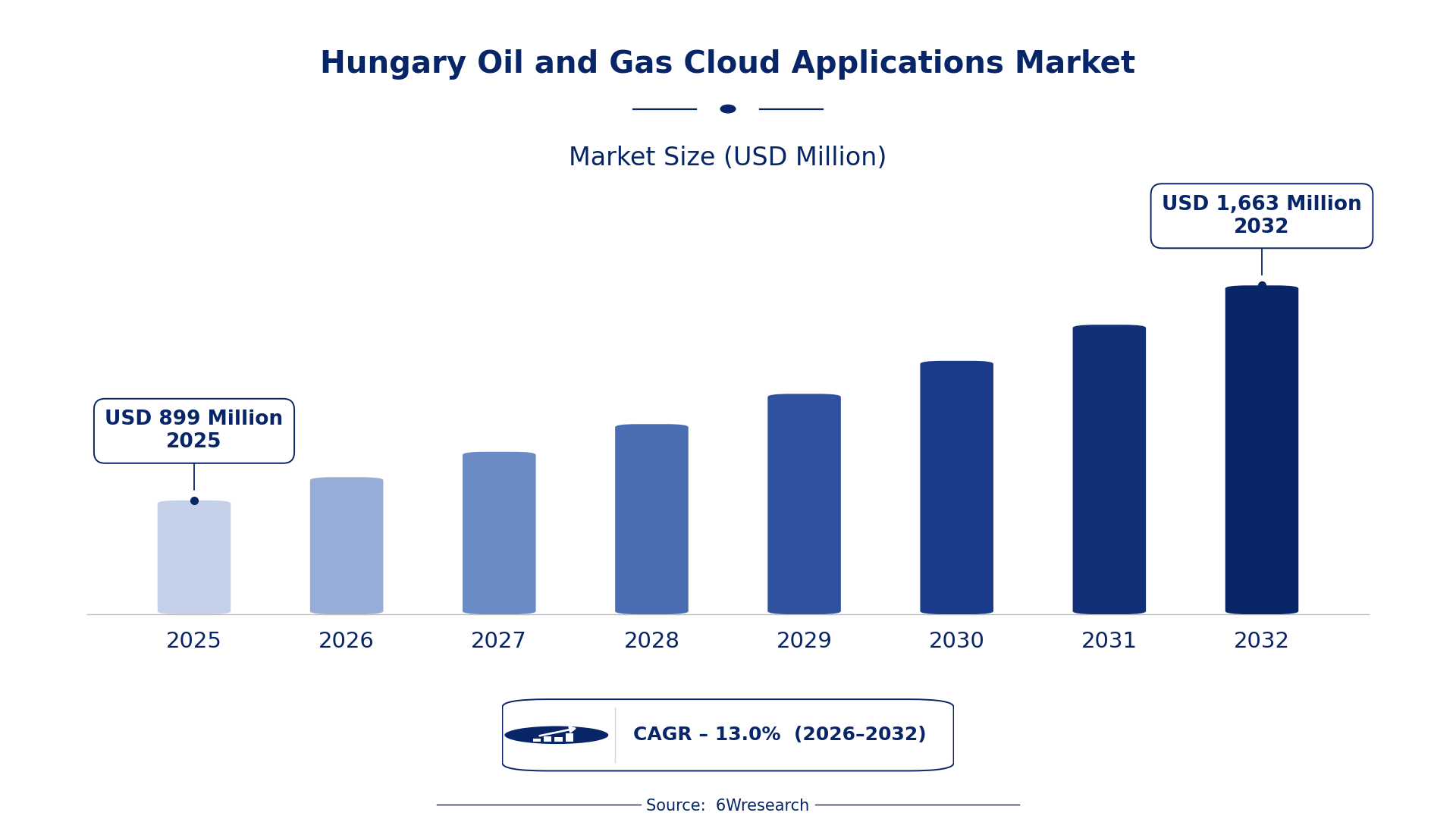
The Hungary Oil and Gas Cloud Applications Market was estimated at USD 899 Million in 2025 and is projected to reach USD 1663 Million by 2032, growing at a CAGR of 13.0% from 2026 to 2032.
Hungary Oil and Gas Cloud Applications Market Synopsis
The Hungary oil and gas sector is actively pursuing cloud applications to boost operational efficiencies and reduce costs. Companies are increasingly recognizing the value of real-time data access and analytics, which empower them to make informed decisions and optimize production.
This market is benefiting from Hungary's strategic initiatives aimed at digital transformation. The shift to cloud-based solutions is being fueled by the need for scalable and flexible technologies, enabling companies to adapt to the evolving energy landscape effectively.
Hungary Oil and Gas Cloud Applications Market Year-wise Growth Rate and Key Drivers
This graph illustrates the annual growth rates of the Hungary Oil and Gas Cloud Applications Market from 2021 to 2032, highlighting a steady upward trajectory and projected expansion over the forecast period.
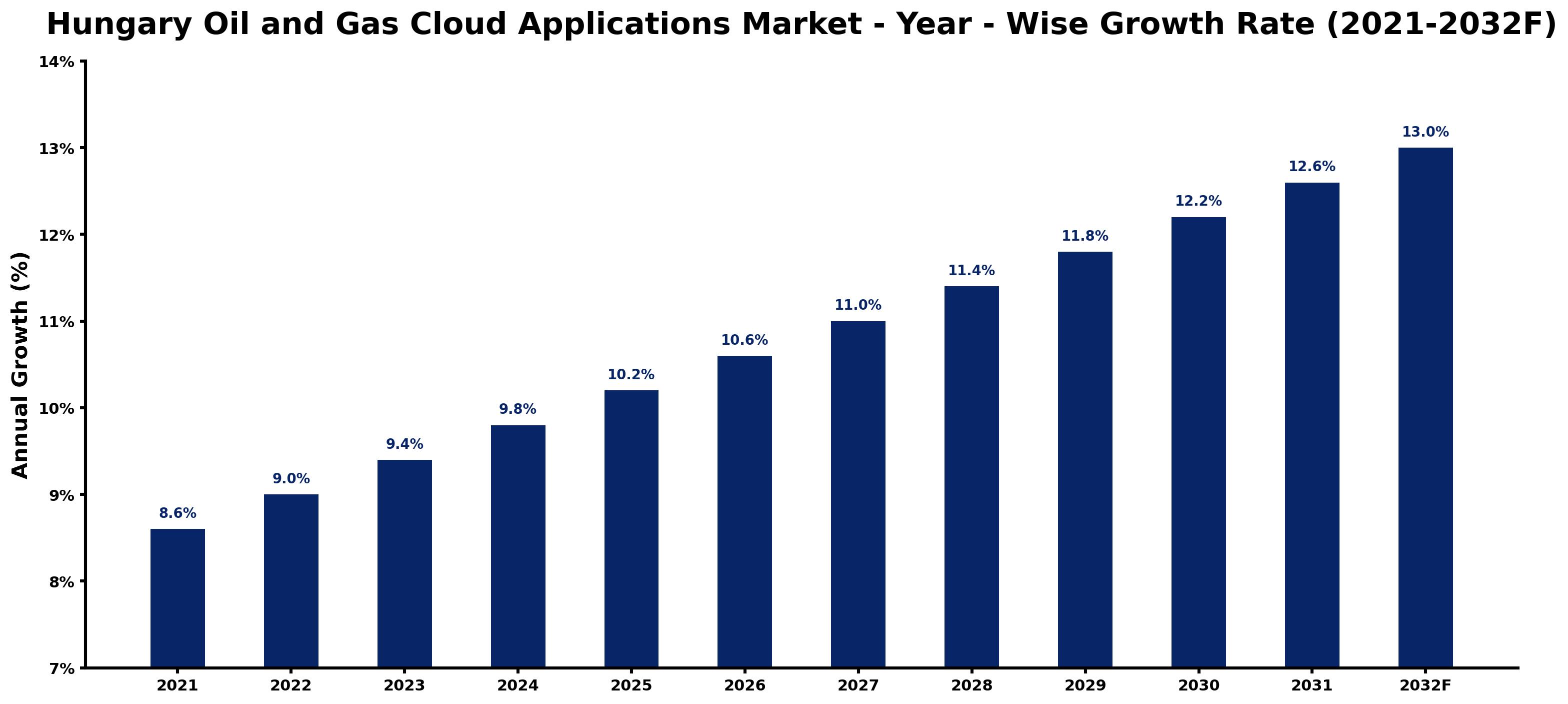
The table below presents the year‑wise growth rates along with the key drivers influencing the market
| Year | Growth Rate | Major Drivers |
| 2021 | 8.6% | Hungarian Oil and Gas Authority promotes digital transition |
| 2022 | 9.0% | Increased adoption of IoT in regional oil monitoring |
| 2023 | 9.4% | Rising investments in green energy technologies in Hungary |
| 2024 | 9.8% | Local universities enhance cloud application development expertise |
| 2025 | 10.2% | Hungary's energy efficiency targets drive cloud solutions adoption |
| 2026 | 10.6% | Partnerships with EU for smart energy innovations boost sector |
| 2027 | 11.0% | Enhanced cybersecurity regulations require cloud compliance solutions |
| 2028 | 11.4% | Increase in oil recovery projects necessitates advanced analytics |
| 2029 | 11.8% | Growing interest in carbon capture technology fosters cloud tools |
| 2030 | 12.2% | Support for startups fuels innovation in energy cloud applications |
| 2031 | 12.6% | Hungary's focus on biomass energy promotes data management systems |
| 2032 | 13.0% | Local ventures in digital twins enhance operational efficiency |
Note: Market size estimations and growth projections presented in this report are based on 6Wresearch's proprietary forecasting methodology, utilizing the latest available industry data, government publications, and primary research inputs.
Hungary Oil and Gas Cloud Applications Market Key Takeaways
Below are some of the specific key takeaways from the market, including:
- Cloud applications enhance data-driven decision-making in oil and gas operations.
- Investment in cybersecurity is vital for building confidence in cloud technologies.
- Government policies are actively promoting digitalization within the sector.
- Data sovereignty concerns remain a hurdle for full cloud adoption.
- Real-time analytics and asset management tools are gaining traction among operators.
Evaluation of Restraints in Hungary Oil and Gas Cloud Applications Market
Several factors are hindering the growth of cloud applications in Hungary's oil and gas sector. Foremost are concerns regarding data security and compliance with industry regulations. Many companies are still reliant on legacy systems, making integration with cloud solutions challenging. Additionally, issues related to data sovereignty and latency continue to raise apprehensions about migrating critical operations to the cloud.
Hungary Oil and Gas Cloud Applications Market Trends
A notable trend is the increasing emphasis on cybersecurity within cloud deployments. Operators are investing in advanced security measures to protect sensitive data. on top of that, the focus on sustainability is prompting companies to adopt cloud solutions that facilitate efficient resource management and reduced carbon footprints.
Collaboration tools are also becoming essential as remote work and digital interactions rise. This shift is driving demand for cloud applications that enhance workforce mobility and communication across various operational sites.
Hungary Oil and Gas Cloud Applications Market Opportunities
The market presents several promising growth opportunities. Companies that capitalize on advancements in cloud technology can streamline their operations and improve asset management. Additionally, the increasing need for data analytics is creating a demand for sophisticated cloud solutions that offer predictive insights into reservoir performance and production optimization.
on top of that, partnerships between technology providers and oil and gas companies are likely to foster innovation and facilitate the development of tailored solutions that address specific industry needs.
Government Initiatives in the Hungary Oil and Gas Cloud Applications Market
The Hungarian government is actively supporting the adoption of cloud applications in the oil and gas sector through various initiatives. These efforts are crucial for promoting digital transformation and enhancing the overall competitiveness of the industry. By prioritizing innovation and technological advancement, public policy is enabling companies to transition to cloud-based solutions.
- A national digital infrastructure upgrade programme launched recently aims to improve connectivity across the oil and gas sector.
- Current initiatives focus on providing training and resources to enhance workforce skills in cloud technologies.
- A regulatory framework introduced in 2025 mandates compliance with data privacy standards for cloud deployments.
- Upcoming collaborations between the government and technology providers aim to address cybersecurity challenges in cloud applications.
Future Insights of the Hungary Oil and Gas Cloud Applications Market
Looking ahead to 2026-2032, the Hungary oil and gas cloud applications market is set for substantial growth. With increasing investments in technology and a shift towards data-driven strategies, companies will likely embrace cloud solutions more broadly. The emphasis on sustainability and operational efficiency will drive innovation, leading to the development of new applications tailored to the specific needs of the sector.
Hungary Oil and Gas Cloud Applications Market Latest Developments
In the past 12-14 months, the Hungary oil and gas cloud applications market has seen notable advancements. Operators are rapidly adopting cloud technologies to enhance efficiency and drive innovation. The focus on cybersecurity is intensifying as companies seek to protect their data and maintain compliance with evolving regulations.
- A leading regional operator launched a new cloud-based asset management platform in early 2025, improving operational transparency.
- An ongoing initiative aims to integrate AI-driven analytics into cloud applications for better production forecasting, with implementation expected by mid-2026.
- A partnership between a major technology vendor and an oil company is currently underway to develop custom cloud solutions for enhanced data security.
- Plans for a nationwide training programme targeting cloud technology skills are expected to roll out in late 2026, aimed at enhancing workforce capabilities.
Hungary Oil and Gas Cloud Applications Market - Key Attractiveness of the Report
- 10 Years of Market Numbers
- Historical Data Starting from 2022 to 2025
- Base Year: 2025
- Forecast Data until 2032
- Key Performance Indicators Impacting the Market
- Major Upcoming Developments and Projects
Key Highlights of the Report:
- Hungary Oil and Gas Cloud Applications Market Outlook
- Market Size of Hungary Oil and Gas Cloud Applications Market, 2025
- Forecast of Hungary Oil and Gas Cloud Applications Market, 2032
- Historical Data and Forecast of Hungary Oil and Gas Cloud Applications Revenues & Volume for the Period 2022-2032F
- Hungary Oil and Gas Cloud Applications Market Trend Evolution
- Hungary Oil and Gas Cloud Applications Market Drivers and Challenges
- Hungary Oil and Gas Cloud Applications Price Trends
- Hungary Oil and Gas Cloud Applications Porter's Five Forces
- Hungary Oil and Gas Cloud Applications Industry Life Cycle
- Historical Data and Forecast of Hungary Oil and Gas Cloud Applications Market Revenues & Volume By Component for the Period 2022-2032F
- Historical Data and Forecast of Hungary Oil and Gas Cloud Applications Market Revenues & Volume By Solution for the Period 2022-2032F
- Historical Data and Forecast of Hungary Oil and Gas Cloud Applications Market Revenues & Volume By Services for the Period 2022-2032F
- Historical Data and Forecast of Hungary Oil and Gas Cloud Applications Market Revenues & Volume By Deployment Type for the Period 2022-2032F
- Historical Data and Forecast of Hungary Oil and Gas Cloud Applications Market Revenues & Volume By Private for the Period 2022-2032F
- Historical Data and Forecast of Hungary Oil and Gas Cloud Applications Market Revenues & Volume By Public Cloud for the Period 2022-2032F
- Historical Data and Forecast of Hungary Oil and Gas Cloud Applications Market Revenues & Volume By Operation for the Period 2022-2032F
- Historical Data and Forecast of Hungary Oil and Gas Cloud Applications Market Revenues & Volume By Upstream for the Period 2022-2032F
- Historical Data and Forecast of Hungary Oil and Gas Cloud Applications Market Revenues & Volume By Midstream for the Period 2022-2032F
- Historical Data and Forecast of Hungary Oil and Gas Cloud Applications Market Revenues & Volume By Downstream for the Period 2022-2032F
- Hungary Oil and Gas Cloud Applications Import Export Trade Statistics
- Market Opportunity Assessment By Component
- Market Opportunity Assessment By Deployment Type
- Market Opportunity Assessment By Operation
- Hungary Oil and Gas Cloud Applications Top Companies Market Share
- Hungary Oil and Gas Cloud Applications Competitive Benchmarking By Technical and Operational Parameters
- Hungary Oil and Gas Cloud Applications Company Profiles
- Hungary Oil and Gas Cloud Applications Key Strategic Recommendations






































