Hungary Penicillin Market: Import Trend Analysis
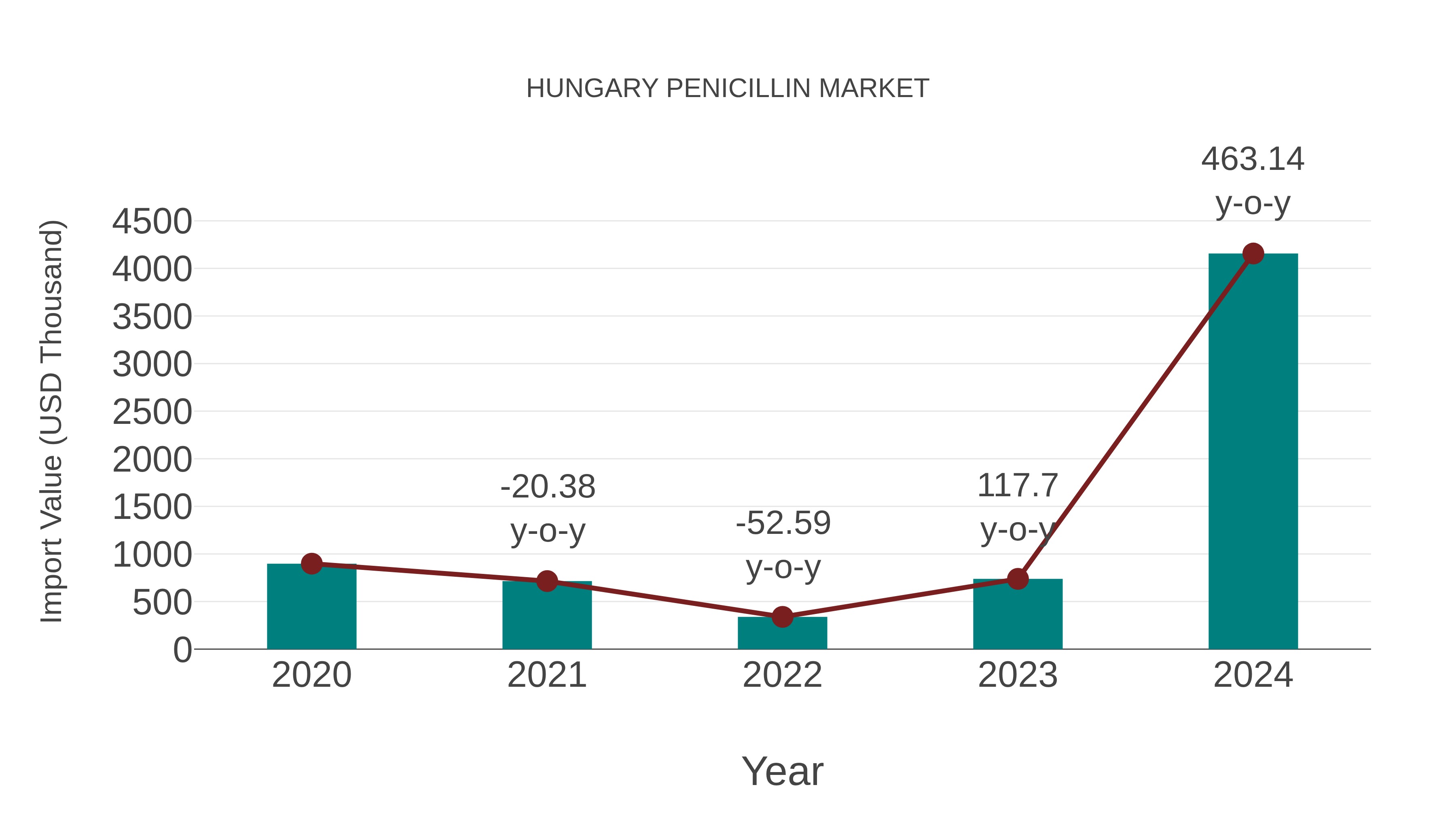
Hungary`s import trend for the penicillin market experienced significant growth from 2023 to 2024, with a remarkable increase of 463.14%. The compound annual growth rate (CAGR) for the period 2020-2024 stood at 46.67%. This surge in imports could be attributed to a surge in demand for pharmaceutical products or changes in trade policies that facilitated increased market access.
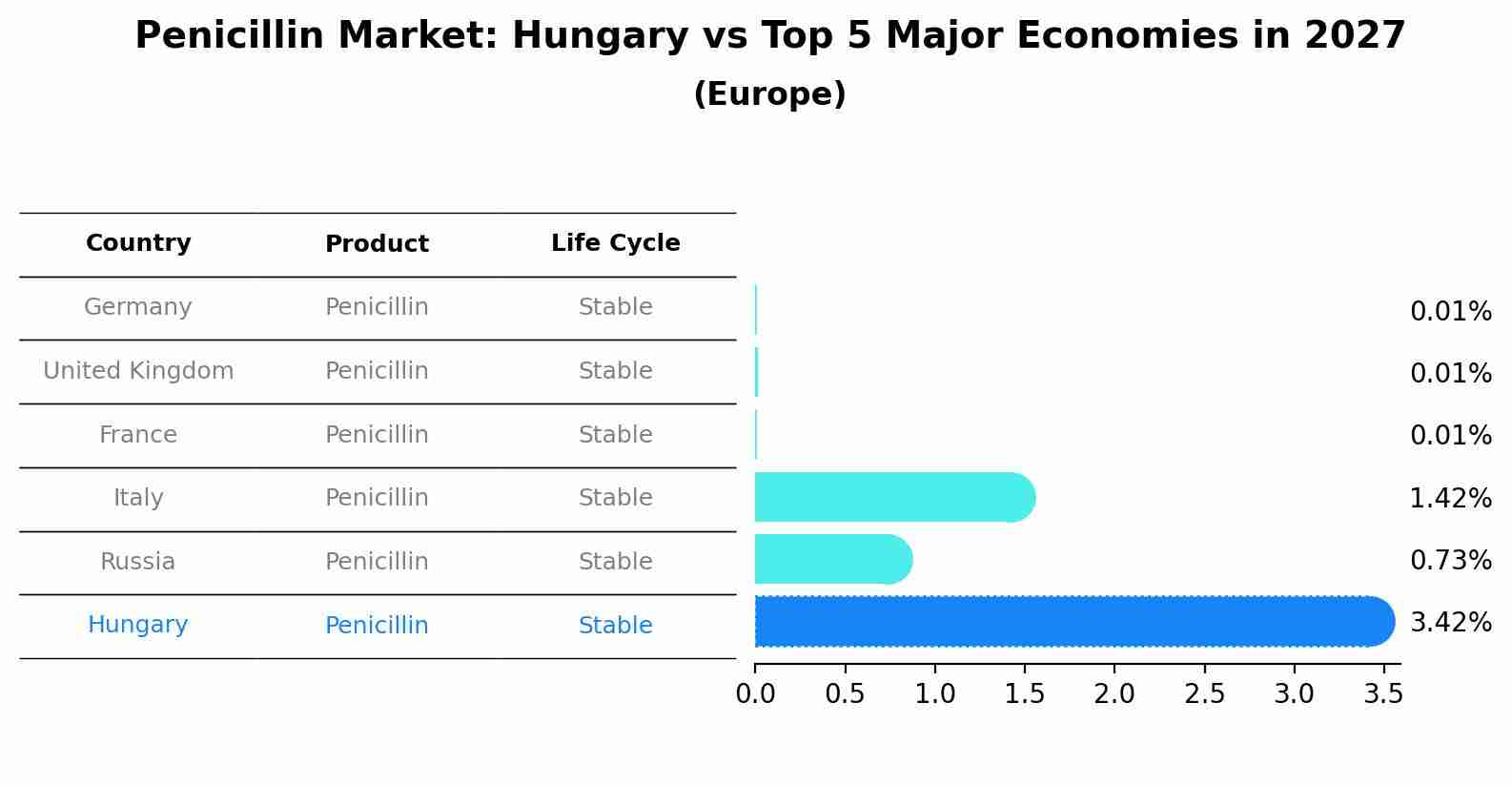
Penicillin Market: Hungary vs Top 5 Major Economies in 2027 (Europe)
The Penicillin market in Hungary is projected to grow at a stable growth rate of 3.42% by 2027, within the Europe region led by Germany, along with other countries like United Kingdom, France, Italy and Russia, collectively shaping a dynamic and evolving market environment driven by innovation and increasing adoption of emerging technologies.
Hungary Penicillin Market Overview
The Hungary Penicillin market is characterized by a growing demand for antibiotics, including Penicillin, driven by the increasing prevalence of bacterial infections and the rise in healthcare expenditure. The market is dominated by both domestic pharmaceutical companies and international players, offering a wide range of Penicillin products to healthcare facilities and retail pharmacies. The government`s focus on improving healthcare infrastructure and promoting access to essential medicines is expected to further boost the market growth. Factors such as the development of drug-resistant bacteria and the need for effective treatment options are also driving the demand for Penicillin in Hungary. Market players are investing in research and development activities to introduce innovative formulations and strengthen their market presence in the country.
Hungary Penicillin Market Trends
The Hungary Penicillin Market is experiencing steady growth, driven by the increasing prevalence of bacterial infections and the rising demand for effective antibiotics. Key trends in the market include the growing preference for oral penicillin formulations over injectable ones due to their convenience and ease of administration. Additionally, there is a rising focus on developing novel penicillin derivatives with improved efficacy and reduced side effects to address antibiotic resistance issues. Market players are also increasingly investing in research and development activities to introduce innovative penicillin products that cater to specific patient needs. Overall, the Hungary Penicillin Market is expected to continue expanding, fueled by the growing awareness of the importance of antibiotics in healthcare and the continuous efforts to combat infectious diseases effectively.
Hungary Penicillin Market Challenges
In the Hungary Penicillin Market, one of the key challenges faced is the increasing prevalence of antibiotic resistance. This poses a significant threat to the effectiveness of penicillin and other antibiotics, leading to a higher demand for alternative treatment options. Additionally, regulatory changes and pricing pressures in the healthcare industry can impact the market dynamics for penicillin products. Furthermore, the presence of counterfeit or substandard penicillin products in the market can undermine trust among consumers and healthcare professionals, affecting the overall market growth. To address these challenges, stakeholders in the Hungary Penicillin Market need to focus on promoting responsible antibiotic use, investing in research and development for new antibiotic formulations, and enhancing quality control measures to ensure the safety and efficacy of penicillin products.
Hungary Penicillin Market Investment Opportunities
Investment opportunities in the Hungarian Penicillin market include the potential for growth due to increasing demand for antibiotics, especially in the healthcare sector. With the rise of infectious diseases and the need for effective treatment options, there is a steady demand for penicillin products in Hungary. Investors could consider opportunities in pharmaceutical companies that manufacture and distribute penicillin-based medications, as well as in research and development of new formulations or improved delivery methods. Additionally, with Hungary being a part of the European Union, companies operating in the Hungarian Penicillin market could benefit from access to a larger market and regulatory support. Overall, investing in the Hungarian Penicillin market presents opportunities for long-term growth and potential returns for investors.
Hungary Penicillin Market Government Policy
Government policies related to the Hungary Penicillin Market primarily focus on regulating the production, distribution, and pricing of penicillin to ensure quality and affordability for consumers. The Hungarian government has implemented regulations to ensure that penicillin products meet safety and efficacy standards set by the National Institute of Pharmacy and Nutrition. Additionally, the government may provide subsidies or incentives to domestic penicillin manufacturers to promote local production and reduce dependency on imports. Pricing policies may also be in place to control the cost of penicillin to ensure it remains accessible to the general population. Overall, government policies in Hungary aim to regulate the penicillin market to safeguard public health and promote a competitive and sustainable industry.
Hungary Penicillin Market Future Outlook
The Hungary Penicillin Market is expected to witness steady growth in the coming years due to the increasing prevalence of bacterial infections and the rising demand for effective antibiotics. The market is likely to be driven by factors such as the growing awareness about the importance of proper antibiotic usage and the increasing investments in healthcare infrastructure. Additionally, the emergence of new penicillin-based products and advancements in drug delivery technology are anticipated to further boost market growth. However, challenges such as the rising prevalence of antibiotic resistance and stringent regulatory requirements may hinder market expansion. Overall, the Hungary Penicillin Market is projected to experience moderate yet sustained growth in the foreseeable future, presenting opportunities for market players to innovate and expand their product offerings to meet evolving healthcare needs.
Key Highlights of the Report:
- Hungary Penicillin Market Outlook
- Market Size of Hungary Penicillin Market, 2025
- Forecast of Hungary Penicillin Market, 2032
- Historical Data and Forecast of Hungary Penicillin Revenues & Volume for the Period 2022 - 2032F
- Hungary Penicillin Market Trend Evolution
- Hungary Penicillin Market Drivers and Challenges
- Hungary Penicillin Price Trends
- Hungary Penicillin Porter's Five Forces
- Hungary Penicillin Industry Life Cycle
- Historical Data and Forecast of Hungary Penicillin Market Revenues & Volume By Product for the Period 2022 - 2032F
- Historical Data and Forecast of Hungary Penicillin Market Revenues & Volume By Bulk for the Period 2022 - 2032F
- Historical Data and Forecast of Hungary Penicillin Market Revenues & Volume By Dosage for the Period 2022 - 2032F
- Historical Data and Forecast of Hungary Penicillin Market Revenues & Volume By Type for the Period 2022 - 2032F
- Historical Data and Forecast of Hungary Penicillin Market Revenues & Volume By Aminopenicillin for the Period 2022 - 2032F
- Historical Data and Forecast of Hungary Penicillin Market Revenues & Volume By Antipseudomonal Penicillin for the Period 2022 - 2032F
- Historical Data and Forecast of Hungary Penicillin Market Revenues & Volume By Beta-lactamase Inhibitor for the Period 2022 - 2032F
- Historical Data and Forecast of Hungary Penicillin Market Revenues & Volume By Natural Penicillin for the Period 2022 - 2032F
- Historical Data and Forecast of Hungary Penicillin Market Revenues & Volume By Penicillinase-resistant Penicillin for the Period 2022 - 2032F
- Historical Data and Forecast of Hungary Penicillin Market Revenues & Volume By Manufacturing Process for the Period 2022 - 2032F
- Historical Data and Forecast of Hungary Penicillin Market Revenues & Volume By Synthetic Process for the Period 2022 - 2032F
- Historical Data and Forecast of Hungary Penicillin Market Revenues & Volume By Natural Process for the Period 2022 - 2032F
- Historical Data and Forecast of Hungary Penicillin Market Revenues & Volume By Semisynthetic Process for the Period 2022 - 2032F
- Historical Data and Forecast of Hungary Penicillin Market Revenues & Volume By Mode of Delivery for the Period 2022 - 2032F
- Historical Data and Forecast of Hungary Penicillin Market Revenues & Volume By Oral for the Period 2022 - 2032F
- Historical Data and Forecast of Hungary Penicillin Market Revenues & Volume By Intramuscular for the Period 2022 - 2032F
- Historical Data and Forecast of Hungary Penicillin Market Revenues & Volume By Intravenous for the Period 2022 - 2032F
- Historical Data and Forecast of Hungary Penicillin Market Revenues & Volume By End User for the Period 2022 - 2032F
- Historical Data and Forecast of Hungary Penicillin Market Revenues & Volume By Hospitals for the Period 2022 - 2032F
- Historical Data and Forecast of Hungary Penicillin Market Revenues & Volume By Clinics for the Period 2022 - 2032F
- Historical Data and Forecast of Hungary Penicillin Market Revenues & Volume By Research Institutes for the Period 2022 - 2032F
- Historical Data and Forecast of Hungary Penicillin Market Revenues & Volume By Others for the Period 2022 - 2032F
- Hungary Penicillin Import Export Trade Statistics
- Market Opportunity Assessment By Product
- Market Opportunity Assessment By Type
- Market Opportunity Assessment By Manufacturing Process
- Market Opportunity Assessment By Mode of Delivery
- Market Opportunity Assessment By End User
- Hungary Penicillin Top Companies Market Share
- Hungary Penicillin Competitive Benchmarking By Technical and Operational Parameters
- Hungary Penicillin Company Profiles
- Hungary Penicillin Key Strategic Recommendations






































