Hungary Pharmaceutical Packaging Market Summary
The hungary pharmaceutical packaging market was estimated at USD 831 Million in 2025 and is projected to reach USD 1191 Million by 2032, growing at a CAGR of 6.3% from 2026 to 2032.
Hungary Pharmaceutical Packaging Market Year-wise Growth Rate and Key Drivers
This graph highlights how the Hungary Pharmaceutical Packaging Market has steadily grown over the past five years, supported by major growth factors.
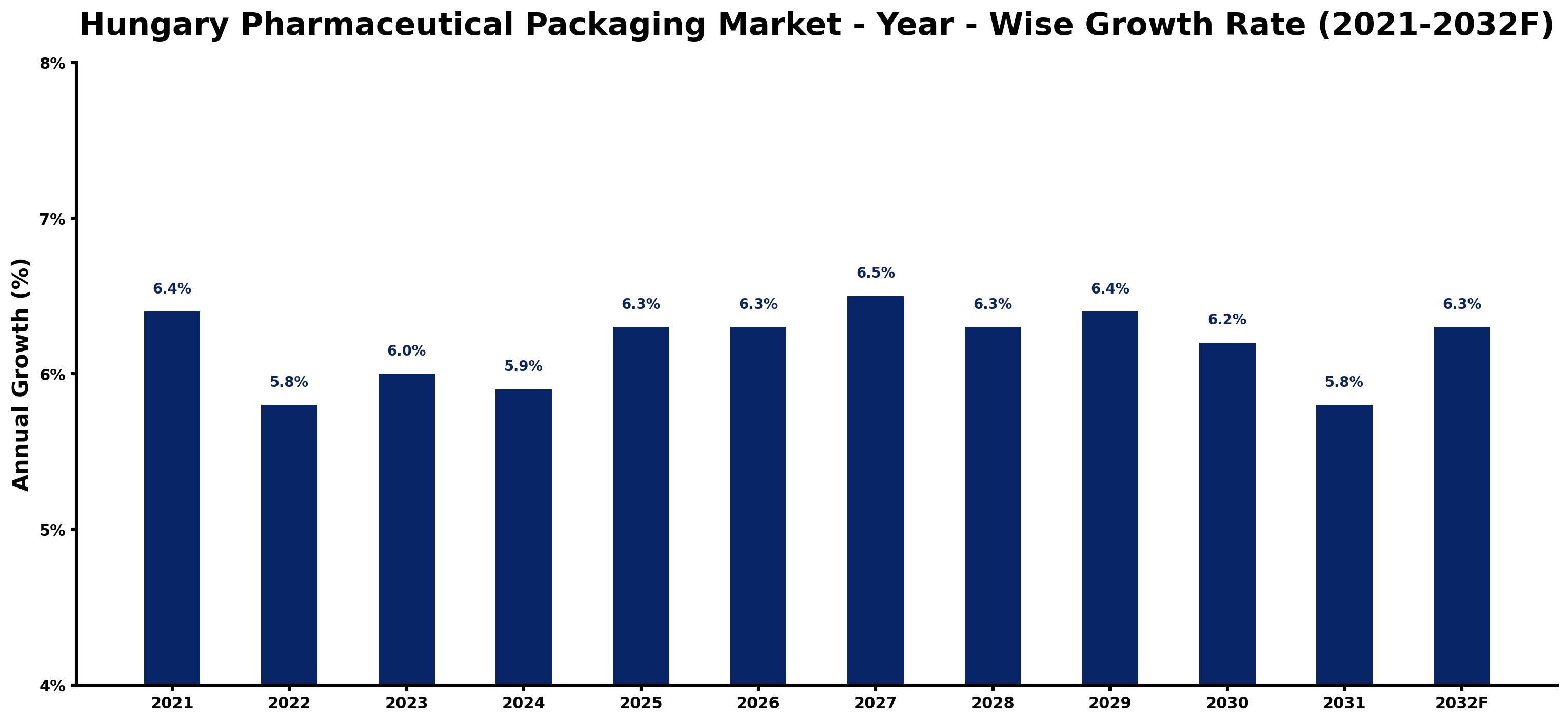
The table below presents the year wise growth rates along with the key drivers influencing the market
| Year | Growth Rate | Major Drivers |
| 2021 | 6.4% | COVID-19 emphasized the need for reliable pharmaceutical supply chains across Europe. |
| 2022 | 5.8% | Sustainability trends pushed many companies toward eco-friendly packaging options this year. |
| 2023 | 6.0% | Technological advancements in packaging materials significantly enhanced product shelf life expectations. |
| 2024 | 5.9% | Local pharmaceutical manufacturers expanded, creating new opportunities for packaging partnerships. |
| 2025 | 6.3% | Consumer awareness about medication safety led to increased demand for tamper-evident packaging. |
| 2026 | 6.3% | E-commerce growth required innovative packaging solutions for direct-to-consumer delivery needs. |
| 2027 | 6.5% | Regulatory pressures for serialization emphasized the importance of packaging traceability systems. |
| 2028 | 6.3% | Market consolidation among pharma firms likely influenced packaging procurement strategies and relationships. |
| 2029 | 6.4% | Emergence of biologics necessitated specialized packaging tailored to sensitive biological products. |
| 2030 | 6.2% | Investment in automation technologies streamlined pharmaceutical packaging operations across facilities. |
| 2031 | 5.8% | Increased healthcare expenditure focused on advanced packaging technologies for improved patient compliance. |
| 2032 | 6.3% | Digital transformation initiatives within pharma companies redefined traditional packaging processes and approaches. |
Note - Market size estimations and growth projections presented in this report are based on 6Wresearch's advanced forecasting approach, validated with industry datasets as of June 2026.
Hungary Pharmaceutical Packaging Market Synopsis
The Hungary Pharmaceutical Packaging Market is projected to reach 6.3% and witness significant growth during the forecast period (2026-2032). This growth is largely attributed to the increasing demand for pharmaceutical products, which spurs investment in efficient and innovative packaging solutions. Factors such as stringent regulations governing packaging safety and a growing emphasis on sustainable options further underpin the market's expansion. Companies within this sector are increasingly focusing on eco-friendly materials while also adopting advanced technologies to improve supply chain efficiency and product integrity.
Hungary Pharmaceutical Packaging Market Growth Drivers
The growth of the Hungary Pharmaceutical Packaging Market is driven by several pivotal factors:
- The rising pharmaceutical production in Hungary is a primary catalyst, creating a robust demand for quality packaging solutions tailored to meet regulatory standards.
- Stringent regulations on packaging safety and labeling are pushing manufacturers to adopt compliant packaging practices that enhance product protection and consumer trust.
- Increased awareness of environmental issues is driving demand for sustainable packaging options, leading companies to innovate with recyclable and biodegradable materials.
- The implementation of advanced technologies, such as track-and-trace systems, enhances supply chain visibility and helps combat the issue of counterfeit drugs in the market.
- Consumer safety concerns have led to a heightened focus on child-resistant and tamper-evident packaging solutions, providing added layers of protection for vulnerable populations.
Hungary Pharmaceutical Packaging Market Trends and Opportunities
Current trends within the Hungary Pharmaceutical Packaging Market indicate a shift towards innovative, sustainable, and smart packaging solutions:
- There is a burgeoning demand for eco-friendly packaging driven by consumer and regulatory pressures to reduce environmental impact, pushing companies towards sustainable practices.
- The adoption of smart packaging technologies, including RFID tags and temperature-monitoring sensors, ensures product integrity and compliance with health regulations.
- The increasing prevalence of personalized medicine requires tailored packaging solutions that cater to specific patient needs, enhancing medication adherence.
- Pharmaceutical companies are increasingly investing in packaging that provides enhanced information and usability for consumers, thereby improving overall customer experience.
- As biopharmaceuticals gain traction, the market is witnessing an upward trend toward specialized packaging solutions that address the unique requirements of these products.
Hungary Pharmaceutical Packaging Market Challenges and Restraints
While the Hungary Pharmaceutical Packaging Market presents numerous opportunities, it also faces several challenges that must be navigated:
- Increased regulatory requirements pose significant hurdles, as manufacturers must continually adjust their packaging processes to comply with changing standards.
- Rising costs of raw materials can impact profit margins, prompting companies to seek more cost-effective solutions without compromising quality.
- The threat of counterfeit drugs remains a pressing issue, necessitating robust anti-counterfeiting measures and technologies to ensure product authenticity.
- Sustainability concerns are becoming more prominent, and companies are tasked with balancing eco-friendly initiatives against profitability.
- The rapid pace of technological advancement creates pressure for continuous innovation and adaptation in packaging design and functionality.
Hungary Pharmaceutical Packaging Market Investment Opportunities
The Hungary Pharmaceutical Packaging Market is ripe with investment opportunities, particularly in the following areas:
- Investing in sustainable and eco-friendly packaging solutions aligns with both consumer preferences and regulatory expectations, creating a competitive advantage.
- Advanced technologies, such as smart packaging, present opportunities for innovation that can enhance product safety and consumer engagement.
- Customized packaging solutions intended for personalized medicine and biopharmaceuticals can address unmet needs in the market, driving demand.
- Partnerships with local manufacturers can facilitate entry into the market, enabling investors to leverage existing capabilities and networks.
- Value-added services that enhance the packaging experience for pharmaceutical companies can create additional revenue streams for market participants.
Hungary Pharmaceutical Packaging Market Government Investment and Initiatives
Government policies play a crucial role in shaping the Hungary Pharmaceutical Packaging Market. Regulatory bodies, including the National Institute of Pharmacy and Nutrition (OGYEI) and the National Institute for Health Insurance Fund Management (NEAK), enforce stringent packaging regulations designed to ensure the safety and quality of pharmaceutical products. These regulations require features such as child-resistant designs, proper labeling, and tamper-evident measures that protect consumers from counterfeit drugs.
Furthermore, the Hungarian government is promoting sustainable packaging practices to mitigate environmental impacts, offering guidance and potential incentives for companies adopting eco-friendly solutions. Initiatives aimed at fostering innovation in the packaging sector are also being implemented, highlighting the government's commitment to modernizing the pharmaceutical industry and ensuring public health.
Hungary Pharmaceutical Packaging Market Latest Developments (May 2025 - June 2026)
The Hungary Pharmaceutical Packaging Market has seen significant developments between May 2025 and June 2026, characterized by a continuing focus on sustainability and innovation. Many companies have intensified their efforts to incorporate eco-friendly materials into their packaging lines in response to consumer demand and regulatory pressures. Additionally, advancements in smart packaging technologies have gained traction, with more firms adopting solutions that enhance product safety and traceability.
Moreover, the trend towards personalized medicine has fostered collaborations among pharmaceutical manufacturers and packaging providers, leading to the creation of specialized packaging solutions tailored to individual patient needs. As regulatory frameworks become increasingly stringent, many market players have invested in compliance-driven innovations to maintain product integrity and consumer trust.
Hungary Pharmaceutical Packaging Market - Key Attractiveness of the Report
- 10 Years of Market Numbers
- Historical Data Starting from 2022 to 2025
- Base Year: 2025
- Forecast Data until 2032
- Key Performance Indicators Impacting the Market
- Major Upcoming Developments and Projects
Key Highlights of the Report:
- Hungary Pharmaceutical Packaging Market Outlook
- Market Size of Hungary Pharmaceutical Packaging Market, 2025
- Forecast of Hungary Pharmaceutical Packaging Market, 2032F
- Historical Data and Forecast of Hungary Pharmaceutical Packaging Revenues & Volume for the Period 2022-2032F
- Hungary Pharmaceutical Packaging Market Trend Evolution
- Hungary Pharmaceutical Packaging Market Drivers and Challenges
- Hungary Pharmaceutical Packaging Price Trends
- Hungary Pharmaceutical Packaging Porter's Five Forces
- Hungary Pharmaceutical Packaging Industry Life Cycle
- Historical Data and Forecast of Hungary Pharmaceutical Packaging Market Revenues & Volume By Material Types for the Period 2022-2032F
- Historical Data and Forecast of Hungary Pharmaceutical Packaging Market Revenues & Volume By Plastics & Polymers for the Period 2022-2032F
- Historical Data and Forecast of Hungary Pharmaceutical Packaging Market Revenues & Volume By Paper & Paperboard for the Period 2022-2032F
- Historical Data and Forecast of Hungary Pharmaceutical Packaging Market Revenues & Volume By Glass for the Period 2022-2032F
- Historical Data and Forecast of Hungary Pharmaceutical Packaging Market Revenues & Volume By Aluminum Foil for the Period 2022-2032F
- Historical Data and Forecast of Hungary Pharmaceutical Packaging Market Revenues & Volume By Others for the Period 2022-2032F
- Historical Data and Forecast of Hungary Pharmaceutical Packaging Market Revenues & Volume By Product Types for the Period 2022-2032F
- Historical Data and Forecast of Hungary Pharmaceutical Packaging Market Revenues & Volume By Primary Pharmaceutical Packaging for the Period 2022-2032F
- Historical Data and Forecast of Hungary Pharmaceutical Packaging Market Revenues & Volume By Secondary Pharmaceutical Packaging for the Period 2022-2032F
- Historical Data and Forecast of Hungary Pharmaceutical Packaging Market Revenues & Volume By Tertiary Pharmaceutical Packaging for the Period 2022-2032F
- Historical Data and Forecast of Hungary Pharmaceutical Packaging Market Revenues & Volume By End-users for the Period 2022-2032F
- Historical Data and Forecast of Hungary Pharmaceutical Packaging Market Revenues & Volume By Pharmaceutical Manufacturing for the Period 2022-2032F
- Historical Data and Forecast of Hungary Pharmaceutical Packaging Market Revenues & Volume By Retail Pharmacy for the Period 2022-2032F
- Historical Data and Forecast of Hungary Pharmaceutical Packaging Market Revenues & Volume By Contract Packaging for the Period 2022-2032F
- Historical Data and Forecast of Hungary Pharmaceutical Packaging Market Revenues & Volume By Institutional Pharmacy for the Period 2022-2032F
- Historical Data and Forecast of Hungary Pharmaceutical Packaging Market Revenues & Volume By Others for the Period 2022-2032F
- Hungary Pharmaceutical Packaging Import Export Trade Statistics
- Market Opportunity Assessment By Material Types
- Market Opportunity Assessment By Product Types
- Market Opportunity Assessment By End-users
- Hungary Pharmaceutical Packaging Top Companies Market Share
- Hungary Pharmaceutical Packaging Competitive Benchmarking By Technical and Operational Parameters
- Hungary Pharmaceutical Packaging Company Profiles
- Hungary Pharmaceutical Packaging Key Strategic Recommendations






































