Hungary Phenolic Resin Market Size (2020-2030)
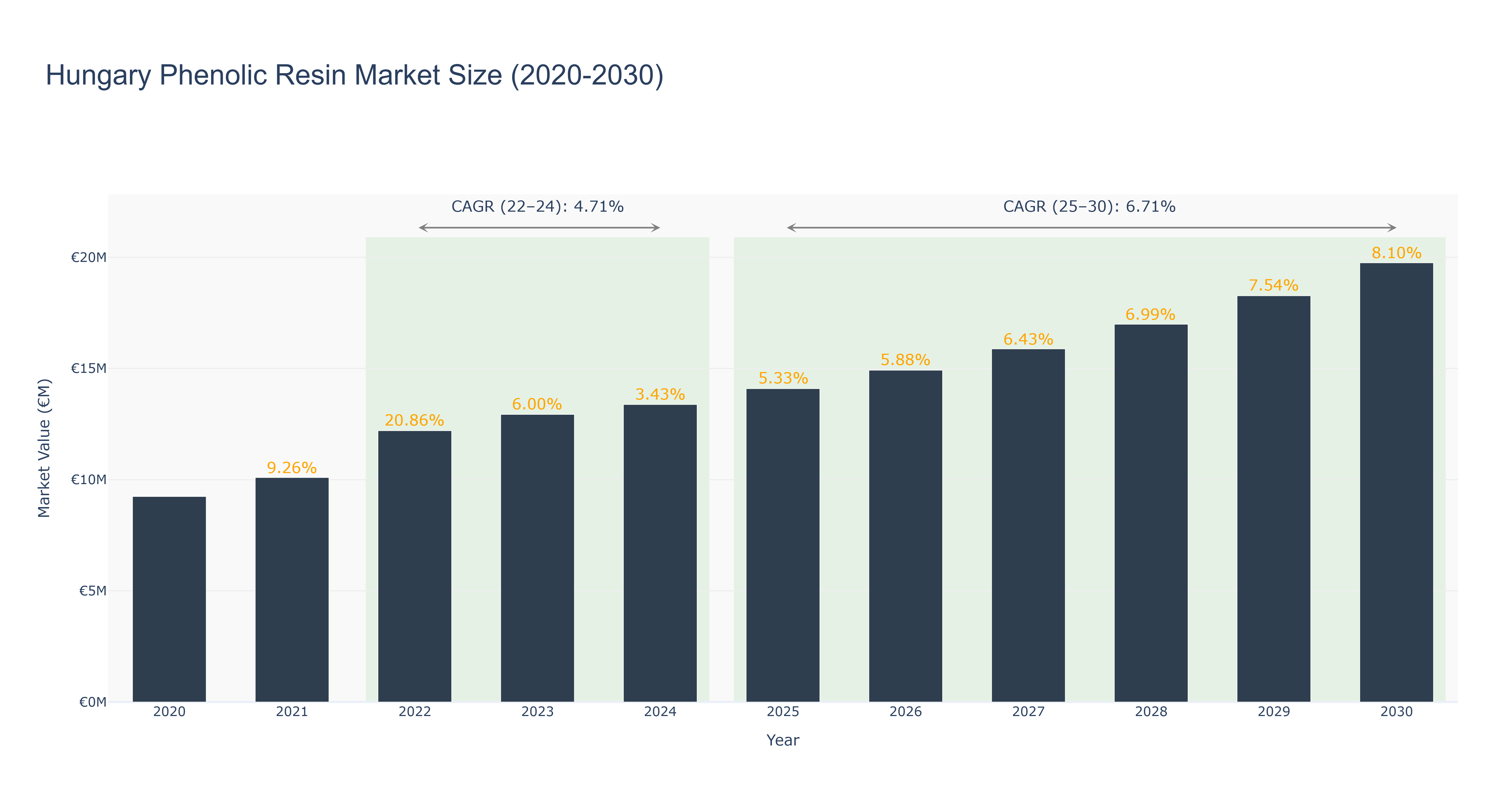
Hungary Phenolic Resin Market has shown a steady growth trajectory, with a peak market size of €19.75 million expected in 2030. The market experienced an actual size increase from €12.20 million in 2022 to €13.38 million in 2024, with a CAGR of 4.71%. The forecasted growth from 2025 to 2030 is projected to have a CAGR of 6.71%. The market's growth can be attributed to increasing demand from industries like automotive and construction, driven by the resin's versatile properties. Recent developments in Hungary's phenolic resin market include collaborations with key players to enhance product quality and sustainability. Future projects focus on expanding production capacities to meet the growing demand for phenolic resins in various applications. As of 2026, the market is poised for further expansion, supported by ongoing industry advancements and strategic partnerships.
Hungary Phenolic Resin Market: Production & Trade Performance (2019-2025)
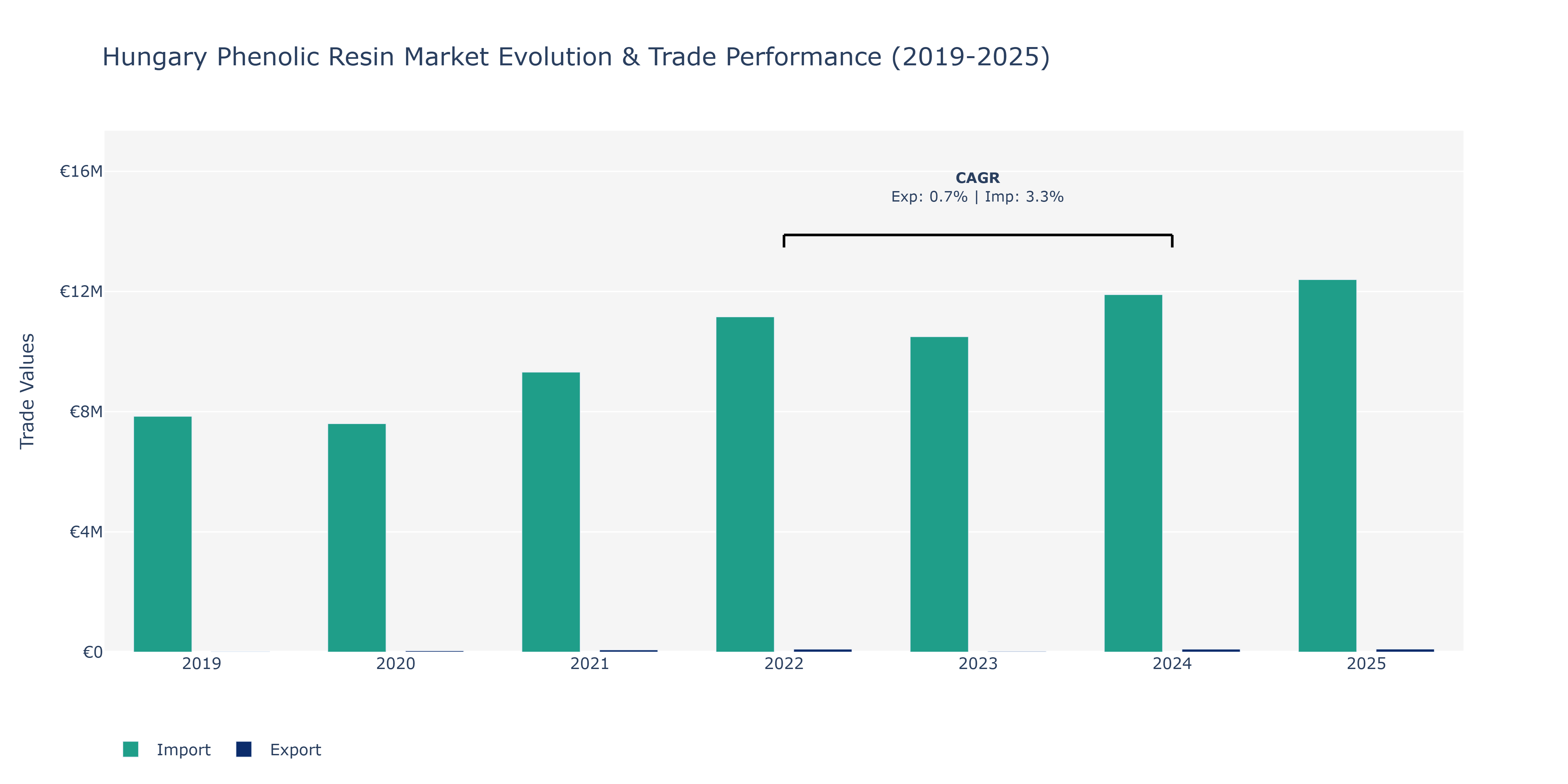
Between 2019 and 2025, Hungary's Phenolic Resin Market saw a notable increase in both exports and imports. Exports started at €17.93 thousand in 2019 and experienced substantial growth, reaching €97.77 thousand by 2025. This growth can be attributed to increasing global demand for phenolic resins in various industries such as automotive, construction, and electronics, where Hungary has strengthened its position as a key supplier. On the import side, the market began at a high of €7.85 million in 2019, with fluctuations over the years but consistently trending upwards to €12.4 million in 2025. The rise in imports may be linked to the need for raw materials and advanced technologies to support the expanding domestic production of phenolic resins. The CAGR for imports was 3.27%, indicating a steady upward trajectory, while the CAGR for exports stood at 0.72%, reflecting a slower but still positive growth rate. These trends align with the increasing demand for phenolic resins globally, with Hungary strategically positioning itself in the market through trade agreements, technological advancements, and a focus on product quality to meet international standards.
Hungary Phenolic Resin Market Overview
The Hungary Phenolic Resin Market has been experiencing steady growth in recent years, driven by increasing demand from various end-use industries such as automotive, construction, and electronics. Phenolic resins are widely used in Hungary for applications including adhesives, coatings, and molding compounds due to their excellent heat resistance and mechanical properties. The market is also benefiting from ongoing technological advancements in phenolic resin production and formulation, leading to the development of high-performance and eco-friendly products. Key players in the Hungary Phenolic Resin Market include companies such as Hexion Inc., Georgia-Pacific Chemicals, and SI Group, among others. With a focus on innovation and sustainability, the market is expected to continue its growth trajectory in the coming years, driven by the country`s expanding industrial sector and increasing investments in research and development.
Hungary Phenolic Resin Market Trends and Opportunities
The Hungary Phenolic Resin Market is experiencing growth driven by increasing demand from end-use industries such as automotive, construction, and electronics. A key trend in the market is the rising popularity of environmentally friendly and sustainable phenolic resins, as companies are increasingly focusing on reducing their carbon footprint. Another opportunity lies in the development of innovative applications for phenolic resins, such as in composites, adhesives, and insulation materials. Additionally, the growing emphasis on fire-retardant materials in construction and automotive sectors is expected to further drive the demand for phenolic resins in Hungary. Overall, the market is poised for steady growth, with manufacturers focusing on product innovation and expanding their product portfolios to cater to diverse industry needs.
Hungary Phenolic Resin Market Challenges
In the Hungary Phenolic Resin Market, some challenges include fluctuating raw material prices, increasing competition from alternative resin types, and stringent environmental regulations. The volatility of raw material prices can impact production costs and ultimately affect pricing strategies. Additionally, as industries continue to explore more sustainable and environmentally friendly options, phenolic resins face competition from newer resin types that may offer better performance or lower environmental impact. Adhering to strict environmental regulations regarding emissions, waste disposal, and worker safety can also pose challenges for companies operating in the phenolic resin market in Hungary. Navigating these challenges requires companies to innovate, invest in research and development, and adapt their strategies to remain competitive in the market.
Hungary Phenolic Resin Market Drivers
The Hungary Phenolic Resin Market is primarily driven by the increasing demand from end-use industries such as automotive, construction, and electronics due to the superior properties of phenolic resins such as high temperature resistance, excellent adhesion, and chemical resistance. The growing emphasis on lightweight and fuel-efficient vehicles is boosting the use of phenolic resins in automotive applications, while the construction sector is witnessing a surge in demand for phenolic resins in insulation materials and laminates. Additionally, the expanding electronics industry in Hungary is driving the demand for phenolic resins in printed circuit boards and electronic components. Technological advancements leading to the development of eco-friendly phenolic resins and increasing investments in research and development activities are further propelling the market growth.
Hungary Phenolic Resin Market Government Policy
Government policies related to the Hungary Phenolic Resin Market focus on ensuring environmental sustainability and compliance with regulations. Hungary has implemented strict regulations on the usage and disposal of phenolic resins to minimize environmental impact. The government encourages the adoption of eco-friendly production processes and technologies to reduce emissions and waste generation. Additionally, there are policies in place to promote research and development in the phenolic resin sector to improve product quality and drive innovation. Overall, the government`s policies aim to strike a balance between supporting industry growth and protecting the environment, thereby creating a sustainable and competitive market for phenolic resins in Hungary.
Hungary Phenolic Resin Market Future Outlook
The Hungary Phenolic Resin Market is expected to witness moderate growth in the coming years, driven by increasing demand from various end-use industries such as automotive, construction, and electronics. The rising adoption of phenolic resins due to their superior properties such as high heat resistance, mechanical strength, and chemical resistance is anticipated to fuel market growth. Additionally, the growing emphasis on sustainable and eco-friendly products is likely to drive the demand for bio-based phenolic resins in Hungary. However, challenges such as fluctuating raw material prices and increasing competition from alternative materials may hinder market growth to some extent. Overall, the Hungary Phenolic Resin Market is projected to expand steadily, with manufacturers focusing on product innovation and strategic collaborations to maintain a competitive edge in the market.
Key Highlights of the Report:
- Hungary Phenolic Resin Market Outlook
- Market Size of Hungary Phenolic Resin Market, 2025
- Forecast of Hungary Phenolic Resin Market, 2032
- Historical Data and Forecast of Hungary Phenolic Resin Revenues & Volume for the Period 2022 - 2032F
- Hungary Phenolic Resin Market Trend Evolution
- Hungary Phenolic Resin Market Drivers and Challenges
- Hungary Phenolic Resin Price Trends
- Hungary Phenolic Resin Porter's Five Forces
- Hungary Phenolic Resin Industry Life Cycle
- Historical Data and Forecast of Hungary Phenolic Resin Market Revenues & Volume By Type for the Period 2022 - 2032F
- Historical Data and Forecast of Hungary Phenolic Resin Market Revenues & Volume By Resol for the Period 2022 - 2032F
- Historical Data and Forecast of Hungary Phenolic Resin Market Revenues & Volume By Novolac for the Period 2022 - 2032F
- Historical Data and Forecast of Hungary Phenolic Resin Market Revenues & Volume By Application for the Period 2022 - 2032F
- Historical Data and Forecast of Hungary Phenolic Resin Market Revenues & Volume By Wood Adhesives for the Period 2022 - 2032F
- Historical Data and Forecast of Hungary Phenolic Resin Market Revenues & Volume By Laminates for the Period 2022 - 2032F
- Historical Data and Forecast of Hungary Phenolic Resin Market Revenues & Volume By Foundry & Moldings for the Period 2022 - 2032F
- Historical Data and Forecast of Hungary Phenolic Resin Market Revenues & Volume By Paper Impregnation for the Period 2022 - 2032F
- Historical Data and Forecast of Hungary Phenolic Resin Market Revenues & Volume By Coatings for the Period 2022 - 2032F
- Historical Data and Forecast of Hungary Phenolic Resin Market Revenues & Volume By Insulations for the Period 2022 - 2032F
- Hungary Phenolic Resin Import Export Trade Statistics
- Market Opportunity Assessment By Type
- Market Opportunity Assessment By Application
- Hungary Phenolic Resin Top Companies Market Share
- Hungary Phenolic Resin Competitive Benchmarking By Technical and Operational Parameters
- Hungary Phenolic Resin Company Profiles
- Hungary Phenolic Resin Key Strategic Recommendations






































