Hungary Physical Security Market Size & Growth Rate (2026-2032)
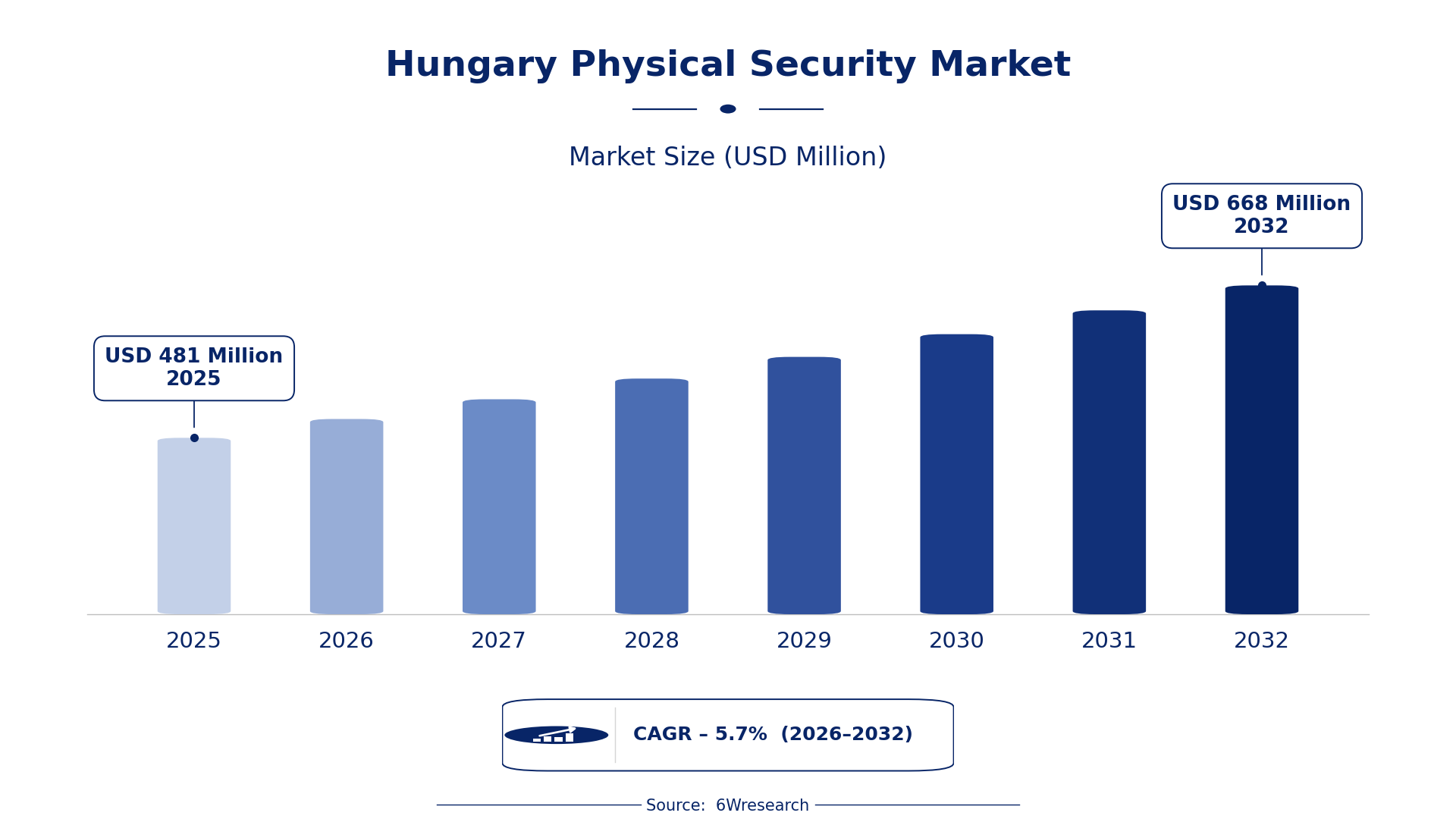
The Hungary Physical Security Market was estimated at USD 481 Million in 2025 and is projected to reach USD 668 Million by 2032, growing at a CAGR of 5.7% from 2026 to 2032.
Hungary Physical Security Market Synopsis
The Hungary Physical Security Market has gained momentum due to increasing safety concerns across various sectors. This demand has propelled the adoption of advanced technologies aimed at safeguarding people and assets. Looking forward, the market is expected to grow further, driven by heightened awareness and stricter regulations, as businesses and the government prioritize security.
The integration of technologies like AI and IoT into physical security systems marks a shift toward more sophisticated and responsive solutions. As organizations increasingly seek comprehensive security strategies, the market is adapting to offer innovative approaches that combine traditional security measures with cutting-edge technology.
Hungary Physical Security Market Year-wise Growth Rate and Key Drivers
This graph illustrates the annual growth rates of the Hungary Physical Security Market from 2021 to 2032, highlighting a steady upward trajectory and projected expansion over the forecast period.
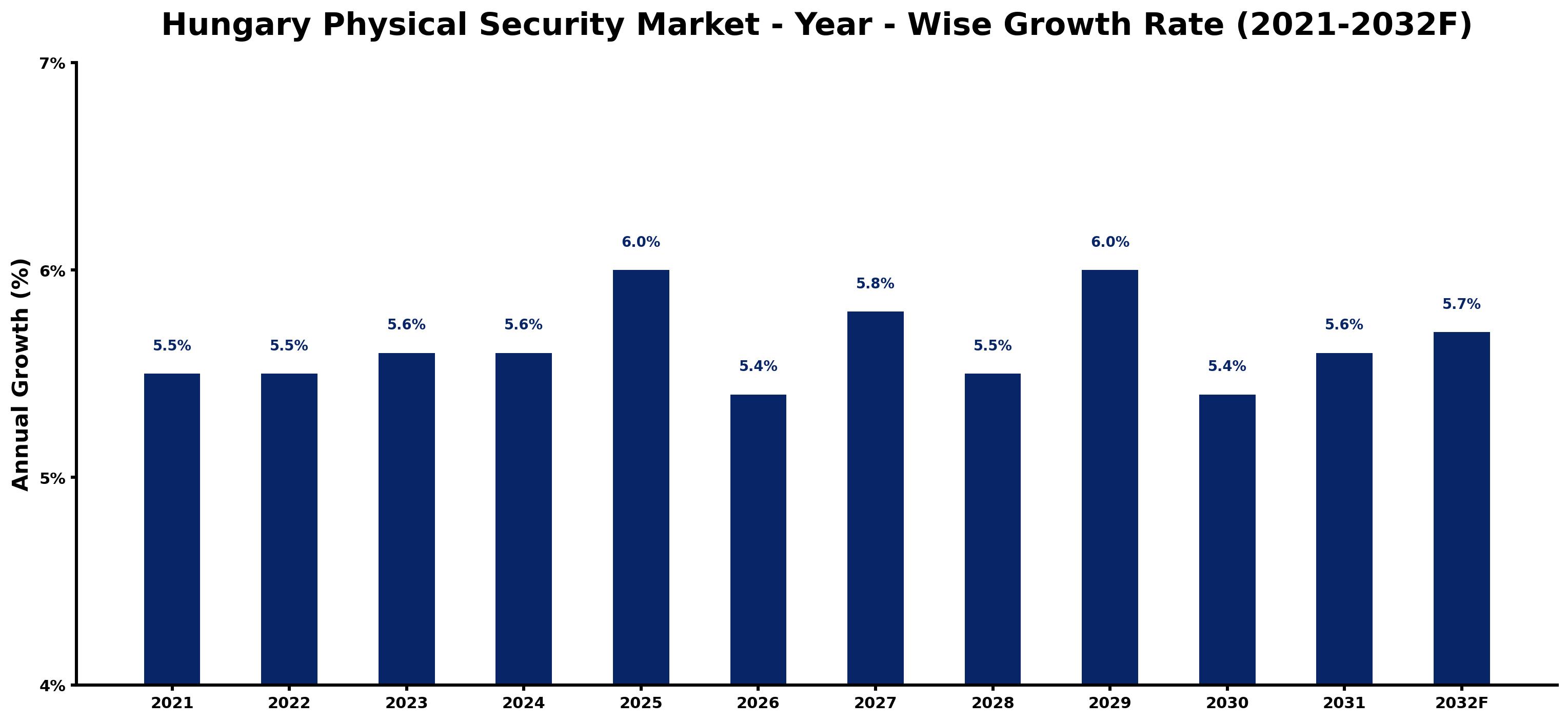
The table below presents the year‑wise growth rates along with the key drivers influencing the market
| Year | Growth Rate | Major Drivers |
| 2021 | 5.5% | Increased EU funding for border security technologies. |
| 2022 | 5.5% | Government initiatives boosting cybersecurity in public sectors. |
| 2023 | 5.6% | Surge in biometric surveillance adoption by local businesses. |
| 2024 | 5.6% | New regulations enhancing surveillance system compliance requirements. |
| 2025 | 6.0% | Growing urbanization leading to higher demand for security. |
| 2026 | 5.4% | Increased investment in smart surveillance by municipalities. |
| 2027 | 5.8% | Heightened concerns over public safety driving security upgrades. |
| 2028 | 5.5% | Legal mandates for enhanced physical security in schools. |
| 2029 | 6.0% | Growing awareness of cybersecurity threats among enterprises. |
| 2030 | 5.4% | Public-private partnerships enhancing infrastructure security solutions. |
| 2031 | 5.6% | Investment in IoT security devices gaining traction. |
| 2032 | 5.7% | Rising insurance premiums driving demand for physical security. |
Note: Market size estimations and growth projections presented in this report are based on 6Wresearch's proprietary forecasting methodology, utilizing the latest available industry data, government publications, and primary research inputs.
Hungary Physical Security Market Key Takeaways
Below are some of the specific key takeaways from the market, including:
- Growing demand for integrated security solutions offering real-time monitoring.
- Shift toward cloud-based security systems for enhanced scalability.
- Increased focus on cybersecurity to protect physical security frameworks.
- Emergence of AI-driven technologies for improved threat detection.
- Expanding government initiatives to bolster public safety and security measures.
Evaluation of Restraints in Hungary Physical Security Market
Several factors are restraining the growth of the Hungary Physical Security Market. The rising sophistication of security threats demands continuous advancements in security technologies, creating pressure for companies to remain innovative and compliant. Regulatory requirements and strict data protection laws add to operational complexities, limiting flexibility. on top of that, budget constraints faced by many organizations restrict their ability to invest in comprehensive security systems, which can hinder market potential.
Hungary Physical Security Market Trends
The market is currently witnessing significant trends that are reshaping its dynamics. One notable trend is the increasing adoption of biometric authentication methods as organizations seek reliable and efficient access control. Video surveillance technology continues to evolve, with high-resolution cameras and smart analytics enhancing monitoring capabilities. The demand for automated security solutions is also growing, as businesses seek to streamline operations and reduce human error.
Hungary Physical Security Market Opportunities
Investment opportunities are flourishing within the Hungary Physical Security Market. The push for advanced video surveillance systems and access control technologies creates potential for businesses to capitalize on innovative offerings. on top of that, as companies look to integrate AI and cloud solutions into their security infrastructure, the need for partnerships with technology providers and system integrators will rise. The government’s commitment to improving public safety opens new avenues for private sector collaboration and investment.
Government Initiatives in the Hungary Physical Security Market
Government policies play a crucial role in shaping the Hungary Physical Security Market. With a focus on enhancing public safety, the Hungarian government has launched several initiatives aimed at improving national security and infrastructure resilience. The commitment to modernizing security frameworks ensures ongoing investment and development in this sector.
- A national cybersecurity enhancement programme initiated in early 2025 to safeguard critical infrastructure.
- Current efforts to upgrade border security systems, focusing on technology integration, are underway.
- Planning for a comprehensive public-private partnership expected to expand emergency response capabilities by 2027.
- Implementation of new regulatory frameworks in 2026 designed to standardize security measures across sectors.
- Collaboration with key industry stakeholders to address physical and cybersecurity threats, currently being executed.
Future Insights of the Hungary Physical Security Market
The Hungary Physical Security Market is set to experience consistent growth from 2026 to 2032, driven by an increasing emphasis on safety and the integration of advanced technologies. Rising crime rates and the necessity for stringent safety regulations will continue to propel demand. However, the market's trajectory may face challenges from initial investment costs and growing concerns surrounding data privacy. As businesses adapt, opportunities for innovative and comprehensive solutions will proliferate.
Hungary Physical Security Market Latest Developments
Recent activity in the Hungary Physical Security Market reflects a broader trend towards modernization and technological integration. Companies are increasingly embracing solutions that not only enhance security but also optimize operational efficiency. The last 12-14 months have been pivotal in shaping this evolving landscape.
- A major technology vendor launched an innovative AI-driven surveillance solution in early 2025, focusing on real-time threat detection.
- Ongoing integration of IoT capabilities into existing security frameworks began in mid-2025 and continues to show promise for improved management.
- A planned rollout of advanced perimeter security systems is expected to commence in Q3 2026, targeting commercial properties.
- An initiative to expand cloud-based security services was recently completed, enhancing accessibility for various sectors.
- Current partnerships between local security providers and tech firms aim to develop hybrid security solutions that are expected to launch in late 2026.
Hungary Physical Security Market - Key Attractiveness of the Report
- 10 Years of Market Numbers
- Historical Data Starting from 2022 to 2025
- Base Year: 2025
- Forecast Data until 2032
- Key Performance Indicators Impacting the Market
- Major Upcoming Developments and Projects
Key Highlights of the Report:
- Hungary Physical Security Market Outlook
- Market Size of Hungary Physical Security Market, 2025
- Forecast of Hungary Physical Security Market, 2032
- Historical Data and Forecast of Hungary Physical Security Revenues & Volume for the Period 2022-2032F
- Hungary Physical Security Market Trend Evolution
- Hungary Physical Security Market Drivers and Challenges
- Hungary Physical Security Price Trends
- Hungary Physical Security Porter's Five Forces
- Hungary Physical Security Industry Life Cycle
- Historical Data and Forecast of Hungary Physical Security Market Revenues & Volume By Component for the Period 2022-2032F
- Historical Data and Forecast of Hungary Physical Security Market Revenues & Volume By Systems (PACS, PSIM, PIAM, Video Surveillance, Fire and Life Safety) for the Period 2022-2032F
- Historical Data and Forecast of Hungary Physical Security Market Revenues & Volume By Services for the Period 2022-2032F
- Historical Data and Forecast of Hungary Physical Security Market Revenues & Volume By Vertical for the Period 2022-2032F
- Historical Data and Forecast of Hungary Physical Security Market Revenues & Volume By BFSI for the Period 2022-2032F
- Historical Data and Forecast of Hungary Physical Security Market Revenues & Volume By Government for the Period 2022-2032F
- Historical Data and Forecast of Hungary Physical Security Market Revenues & Volume By Retail for the Period 2022-2032F
- Historical Data and Forecast of Hungary Physical Security Market Revenues & Volume By Transportation for the Period 2022-2032F
- Historical Data and Forecast of Hungary Physical Security Market Revenues & Volume By Residential for the Period 2022-2032F
- Historical Data and Forecast of Hungary Physical Security Market Revenues & Volume By Telecom and IT for the Period 2022-2032F
- Historical Data and Forecast of Hungary Physical Security Market Revenues & Volume By Other Verticals (Healthcare, Manufacturing, Energy and Utilities, and Education). for the Period 2022-2032F
- Historical Data and Forecast of Hungary Physical Security Market Revenues & Volume By Organization Size for the Period 2022-2032F
- Historical Data and Forecast of Hungary Physical Security Market Revenues & Volume By SMEs for the Period 2022-2032F
- Historical Data and Forecast of Hungary Physical Security Market Revenues & Volume By Large Enterprises for the Period 2022-2032F
- Hungary Physical Security Import Export Trade Statistics
- Market Opportunity Assessment By Component
- Market Opportunity Assessment By Vertical
- Market Opportunity Assessment By Organization Size
- Hungary Physical Security Top Companies Market Share
- Hungary Physical Security Competitive Benchmarking By Technical and Operational Parameters
- Hungary Physical Security Company Profiles
- Hungary Physical Security Key Strategic Recommendations






































