Hungary Policy Management in Telecom Market Size & Growth Rate (2026-2032)
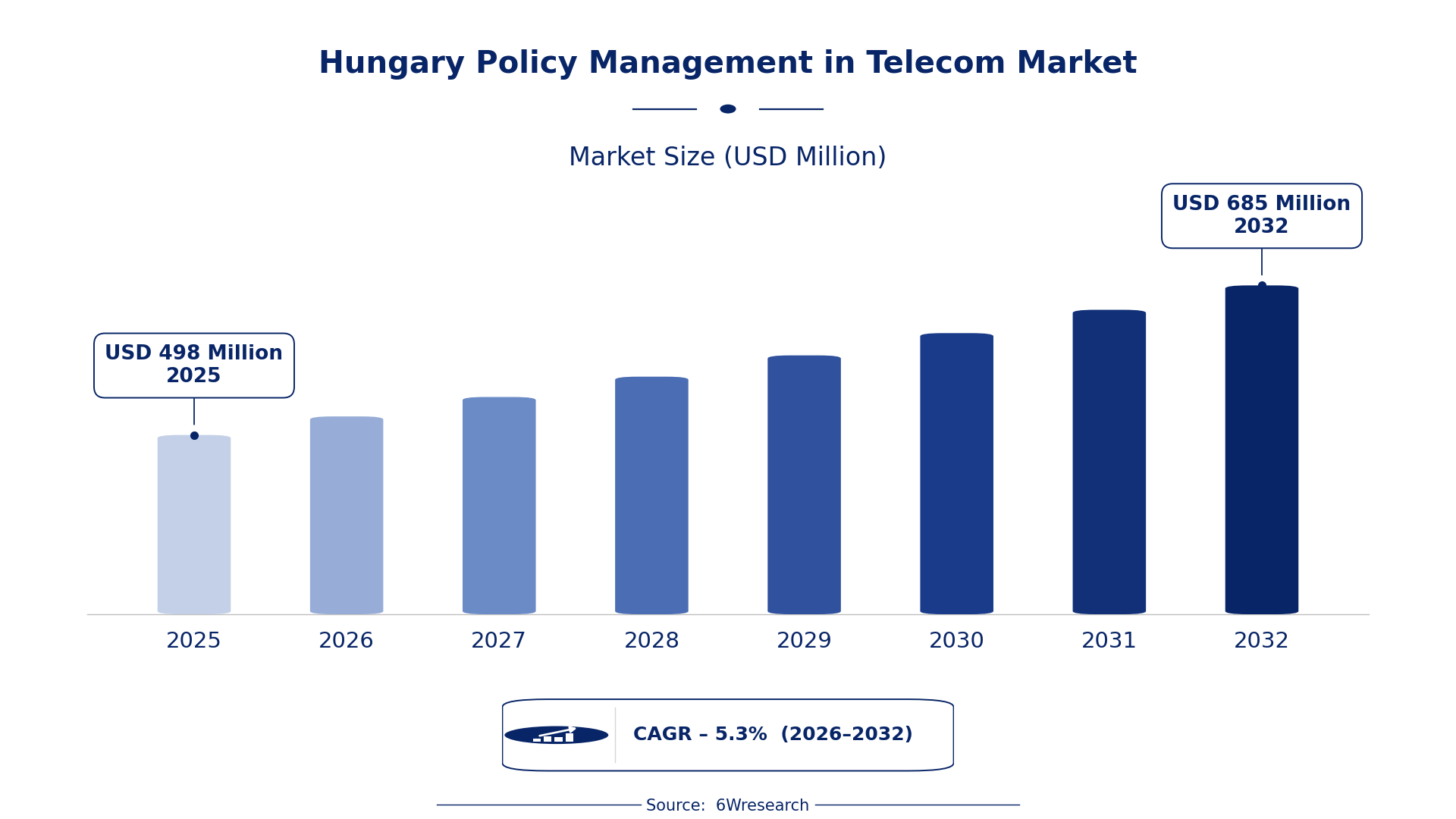
The Hungary Policy Management in Telecom Market was estimated at USD 498 Million in 2025 and is projected to reach USD 685 Million by 2032, growing at a CAGR of 5.3% from 2026 to 2032.
Hungary Policy Management in Telecom Market Synopsis
The telecom sector in Hungary is witnessing a surge in demand for policy management solutions as operators strive to efficiently manage their network resources. The growing reliance on mobile devices and data services has catalyzed investments in advanced systems that can ensure service quality and regulatory compliance.
With the introduction of 5G and the proliferation of IoT devices, the need for sophisticated policy management frameworks has never been more pressing. These frameworks not only enhance user experience but also allow telecom operators to monetize new services effectively.
Hungary Policy Management in Telecom Market Year-wise Growth Rate and Key Drivers
This graph illustrates the annual growth rates of the Hungary Policy Management in Telecom Market from 2021 to 2032, highlighting a steady upward trajectory and projected expansion over the forecast period.
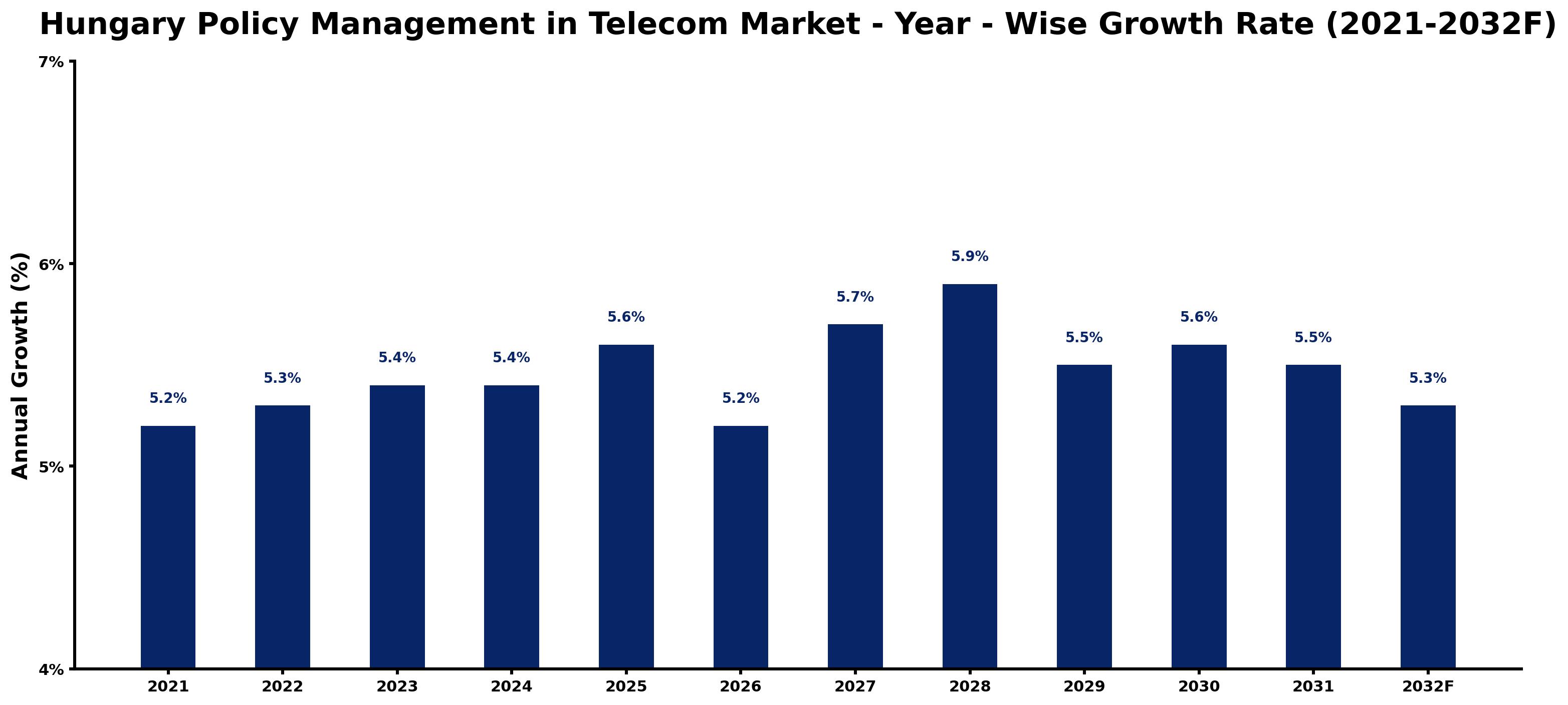
The table below presents the year‑wise growth rates along with the key drivers influencing the market
| Year | Growth Rate | Major Drivers |
| 2021 | 5.2% | Hungary's 5G National Action Plan stimulating telecom innovations. |
| 2022 | 5.3% | Increased demand for mobile data due to remote work. |
| 2023 | 5.4% | Regulatory reforms enhancing competition among telecom providers. |
| 2024 | 5.4% | Government funding for broadband expansion in rural areas. |
| 2025 | 5.6% | Rise in IoT applications driving telecom policy adaptations. |
| 2026 | 5.2% | Telecom Tax incentives attracting foreign investments in Hungary. |
| 2027 | 5.7% | Growing digital literacy improving telecom service adoption rates. |
| 2028 | 5.9% | EU recovery funds boosting telecom infrastructure projects. |
| 2029 | 5.5% | Emergence of fintech requiring advanced telecom solutions. |
| 2030 | 5.6% | Telecom regulatory body promoting 5G usage in urban areas. |
| 2031 | 5.5% | Increased focus on cybersecurity in telecom regulations. |
| 2032 | 5.3% | Ongoing public-private partnerships enhancing telecom service quality. |
Note: Market size estimations and growth projections presented in this report are based on 6Wresearch's proprietary forecasting methodology, utilizing the latest available industry data, government publications, and primary research inputs.
Hungary Policy Management in Telecom Market Key Takeaways
Below are some of the specific key takeaways from the market, including:
- The market is expected to expand significantly, driven by advancements in 5G technology.
- Telecom operators are focusing on policy management systems to optimize network performance.
- Regulatory compliance remains a top priority for operators amidst evolving legislation.
- The increasing number of IoT devices is intensifying the demand for dynamic policy frameworks.
- Consumer rights protection is shaping policy management strategies in the telecom market.
Evaluation of Restraints in Hungary Policy Management in Telecom Market
The policy management market in Hungary faces real challenges as telecom operators grapple with a complex regulatory environment. Compliance with a myriad of data privacy and security regulations can stymie innovation and limit operational flexibility. The rapid pace of technological evolution demands adaptable policy solutions that can accommodate new services, which is often a hurdle for many operators. Furthermore, competition within the market is intensifying, which can impact profitability and strategic direction.
Hungary Policy Management in Telecom Market Trends
Key trends in Hungary's telecom policy management market reflect a growing emphasis on automation and data-driven decision-making. Operators are increasingly adopting AI and machine learning technologies to enhance policy enforcement and network optimization. Additionally, the rise of real-time data analytics tools is enabling operators to respond swiftly to customer needs, thereby improving service delivery.
Another trend is the integration of security features within policy management systems. With growing concerns over data breaches, telecom companies are prioritizing comprehensive security measures to protect consumer information and ensure regulatory adherence.
Hungary Policy Management in Telecom Market Opportunities
Opportunities in the Hungary policy management market are expanding, particularly in sectors like IoT and 5G applications. Telecom operators can explore partnerships with technology providers to implement cutting-edge policy management systems that leverage cloud-based solutions. Such collaborations could enhance their service offerings and improve operational efficiencies.
Moreover, initiatives aimed at enhancing broadband access in underserved areas present a chance for investment in infrastructure upgrades that necessitate robust policy management frameworks.
Government Initiatives in the Hungary Policy Management in Telecom Market
The Hungarian government is actively involved in shaping the policy management framework within its telecom sector. Its regulatory posture focuses on fostering competition while ensuring consumer protection. Recent initiatives include efforts to enhance broadband access and promote digital inclusion. These government-led actions are crucial for establishing a favorable environment for telecom operators, balancing innovation with public interests.
- A national broadband expansion programme recently launched aims to improve access in rural areas.
- Current initiatives focus on implementing a regulatory framework for data privacy compliance among telecom operators.
- A planned public-private partnership is expected to address infrastructure challenges by 2028.
- The government has introduced new licensing policies to encourage more entrants into the market, increasing competition.
- In 2025, a comprehensive review of spectrum allocation policies was completed to enhance operational efficiency.
Future Insights of the Hungary Policy Management in Telecom Market
Looking ahead to 2026-2032, the Hungary policy management in telecom market is set for substantial evolution. As 5G technology becomes mainstream, operators will require increasingly sophisticated policy management tools to manage diverse applications ranging from IoT to smart cities. Greater regulatory scrutiny regarding consumer rights and data protection will also necessitate adaptive policy solutions, influencing the operational strategies of telecom companies.
Hungary Policy Management in Telecom Market Latest Developments
Over the past year, the Hungary policy management market has seen noteworthy developments that signal a shift towards modernization and improved service delivery. Operators are prioritizing the adoption of advanced technologies to stay competitive in a rapidly changing environment.
- A leading telecom operator launched a new policy management system in Q1 2025 aimed at enhancing QoS for 5G users.
- An initiative began in mid-2025 to integrate AI-driven analytics into existing policy management frameworks.
- A pilot project that started in early 2025 focuses on automating policy enforcement processes to increase efficiency.
- Plans are underway for a major upgrade to policy management tools expected to commence in late 2026, focusing on user experience enhancements.
Hungary Policy Management in Telecom Market - Key Attractiveness of the Report
- 10 Years of Market Numbers
- Historical Data Starting from 2022 to 2025
- Base Year: 2025
- Forecast Data until 2032
- Key Performance Indicators Impacting the Market
- Major Upcoming Developments and Projects
Key Highlights of the Report:
- Hungary Policy Management in Telecom Market Outlook
- Market Size of Hungary Policy Management in Telecom Market, 2025
- Forecast of Hungary Policy Management in Telecom Market, 2032
- Historical Data and Forecast of Hungary Policy Management in Telecom Revenues & Volume for the Period 2022-2032F
- Hungary Policy Management in Telecom Market Trend Evolution
- Hungary Policy Management in Telecom Market Drivers and Challenges
- Hungary Policy Management in Telecom Price Trends
- Hungary Policy Management in Telecom Porter's Five Forces
- Hungary Policy Management in Telecom Industry Life Cycle
- Historical Data and Forecast of Hungary Policy Management in Telecom Market Revenues & Volume By Network for the Period 2022-2032F
- Historical Data and Forecast of Hungary Policy Management in Telecom Market Revenues & Volume By Fixed for the Period 2022-2032F
- Historical Data and Forecast of Hungary Policy Management in Telecom Market Revenues & Volume By Wireless for the Period 2022-2032F
- Historical Data and Forecast of Hungary Policy Management in Telecom Market Revenues & Volume By Component for the Period 2022-2032F
- Historical Data and Forecast of Hungary Policy Management in Telecom Market Revenues & Volume By Solutions for the Period 2022-2032F
- Historical Data and Forecast of Hungary Policy Management in Telecom Market Revenues & Volume By Services for the Period 2022-2032F
- Historical Data and Forecast of Hungary Policy Management in Telecom Market Revenues & Volume By Deployment for the Period 2022-2032F
- Historical Data and Forecast of Hungary Policy Management in Telecom Market Revenues & Volume By Cloud for the Period 2022-2032F
- Historical Data and Forecast of Hungary Policy Management in Telecom Market Revenues & Volume By On-Premises for the Period 2022-2032F
- Hungary Policy Management in Telecom Import Export Trade Statistics
- Market Opportunity Assessment By Network
- Market Opportunity Assessment By Component
- Market Opportunity Assessment By Deployment
- Hungary Policy Management in Telecom Top Companies Market Share
- Hungary Policy Management in Telecom Competitive Benchmarking By Technical and Operational Parameters
- Hungary Policy Management in Telecom Company Profiles
- Hungary Policy Management in Telecom Key Strategic Recommendations






































