Hungary Quilt Market Outlook | Trends, Revenue, Forecast, Size, Share, Industry, Growth, Companies, Analysis, COVID-19 IMPACT & Value
Market Forecast By Product Type (Cotton, Flannel, Cotton/Poly Blend, Linen, Silk), By Application (Residential, Commercial) And Competitive Landscape
| Product Code: ETC126941 | Publication Date: Jun 2021 | Updated Date: Jan 2026 | Product Type: Report | |
| Publisher: 6Wresearch | Author: Shubham Deep | No. of Pages: 70 | No. of Figures: 35 | No. of Tables: 5 |
Hungary Quilt Market: Import Trend Analysis
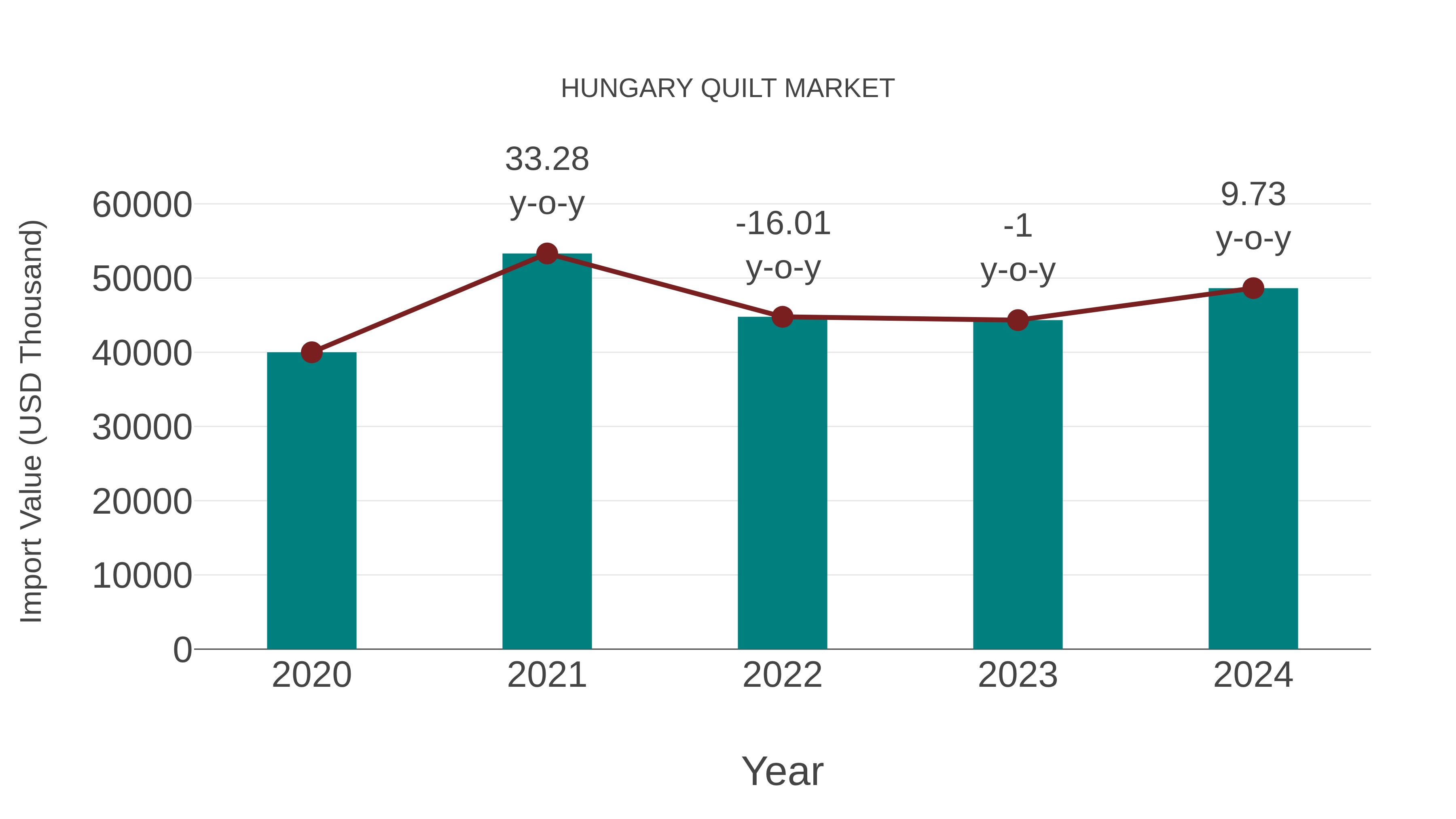
In 2024, Hungary`s import trend for the Hungary quilt market showed a growth rate of 9.73% compared to the previous year, with a compound annual growth rate (CAGR) of 5.01% for the period 2020-2024. This increase can be attributed to a notable shift in consumer demand towards higher-quality quilts, reflecting a strengthening market stability and evolving consumer preferences in the region.
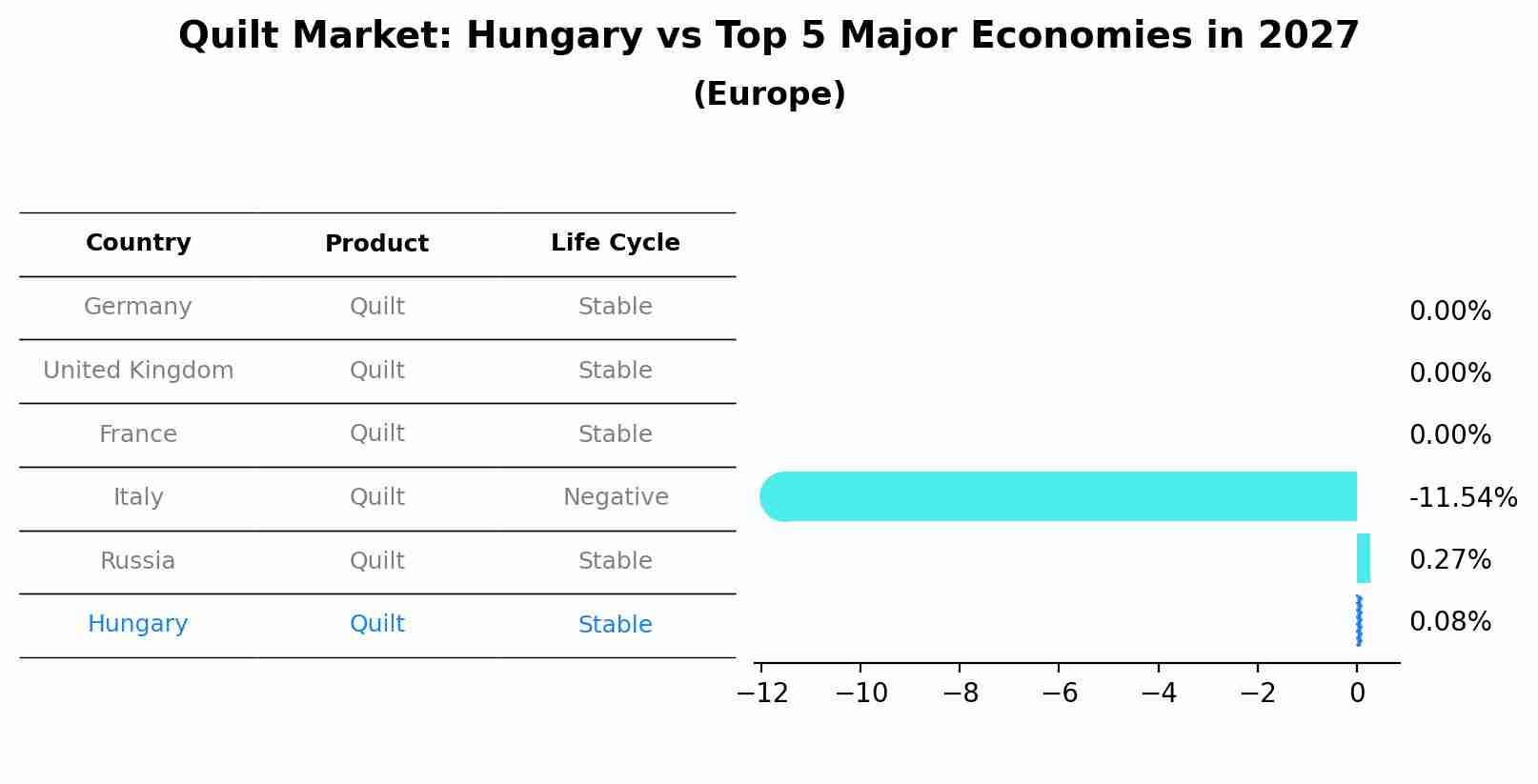
Quilt Market: Hungary vs Top 5 Major Economies in 2027 (Europe)
In the Europe region, the Quilt market in Hungary is projected to expand at a stable growth rate of 0.08% by 2027. The largest economy is Germany, followed by United Kingdom, France, Italy and Russia.
Hungary Quilt Market Overview
The Hungary quilt market is characterized by a growing interest in traditional and modern quilting techniques, reflecting a combination of cultural heritage and contemporary design trends. Quilting in Hungary has a rich history, with intricate folk patterns and vibrant colors being prominent features. The market caters to a diverse range of consumers, from hobbyists and DIY enthusiasts to professional quilters and collectors. Local artisans and small businesses play a significant role in the market, offering handmade quilts, patterns, and supplies. With an increasing focus on sustainability and craftsmanship, there is a growing demand for high-quality, locally sourced materials. Online platforms and social media have also contributed to the market`s visibility, allowing for broader reach and collaboration within the quilting community.
Hungary Quilt Market Trends
The Hungary Quilt Market is experiencing a surge in demand for handmade and artisanal quilts, reflecting a growing appreciation for traditional craftsmanship and unique, one-of-a-kind pieces. Consumers are seeking out quilts that are not only functional but also serve as statement pieces in their homes, with a focus on quality materials and intricate designs. Additionally, there is a noticeable trend towards sustainability and eco-consciousness, leading to an increased interest in quilts made from organic and recycled fabrics. Online marketplaces and social media platforms are playing a key role in connecting consumers with independent quilt makers and small businesses, providing a platform for showcasing their work and reaching a wider audience. Overall, the Hungary Quilt Market is embracing creativity, individuality, and sustainability as key driving forces in current trends.
Hungary Quilt Market Challenges
In the Hungary Quilt Market, some of the challenges faced include increasing competition from low-cost imports, fluctuating raw material prices, and changing consumer preferences. The market is becoming more saturated with cheaper quilt products from other countries, making it difficult for local quilt makers to compete on price alone. Additionally, the volatility of raw material prices, such as fabric and thread, can impact the profitability of quilt businesses. Furthermore, as consumer preferences evolve, quilt makers need to stay updated with the latest trends and designs to remain relevant in the market. Adapting to these challenges by focusing on quality craftsmanship, unique designs, and effective marketing strategies can help businesses thrive in the Hungary Quilt Market.
Hungary Quilt Market Investment Opportunities
In the Hungary Quilt Market, there are several investment opportunities to consider. With a growing interest in home décor and handmade goods, investing in the production and distribution of high-quality quilts could prove to be lucrative. Targeting niche markets such as eco-friendly materials or traditional Hungarian designs could also set your investment apart. Additionally, offering customization options or creating quilt-making workshops could attract a niche customer base and drive sales. Collaborating with local artisans or designers to create unique quilt collections could further differentiate your brand in the market. Overall, investing in the Hungary Quilt Market presents opportunities for innovation, creativity, and tapping into the increasing consumer demand for unique and artisanal products.
Hungary Quilt Market Government Policy
The Hungarian government does not have specific policies targeting the quilt market, but the general business environment in Hungary is regulated by laws related to consumer protection, taxation, and trade. The country is a member of the European Union, and as such, adheres to EU regulations concerning product standards and labeling requirements. Additionally, Hungary offers various incentives and support programs for small and medium-sized enterprises, which may benefit quilt makers and retailers in the market. Overall, businesses operating in the quilt market in Hungary must comply with standard regulations governing commerce, while also having access to potential support mechanisms aimed at fostering entrepreneurship and economic growth.
Hungary Quilt Market Future Outlook
The future outlook for the Hungary Quilt Market appears promising, driven by factors such as increasing consumer interest in home décor and the growing popularity of handmade and artisanal products. With a rising trend towards sustainable and eco-friendly products, there is a potential market for quilts made from organic materials or recycled fabrics. Additionally, the rise of online marketplaces and e-commerce platforms provides opportunities for quilt makers to reach a wider audience both domestically and internationally. Collaborations with designers and artists, as well as participation in craft fairs and exhibitions, can further boost the visibility and demand for Hungarian quilts. Overall, the Hungary Quilt Market is expected to see steady growth in the coming years, fueled by a combination of traditional craftsmanship and modern design trends.
Key Highlights of the Report:
- Hungary Quilt Market Outlook
- Market Size of Hungary Quilt Market, 2021
- Forecast of Hungary Quilt Market, 2027
- Historical Data and Forecast of Hungary Quilt Revenues & Volume for the Period 2018 - 2027
- Hungary Quilt Market Trend Evolution
- Hungary Quilt Market Drivers and Challenges
- Hungary Quilt Price Trends
- Hungary Quilt Porter's Five Forces
- Hungary Quilt Industry Life Cycle
- Historical Data and Forecast of Hungary Quilt Market Revenues & Volume By Product Type for the Period 2018 - 2027
- Historical Data and Forecast of Hungary Quilt Market Revenues & Volume By Cotton for the Period 2018 - 2027
- Historical Data and Forecast of Hungary Quilt Market Revenues & Volume By Flannel for the Period 2018 - 2027
- Historical Data and Forecast of Hungary Quilt Market Revenues & Volume By Cotton/Poly Blend for the Period 2018 - 2027
- Historical Data and Forecast of Hungary Quilt Market Revenues & Volume By Linen for the Period 2018 - 2027
- Historical Data and Forecast of Hungary Quilt Market Revenues & Volume By Silk for the Period 2018 - 2027
- Historical Data and Forecast of Hungary Quilt Market Revenues & Volume By Application for the Period 2018 - 2027
- Historical Data and Forecast of Hungary Quilt Market Revenues & Volume By Residential for the Period 2018 - 2027
- Historical Data and Forecast of Hungary Quilt Market Revenues & Volume By Commercial for the Period 2018 - 2027
- Hungary Quilt Import Export Trade Statistics
- Market Opportunity Assessment By Product Type
- Market Opportunity Assessment By Application
- Hungary Quilt Top Companies Market Share
- Hungary Quilt Competitive Benchmarking By Technical and Operational Parameters
- Hungary Quilt Company Profiles
- Hungary Quilt Key Strategic Recommendations
Frequently Asked Questions About the Market Study (FAQs):
6Wresearch actively monitors the Hungary Quilt Market and publishes its comprehensive annual report, highlighting emerging trends, growth drivers, revenue analysis, and forecast outlook. Our insights help businesses to make data-backed strategic decisions with ongoing market dynamics. Our analysts track relevent industries related to the Hungary Quilt Market, allowing our clients with actionable intelligence and reliable forecasts tailored to emerging regional needs.
Yes, we provide customisation as per your requirements. To learn more, feel free to contact us on sales@6wresearch.com
Hungary Quilt |
1 Executive Summary |
2 Introduction |
2.1 Key Highlights of the Report |
2.2 Report Description |
2.3 Market Scope & Segmentation |
2.4 Research Methodology |
2.5 Assumptions |
3 Hungary Quilt Market Overview |
3.1 Hungary Country Macro Economic Indicators |
3.2 Hungary Quilt Market Revenues & Volume, 2021 & 2027F |
3.3 Hungary Quilt Market - Industry Life Cycle |
3.4 Hungary Quilt Market - Porter's Five Forces |
3.5 Hungary Quilt Market Revenues & Volume Share, By Product Type, 2021 & 2027F |
3.6 Hungary Quilt Market Revenues & Volume Share, By Application, 2021 & 2027F |
4 Hungary Quilt Market Dynamics |
4.1 Impact Analysis |
4.2 Market Drivers |
4.3 Market Restraints |
5 Hungary Quilt Market Trends |
6 Hungary Quilt Market, By Types |
6.1 Hungary Quilt Market, By Product Type |
6.1.1 Overview and Analysis |
6.1.2 Hungary Quilt Market Revenues & Volume, By Product Type, 2018 - 2027F |
6.1.3 Hungary Quilt Market Revenues & Volume, By Cotton, 2018 - 2027F |
6.1.4 Hungary Quilt Market Revenues & Volume, By Flannel, 2018 - 2027F |
6.1.5 Hungary Quilt Market Revenues & Volume, By Cotton/Poly Blend, 2018 - 2027F |
6.1.6 Hungary Quilt Market Revenues & Volume, By Linen, 2018 - 2027F |
6.1.7 Hungary Quilt Market Revenues & Volume, By Silk, 2018 - 2027F |
6.2 Hungary Quilt Market, By Application |
6.2.1 Overview and Analysis |
6.2.2 Hungary Quilt Market Revenues & Volume, By Residential, 2018 - 2027F |
6.2.3 Hungary Quilt Market Revenues & Volume, By Commercial, 2018 - 2027F |
7 Hungary Quilt Market Import-Export Trade Statistics |
7.1 Hungary Quilt Market Export to Major Countries |
7.2 Hungary Quilt Market Imports from Major Countries |
8 Hungary Quilt Market Key Performance Indicators |
9 Hungary Quilt Market - Opportunity Assessment |
9.1 Hungary Quilt Market Opportunity Assessment, By Product Type, 2021 & 2027F |
9.2 Hungary Quilt Market Opportunity Assessment, By Application, 2021 & 2027F |
10 Hungary Quilt Market - Competitive Landscape |
10.1 Hungary Quilt Market Revenue Share, By Companies, 2021 |
10.2 Hungary Quilt Market Competitive Benchmarking, By Operating and Technical Parameters |
11 Company Profiles |
12 Recommendations |
13 Disclaimer |
Export potential assessment - trade Analytics for 2030
Export potential enables firms to identify high-growth global markets with greater confidence by combining advanced trade intelligence with a structured quantitative methodology. The framework analyzes emerging demand trends and country-level import patterns while integrating macroeconomic and trade datasets such as GDP and population forecasts, bilateral import–export flows, tariff structures, elasticity differentials between developed and developing economies, geographic distance, and import demand projections. Using weighted trade values from 2020–2024 as the base period to project country-to-country export potential for 2030, these inputs are operationalized through calculated drivers such as gravity model parameters, tariff impact factors, and projected GDP per-capita growth. Through an analysis of hidden potentials, demand hotspots, and market conditions that are most favorable to success, this method enables firms to focus on target countries, maximize returns, and global expansion with data, backed by accuracy.
By factoring in the projected importer demand gap that is currently unmet and could be potential opportunity, it identifies the potential for the Exporter (Country) among 190 countries, against the general trade analysis, which identifies the biggest importer or exporter.
To discover high-growth global markets and optimize your business strategy:
Click Here
Pricing
- Single User License$ 1,995
- Department License$ 2,400
- Site License$ 3,120
- Global License$ 3,795

Search
Thought Leadership and Analyst Meet





Our Clients








Latest Reports
- United Kingdom (UK) Long-term Care Insurance Market (2026-2032) | Growth, Share, Consumer Insights, Drivers, Opportunities, Competition, Pricing Analysis, Segments, Restraints, Companies, Competitive, Value, Outlook, Size, Demand, Analysis, Challenges, Strategic Insights, Investment Trends, Revenue, Trends, Supply, Forecast
- United Kingdom (UK) Long Term Care Market (2026-2032) | Companies, Outlook, Analysis, Trends, Value, Revenue, Segmentation, Share, Forecast, Competitive Landscape, Growth, Size & Forecast
- Iraq Insulation and Waterproofing Market (2026-2032) | Outlook, Drivers, Growth, Size, Share, Industry, Revenue, Trends, Demand, Competitive, Strategic Insights, Opportunities, Segments, Companies, Challenges, Strategy, Consumer Insights, Analysis, Investment Trends, Value, Segmentation, Forecast, Restraints
- India Switchgear Market Outlook (2026 - 2032) | Size, Share, Trends, Growth, Revenue, Forecast, Analysis, Value, Outlook
- Pakistan Contraceptive Implants Market (2025-2031) | Demand, Growth, Size, Share, Industry, Pricing Analysis, Competitive, Strategic Insights, Strategy, Consumer Insights, Analysis, Investment Trends, Opportunities, Revenue, Segments, Value, Segmentation, Supply, Forecast, Restraints, Outlook, Competition, Drivers, Trends, Companies, Challenges
- Sri Lanka Packaging Market (2026-2032) | Outlook, Competition, Drivers, Trends, Demand, Pricing Analysis, Competitive, Strategic Insights, Companies, Challenges, Strategy, Consumer Insights, Analysis, Investment Trends, Opportunities, Growth, Size, Share, Industry, Revenue, Segments, Value, Segmentation, Supply, Forecast, Restraints
- India Kids Watches Market (2026-2032) | Strategy, Consumer Insights, Analysis, Investment Trends, Opportunities, Growth, Size, Share, Industry, Revenue, Segments, Value, Segmentation, Supply, Forecast, Restraints, Outlook, Competition, Drivers, Trends, Demand, Pricing Analysis, Competitive, Strategic Insights, Companies, Challenges
- Saudi Arabia Core Assurance Service Market (2025-2031) | Strategy, Consumer Insights, Analysis, Investment Trends, Opportunities, Growth, Size, Share, Industry, Revenue, Segments, Value, Segmentation, Supply, Forecast, Restraints, Outlook, Competition, Drivers, Trends, Demand, Pricing Analysis, Competitive, Strategic Insights, Companies, Challenges
- Romania Uninterruptible Power Supply (UPS) Market (2026-2032) | Industry, Analysis, Revenue, Size, Forecast, Outlook, Value, Trends, Share, Growth & Companies
- Saudi Arabia Car Window Tinting Film, Paint Protection Film (PPF), and Ceramic Coating Market (2025-2031) | Strategy, Consumer Insights, Analysis, Investment Trends, Opportunities, Growth, Size, Share, Industry, Revenue, Segments, Value, Segmentation, Supply, Forecast, Restraints, Outlook, Competition, Drivers, Trends, Demand, Pricing Analysis, Competitive, Strategic Insights, Companies, Challenges
Industry Events and Analyst Meet

India EV Show 2026

EV tech India Expo 2026

Auto Tech Asia 2026

Battery Tech India 2026

Smart Production Solutions Guangzhou 2026
Whitepaper
- Middle East & Africa Commercial Security Market Click here to view more.
- Middle East & Africa Fire Safety Systems & Equipment Market Click here to view more.
- GCC Drone Market Click here to view more.
- Middle East Lighting Fixture Market Click here to view more.
- GCC Physical & Perimeter Security Market Click here to view more.
6WResearch In News
- Doha a strategic location for EV manufacturing hub: IPA Qatar
- Demand for luxury TVs surging in the GCC, says Samsung
- Empowering Growth: The Thriving Journey of Bangladesh’s Cable Industry
- Demand for luxury TVs surging in the GCC, says Samsung
- Video call with a traditional healer? Once unthinkable, it’s now common in South Africa
- Intelligent Buildings To Smooth GCC’s Path To Net Zero


