Hungary Radioactive Waste Management Market Size, Share & Growth Rate
The Hungary Radioactive Waste Management Market was estimated at USD 496 Million in 2025 and is projected to reach USD 690 Million by 2032, growing at a CAGR of 4.8% from 2026 to 2032. This growth trajectory is primarily driven by the expansion of nuclear power generation within the country, which intensifies the need for specialized waste management solutions. Additionally, stringent regulations and a heightened focus on environmental safety are compelling stakeholders to invest in comprehensive waste management strategies that ensure public health and environmental protection.
Hungary Radioactive Waste Management Market Year-wise Growth Rate and Key Drivers
This graph highlights how the Hungary Radioactive Waste Management Market has steadily grown over the years, supported by major growth factors.
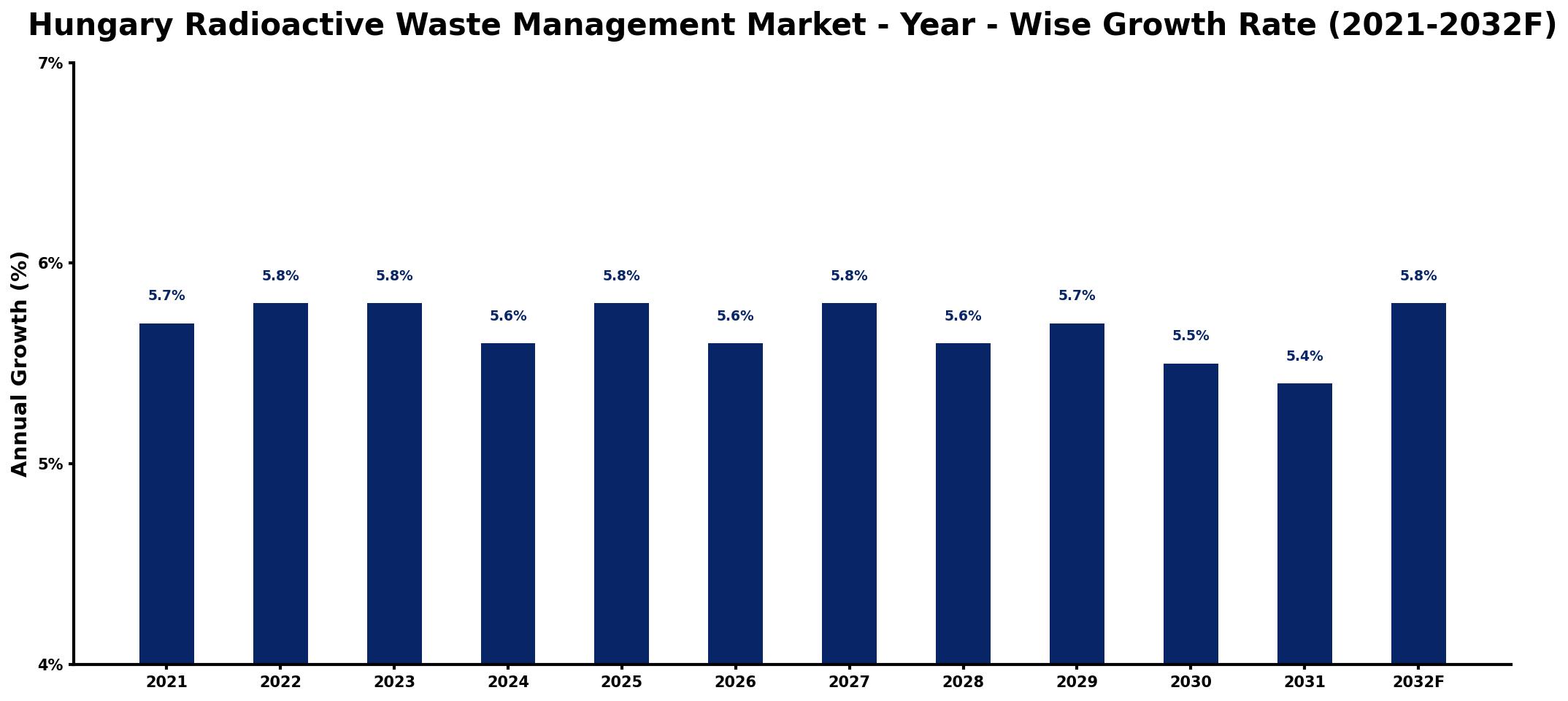
The table below presents the year‑wise growth rates along with the key drivers influencing the market
| Year | Growth Rate | Major Drivers |
| 2021 | 5.7% | Increased investments in infrastructure |
| 2022 | 5.8% | Growing public awareness initiatives |
| 2023 | 5.8% | Expansion of regulatory frameworks |
| 2024 | 5.6% | Rising demand for safety protocols |
| 2025 | 5.8% | Technological advancements in processes |
| 2026 | 5.6% | Strengthened international cooperation agreements |
| 2027 | 5.8% | Emergence of new industry players |
| 2028 | 5.6% | Enhanced environmental protection policies |
| 2029 | 5.7% | Higher funding for research projects |
| 2030 | 5.5% | Boosted community engagement programs |
| 2031 | 5.4% | Wider adoption of best practices |
| 2032 | 5.8% | Increased collaboration with stakeholders |
Note: Market size estimations and growth projections presented in this report are based on 6Wresearch's proprietary forecasting methodology, utilizing the latest available industry data, government publications, and primary research inputs.
Hungary Radioactive Waste Management Market Synopsis
The management of radioactive waste in Hungary is becoming increasingly critical as the country continues to rely on nuclear power for a significant portion of its energy needs. Radioactive waste generated from various sources, including medical and industrial applications, necessitates meticulous planning and execution of safety protocols to mitigate health risks and environmental impacts.
Current practices in the Hungary Radioactive Waste Management Market emphasize safe handling, effective transportation, and secure disposal methods. As a result, stakeholders are actively seeking advanced technologies and innovative solutions to address the complexities of waste management while fostering public trust and acceptance.
Hungary Radioactive Waste Management Market Key Takeaways
- Significant projected growth driven by the expansion of nuclear energy and stringent regulatory frameworks.
- Emphasis on technological advancements to ensure safety and compliance in waste handling practices.
- Growing demand for sustainable waste management solutions to address public and environmental concerns.
- Focus on fostering public acceptance through transparency and effective communication strategies.
- Continuous need for investment in infrastructure and research for long-term waste disposal solutions.
Evaluation of Restraints in Hungary Radioactive Waste Management Market
Despite the promising growth outlook, the Hungary Radioactive Waste Management Market faces certain restraints that could impede its progress. Public perception remains a significant barrier, as communities often exhibit reluctance towards local waste management facilities. Furthermore, maintaining compliance with evolving regulatory standards poses challenges for industry players. The long-term storage of radioactive materials also raises concerns, necessitating innovative solutions to ensure safety and sustainability. These factors create a complex landscape that stakeholders must navigate effectively to foster growth in the market.
Hungary Radioactive Waste Management Market Trends
Recent trends in the Hungary Radioactive Waste Management Market highlight a shift towards adopting advanced technologies, such as remote monitoring and automation, to enhance operational efficiency and safety. Furthermore, there is a growing emphasis on developing circular economy models, which aim to minimize waste generation and optimize resource utilization. Stakeholders are increasingly collaborating with research institutions to innovate sustainable waste processing methods, demonstrating a commitment to addressing both environmental and regulatory demands.
Hungary Radioactive Waste Management Market Opportunities
Opportunities for growth within the Hungary Radioactive Waste Management Market abound, particularly in the development of comprehensive waste treatment facilities. With increasing investments in nuclear energy, there is a pressing need for solutions that facilitate the safe and efficient processing of radioactive materials. Additionally, advancements in waste recycling technologies present avenues for reducing disposal volume while recovering valuable resources, aligning with global sustainability efforts. The potential for international collaboration on waste management practices also offers unique growth prospects for local stakeholders.
Government Initiatives in the Hungary Radioactive Waste Management Market
The Hungarian government plays a crucial role in shaping the radioactive waste management landscape through comprehensive regulations and policies. These regulations are designed to ensure the safe handling, transportation, and disposal of radioactive materials, focusing on public health and environmental safety. Public spending on infrastructure for waste management is expected to increase, alongside initiatives aimed at enhancing public awareness and engagement in nuclear safety practices. Ongoing governmental programs are geared towards fostering innovation and accountability in waste management practices.
Future Insights of the Hungary Radioactive Waste Management Market
Looking ahead to the period between 2026 and 2032, the Hungary Radioactive Waste Management Market is poised for robust development. As the nuclear sector expands, there will be an increased focus on creating resilient waste management infrastructures that can withstand future challenges. The integration of cutting-edge technology for waste processing and monitoring is likely to enhance safety and efficiency. Moreover, ongoing dialogue with the public regarding waste management initiatives will be critical in ensuring acceptance and compliance. Overall, the market is set to navigate complexities while tapping into opportunities that promote sustainability and innovation.
Hungary Radioactive Waste Management Market Latest Developments (2025 - 2026)
In recent months, the Hungary Radioactive Waste Management Market has witnessed several significant developments. Stakeholders are increasingly focusing on enhancing infrastructure capabilities, with a particular emphasis on long-term storage solutions. Collaborative research initiatives between governmental bodies and academic institutions are emerging, aimed at improving waste processing technologies. Furthermore, public awareness campaigns are being launched to foster understanding of radioactive waste management practices and the importance of safety measures in ensuring community well-being.
Hungary Radioactive Waste Management Market - Key Attractiveness of the Report
- 10 Years of Market Numbers
- Historical Data Starting from 2022 to 2025
- Base Year: 2025
- Forecast Data until 2032
- Key Performance Indicators Impacting the Market
- Major Upcoming Developments and Projects
Key Highlights of the Report:
- Hungary Radioactive Waste Management Market Outlook
- Market Size of Hungary Radioactive Waste Management Market, 2025
- Forecast of Hungary Radioactive Waste Management Market, 2032
- Historical Data and Forecast of Hungary Radioactive Waste Management Revenues & Volume for the Period 2022-2032F
- Hungary Radioactive Waste Management Market Trend Evolution
- Hungary Radioactive Waste Management Market Drivers and Challenges
- Hungary Radioactive Waste Management Price Trends
- Hungary Radioactive Waste Management Porter's Five Forces
- Hungary Radioactive Waste Management Industry Life Cycle
- Historical Data and Forecast of Hungary Radioactive Waste Management Market Revenues & Volume By Type for the Period 2022-2032F
- Historical Data and Forecast of Hungary Radioactive Waste Management Market Revenues & Volume By Exempt Waste and Very Low-Level Waste(VLLW) for the Period 2022-2032F
- Historical Data and Forecast of Hungary Radioactive Waste Management Market Revenues & Volume By Low-Level Waste(LLW) for the Period 2022-2032F
- Historical Data and Forecast of Hungary Radioactive Waste Management Market Revenues & Volume By Intermediate-Level Waste(ILW) for the Period 2022-2032F
- Historical Data and Forecast of Hungary Radioactive Waste Management Market Revenues & Volume By High-Level Waste(HLW) for the Period 2022-2032F
- Historical Data and Forecast of Hungary Radioactive Waste Management Market Revenues & Volume By Application for the Period 2022-2032F
- Historical Data and Forecast of Hungary Radioactive Waste Management Market Revenues & Volume By Industrial for the Period 2022-2032F
- Historical Data and Forecast of Hungary Radioactive Waste Management Market Revenues & Volume By Utility for the Period 2022-2032F
- Hungary Radioactive Waste Management Import Export Trade Statistics
- Market Opportunity Assessment By Type
- Market Opportunity Assessment By Application
- Hungary Radioactive Waste Management Top Companies Market Share
- Hungary Radioactive Waste Management Competitive Benchmarking By Technical and Operational Parameters
- Hungary Radioactive Waste Management Company Profiles
- Hungary Radioactive Waste Management Key Strategic Recommendations






































