Hungary Railway Platform Security Market Size & Growth Rate (2026-2032)
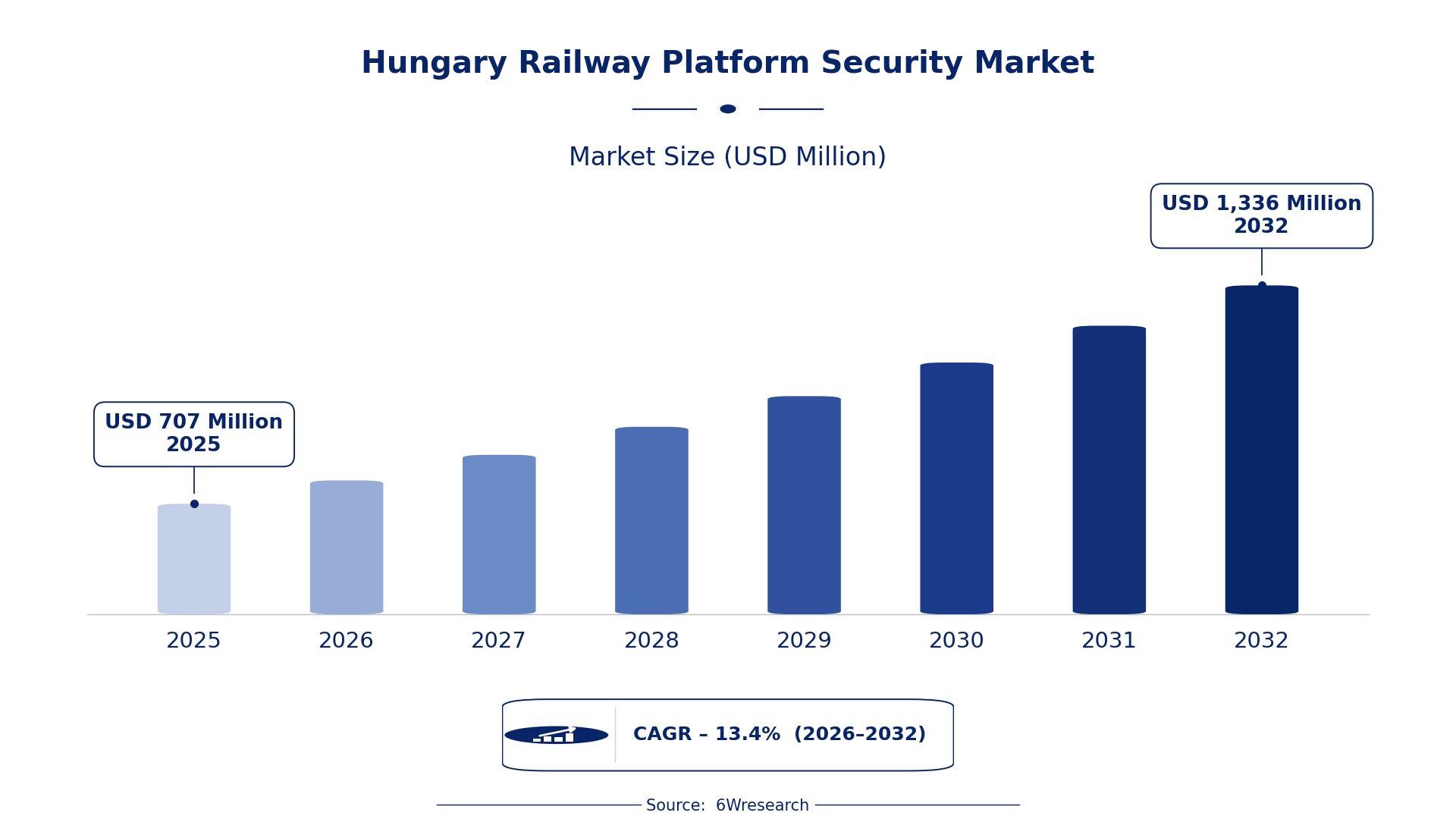
The Hungary Railway Platform Security Market was estimated at USD 707 Million in 2025 and is projected to reach USD 1336 Million by 2032, growing at a CAGR of 13.4% from 2026 to 2032.
Hungary Railway Platform Security Market Synopsis
The increasing concerns regarding public safety and the threat of terrorism are driving demand for sophisticated security solutions across Hungary's railway platforms. Operators are now prioritizing the integration of advanced technologies such as AI-driven surveillance and biometric access control systems to enhance passenger safety and deter criminal activities.
In response to these pressures, the market is witnessing a surge in investment from both public and private sectors. This investment is directed towards modernizing existing security frameworks, thereby creating a conducive environment for innovative solutions that address both physical and digital security challenges within the railway sector.
Hungary Railway Platform Security Market Year-wise Growth Rate and Key Drivers
This graph illustrates the annual growth rates of the Hungary Railway Platform Security Market from 2021 to 2032, highlighting a steady upward trajectory and projected expansion over the forecast period.
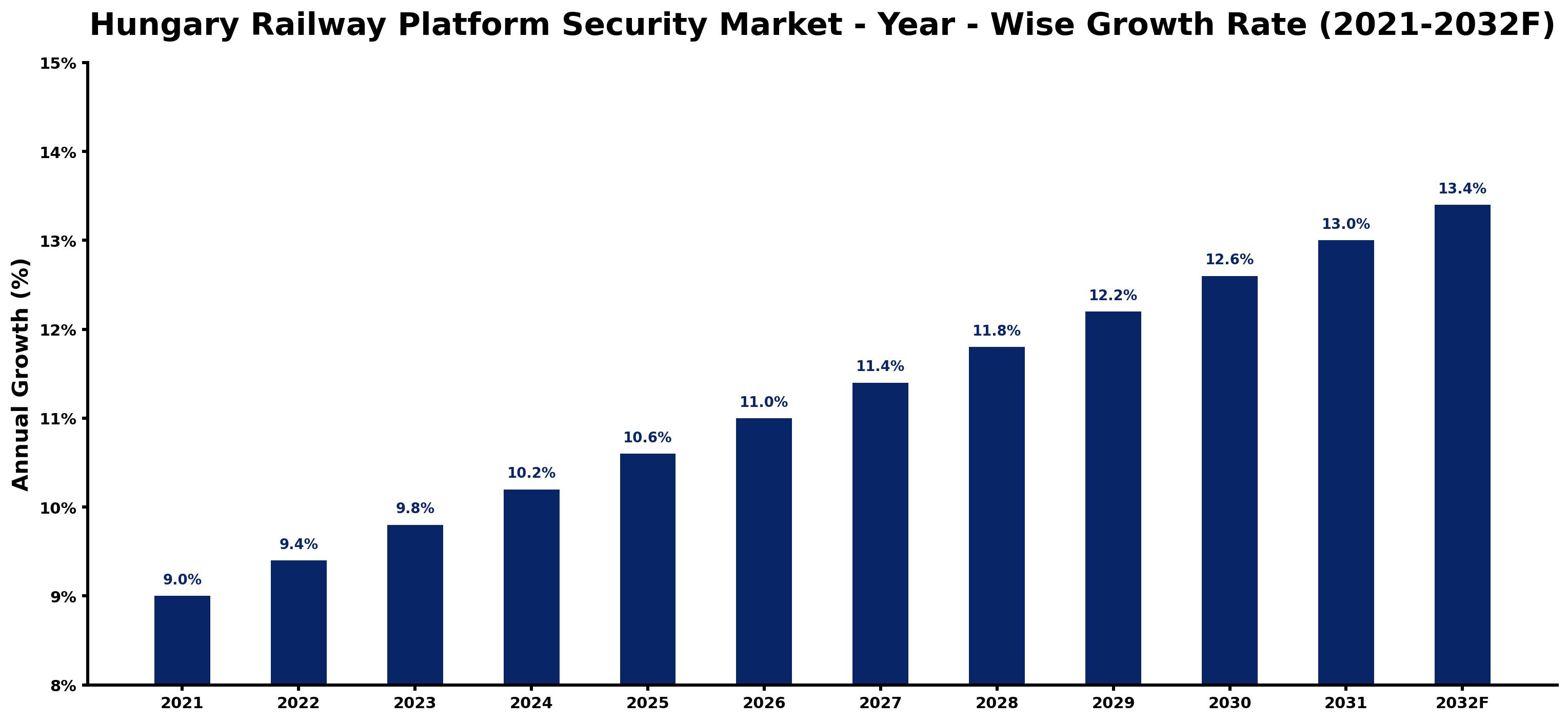
The table below presents the year‑wise growth rates along with the key drivers influencing the market
| Year | Growth Rate | Major Drivers |
| 2021 | 9.0% | Hungarian Railways modernization plans prioritize comprehensive security measures. |
| 2022 | 9.4% | Increased EU funding for rail safety projects enhances investments. |
| 2023 | 9.8% | Growing passenger traffic prompts demands for enhanced security systems. |
| 2024 | 10.2% | New cybersecurity regulations spur tech upgrades in rail security. |
| 2025 | 10.6% | Rise in rail-related incidents raises demand for security solutions. |
| 2026 | 11.0% | Government initiatives promote digital surveillance at railway stations. |
| 2027 | 11.4% | Focus on biometrics for ticketing boosts platform security adoption. |
| 2028 | 11.8% | Public-private partnerships strengthen investment in security infrastructure. |
| 2029 | 12.2% | Emerging threats drive innovation in railway security technologies. |
| 2030 | 12.6% | Increased public awareness of safety drives platform security upgrades. |
| 2031 | 13.0% | Support for smart railway systems amplifies demand for security tech. |
| 2032 | 13.4% | Strengthened regulations on rail transport security compel compliance upgrades. |
Note: Market size estimations and growth projections presented in this report are based on 6Wresearch's proprietary forecasting methodology, utilizing the latest available industry data, government publications, and primary research inputs.
Hungary Railway Platform Security Market Key Takeaways
Below are some of the specific key takeaways from the market, including:
- Growing demand for integrated security solutions that combine video surveillance, access control, and analytics.
- Adoption of AI-powered video analytics and facial recognition technologies to bolster security measures.
- Government mandates for enhanced safety protocols, including the installation of CCTV cameras and metal detectors.
- Focus on cybersecurity solutions to protect against digital threats affecting railway platforms.
- Increased investment in modernizing railway infrastructure to ensure passenger safety and operational efficiency.
Evaluation of Restraints in Hungary Railway Platform Security Market
Despite the positive outlook, the Hungary Railway Platform Security Market is grappling with several key limitations. One major challenge is the inadequate funding for comprehensive security upgrades, which hinders railway operators from implementing state-of-the-art systems. The geographical spread of railway platforms across the country complicates the establishment of uniform security standards. Additionally, the integration of new technologies into existing infrastructures demands significant investment and careful planning, which can be daunting for many operators.
Hungary Railway Platform Security Market Trends
The market is currently witnessing a notable trend towards the adoption of integrated security systems. These systems merge various technologies such as video surveillance, access control, and analytics to provide comprehensive protection against emerging security threats. on top of that, the growing emphasis on passenger experience is prompting operators to implement advanced technologies that not only enhance security but also improve service delivery.
AI and machine learning are increasingly being employed to analyze real-time data from surveillance systems, allowing for proactive responses to potential threats. As the railway sector modernizes, a parallel focus on cybersecurity is also emerging, addressing the need to safeguard digital infrastructures from potential breaches.
Hungary Railway Platform Security Market Opportunities
Significant opportunities lie in advanced security technologies. The implementation of AI-driven analytics and facial recognition systems is set to redefine security protocols at railway platforms. Additionally, the growing trend towards smart transportation systems offers an avenue for innovative security solutions that cater to modern passenger needs. With government initiatives prioritizing infrastructure safety, companies that invest in cutting-edge technologies are likely to reap substantial rewards in the evolving market.
Government Initiatives in the Hungary Railway Platform Security Market
The Hungarian government is taking decisive steps to bolster security across railway platforms, recognizing the critical role of public safety in transportation. With a series of policies aimed at enhancing security measures, the government is not only addressing immediate threats but also laying the groundwork for a safer future in railway transport. These initiatives reflect a commitment to aligning with international security standards while ensuring the safety of passengers and infrastructure.
- A recently completed initiative mandated the installation of CCTV cameras at all major railway stations to enhance surveillance and monitoring.
- Current efforts involve regular security patrols by trained personnel, aimed at deterring potential criminal activity and ensuring a visible security presence.
- Planned regulations will introduce metal detectors and X-ray scanners at key railway hubs to screen passengers and luggage for threats.
- A national digital infrastructure upgrade programme, now in its rollout phase, focuses on integrating cybersecurity measures across railway platforms.
- Upcoming policies are expected to enforce stricter access control measures, limiting unauthorized entries to ensure passenger safety.
Future Insights of the Hungary Railway Platform Security Market
Looking ahead, the Hungary Railway Platform Security Market is on a trajectory of steady growth. With ongoing investments in modernizing railway infrastructure, the demand for advanced security solutions is anticipated to rise sharply. The emphasis on integrating cutting-edge technologies will play a crucial role in addressing evolving threats, while government initiatives aimed at strengthening transportation security will further bolster market dynamics. Stakeholders who prioritize innovation and passenger safety will find ample opportunities in this expanding market.
Hungary Railway Platform Security Market Latest Developments
In recent months, the Hungary Railway Platform Security Market has seen a surge in activity as stakeholders respond to the pressing need for enhanced safety measures. With the implementation of new technologies and strategic partnerships, the sector is rapidly evolving to address both physical and cyber threats. This momentum is expected to accelerate as the government continues to push for modernization and improved security frameworks.
- A leading technology vendor launched an AI-based surveillance solution in early 2025, aimed at improving real-time monitoring capabilities across railway platforms.
- An ongoing initiative began in mid-2025, focused on upgrading existing access control systems to incorporate biometric identification technologies.
- A planned partnership between public transport authorities and private security firms is expected to enhance on-ground security measures by mid-2026.
- In Q3 2025, a major rollout of cybersecurity protocols was initiated to protect digital infrastructures associated with railway operations.
- A new pilot program set to begin in early 2026 will evaluate the effectiveness of integrated security systems across selected railway stations.
Hungary Railway Platform Security Market - Key Attractiveness of the Report
- 10 Years of Market Numbers
- Historical Data Starting from 2022 to 2025
- Base Year: 2025
- Forecast Data until 2032
- Key Performance Indicators Impacting the Market
- Major Upcoming Developments and Projects
Key Highlights of the Report:
- Hungary Railway Platform Security Market Outlook
- Market Size of Hungary Railway Platform Security Market, 2025
- Forecast of Hungary Railway Platform Security Market, 2032
- Historical Data and Forecast of Hungary Railway Platform Security Revenues & Volume for the Period 2022-2032F
- Hungary Railway Platform Security Market Trend Evolution
- Hungary Railway Platform Security Market Drivers and Challenges
- Hungary Railway Platform Security Price Trends
- Hungary Railway Platform Security Porter's Five Forces
- Hungary Railway Platform Security Industry Life Cycle
- Historical Data and Forecast of Hungary Railway Platform Security Market Revenues & Volume By Components for the Period 2022-2032F
- Historical Data and Forecast of Hungary Railway Platform Security Market Revenues & Volume By Solutions for the Period 2022-2032F
- Historical Data and Forecast of Hungary Railway Platform Security Market Revenues & Volume By Services for the Period 2022-2032F
- Historical Data and Forecast of Hungary Railway Platform Security Market Revenues & Volume By Applications for the Period 2022-2032F
- Historical Data and Forecast of Hungary Railway Platform Security Market Revenues & Volume By Subways for the Period 2022-2032F
- Historical Data and Forecast of Hungary Railway Platform Security Market Revenues & Volume By Trains for the Period 2022-2032F
- Hungary Railway Platform Security Import Export Trade Statistics
- Market Opportunity Assessment By Components
- Market Opportunity Assessment By Applications
- Hungary Railway Platform Security Top Companies Market Share
- Hungary Railway Platform Security Competitive Benchmarking By Technical and Operational Parameters
- Hungary Railway Platform Security Company Profiles
- Hungary Railway Platform Security Key Strategic Recommendations






































