Hungary Smart Airport Market Size, Share & Growth Rate
The Hungary Smart Airport Market was estimated at USD 1118 Million in 2025 and is projected to reach USD 1969 Million by 2032, growing at a CAGR of 8.4% from 2026 to 2032. This robust growth trajectory is fueled by significant investments aimed at modernizing airport facilities, alongside the increasing adoption of cutting-edge technologies designed to enrich passenger experiences and bolster operational efficiencies.
Hungary Smart Airport Market Year-wise Growth Rate and Key Drivers
This graph highlights how the Hungary Smart Airport Market has steadily grown over the years, supported by major growth factors.
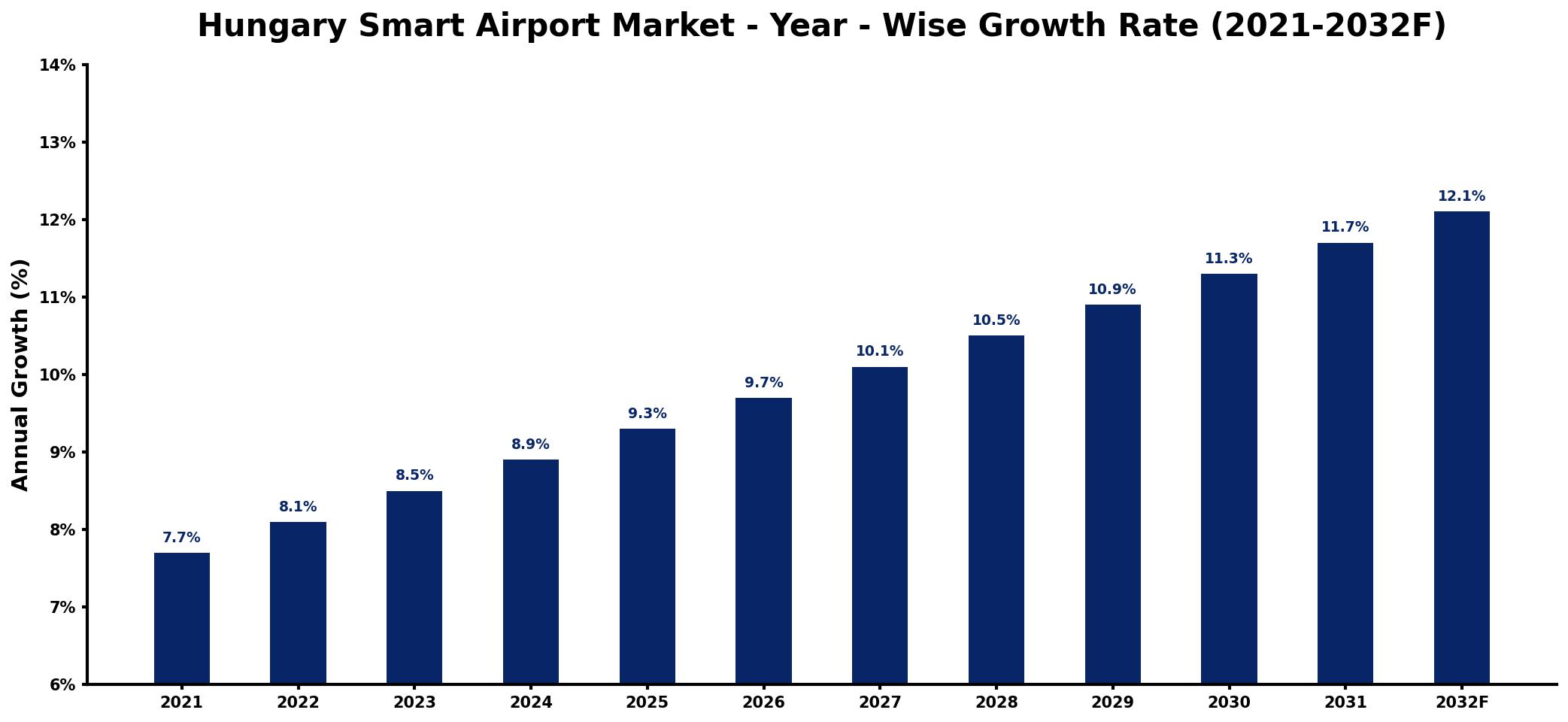
The table below presents the year‑wise growth rates along with the key drivers influencing the market
| Year | Growth Rate | Major Drivers |
| 2021 | 7.7% | Increased investment in technology |
| 2022 | 8.1% | Rising demand for automation solutions |
| 2023 | 8.5% | Expansion of digital infrastructure capabilities |
| 2024 | 8.9% | Growing focus on sustainability initiatives |
| 2025 | 9.3% | Enhanced passenger experience expectations |
| 2026 | 9.7% | Development of integrated data platforms |
| 2027 | 10.1% | Emergence of new travel trends |
| 2028 | 10.5% | rising export shipment volumes |
| 2029 | 10.9% | Adoption of advanced security measures |
| 2030 | 11.3% | Integration of IoT applications |
| 2031 | 11.7% | Shift towards contactless solutions |
| 2032 | 12.1% | Increased emphasis on operational efficiency |
Note: Market size estimations and growth projections presented in this report are based on 6Wresearch's proprietary forecasting methodology, utilizing the latest available industry data, government publications, and primary research inputs.
Hungary Smart Airport Market Synopsis
Currently, Hungary is actively embracing the transformation of its airport infrastructure into smart facilities that integrate advanced technologies. This shift is marked by initiatives focused on biometric systems, automated check-ins, and enhanced passenger information services, which are reshaping the travel experience for both domestic and international passengers.
Moreover, there is a palpable push towards sustainability within the Hungary Smart Airport Market. As airports modernize, they are increasingly incorporating energy-efficient systems and green technologies that not only minimize their carbon footprint but also optimize operational costs. This dual focus on efficiency and sustainability is paving the way for innovations in airport management.
Hungary Smart Airport Market Key Takeaways
- The market is witnessing significant growth due to rising investments in smart technologies and infrastructure.
- Advanced solutions such as biometrics and IoT are enhancing security and operational efficiency.
- Sustainability practices are increasingly integrated into airport operations to reduce environmental impact.
- Government support and policies are facilitating the development of smart airports in Hungary.
- Investment opportunities abound in areas such as digital passenger services and energy-efficient systems.
Evaluation of Restraints in Hungary Smart Airport Market
Despite the promising outlook, several key restraints hinder the Hungary Smart Airport Market. Notably, the substantial capital investment required for infrastructure upgrades poses a significant challenge for stakeholders. Additionally, concerns regarding data security and passenger privacy are paramount, as the adoption of advanced technologies leads to the collection of vast amounts of personal information. Furthermore, integrating diverse systems effectively to ensure seamless airport operations remains a complex undertaking, requiring skilled personnel and robust training programs.
Hungary Smart Airport Market Trends
The landscape of the Hungary Smart Airport Market is increasingly shaped by the implementation of innovative technologies such as artificial intelligence and IoT devices. Smart airports are now prioritizing digital transformation to create a frictionless travel experience, with automated check-in processes and real-time passenger data applications being at the forefront. Furthermore, the adoption of eco-friendly practices, such as energy management systems, is becoming a standard, aligning with global sustainability efforts.
Hungary Smart Airport Market Opportunities
Significant growth opportunities exist in the Hungary Smart Airport Market, particularly in the sectors of smart security and digital passenger services. Investing in state-of-the-art security solutions, including AI-driven surveillance and biometric technology, will greatly enhance both safety and efficiency. Additionally, the shift towards enhancing passenger experience through mobile applications and self-service options presents a valuable avenue for investment. Sustainable infrastructure development also represents a critical growth area, aligning with global trends towards greener practices.
Government Initiatives in the Hungary Smart Airport Market
The Hungarian government is playing an active role in fostering the development of smart airports through various policies and initiatives. These include significant investments aimed at upgrading airport infrastructure, facilitating the adoption of advanced technologies for enhanced passenger processing and security, and promoting sustainable practices. Collaboration with industry stakeholders is also a key focus, aimed at fostering innovation and improving the travel experience, thus positioning Hungary as a regional aviation hub.
Future Insights of the Hungary Smart Airport Market
Looking ahead to 2026-2032, the Hungary Smart Airport Market is poised for robust growth, driven by the continuous modernization of airport infrastructure and the accelerating demand for smart technologies. As air passenger traffic increases and the government continues to focus on aviation sector development, the need for innovative solutions will become ever more critical. The integration of smart technologies is expected to not only enhance security but also streamline operations, ensuring that Hungarian airports remain competitive on a global scale.
Hungary Smart Airport Market Latest Developments (2025 - 2026)
Recent trends indicate that Hungarian airports are investing in cutting-edge smart technologies aimed at improving passenger experience and operational efficiency. Projects focusing on the rollout of biometric identification systems and automated baggage handling are gaining momentum, reflecting a commitment to digital transformation. Additionally, collaborations between public and private sectors are being observed, aimed at facilitating innovation and addressing sustainability challenges within the aviation industry.
Hungary Smart Airport Market - Key Attractiveness of the Report
- 10 Years of Market Numbers
- Historical Data Starting from 2022 to 2025
- Base Year: 2025
- Forecast Data until 2032
- Key Performance Indicators Impacting the Market
- Major Upcoming Developments and Projects
Key Highlights of the Report:
- Hungary Smart Airport Market Outlook
- Market Size of Hungary Smart Airport Market, 2025
- Forecast of Hungary Smart Airport Market, 2032
- Historical Data and Forecast of Hungary Smart Airport Revenues & Volume for the Period 2022-2032F
- Hungary Smart Airport Market Trend Evolution
- Hungary Smart Airport Market Drivers and Challenges
- Hungary Smart Airport Price Trends
- Hungary Smart Airport Porter's Five Forces
- Hungary Smart Airport Industry Life Cycle
- Historical Data and Forecast of Hungary Smart Airport Market Revenues & Volume By System for the Period 2022-2032F
- Historical Data and Forecast of Hungary Smart Airport Market Revenues & Volume By Communication and Network Systems for the Period 2022-2032F
- Historical Data and Forecast of Hungary Smart Airport Market Revenues & Volume By Endpoint Devices for the Period 2022-2032F
- Historical Data and Forecast of Hungary Smart Airport Market Revenues & Volume By Data Storage for the Period 2022-2032F
- Historical Data and Forecast of Hungary Smart Airport Market Revenues & Volume By Software and Solutions for the Period 2022-2032F
- Historical Data and Forecast of Hungary Smart Airport Market Revenues & Volume By End User for the Period 2022-2032F
- Historical Data and Forecast of Hungary Smart Airport Market Revenues & Volume By Implementation for the Period 2022-2032F
- Historical Data and Forecast of Hungary Smart Airport Market Revenues & Volume By Upgrades and Services for the Period 2022-2032F
- Historical Data and Forecast of Hungary Smart Airport Market Revenues & Volume By Location for the Period 2022-2032F
- Historical Data and Forecast of Hungary Smart Airport Market Revenues & Volume By Landside for the Period 2022-2032F
- Historical Data and Forecast of Hungary Smart Airport Market Revenues & Volume By Airside for the Period 2022-2032F
- Historical Data and Forecast of Hungary Smart Airport Market Revenues & Volume By Terminal Side for the Period 2022-2032F
- Hungary Smart Airport Import Export Trade Statistics
- Market Opportunity Assessment By System
- Market Opportunity Assessment By End User
- Market Opportunity Assessment By Location
- Hungary Smart Airport Top Companies Market Share
- Hungary Smart Airport Competitive Benchmarking By Technical and Operational Parameters
- Hungary Smart Airport Company Profiles
- Hungary Smart Airport Key Strategic Recommendations






































