Hungary Television Broadcasting Market Size, Share & Growth Rate
The Hungary Television Broadcasting Market was estimated at USD 437 Million in 2025 and is projected to reach USD 753 Million by 2032, growing at a CAGR of 8.1% from 2026 to 2032. This growth trajectory is propelled by the increasing demand for original localized content and the rapid adoption of digital streaming platforms. As consumers increasingly opt for on-demand viewing, traditional broadcasters are adapting by investing in innovative technologies and content strategies to capture a share of the evolving audience landscape.
Hungary Television Broadcasting Market Year-wise Growth Rate and Key Drivers
This graph highlights how the Hungary Television Broadcasting Market has steadily grown over the years, supported by major growth factors.
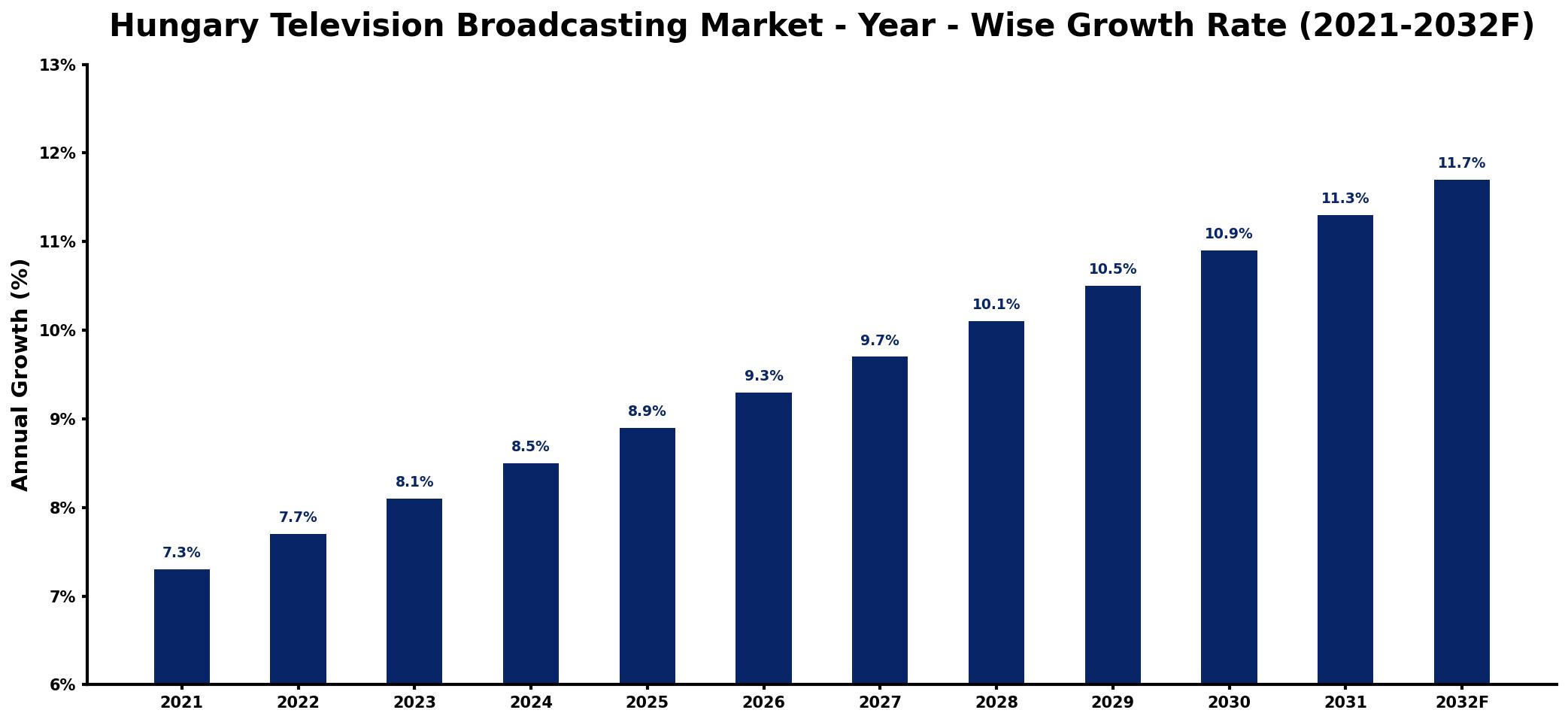
The table below presents the year‑wise growth rates along with the key drivers influencing the market
| Year | Growth Rate | Major Drivers |
| 2021 | 7.3% | Rising consumer demand for content |
| 2022 | 7.7% | Increased advertising revenue opportunities |
| 2023 | 8.1% | Growth in digital streaming platforms |
| 2024 | 8.5% | Expansion of original programming investments |
| 2025 | 8.9% | Technological advancements in production |
| 2026 | 9.3% | Higher subscription service adoption rates |
| 2027 | 9.7% | Emergence of new content creators |
| 2028 | 10.1% | Enhanced viewer engagement strategies |
| 2029 | 10.5% | Diversification of content distribution channels |
| 2030 | 10.9% | Growing interest in interactive formats |
| 2031 | 11.3% | Strengthened partnerships with advertisers |
| 2032 | 11.7% | Rising international content collaborations |
Note: Market size estimations and growth projections presented in this report are based on 6Wresearch's proprietary forecasting methodology, utilizing the latest available industry data, government publications, and primary research inputs.
Hungary Television Broadcasting Market Synopsis
The Hungarian television broadcasting landscape is marked by a vibrant mix of public and commercial entities, with a significant push towards localized programming to resonate with domestic audiences. The rising preference for high-quality, original content is prompting broadcasters to invest heavily in unique productions that cater to Hungarian tastes.
In addition, the emergence of OTT platforms is reshaping viewer habits, compelling traditional broadcasters to explore partnerships and create exclusive content that enhances their competitive edge. This dynamic interplay between traditional and digital platforms underscores the current evolution of the market.
Hungary Television Broadcasting Market Key Takeaways
- The market is experiencing significant growth due to a shift towards digital streaming and demand for localized content.
- Public broadcaster MTVA remains a strong player alongside competitive commercial channels, leading to a diverse programming landscape.
- Investment in technology upgrades is essential for traditional broadcasters to keep pace with consumer preferences.
- Regulatory frameworks continue to shape market dynamics, influencing competition and content delivery strategies.
- Innovative collaborations with digital platforms offer new pathways for audience engagement and revenue generation.
Evaluation of Restraints in Hungary Television Broadcasting Market
The Hungary Television Broadcasting Market is currently grappling with several constraints that impact its growth potential. Chief among these are the increasing competitive pressures from streaming services, which have shifted viewer preferences towards more personalized and on-demand content. Additionally, regulatory challenges, such as complex licensing requirements and the controversial media tax, present hurdles for broadcasters trying to maintain a diverse and free media landscape. This environment demands a strategic approach to both audience engagement and content monetization as companies strive to adapt.
Hungary Television Broadcasting Market Trends
A notable trend in the Hungary Television Broadcasting Market is the surging popularity of streaming services, prompting traditional broadcasters to rethink their content delivery and marketing strategies. The rise of platforms such as Netflix and local OTT services has catalyzed the creation of original Hungarian programming, reflecting a growing consumer demand for culturally relevant content. Moreover, advancements in broadcasting technology, such as enhanced streaming quality and mobile accessibility, are further shaping viewer habits and expectations.
Hungary Television Broadcasting Market Opportunities
Investment opportunities abound in the Hungary Television Broadcasting Market, particularly in the development of digital services that cater to the rising demand for on-demand content. There is also a significant potential for creating high-quality localized programming that addresses the unique preferences of Hungarian viewers. As broadcasters seek to enhance their technological infrastructure, opportunities for investment in innovations such as 4K and HDR content delivery systems are emerging. Collaborating with local creators to develop compelling narratives can further enrich the viewing experience and attract a broader audience base.
Government Initiatives in the Hungary Television Broadcasting Market
The regulatory environment for Hungarys television broadcasting market is primarily overseen by the National Media and Infocommunications Authority (NMHH), which ensures compliance with licensing and content guidelines. The framework established by the Media Act of 2010 promotes competition and diversity, although it also imposes restrictions that broadcasters must navigate. Government initiatives aim to bolster the media landscape through programs supporting local content production, while also emphasizing the importance of ethical standards and diverse programming.
Future Insights of the Hungary Television Broadcasting Market
Looking ahead to 2026-2032, the Hungary Television Broadcasting Market is poised for further transformation. The anticipated rise in digital consumption will necessitate that traditional broadcasters innovate to maintain relevance amidst fierce competition. As consumer demand shifts toward high-quality, interactive content, we can expect to see more collaborations between traditional media and digital platforms. Additionally, advancements in technology, such as the rollout of 5G networks, may enhance the viewer experience, making way for new formats and content delivery methods that could redefine the industry.
Hungary Television Broadcasting Market Latest Developments (2025 - 2026)
Recent developments in the Hungary Television Broadcasting Market indicate a strong trend towards digital transformation, with many broadcasters launching new streaming services and enhancing their digital offerings. This shift is being complemented by increased investment in original content aimed at attracting younger audiences. Additionally, there are ongoing discussions around regulatory adjustments that could facilitate greater flexibility in content distribution and advertising, reflecting the market's need to adapt to a rapidly changing media landscape.
Hungary Television Broadcasting Market - Key Attractiveness of the Report
- 10 Years of Market Numbers
- Historical Data Starting from 2022 to 2025
- Base Year: 2025
- Forecast Data until 2032
- Key Performance Indicators Impacting the Market
- Major Upcoming Developments and Projects
Key Highlights of the Report:
- Hungary Television Broadcasting Market Outlook
- Market Size of Hungary Television Broadcasting Market, 2025
- Forecast of Hungary Television Broadcasting Market, 2032
- Historical Data and Forecast of Hungary Television Broadcasting Revenues & Volume for the Period 2022-2032F
- Hungary Television Broadcasting Market Trend Evolution
- Hungary Television Broadcasting Market Drivers and Challenges
- Hungary Television Broadcasting Price Trends
- Hungary Television Broadcasting Porter's Five Forces
- Hungary Television Broadcasting Industry Life Cycle
- Historical Data and Forecast of Hungary Television Broadcasting Market Revenues & Volume By Type for the Period 2022-2032F
- Historical Data and Forecast of Hungary Television Broadcasting Market Revenues & Volume By Television Station for the Period 2022-2032F
- Historical Data and Forecast of Hungary Television Broadcasting Market Revenues & Volume By Television Network for the Period 2022-2032F
- Historical Data and Forecast of Hungary Television Broadcasting Market Revenues & Volume By Broadcaster Type for the Period 2022-2032F
- Historical Data and Forecast of Hungary Television Broadcasting Market Revenues & Volume By Public for the Period 2022-2032F
- Historical Data and Forecast of Hungary Television Broadcasting Market Revenues & Volume By Commercial for the Period 2022-2032F
- Historical Data and Forecast of Hungary Television Broadcasting Market Revenues & Volume By Revenue Source for the Period 2022-2032F
- Historical Data and Forecast of Hungary Television Broadcasting Market Revenues & Volume By Subscription-based for the Period 2022-2032F
- Historical Data and Forecast of Hungary Television Broadcasting Market Revenues & Volume By Advertisement-based for the Period 2022-2032F
- Hungary Television Broadcasting Import Export Trade Statistics
- Market Opportunity Assessment By Type
- Market Opportunity Assessment By Broadcaster Type
- Market Opportunity Assessment By Revenue Source
- Hungary Television Broadcasting Top Companies Market Share
- Hungary Television Broadcasting Competitive Benchmarking By Technical and Operational Parameters
- Hungary Television Broadcasting Company Profiles
- Hungary Television Broadcasting Key Strategic Recommendations






































