Hungary Trolley Market Size, Share & Growth Rate
The Hungary Trolley Market was estimated at USD 342 Million in 2025 and is projected to reach USD 455 Million by 2032, growing at a CAGR of 4.2% from 2026 to 2032. This positive trajectory is being fueled by the escalating demand for efficient logistical solutions, particularly in retail and e-commerce sectors, as well as the growth of airport and travel industries. The modernization of supply chains and consumer preferences for convenient shopping experiences further underpin this market's expansion.
Hungary Trolley Market Year-wise Growth Rate and Key Drivers
This graph highlights how the Hungary Trolley Market has steadily grown over the years, supported by major growth factors.
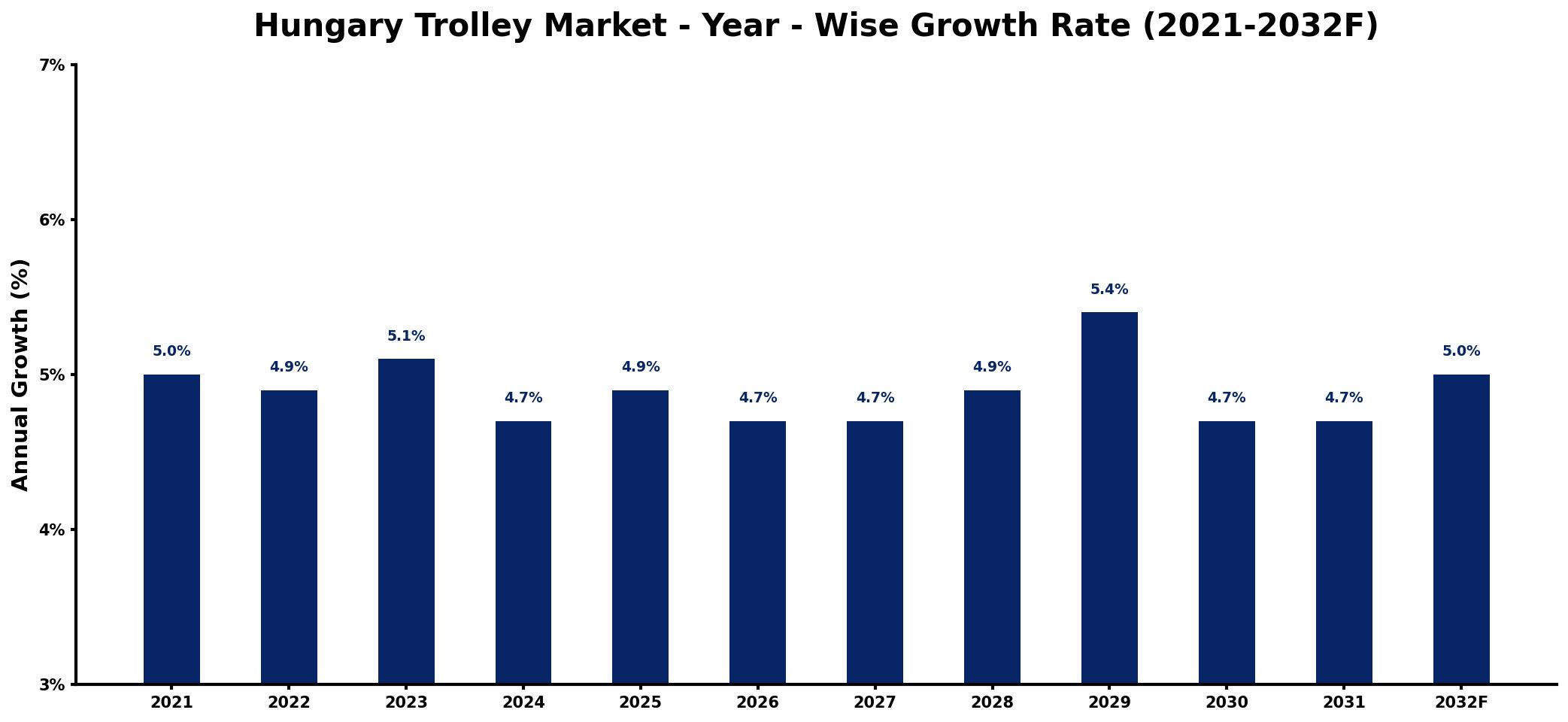
The table below presents the year‑wise growth rates along with the key drivers influencing the market
| Year | Growth Rate | Major Drivers |
| 2021 | 5.0% | Rising consumer spending on transport |
| 2022 | 4.9% | Increased urbanization and mobility |
| 2023 | 5.1% | Growing demand for eco-friendly options |
| 2024 | 4.7% | Expansion of e-commerce logistics networks |
| 2025 | 4.9% | Investment in smart transport solutions |
| 2026 | 4.7% | Increasing focus on sustainability initiatives |
| 2027 | 4.7% | Enhanced public transportation infrastructure |
| 2028 | 4.9% | expanding healthcare application demand |
| 2029 | 5.4% | Greater emphasis on convenience features |
| 2030 | 4.7% | Development of urban delivery services |
| 2031 | 4.7% | Rising popularity of rental services |
| 2032 | 5.0% | Innovations in lightweight materials technology |
Note: Market size estimations and growth projections presented in this report are based on 6Wresearch's proprietary forecasting methodology, utilizing the latest available industry data, government publications, and primary research inputs.
Hungary Trolley Market Synopsis
The most significant driving force currently shaping the Hungary Trolley Market is the rapid growth of e-commerce and retail infrastructure. As online shopping becomes increasingly popular, demand for durable and efficient material handling solutions is surging. Shopping carts and luggage trolleys have become essential tools for enhancing customer experience and operational effectiveness in various sectors.
In addition, the expansion of hypermarkets and supermarkets has propelled the need for versatile trolley solutions. These facilities require robust transportation equipment that can easily navigate their expansive layouts while meeting the ergonomic and sustainability preferences of modern consumers.
Hungary Trolley Market Key Takeaways
- The market is projected to reach USD 455 Million by 2032, reflecting a CAGR of 4.2% from 2026-2032.
- Growth is driven by advancements in the retail and e-commerce sectors, which necessitate improved logistical solutions.
- Consumer preferences are increasingly favoring trolleys that prioritize convenience, sustainability, and ergonomic design.
- Investments in modernizing logistics infrastructure are enhancing the operational efficiency of various industries.
- Government initiatives related to public transportation and urban mobility are influencing trolley market dynamics.
Evaluation of Restraints in Hungary Trolley Market
Despite the growth potential, the Hungary Trolley Market faces challenges stemming from changing consumer preferences and the presence of alternative transportation solutions. Many consumers are exploring alternatives that may offer greater convenience or align more closely with sustainability goals. As a result, manufacturers are tasked with innovating to meet these evolving demands while also ensuring that products are versatile, durable, and capable of enhancing user experience in a competitive landscape.
Hungary Trolley Market Trends
Several current and emerging trends are shaping the Hungary Trolley Market. Notably, the integration of smart technology into trolley designs is gaining traction, allowing for enhanced tracking and customer engagement features. Additionally, the focus on sustainable materials is becoming crucial as environmental awareness grows among consumers. Ergonomic designs are also being prioritized to improve user experience, particularly in retail environments where ease of use can significantly impact customer satisfaction.
Hungary Trolley Market Opportunities
The genuine growth opportunities within the Hungary Trolley Market lie in innovation and adaptability. Companies that invest in developing multifunctional trolleys equipped with technology, such as RFID tracking and enhanced maneuverability, are likely to gain competitive advantages. Furthermore, expanding into niche markets such as specialized airport trolleys and eco-friendly carts can unlock new revenue streams and appeal to a broader consumer base.
Government Initiatives in the Hungary Trolley Market
The Hungarian government is actively engaging in initiatives that influence the trolley market, particularly in urban mobility planning and public transportation standards. Investments in transportation infrastructure, including trolleybus systems, aim to enhance the efficiency of urban transit. Additionally, policies promoting accessibility and sustainability are likely to impact the design and distribution of trolleys, encouraging manufacturers to align with national goals for improved public transport services.
Future Insights of the Hungary Trolley Market
Looking ahead to 2026-2032, the Hungary Trolley Market is poised for continued growth driven by advancements in retail logistics and evolving consumer behaviors. The demand for innovative and sustainable trolley solutions will likely escalate, with companies focusing on improving ergonomics and integrating smart features into their designs. As the economy recovers and consumer spending increases, the trolley market can expect robust demand across various sectors, particularly in e-commerce and retail environments.
Hungary Trolley Market Latest Developments (2025 - 2026)
In recent months, the Hungary Trolley Market has seen significant shifts towards sustainability, with many manufacturers adopting eco-friendly materials and practices. The push for smart trolley solutions is also gaining momentum, with firms developing trolleys equipped with tracking technology to improve inventory management in retail settings. Additionally, local governments are collaborating with industry stakeholders to enhance urban mobility infrastructure, positively impacting trolley usage across public and private sectors.
Hungary Trolley Market - Key Attractiveness of the Report
- 10 Years of Market Numbers
- Historical Data Starting from 2022 to 2025
- Base Year: 2025
- Forecast Data until 2032
- Key Performance Indicators Impacting the Market
- Major Upcoming Developments and Projects
Key Highlights of the Report:
- Hungary Trolley Market Outlook
- Market Size of Hungary Trolley Market, 2025
- Forecast of Hungary Trolley Market, 2032
- Historical Data and Forecast of Hungary Trolley Revenues & Volume for the Period 2022-2032F
- Hungary Trolley Market Trend Evolution
- Hungary Trolley Market Drivers and Challenges
- Hungary Trolley Price Trends
- Hungary Trolley Porter's Five Forces
- Hungary Trolley Industry Life Cycle
- Historical Data and Forecast of Hungary Trolley Market Revenues & Volume By Product for the Period 2022-2032F
- Historical Data and Forecast of Hungary Trolley Market Revenues & Volume By Manual for the Period 2022-2032F
- Historical Data and Forecast of Hungary Trolley Market Revenues & Volume By Electric for the Period 2022-2032F
- Historical Data and Forecast of Hungary Trolley Market Revenues & Volume By Application for the Period 2022-2032F
- Historical Data and Forecast of Hungary Trolley Market Revenues & Volume By Commercial for the Period 2022-2032F
- Historical Data and Forecast of Hungary Trolley Market Revenues & Volume By Non-commercial for the Period 2022-2032F
- Historical Data and Forecast of Hungary Trolley Market Revenues & Volume By Distribution for the Period 2022-2032F
- Historical Data and Forecast of Hungary Trolley Market Revenues & Volume By Offline for the Period 2022-2032F
- Historical Data and Forecast of Hungary Trolley Market Revenues & Volume By Online for the Period 2022-2032F
- Hungary Trolley Import Export Trade Statistics
- Market Opportunity Assessment By Product
- Market Opportunity Assessment By Application
- Market Opportunity Assessment By Distribution
- Hungary Trolley Top Companies Market Share
- Hungary Trolley Competitive Benchmarking By Technical and Operational Parameters
- Hungary Trolley Company Profiles
- Hungary Trolley Key Strategic Recommendations






































