Hungary TV Analytics Market (2026-2032) Outlook | Size, Industry, Value, Revenue, Analysis, Forecast, Companies, Growth, Share & Trends
Market Forecast By TV Transmission Type (Cable TV, Satellite TV/ DTH, IPTV, Over the Top OTT), By Application (Customer Lifetime Management, Content Development, Competitive Intelligence, Campaign Management) And Competitive Landscape
| Product Code: ETC4399100 | Publication Date: Jul 2023 | Updated Date: Jul 2026 | Product Type: Report | |
| Publisher: 6Wresearch | Author: Bhawna Singh | No. of Pages: 85 | No. of Figures: 45 | No. of Tables: 25 |
Hungary TV Analytics Market Size & Growth Rate (2026-2032)
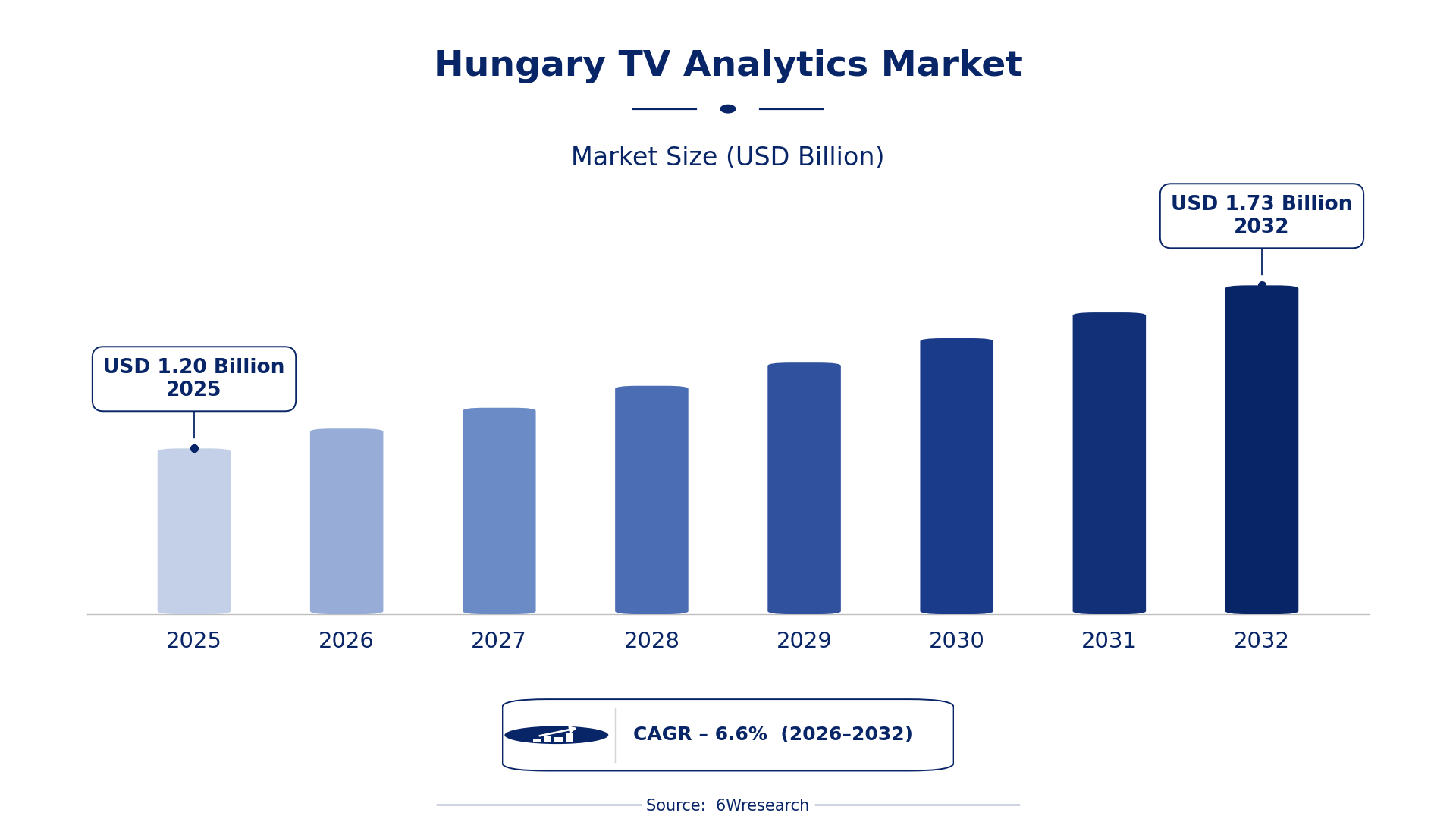
The Hungary TV Analytics Market was estimated at USD 1200 Million in 2025 and is projected to reach USD 1731 Million by 2032, growing at a CAGR of 6.3% from 2026 to 2032.
Hungary TV Analytics Market Synopsis
The Hungary TV Analytics Market has witnessed a surge in demand for data-driven insights, especially as broadcasters and advertisers increasingly rely on analytics to refine their strategies. Recent trends indicate a shift towards more sophisticated tools that capture viewer behavior across various platforms.
Looking forward, the integration of advanced technologies like AI and machine learning is set to redefine the market. As the popularity of streaming services continues to rise, analytics solutions that provide real-time insights into viewer preferences will be crucial for success.
Hungary TV Analytics Market Year-wise Growth Rate and Key Drivers
This graph highlights how the Hungary TV Analytics Market has steadily grown over the past five years, supported by major growth factors.
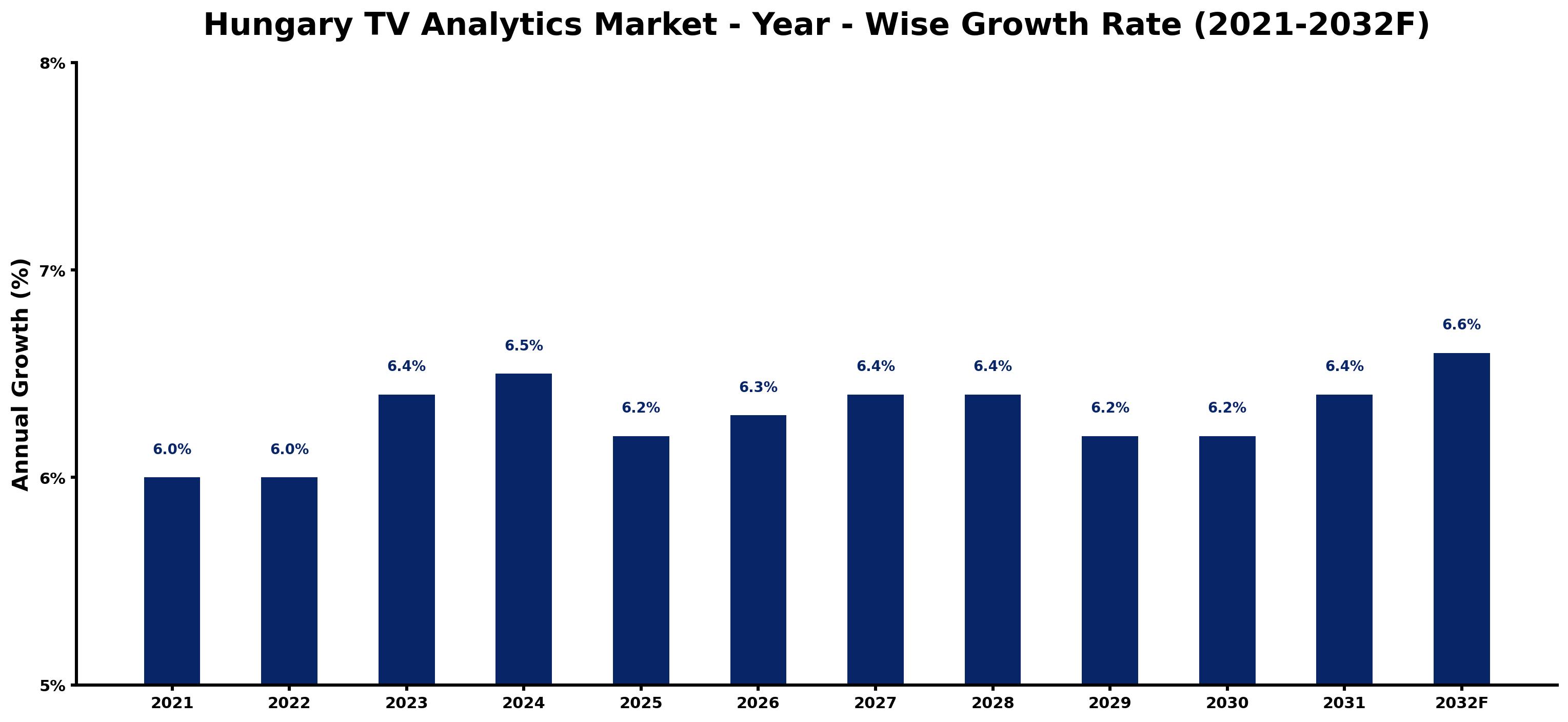
The table below presents the year‑wise growth rates along with the key drivers influencing the market
| Year | Growth Rate | Major Drivers |
| 2021 | 6.0% | Hungarian media regulations enhancing audience measurement standards |
| 2022 | 6.0% | Increased advertising spend on targeted TV campaigns |
| 2023 | 6.4% | Rise in hybrid viewing behaviors among Hungarian consumers |
| 2024 | 6.5% | Government initiatives promoting digital content analytics |
| 2025 | 6.2% | Surge in local content production boosting analytics demand |
| 2026 | 6.3% | Adoption of AI-driven data insights by broadcasters |
| 2027 | 6.4% | Growing relevance of viewer privacy regulations impacting analytics |
| 2028 | 6.4% | Consumer trend towards binge-watching influencing analytics strategies |
| 2029 | 6.2% | Advent of 5G enhancing real-time data analytics capabilities |
| 2030 | 6.2% | Focus on cross-platform advertising effectiveness driving insight needs |
| 2031 | 6.4% | Hungary's cultural events fueling interest in viewer demographics |
| 2032 | 6.6% | Emergence of data-driven partnerships among local broadcasters |
Note: Market size estimations and growth projections presented in this report are based on 6Wresearch's proprietary forecasting methodology, utilizing the latest available industry data, government publications, and primary research inputs.
Hungary TV Analytics Market Key Takeaways
Below are some of the specific key takeaways from the market, including:
- The market is expected to grow significantly, driven by the need for targeted advertising.
- Advanced analytics tools are becoming essential for understanding audience behavior and optimizing content delivery.
- Cross-platform analytics solutions are gaining traction as viewership becomes more fragmented.
- AI and machine learning are enhancing the capabilities of analytics tools, offering deeper insights.
- Government policies are shaping the market by promoting fair competition and data privacy.
Evaluation of Restraints in Hungary TV Analytics Market
Fragmentation of viewership remains a critical challenge in the Hungary TV Analytics Market. With audiences split between traditional television and a myriad of streaming services, accurately tracking viewer engagement has become increasingly complex. on top of that, data privacy regulations pose additional hurdles for analytics providers seeking to gather and utilize viewer data effectively. Staying ahead in such a rapidly changing environment demands agility and innovation from market players.
Hungary TV Analytics Market Trends
The rise of over-the-top (OTT) platforms is reshaping how analytics are utilized. Companies are now focusing on real-time data insights to adapt quickly to viewer preferences. The demand for content optimization is leading to increased investment in tools that can analyze audience reactions and engagement across various channels.
Another prominent trend is the shift toward cross-platform analytics. As viewers consume content across multiple devices, the need for comprehensive data that encompasses TV, online, and mobile viewership has become apparent. This trend indicates a growing market for solutions that can integrate these diverse data streams effectively.
Hungary TV Analytics Market Opportunities
Investment opportunities in the Hungary TV Analytics Market are abundant, particularly in the development of AI-powered tools. These solutions can enhance the accuracy of viewer engagement tracking and provide valuable insights into content consumption patterns. on top of that, the shift towards personalized advertising presents a lucrative avenue for analytics providers to develop targeted offerings that meet specific audience needs.
Companies that can deliver integrated analytics across platforms stand to gain a competitive edge. As more advertisers seek to optimize their campaigns based on detailed viewership data, the demand for comprehensive analytics services will continue to rise.
Government Initiatives in the Hungary TV Analytics Market
Government policies are instrumental in shaping the Hungary TV Analytics Market, particularly concerning data privacy and fair competition. The National Media and Infocommunications Authority (NMHH) oversees regulations that impact audience measurement practices. Current public-sector priorities include fostering innovation while ensuring compliance with data protection laws, which is crucial for market stability.
- A regulatory framework established in 2023 mandates increased transparency in audience measurement practices.
- Ongoing initiatives aim to enhance local content production, providing incentives for broadcasters to invest in domestic programming.
- A national digital infrastructure upgrade program is currently underway, expected to improve data collection methods for analytics.
- Upcoming legislation planned for 2026 focuses on strengthening consumer data protection in the context of analytics.
Future Insights of the Hungary TV Analytics Market
The Hungary TV Analytics Market is set for considerable growth as the demand for data-driven insights intensifies. The increasing prevalence of digital platforms and streaming services necessitates sophisticated analytics solutions capable of delivering actionable insights. As broadcasters and advertisers strive to enhance viewer engagement and measure campaign effectiveness, the market is likely to see a surge in the adoption of advanced analytics tools.
Technological advancements will play a pivotal role in this growth, particularly through AI and machine learning, enabling more nuanced analysis and predictive capabilities. The overall outlook for the market points towards a dynamic environment where innovation and adaptability will be essential for success.
Hungary TV Analytics Market Latest Developments
In the past year, the Hungary TV Analytics Market has seen significant advancements, particularly in the integration of AI technologies. These developments are aimed at enhancing the capabilities of analytics tools, allowing for more precise audience measurement and engagement tracking. As competition intensifies, companies are increasingly focused on innovating their product offerings to meet evolving market demands.
- A new analytics platform launched in Q2 2025 has begun to integrate real-time data processing capabilities.
- By early 2026, a major technology vendor plans to introduce an AI-driven tool designed to optimize ad targeting across multiple platforms.
- An initiative that started in late 2025 aims to improve audience measurement accuracy through enhanced data sharing agreements among broadcasters.
- Upcoming partnerships are expected to be announced in mid-2026, focusing on cross-platform analytics integration.
Hungary TV Analytics Market - Key Attractiveness of the Report
- 10 Years of Market Numbers
- Historical Data Starting from 2022 to 2025
- Base Year: 2025
- Forecast Data until 2032
- Key Performance Indicators Impacting the Market
- Major Upcoming Developments and Projects
Key Highlights of the Report:
- Hungary TV Analytics Market Outlook
- Market Size of Hungary TV Analytics Market, 2025
- Forecast of Hungary TV Analytics Market, 2032
- Historical Data and Forecast of Hungary TV Analytics Revenues & Volume for the Period 2022-2032F
- Hungary TV Analytics Market Trend Evolution
- Hungary TV Analytics Market Drivers and Challenges
- Hungary TV Analytics Price Trends
- Hungary TV Analytics Porter's Five Forces
- Hungary TV Analytics Industry Life Cycle
- Historical Data and Forecast of Hungary TV Analytics Market Revenues & Volume By TV Transmission Type for the Period 2022-2032F
- Historical Data and Forecast of Hungary TV Analytics Market Revenues & Volume By Cable TV for the Period 2022-2032F
- Historical Data and Forecast of Hungary TV Analytics Market Revenues & Volume By Satellite TV/ DTH for the Period 2022-2032F
- Historical Data and Forecast of Hungary TV Analytics Market Revenues & Volume By IPTV for the Period 2022-2032F
- Historical Data and Forecast of Hungary TV Analytics Market Revenues & Volume By Over the Top OTT for the Period 2022-2032F
- Historical Data and Forecast of Hungary TV Analytics Market Revenues & Volume By Application for the Period 2022-2032F
- Historical Data and Forecast of Hungary TV Analytics Market Revenues & Volume By Customer Lifetime Management for the Period 2022-2032F
- Historical Data and Forecast of Hungary TV Analytics Market Revenues & Volume By Content Development for the Period 2022-2032F
- Historical Data and Forecast of Hungary TV Analytics Market Revenues & Volume By Competitive Intelligence for the Period 2022-2032F
- Historical Data and Forecast of Hungary TV Analytics Market Revenues & Volume By Campaign Management for the Period 2022-2032F
- Hungary TV Analytics Import Export Trade Statistics
- Market Opportunity Assessment By TV Transmission Type
- Market Opportunity Assessment By Application
- Hungary TV Analytics Top Companies Market Share
- Hungary TV Analytics Competitive Benchmarking By Technical and Operational Parameters
- Hungary TV Analytics Company Profiles
- Hungary TV Analytics Key Strategic Recommendations
Frequently Asked Questions About the Market Study (FAQs):
The market was estimated at USD 1200 Million in 2025 and is projected to reach USD 1731 Million by 2032, growing at a CAGR of 6.3% from 2026 to 2032.
Advertisers are leveraging TV analytics to optimize their campaigns by gaining insights into viewer preferences and behaviors, enabling more targeted and effective advertising strategies.
Government regulation, particularly by the NMHH, ensures compliance with data privacy laws and promotes fair competition among broadcasters, which is essential for maintaining market integrity.
The integration of AI and machine learning technologies is transforming the market, enabling more sophisticated analytics capabilities and real-time insights into viewer behavior.
Key challenges include the fragmentation of viewership across multiple platforms and the need to comply with stringent data privacy regulations, which complicate the collection and analysis of viewer data.
6Wresearch actively monitors the Hungary TV Analytics Market and publishes its comprehensive annual report, highlighting emerging trends, growth drivers, revenue analysis, and forecast outlook. Our insights help businesses to make data-backed strategic decisions with ongoing market dynamics. Our analysts track relevent industries related to the Hungary TV Analytics Market, allowing our clients with actionable intelligence and reliable forecasts tailored to emerging regional needs.
Yes, we provide customisation as per your requirements. To learn more, feel free to contact us on sales@6wresearch.com
1 Executive Summary |
2 Introduction |
2.1 Key Highlights of the Report |
2.2 Report Description |
2.3 Market Scope & Segmentation |
2.4 Research Methodology |
2.5 Assumptions |
3 Hungary TV Analytics Market Overview |
3.1 Hungary Country Macro Economic Indicators |
3.2 Hungary TV Analytics Market Revenues & Volume, 2022 & 2032F |
3.3 Hungary TV Analytics Market - Industry Life Cycle |
3.4 Hungary TV Analytics Market - Porter's Five Forces |
3.5 Hungary TV Analytics Market Revenues & Volume Share, By TV Transmission Type , 2022 & 2032F |
3.6 Hungary TV Analytics Market Revenues & Volume Share, By Application , 2022 & 2032F |
4 Hungary TV Analytics Market Dynamics |
4.1 Impact Analysis |
4.2 Market Drivers |
4.2.1 Increasing demand for personalized content and targeted advertising on TV platforms |
4.2.2 Growing adoption of advanced analytics technologies for improving audience engagement and retention |
4.2.3 Rising investments in digital marketing and advertising strategies by companies in Hungary |
4.3 Market Restraints |
4.3.1 Lack of standardized metrics and measurement tools for TV analytics in Hungary |
4.3.2 Data privacy concerns and regulations impacting the collection and analysis of viewer data |
4.3.3 High implementation costs and complexity associated with deploying TV analytics solutions |
5 Hungary TV Analytics Market Trends |
6 Hungary TV Analytics Market, By Types |
6.1 Hungary TV Analytics Market, By TV Transmission Type |
6.1.1 Overview and Analysis |
6.1.2 Hungary TV Analytics Market Revenues & Volume, By TV Transmission Type , 2022-2032F |
6.1.3 Hungary TV Analytics Market Revenues & Volume, By Cable TV, 2022-2032F |
6.1.4 Hungary TV Analytics Market Revenues & Volume, By Satellite TV/ DTH, 2022-2032F |
6.1.5 Hungary TV Analytics Market Revenues & Volume, By IPTV, 2022-2032F |
6.1.6 Hungary TV Analytics Market Revenues & Volume, By Over the Top OTT, 2022-2032F |
6.2 Hungary TV Analytics Market, By Application |
6.2.1 Overview and Analysis |
6.2.2 Hungary TV Analytics Market Revenues & Volume, By Customer Lifetime Management, 2022-2032F |
6.2.3 Hungary TV Analytics Market Revenues & Volume, By Content Development, 2022-2032F |
6.2.4 Hungary TV Analytics Market Revenues & Volume, By Competitive Intelligence, 2022-2032F |
6.2.6 Hungary TV Analytics Market Revenues & Volume, By Campaign Management, 2022-2032F |
7 Hungary TV Analytics Market Import-Export Trade Statistics |
7.1 Hungary TV Analytics Market Export to Major Countries |
7.2 Hungary TV Analytics Market Imports from Major Countries |
8 Hungary TV Analytics Market Key Performance Indicators |
8.1 Average viewer engagement time per TV program |
8.2 Percentage increase in ad click-through rates after implementing analytics insights |
8.3 Number of TV channels and platforms adopting advanced analytics tools for content optimization |
9 Hungary TV Analytics Market - Opportunity Assessment |
9.1 Hungary TV Analytics Market Opportunity Assessment, By TV Transmission Type , 2022 & 2032F |
9.2 Hungary TV Analytics Market Opportunity Assessment, By Application , 2022 & 2032F |
10 Hungary TV Analytics Market - Competitive Landscape |
10.1 Hungary TV Analytics Market Revenue Share, By Companies, 2025 |
10.2 Hungary TV Analytics Market Competitive Benchmarking, By Operating and Technical Parameters |
11 Company Profiles |
12 Recommendations |
13 Disclaimer |
Global Go To Market Strategy - 2030
Export potential enables firms to identify high-growth global markets with greater confidence by combining advanced trade intelligence with a structured quantitative methodology. The framework analyzes emerging demand trends and country-level import patterns while integrating macroeconomic and trade datasets such as GDP and population forecasts, bilateral import–export flows, tariff structures, elasticity differentials between developed and developing economies, geographic distance, and import demand projections. Using weighted trade values from 2020–2024 as the base period to project country-to-country export potential for 2030, these inputs are operationalized through calculated drivers such as gravity model parameters, tariff impact factors, and projected GDP per-capita growth. Through an analysis of hidden potentials, demand hotspots, and market conditions that are most favorable to success, this method enables firms to focus on target countries, maximize returns, and global expansion with data, backed by accuracy.
By factoring in the projected importer demand gap that is currently unmet and could be potential opportunity, it identifies the potential for the Exporter (Country) among 190 countries, against the general trade analysis, which identifies the biggest importer or exporter.
To discover high-growth global markets and optimize your business strategy:
Click Here
Pricing
- Single User License$ 1,995
- Department License$ 2,400
- Site License$ 3,120
- Global License$ 3,795

Leadership Perspectives from Industry Events
Search
6Wresearch in the News
 Forbes
Citing 6Wresearch analytics to map global infrastructure and pharmaceutical industry trajectories.
 Bloomberg Law
Direct syndication of 6Wresearch's macro data points, capturing complex supply chain shifts.
 Reuters
Tracking industrial manufacturing adjustments and electronic security ecosystem scaling.
 Mint
Mint
Utilizing deep-tech sector market sizing to analyze global automation and robotics.
 The Economic Times
Anchoring features on industrial IoT growth metrics and connected smart-grid devices.
 Business Standard
Featuring strategic evaluations of Advanced Driver Assistance Systems (ADAS) and AI road safety.
 The Hindu
Spotlighting core commercial metrics ranging from unmanned aerial vehicles (UAVs) to consumer durables.
 Financial Express
Anchoring quarterly reviews on cross-border real estate tech and structural hardware manufacturing.
 Yahoo Finance
Syndicating the tracker's $30.1 billion untapped-market findings, spotlighting Japan, the US and China as India's top new-potential importers.
 India Today
Carrying the release on smartphones leading India's export potential to $94 billion by 2031, per 6WExportGTM data.
 Dailyhunt
Distributing the tracker findings to its regional readership, framing India's export diversification into Japan and Mexico.
 PR Newswire Original release
Publishing the full India Export Attractiveness Tracker 2026, detailing new trade corridors across iron ore, LCVs and pharmaceuticals.
 The Industrial
Highlighting the tracker's read on India's semiconductor ambitions and long-term chip-assembly export potential.
 PTI News
Reporting on the $66.81 billion pharmaceuticals export opportunity flagged in the tracker, amid looming US generic-drug tariffs.
 Tribune India
Covering the tracker's tariff-versus-regulation analysis across India's mature export markets in the US, China and UAE.
 ANI News
Amplifying the report's findings on polished diamonds, refined petroleum and medicines as India's core export engines.
 International Business Magazine
Covering the report's insight into how AEB, blind spot detection, and driver monitoring are reshaping India's ADAS market.
 Focus Gaming News
Highlighting the research forecast for Egypt's gambling market, projecting steady growth through 2032.
Thought Leadership and Analyst Meet





Our Clients








Latest Reports
- Poland Engine Ignition Components Market (2026-2032)
- Peru Engine Ignition Components Market (2026-2032)
- Pakistan Engine Ignition Components Market (2026-2032)
- Oman Engine Ignition Components Market (2026-2032)
- Nigeria Engine Ignition Components Market (2026-2032)
- Nepal Engine Ignition Components Market (2026-2032)
- Myanmar Engine Ignition Components Market (2026-2032)
- Morocco Engine Ignition Components Market (2026-2032)
- Mexico Engine Ignition Components Market (2026-2032)
- Malaysia Engine Ignition Components Market (2026-2032)
Industry Events and Analyst Meet

EV India Expo 2026

HIMTEX 2026

India Refining Summit 2026

India EV Show 2026

EV tech India Expo 2026
Whitepaper
- Middle East & Africa Commercial Security Market Click here to view more.
- Middle East & Africa Fire Safety Systems & Equipment Market Click here to view more.
- GCC Drone Market Click here to view more.
- Middle East Lighting Fixture Market Click here to view more.
- GCC Physical & Perimeter Security Market Click here to view more.


