Hungary Ultrasonic Cleaning Equipment Market Size, Share & Growth Rate
The Hungary Ultrasonic Cleaning Equipment Market was estimated at USD 1393 Million in 2025 and is projected to reach USD 1994 Million by 2032, growing at a CAGR of 5.3% from 2026 to 2032. This positive trajectory is primarily driven by the increasing demand for precision cleaning across various sectors, including automotive and healthcare, where strict quality control is paramount. Additionally, the ongoing advancements in ultrasonic technology, coupled with a growing emphasis on environmentally friendly cleaning processes, are further propelling the market forward.
Hungary Ultrasonic Cleaning Equipment Market Growth Rate Analysis (2021-2032)
The Hungarian ultrasonic cleaning equipment market has shown a stable growth pattern over the last few years. With a notable increase of 6.2% in 2021, growth slightly moderated to 5.8% in 2022. However, demand surged again to 6.0% in 2023, driven by advancements in industrial cleaning technologies and a heightened focus on sustainability within various sectors, including automotive and healthcare. The anticipated growth of 6.1% in 2024 and continued expansions through 2029, peaking at 6.5% in 2030, reflects both rising consumer demand for efficient cleaning solutions and ongoing investments in infrastructure upgrades. This upward trend signifies a robust adaptation to energy-efficient practices and digitalization in manufacturing processes.
Hungary Ultrasonic Cleaning Equipment Market Year-wise Growth Rate and Key Drivers
This graph highlights how the Hungary Ultrasonic Cleaning Equipment Market has steadily grown over the past five years, supported by major growth factors.
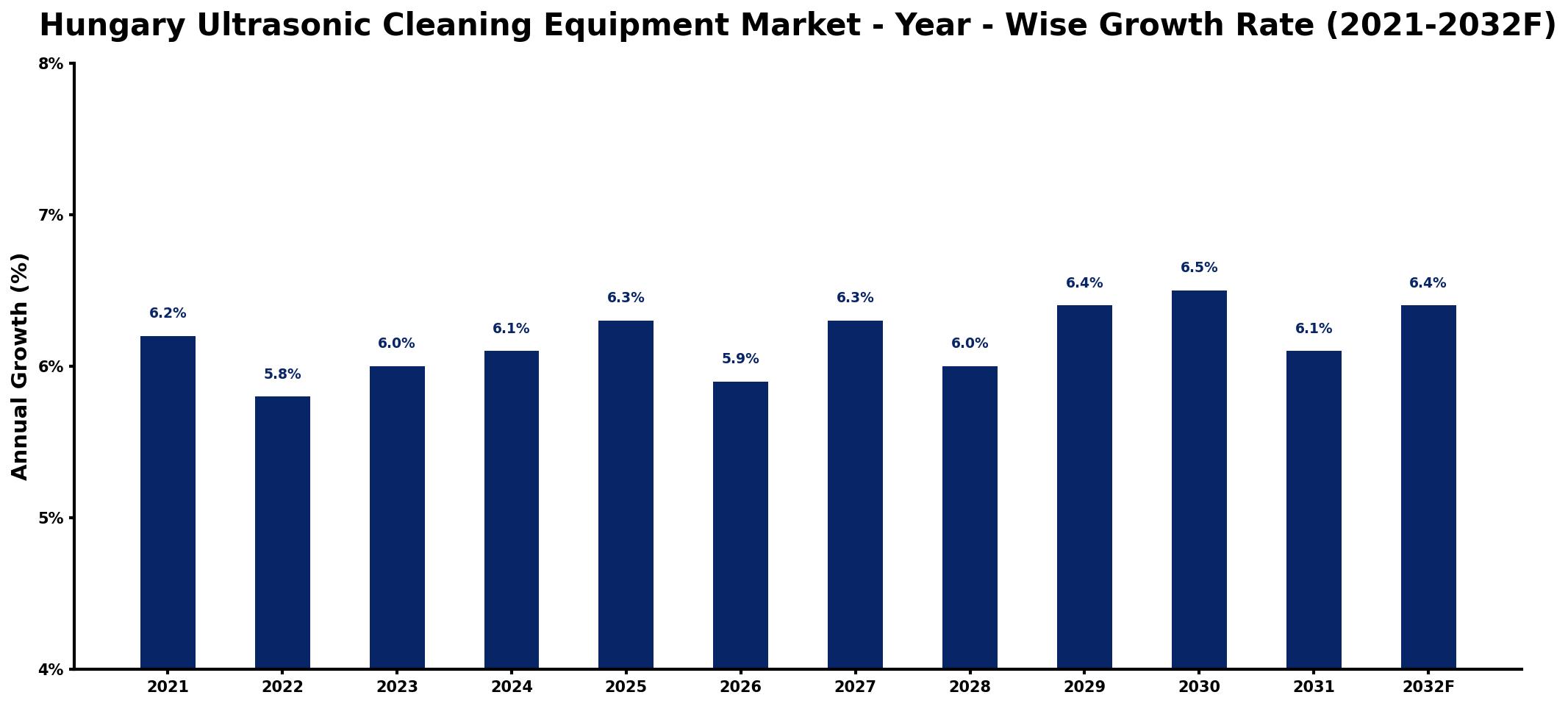
The table below presents the year‑wise growth rates along with the key drivers influencing the market
| Year | Growth Rate | Major Drivers |
| 2021 | 6.2% | Rising demand in automotive sectors |
| 2022 | 5.8% | Growth in healthcare applications |
| 2023 | 6.0% | Increased industrial manufacturing activities |
| 2024 | 6.1% | Expansion in electronics sector |
| 2025 | 6.3% | Surge in jewelry production needs |
| 2026 | 5.9% | Growing popularity in laboratories |
| 2027 | 6.3% | Higher investments in research facilities |
| 2028 | 6.0% | Boost in food processing industries |
| 2029 | 6.4% | Increased consumer awareness benefits |
| 2030 | 6.5% | Emerging trends in renewable energy |
| 2031 | 6.1% | improved processing technologies adoption |
| 2032 | 6.4% | Advancements in precision engineering |
Note: Market size estimations and growth projections presented in this report are based on 6Wresearch's proprietary forecasting methodology, utilizing the latest available industry data, government publications, and primary research inputs.
Hungary Ultrasonic Cleaning Equipment Market Synopsis
A major force currently shaping the Hungary Ultrasonic Cleaning Equipment Market is the trend towards industrial automation. As manufacturing processes become increasingly automated, the demand for efficient and reliable cleaning solutions has surged, particularly in sectors reliant on high-performance parts. This need for automation and precision has prompted industries to adopt advanced ultrasonic cleaning systems, which offer superior cleaning without damaging sensitive components.
Another significant factor influencing the market is the emphasis on environmental sustainability. Industries in Hungary are increasingly recognizing the need to implement eco-friendly cleaning technologies that minimize the use of harsh chemicals. Ultrasonic cleaning equipment aligns with these sustainability goals by utilizing sound waves for cleaning, thereby reducing the environmental impact associated with traditional cleaning methods.
Hungary Ultrasonic Cleaning Equipment Market Key Takeaways
- Precision cleaning is becoming essential in manufacturing, driving demand for ultrasonic cleaning systems.
- Advancements in ultrasonic technology enable more efficient and environmentally friendly cleaning solutions.
- Industrial automation trends are increasing the adoption of automated ultrasonic cleaning systems.
- Compliance with environmental regulations is steering industries towards eco-friendly cleaning technologies.
- Challenges from high equipment costs and imported alternatives require domestic manufacturers to innovate.
Evaluation of Restraints in Hungary Ultrasonic Cleaning Equipment Market
The growth of the Hungary Ultrasonic Cleaning Equipment Market faces several restraints that may impede its potential. High initial costs associated with purchasing ultrasonic cleaning systems can be a significant barrier for smaller enterprises. Furthermore, the necessity for specialized training in equipment operation and maintenance adds another layer of complexity. Moreover, as companies strive to meet strict environmental regulations, they must navigate compliance challenges, which can be both time-consuming and costly. The market is also subject to competition from alternative cleaning technologies, which can lead to price pressures and impact market share for domestic manufacturers.
Hungary Ultrasonic Cleaning Equipment Market Trends
Current trends in the Hungary Ultrasonic Cleaning Equipment Market include an increasing integration of automation in cleaning processes. This includes features such as programmable settings and real-time monitoring, which enhance operational efficiency. Additionally, there is a growing interest in compact ultrasonic cleaning systems that can be utilized in various environments, from small workshops to large manufacturing plants. The trend toward customization is also gaining momentum, as industries seek tailored solutions to meet their specific cleaning needs.
Hungary Ultrasonic Cleaning Equipment Market Opportunities
The Hungary Ultrasonic Cleaning Equipment Market presents several promising opportunities for growth and investment. As industries increasingly prioritize quality assurance, there is a strong potential for innovative ultrasonic cleaning solutions that cater to niche applications within sectors such as medical device manufacturing and aerospace. The push for eco-friendly practices further opens avenues for developing advanced systems that meet both performance and environmental standards. Moreover, collaboration with research institutions to explore new cleaning technologies could yield significant breakthroughs in efficiency and effectiveness.
Government Initiatives in the Hungary Ultrasonic Cleaning Equipment Market
Hungarian government policies play a crucial role in fostering the development of the ultrasonic cleaning equipment market. Regulations focusing on workplace safety and environmental protection are increasingly being implemented, which can lead to stricter standards for cleaning equipment. Furthermore, the government may support training programs aimed at enhancing industrial hygiene practices and promoting awareness of eco-friendly cleaning technologies. Public spending initiatives aimed at boosting manufacturing capabilities may also include provisions for upgrading cleaning systems.
Future Insights of the Hungary Ultrasonic Cleaning Equipment Market
Looking ahead to the years 2026-2032, the Hungary Ultrasonic Cleaning Equipment Market is expected to experience robust growth driven by technological advancements and evolving industry needs. As manufacturers seek to improve operational efficiencies and meet rising quality standards, the adoption of sophisticated ultrasonic cleaning systems is likely to rise. Additionally, increased awareness around environmental sustainability will reinforce the demand for eco-friendly cleaning technologies. Overall, the market is poised for substantial transformation, with innovations continuously shaping its landscape.
Hungary Ultrasonic Cleaning Equipment Market Latest Developments (2025 - 2026)
Recent developments in the Hungary Ultrasonic Cleaning Equipment Market indicate a strong push towards automation and integration of smart technologies. Companies are investing in systems that incorporate IoT capabilities for enhanced monitoring and control during the cleaning process. Additionally, collaborations among manufacturers and technology developers are emerging, focusing on creating more versatile and compact cleaning solutions. The trend towards sustainable practices is also reflected in the introduction of new eco-friendly cleaning agents compatible with ultrasonic systems.
Hungary Ultrasonic Cleaning Equipment Market - Key Attractiveness of the Report
- 10 Years of Market Numbers
- Historical Data Starting from 2022 to 2025
- Base Year: 2025
- Forecast Data until 2032
- Key Performance Indicators Impacting the Market
- Major Upcoming Developments and Projects
Key Highlights of the Report:
- Hungary Ultrasonic Cleaning Equipment Market Outlook
- Market Size of Hungary Ultrasonic Cleaning Equipment Market, 2025
- Forecast of Hungary Ultrasonic Cleaning Equipment Market, 2032
- Historical Data and Forecast of Hungary Ultrasonic Cleaning Equipment Revenues & Volume for the Period 2022-2032F
- Hungary Ultrasonic Cleaning Equipment Market Trend Evolution
- Hungary Ultrasonic Cleaning Equipment Market Drivers and Challenges
- Hungary Ultrasonic Cleaning Equipment Price Trends
- Hungary Ultrasonic Cleaning Equipment Porter's Five Forces
- Hungary Ultrasonic Cleaning Equipment Industry Life Cycle
- Historical Data and Forecast of Hungary Ultrasonic Cleaning Equipment Market Revenues & Volume By Type for the Period 2022-2032F
- Historical Data and Forecast of Hungary Ultrasonic Cleaning Equipment Market Revenues & Volume By Standalone for the Period 2022-2032F
- Historical Data and Forecast of Hungary Ultrasonic Cleaning Equipment Market Revenues & Volume By Benchtop for the Period 2022-2032F
- Historical Data and Forecast of Hungary Ultrasonic Cleaning Equipment Market Revenues & Volume By Multistage for the Period 2022-2032F
- Historical Data and Forecast of Hungary Ultrasonic Cleaning Equipment Market Revenues & Volume By Application for the Period 2022-2032F
- Historical Data and Forecast of Hungary Ultrasonic Cleaning Equipment Market Revenues & Volume By Automotive for the Period 2022-2032F
- Historical Data and Forecast of Hungary Ultrasonic Cleaning Equipment Market Revenues & Volume By Healthcare for the Period 2022-2032F
- Historical Data and Forecast of Hungary Ultrasonic Cleaning Equipment Market Revenues & Volume By Electrical & Electronics for the Period 2022-2032F
- Historical Data and Forecast of Hungary Ultrasonic Cleaning Equipment Market Revenues & Volume By Aerospace & Defense for the Period 2022-2032F
- Historical Data and Forecast of Hungary Ultrasonic Cleaning Equipment Market Revenues & Volume By Others for the Period 2022-2032F
- Hungary Ultrasonic Cleaning Equipment Import Export Trade Statistics
- Market Opportunity Assessment By Type
- Market Opportunity Assessment By Application
- Hungary Ultrasonic Cleaning Equipment Top Companies Market Share
- Hungary Ultrasonic Cleaning Equipment Competitive Benchmarking By Technical and Operational Parameters
- Hungary Ultrasonic Cleaning Equipment Company Profiles
- Hungary Ultrasonic Cleaning Equipment Key Strategic Recommendations






































