Hungary Visual Analytics Market Size & Growth Rate (2026-2032)
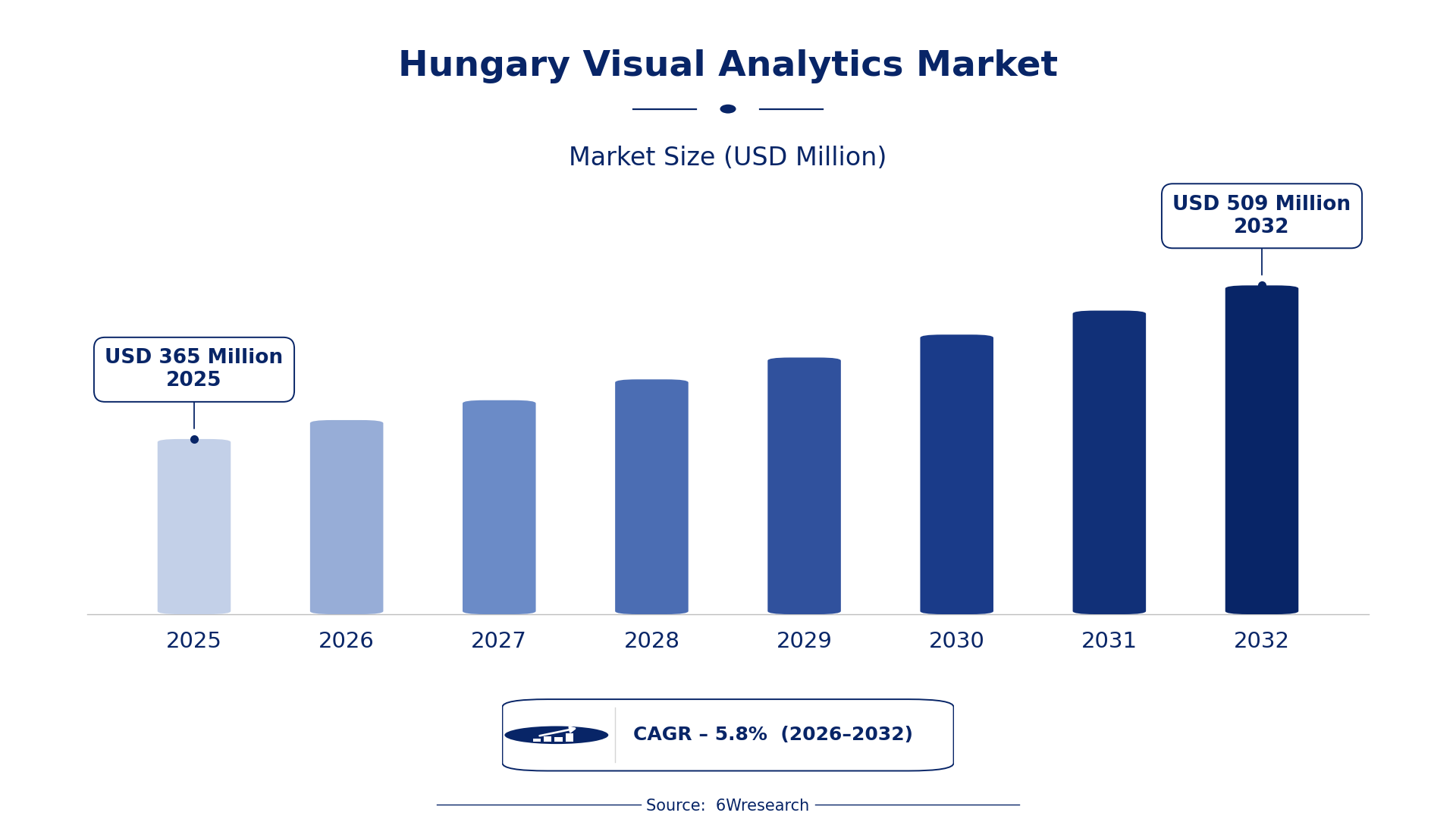
The Hungary Visual Analytics Market was estimated at USD 365 Million in 2025 and is projected to reach USD 509 Million by 2032, growing at a CAGR of 5.8% from 2026 to 2032.
Hungary Visual Analytics Market Synopsis
The visual analytics market in Hungary is on a clear upward trajectory, driven by the urgent need for businesses to harness data for strategic decision-making. Industries such as finance, healthcare, and retail are increasingly investing in visual analytics solutions to turn complex data into actionable insights, enhancing their operational efficiencies.
As organizations recognize the importance of data-driven strategies, the demand for intuitive and interactive visualization tools is surging. The integration of advanced technologies like artificial intelligence and machine learning into these platforms is further transforming how companies analyze and interpret their data.
Hungary Visual Analytics Market Year-wise Growth Rate and Key Drivers
This graph illustrates the annual growth rates of the Hungary Visual Analytics Market from 2021 to 2032, highlighting a steady upward trajectory and projected expansion over the forecast period.
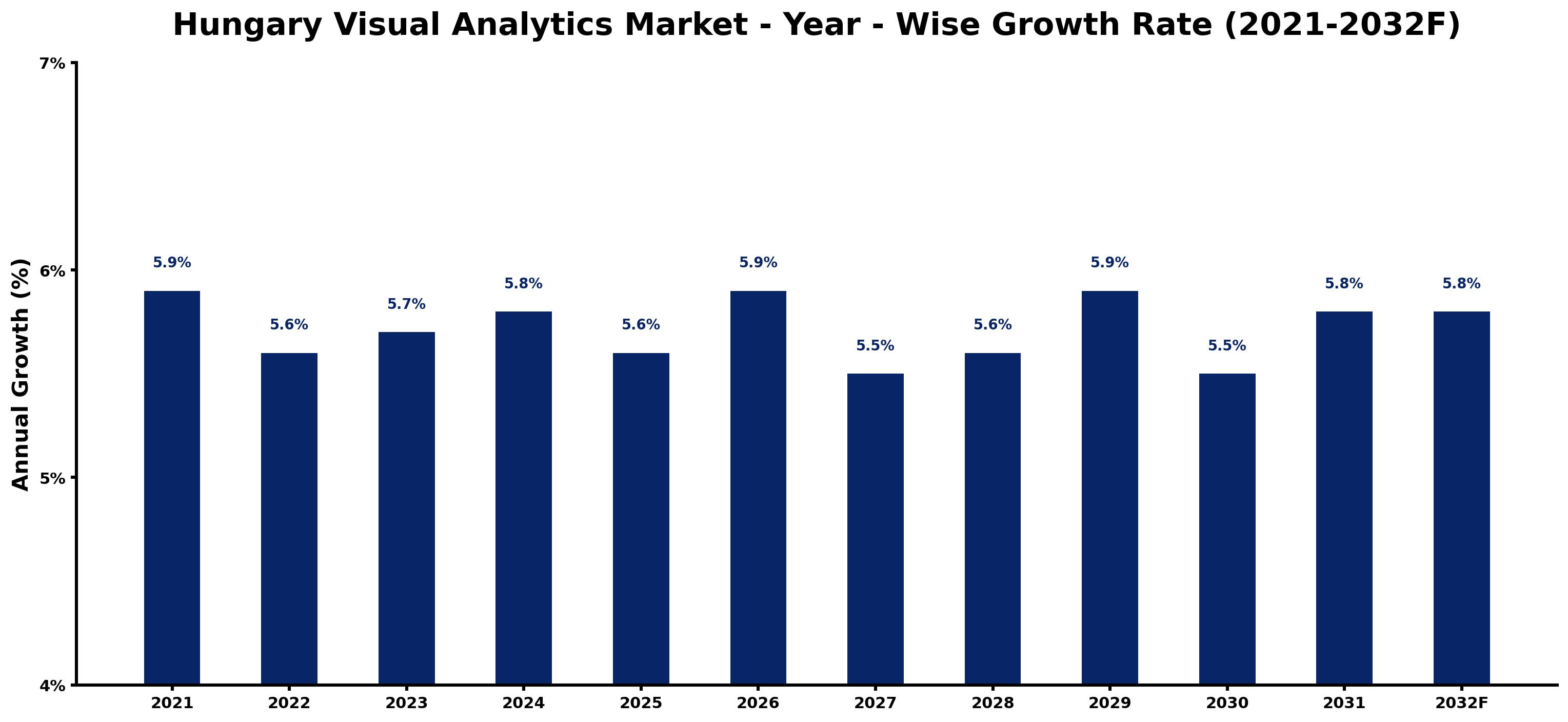
The table below presents the year‑wise growth rates along with the key drivers influencing the market
| Year | Growth Rate | Major Drivers |
| 2021 | 5.9% | Growing interest in data storytelling among Hungarian marketers. |
| 2022 | 5.6% | Local universities introducing advanced data visualization courses. |
| 2023 | 5.7% | Strong emphasis on real-time analytics in Hungarian startups. |
| 2024 | 5.8% | Implementation of EU data strategy bolstering analytics investment. |
| 2025 | 5.6% | Increased adoption of cloud technologies in Hungarian SMEs. |
| 2026 | 5.9% | Government-backed initiatives for digital literacy and data skills. |
| 2027 | 5.5% | Rising need for compliance with GDPR in data management. |
| 2028 | 5.6% | Expanding e-commerce sector necessitating enhanced customer insight tools. |
| 2029 | 5.9% | Investment in AI technologies driving demand for visual analytics. |
| 2030 | 5.5% | Growing collaboration between academia and industry on analytics. |
| 2031 | 5.8% | Emerging trend of big data utilization in public sector. |
| 2032 | 5.8% | Advancements in mobile analytics applications among local businesses. |
Note: Market size estimations and growth projections presented in this report are based on 6Wresearch's proprietary forecasting methodology, utilizing the latest available industry data, government publications, and primary research inputs.
Hungary Visual Analytics Market Key Takeaways
Below are some of the specific key takeaways from the market, including:
- The market is being significantly propelled by the increasing adoption of real-time data visualization tools.
- Integration of AI and machine learning capabilities is becoming a standard feature in visual analytics platforms.
- Mobile and cloud-based analytics solutions are gaining traction across various sectors.
- Healthcare and retail are emerging as key sectors leveraging visual analytics for operational improvements.
- Organizations are focusing on industry-specific solutions to better meet their analytics needs.
Evaluation of Restraints in Hungary Visual Analytics Market
Despite the promising growth trajectory, the Hungary Visual Analytics Market faces notable restraints. A significant barrier is the limited awareness among businesses regarding the benefits of visual analytics, which hinders widespread adoption. on top of that, the shortage of skilled professionals with expertise in these tools poses challenges in effectively implementing and utilizing visual analytics solutions. Data privacy and security concerns, particularly in light of GDPR compliance, also create hesitancy among organizations. Keeping pace with rapid technological advancements requires companies to continuously invest in updates and training, which can strain resources.
Hungary Visual Analytics Market Trends
Several trends are shaping the Hungary Visual Analytics Market. The demand for real-time data visualization tools is escalating, allowing organizations to make timely decisions. Additionally, the integration of AI and machine learning is enhancing the capability of visual analytics tools, enabling deeper insights. There is also a noticeable shift towards mobile and cloud-based analytics platforms, offering flexibility and accessibility for users. Industry-specific solutions are becoming increasingly important as businesses seek tailored analytics that cater to their unique challenges.
Hungary Visual Analytics Market Opportunities
The market presents numerous growth opportunities, particularly in the development of industry-specific visual analytics solutions. As sectors like healthcare and retail increasingly adopt these technologies, there is a clear potential for innovation. The emergence of predictive analytics capabilities can further drive investments, as businesses look to anticipate trends and enhance decision-making processes. Organizations that can effectively harness big data for actionable insights will find themselves at a competitive advantage, opening avenues for collaboration and new product offerings.
Government Initiatives in the Hungary Visual Analytics Market
Government policies in Hungary are actively shaping the visual analytics market, promoting technological innovation and data utilization. The Hungarian government is focused on fostering an environment conducive to the growth of visual analytics by supporting research and development initiatives. Regulatory frameworks are in place to address data privacy and security, which are crucial for market expansion.
- A national initiative launched in 2023 aimed at providing grants for businesses investing in advanced analytics technologies.
- Current efforts include collaborations between academic institutions and tech firms to enhance the development of visual analytics solutions.
- Ongoing regulatory measures are being enforced to ensure compliance with GDPR, fostering trust in data handling practices.
- Plans for a comprehensive data infrastructure project are underway, set to improve access to analytics tools by 2025.
- A public-private partnership focused on promoting innovation in visual analytics is expected to launch in 2026.
Future Insights of the Hungary Visual Analytics Market
Looking ahead to 2026-2032, the Hungary Visual Analytics Market is set for substantial growth. The ongoing emphasis on data-driven decision-making across industries will bolster demand for advanced visualization tools. As big data continues to proliferate, the necessity for actionable insights will drive the adoption of visual analytics solutions. Companies will increasingly leverage AI and machine learning to refine their analytical capabilities, ensuring they remain competitive in a rapidly changing market.
Hungary Visual Analytics Market Latest Developments
In the past year, the Hungary Visual Analytics Market has seen a flurry of activity as organizations seek to modernize their data analytics capabilities. The focus on real-time data access and user-friendly interfaces has prompted various players to enhance their offerings, leading to innovative solutions tailored for local industries.
- A major technology vendor rolled out a new visual analytics platform in Q2 2025, featuring enhanced AI capabilities for predictive analytics.
- A regional operator is currently upgrading its analytics tools to integrate more user-friendly dashboards, with the initiative expected to complete by mid-2026.
- An industry leader launched a partnership program in early 2025 to foster innovation in visual analytics solutions, aimed at startups.
- A recently completed project focused on developing a cloud-based analytics solution specifically for the healthcare sector was announced in late 2024.
- A planned initiative for 2026 aims to provide training programs for professionals in visual analytics, addressing the skills gap in the market.
Hungary Visual Analytics Market - Key Attractiveness of the Report
- 10 Years of Market Numbers
- Historical Data Starting from 2022 to 2025
- Base Year: 2025
- Forecast Data until 2032
- Key Performance Indicators Impacting the Market
- Major Upcoming Developments and Projects
The government has launched initiatives to provide grants for R&D in advanced analytics technologies, while also promoting collaborations between academia and industry to enhance innovation.
Key Highlights of the Report:
- Hungary Visual Analytics Market Outlook
- Market Size of Hungary Visual Analytics Market, 2025
- Forecast of Hungary Visual Analytics Market, 2032
- Historical Data and Forecast of Hungary Visual Analytics Revenues & Volume for the Period 2022-2032F
- Hungary Visual Analytics Market Trend Evolution
- Hungary Visual Analytics Market Drivers and Challenges
- Hungary Visual Analytics Price Trends
- Hungary Visual Analytics Porter's Five Forces
- Hungary Visual Analytics Industry Life Cycle
- Historical Data and Forecast of Hungary Visual Analytics Market Revenues & Volume By Component for the Period 2022-2032F
- Historical Data and Forecast of Hungary Visual Analytics Market Revenues & Volume By Software for the Period 2022-2032F
- Historical Data and Forecast of Hungary Visual Analytics Market Revenues & Volume By Services for the Period 2022-2032F
- Historical Data and Forecast of Hungary Visual Analytics Market Revenues & Volume By Deployment Model for the Period 2022-2032F
- Historical Data and Forecast of Hungary Visual Analytics Market Revenues & Volume By On-Premises for the Period 2022-2032F
- Historical Data and Forecast of Hungary Visual Analytics Market Revenues & Volume By On-Demand for the Period 2022-2032F
- Historical Data and Forecast of Hungary Visual Analytics Market Revenues & Volume By Business Function for the Period 2022-2032F
- Historical Data and Forecast of Hungary Visual Analytics Market Revenues & Volume By IT for the Period 2022-2032F
- Historical Data and Forecast of Hungary Visual Analytics Market Revenues & Volume By Sales and marketing for the Period 2022-2032F
- Historical Data and Forecast of Hungary Visual Analytics Market Revenues & Volume By Supply chain for the Period 2022-2032F
- Historical Data and Forecast of Hungary Visual Analytics Market Revenues & Volume By Finance for the Period 2022-2032F
- Historical Data and Forecast of Hungary Visual Analytics Market Revenues & Volume By Human resources (HR) for the Period 2022-2032F
- Historical Data and Forecast of Hungary Visual Analytics Market Revenues & Volume By Others for the Period 2022-2032F
- Historical Data and Forecast of Hungary Visual Analytics Market Revenues & Volume By Industry for the Period 2022-2032F
- Historical Data and Forecast of Hungary Visual Analytics Market Revenues & Volume By Banking, Financial Services, and Insurance (BFSI) for the Period 2022-2032F
- Historical Data and Forecast of Hungary Visual Analytics Market Revenues & Volume By Telecom and IT for the Period 2022-2032F
- Historical Data and Forecast of Hungary Visual Analytics Market Revenues & Volume By Retail and Consumer goods for the Period 2022-2032F
- Historical Data and Forecast of Hungary Visual Analytics Market Revenues & Volume By Healthcare and Life Sciences for the Period 2022-2032F
- Historical Data and Forecast of Hungary Visual Analytics Market Revenues & Volume By Manufacturing for the Period 2022-2032F
- Historical Data and Forecast of Hungary Visual Analytics Market Revenues & Volume By Government and Defense for the Period 2022-2032F
- Historical Data and Forecast of Hungary Visual Analytics Market Revenues & Volume By Energy and utilities for the Period 2022-2032F
- Historical Data and Forecast of Hungary Visual Analytics Market Revenues & Volume By Media and entertainment for the Period 2022-2032F
- Historical Data and Forecast of Hungary Visual Analytics Market Revenues & Volume By Organization Size for the Period 2022-2032F
- Historical Data and Forecast of Hungary Visual Analytics Market Revenues & Volume By Small and Medium-sized Enterprises (SMEs) for the Period 2022-2032F
- Historical Data and Forecast of Hungary Visual Analytics Market Revenues & Volume By Large Enterprises for the Period 2022-2032F
- Hungary Visual Analytics Import Export Trade Statistics
- Market Opportunity Assessment By Component
- Market Opportunity Assessment By Deployment Model
- Market Opportunity Assessment By Business Function
- Market Opportunity Assessment By Industry
- Market Opportunity Assessment By Organization Size
- Hungary Visual Analytics Top Companies Market Share
- Hungary Visual Analytics Competitive Benchmarking By Technical and Operational Parameters
- Hungary Visual Analytics Company Profiles
- Hungary Visual Analytics Key Strategic Recommendations






































