Hungary Water Treatment Market: Import Trend Analysis
In the Hungary water treatment market, the import trend experienced a decline, with a growth rate of -13.71% from 2023 to 2024 and a CAGR of -0.69% between 2020 and 2024. This negative momentum could be attributed to shifting demand patterns or evolving trade policies impacting market stability.
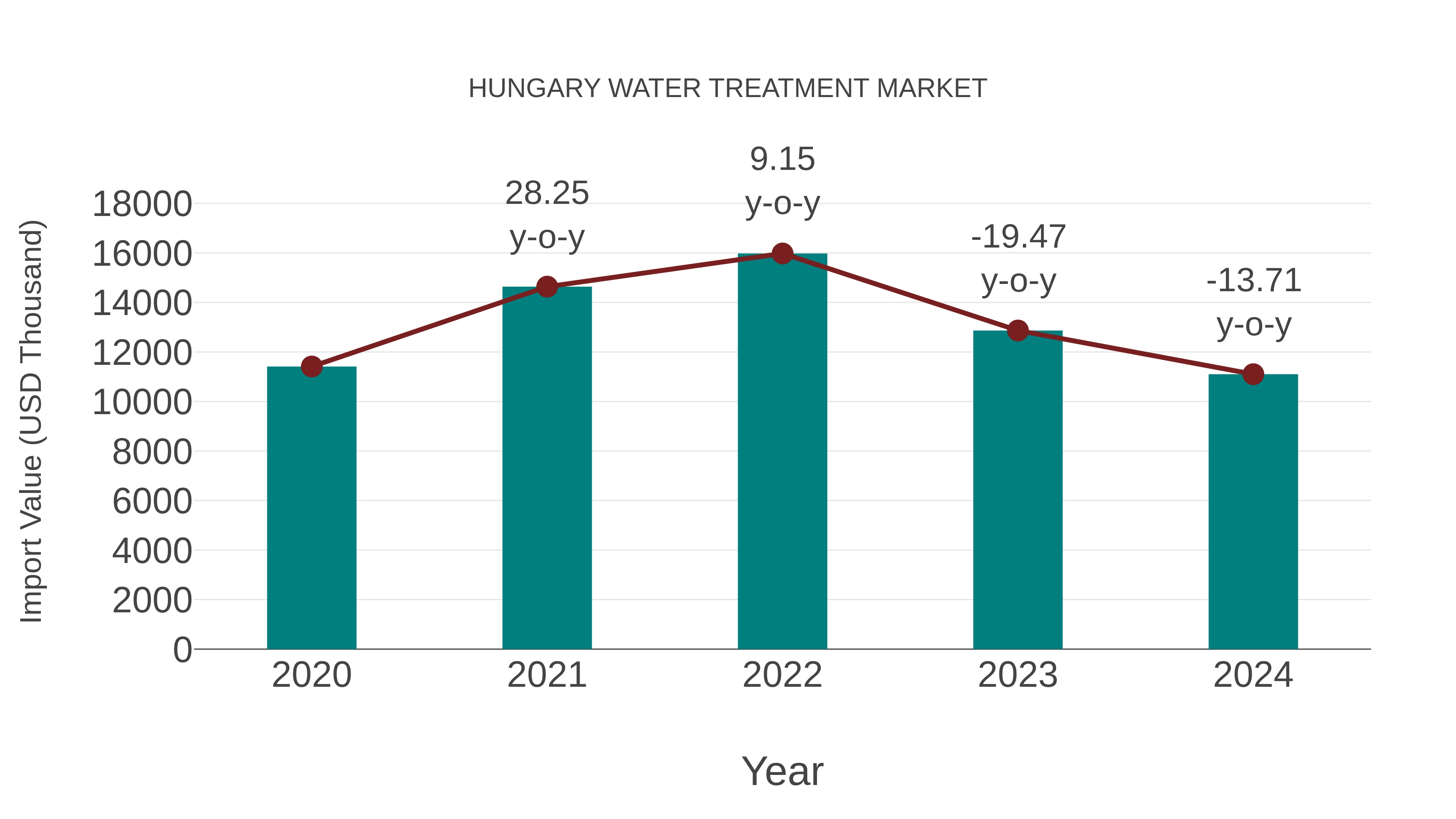
Hungary Water Treatment Market Overview
The Hungary Water Treatment Market involves technologies, equipment, and services for purifying, disinfecting, and conditioning water from various sources such as surface water, groundwater, and wastewater to meet quality standards, health regulations, and industrial requirements. Water treatment solutions include filtration, disinfection, desalination, and chemical treatment processes used in municipal water supply, industrial manufacturing, and environmental remediation projects. With Hungary water infrastructure investments and environmental concerns, the water treatment market is experiencing growth driven by factors such as population growth, urbanization, and water pollution control measures.
Drivers of the market
The Hungary Water Treatment market is witnessing robust growth, propelled by several key drivers. One significant factor driving market expansion is the increasing demand for clean and safe drinking water in urban, rural, and industrial areas. Water treatment solutions play a crucial role in removing contaminants, pathogens, and pollutants from water sources, ensuring compliance with health and environmental standards. Additionally, the growing concerns over waterborne diseases, chemical contamination, and emerging contaminants are driving the adoption of advanced water treatment technologies such as filtration, disinfection, and membrane separation. Moreover, government initiatives, public awareness campaigns, and infrastructure investments are further fueling market growth for water treatment solutions in Hungary.
Challenges of the market
Challenges include developing sustainable water treatment solutions, addressing concerns related to energy consumption and chemical usage, and ensuring affordability and accessibility of treatment technologies.
Government Policy of the market
Government policies in Hungary regarding the water treatment market may include regulations on drinking water quality, pollution control measures, and investment in water infrastructure. This could involve standards for water treatment plant operation and maintenance, pollution prevention requirements for industrial facilities, and public funding for water treatment facility upgrades and expansions.
Key Highlights of the Report:
- Hungary Water Treatment Market Outlook
- Market Size of Hungary Water Treatment Market, 2019
- Forecast of Hungary Water Treatment Market, 2026
- Historical Data and Forecast of Hungary Water Treatment Revenues & Volume for the Period 2016 - 2026
- Hungary Water Treatment Market Trend Evolution
- Hungary Water Treatment Market Drivers and Challenges
- Hungary Water Treatment Price Trends
- Hungary Water Treatment Porter's Five Forces
- Hungary Water Treatment Industry Life Cycle
- Historical Data and Forecast of Hungary Water Treatment Market Revenues & Volume By Types for the Period 2016 - 2026
- Historical Data and Forecast of Hungary Water Treatment Market Revenues & Volume By Distillation? for the Period 2016 - 2026
- Historical Data and Forecast of Hungary Water Treatment Market Revenues & Volume By Filtration? for the Period 2016 - 2026
- Historical Data and Forecast of Hungary Water Treatment Market Revenues & Volume By Disinfection for the Period 2016 - 2026
- Historical Data and Forecast of Hungary Water Treatment Market Revenues & Volume By Reverse Osmosis for the Period 2016 - 2026
- Historical Data and Forecast of Hungary Water Treatment Market Revenues & Volume By Applications for the Period 2016 - 2026
- Historical Data and Forecast of Hungary Water Treatment Market Revenues & Volume By Residential? for the Period 2016 - 2026
- Historical Data and Forecast of Hungary Water Treatment Market Revenues & Volume By Non-Residential? for the Period 2016 - 2026
- Historical Data and Forecast of Hungary Water Treatment Market Revenues & Volume By Installations for the Period 2016 - 2026
- Historical Data and Forecast of Hungary Water Treatment Market Revenues & Volume By Point Of Use for the Period 2016 - 2026
- Historical Data and Forecast of Hungary Water Treatment Market Revenues & Volume By Point Of Entry for the Period 2016 - 2026
- Hungary Water Treatment Import Export Trade Statistics
- Market Opportunity Assessment By Types
- Market Opportunity Assessment By Applications
- Market Opportunity Assessment By Installations
- Hungary Water Treatment Top Companies Market Share
- Hungary Water Treatment Competitive Benchmarking By Technical and Operational Parameters
- Hungary Water Treatment Company Profiles
- Hungary Water Treatment Key Strategic Recommendations






































