Hungary Wireless Network Security Market Size & Growth Rate (2026-2032)
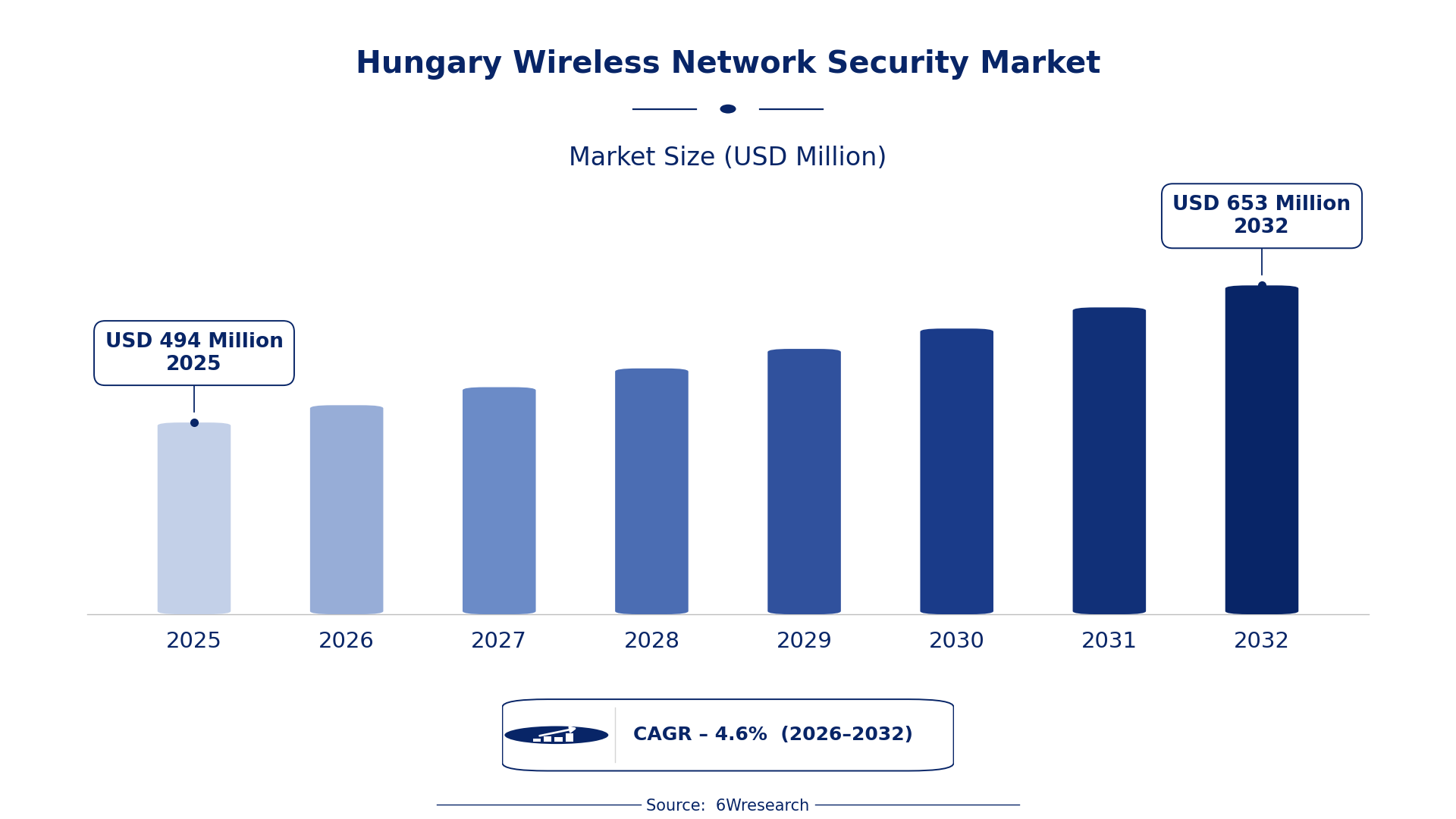
The Hungary Wireless Network Security Market was estimated at USD 494 Million in 2025 and is projected to reach USD 653 Million by 2032, growing at a CAGR of 4.6% from 2026 to 2032.
Hungary Wireless Network Security Market Synopsis
The urgency for robust wireless network security measures in Hungary has reached a tipping point. As digital transformation accelerates across various sectors, the vulnerability of wireless networks has become a critical concern, prompting increased investment in security solutions.
Cyber threats continue to proliferate, with unauthorized access and data breaches posing significant risks. This reality is driving the need for comprehensive security frameworks that not only comply with regulatory requirements but also address the evolving landscape of data privacy and protection.
Hungary Wireless Network Security Market Year-wise Growth Rate and Key Drivers
This graph illustrates the annual growth rates of the Hungary Wireless Network Security Market from 2021 to 2032, highlighting a steady upward trajectory and projected expansion over the forecast period.
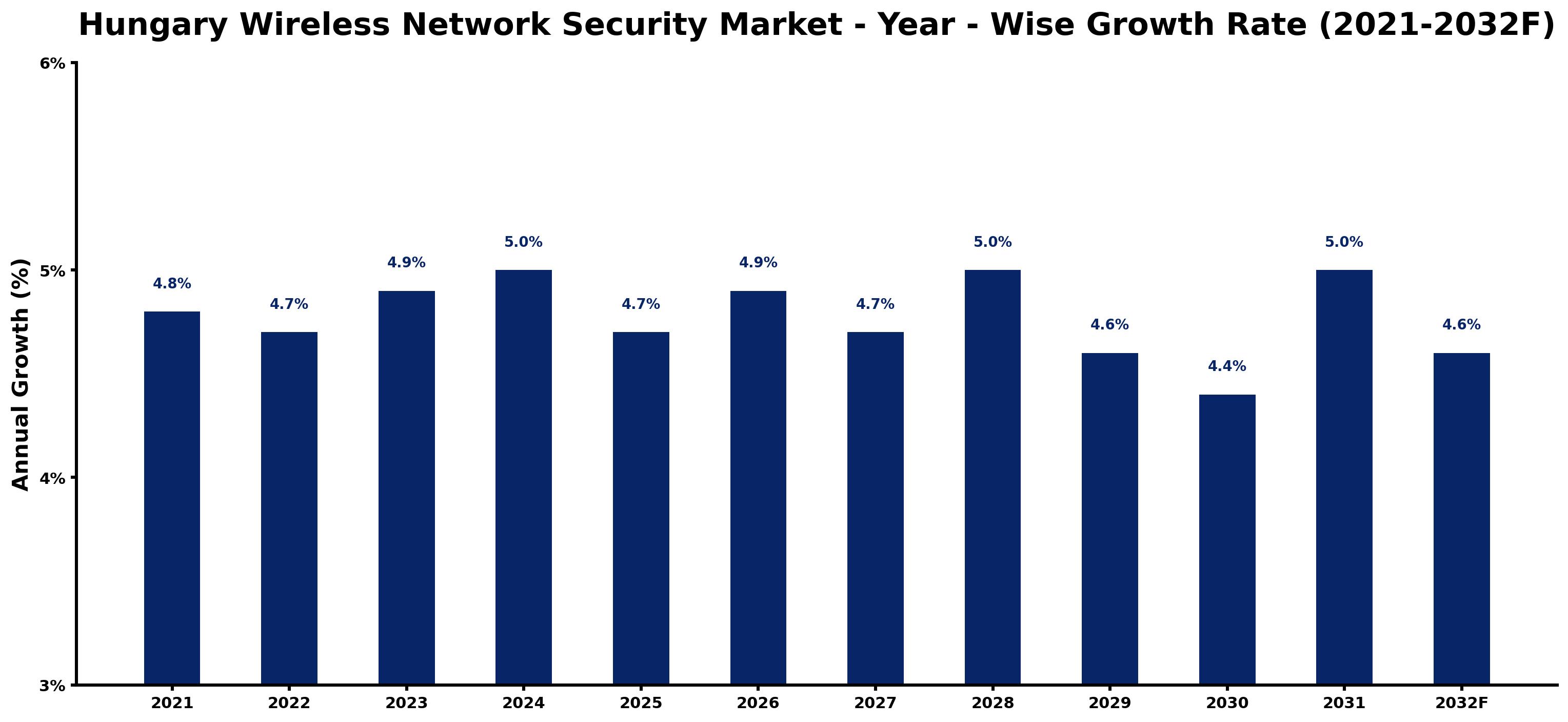
The table below presents the year‑wise growth rates along with the key drivers influencing the market
| Year | Growth Rate | Major Drivers |
| 2021 | 4.8% | National Cybersecurity Strategy focusing on wireless protections |
| 2022 | 4.7% | Increase in mobile banking driving security demand |
| 2023 | 4.9% | New GDPR regulations enhancing data protection requirements |
| 2024 | 5.0% | Government subsidies for local cybersecurity startups |
| 2025 | 4.7% | Rising cyber threats targeting remote work connections |
| 2026 | 4.9% | Adoption of IoT devices necessitating enhanced wireless security |
| 2027 | 4.7% | Partnerships between telecoms and security firms expanding |
| 2028 | 5.0% | Investment in 5G networks boosting security system upgrades |
| 2029 | 4.6% | Growth in online education increasing digital security concerns |
| 2030 | 4.4% | Local demand for secure digital identities surging |
| 2031 | 5.0% | Hungary's cybersecurity training initiatives increasing workforce expertise |
| 2032 | 4.6% | Public awareness campaigns highlighting wireless security risks |
Note: Market size estimations and growth projections presented in this report are based on 6Wresearch's proprietary forecasting methodology, utilizing the latest available industry data, government publications, and primary research inputs.
Hungary Wireless Network Security Market Key Takeaways
Below are some of the specific key takeaways from the market, including:
- The market is anticipated to grow significantly due to rising cyber threats and the need for enhanced security protocols.
- Mobile device and IoT proliferation are expanding the attack surface, necessitating advanced security solutions.
- Regulatory compliance remains a critical driver, pushing organizations to adopt stringent network security measures.
- Continuous technological innovations are shaping the market dynamics, enhancing the effectiveness of security frameworks.
Evaluation of Restraints in Hungary Wireless Network Security Market
Despite the market's positive trajectory, certain constraints hamper growth. One major limitation is the challenge of developing security solutions that can keep pace with rapidly evolving cyber threats. Many organizations struggle with integrating robust security measures into existing infrastructures while balancing costs. This can lead to gaps in protection, especially for smaller enterprises that lack the resources to invest heavily in comprehensive security frameworks. Additionally, data privacy concerns have prompted more stringent regulations, creating pressure for compliance that can be burdensome for businesses.
Hungary Wireless Network Security Market Trends
Several trends are influencing the Hungary Wireless Network Security Market. A noticeable shift is the focus on adopting AI-driven security solutions, which enhance threat detection and response capabilities. Businesses are increasingly prioritizing multi-layered security architectures, integrating encryption, intrusion detection, and risk assessment tools. on top of that, the growth of remote work environments has heightened the need for secure access protocols, leading to increased investments in VPNs and secure access service edge (SASE) solutions.
Hungary Wireless Network Security Market Opportunities
Growth opportunities in Hungary’s wireless network security market are abundant, particularly in sectors such as finance, healthcare, and retail, which are increasingly becoming targets for cyberattacks. Companies offering tailored security solutions that align with industry-specific regulations and compliance requirements are well-positioned for success. Additionally, partnerships between technology firms and government agencies to enhance cybersecurity infrastructure present lucrative prospects for innovation and market expansion.
Government Initiatives in the Hungary Wireless Network Security Market
The Hungarian government has recognized the critical need for enhanced wireless network security, implementing policies that underscore cybersecurity awareness and regulatory compliance. These initiatives aim to foster collaboration across sectors to strengthen the nation’s cybersecurity posture, addressing the pressing threats to digital infrastructure.
- A national cybersecurity awareness campaign launched in early 2025 aims to educate businesses and consumers about wireless security best practices.
- The Ministry of Innovation and Technology is currently underway with an initiative to improve public-private partnerships in cybersecurity infrastructure, enhancing cooperative efforts against cyber threats.
- A planned regulatory framework, expected to be introduced by late 2026, will mandate stricter compliance measures for companies operating wireless networks.
- Recent investments in cybersecurity research funding by the government in early 2025 aim to advance innovation in wireless network security technologies.
Future Insights of the Hungary Wireless Network Security Market
Looking ahead to 2026-2032, the Hungary Wireless Network Security Market is expected to witness transformative changes. With an increasing emphasis on AI and machine learning for predictive security measures, the industry will likely evolve towards more automated solutions capable of preempting cyber threats. on top of that, as the regulatory landscape tightens, businesses will need to adopt more sophisticated compliance strategies to ensure protection against emerging vulnerabilities.
Hungary Wireless Network Security Market Latest Developments
The past year has seen significant movement in the Hungary Wireless Network Security Market, driven by emerging technologies and heightened security awareness among organizations. Companies are rapidly adapting to new standards while striving to enhance their defenses against persistent cyber threats.
- A major technology vendor launched a cutting-edge intrusion detection system in Q2 2025, improving real-time threat detection capabilities for wireless networks.
- A leading regional operator is currently upgrading its security protocols to align with the latest regulatory requirements, an initiative expected to conclude by late 2025.
- An ongoing collaboration between academia and industry was established in mid-2025 to foster innovation in wireless network security solutions.
- A planned security awareness training initiative targeting small to medium-sized enterprises is expected to roll out in early 2026.
Hungary Wireless Network Security Market - Key Attractiveness of the Report
- 10 Years of Market Numbers
- Historical Data Starting from 2022 to 2025
- Base Year: 2025
- Forecast Data until 2032
- Key Performance Indicators Impacting the Market
- Major Upcoming Developments and Projects
Key Highlights of the Report:
- Hungary Wireless Network Security Market Outlook
- Market Size of Hungary Wireless Network Security Market, 2025
- Forecast of Hungary Wireless Network Security Market, 2032
- Historical Data and Forecast of Hungary Wireless Network Security Revenues & Volume for the Period 2022-2032F
- Hungary Wireless Network Security Market Trend Evolution
- Hungary Wireless Network Security Market Drivers and Challenges
- Hungary Wireless Network Security Price Trends
- Hungary Wireless Network Security Porter's Five Forces
- Hungary Wireless Network Security Industry Life Cycle
- Historical Data and Forecast of Hungary Wireless Network Security Market Revenues & Volume By Solutions for the Period 2022-2032F
- Historical Data and Forecast of Hungary Wireless Network Security Market Revenues & Volume By Firewall for the Period 2022-2032F
- Historical Data and Forecast of Hungary Wireless Network Security Market Revenues & Volume By IPS/IDS for the Period 2022-2032F
- Historical Data and Forecast of Hungary Wireless Network Security Market Revenues & Volume By Encryption for the Period 2022-2032F
- Historical Data and Forecast of Hungary Wireless Network Security Market Revenues & Volume By I&AM for the Period 2022-2032F
- Historical Data and Forecast of Hungary Wireless Network Security Market Revenues & Volume By UTM for the Period 2022-2032F
- Historical Data and Forecast of Hungary Wireless Network Security Market Revenues & Volume By Services for the Period 2022-2032F
- Historical Data and Forecast of Hungary Wireless Network Security Market Revenues & Volume By Security Operations for the Period 2022-2032F
- Historical Data and Forecast of Hungary Wireless Network Security Market Revenues & Volume By Consulting for the Period 2022-2032F
- Historical Data and Forecast of Hungary Wireless Network Security Market Revenues & Volume By Managed Security Services for the Period 2022-2032F
- Hungary Wireless Network Security Import Export Trade Statistics
- Market Opportunity Assessment By Solutions
- Market Opportunity Assessment By Services
- Hungary Wireless Network Security Top Companies Market Share
- Hungary Wireless Network Security Competitive Benchmarking By Technical and Operational Parameters
- Hungary Wireless Network Security Company Profiles
- Hungary Wireless Network Security Key Strategic Recommendations






































