Iceland Electrical Equipment Market Growth Rate Analysis (2025 - 2031)
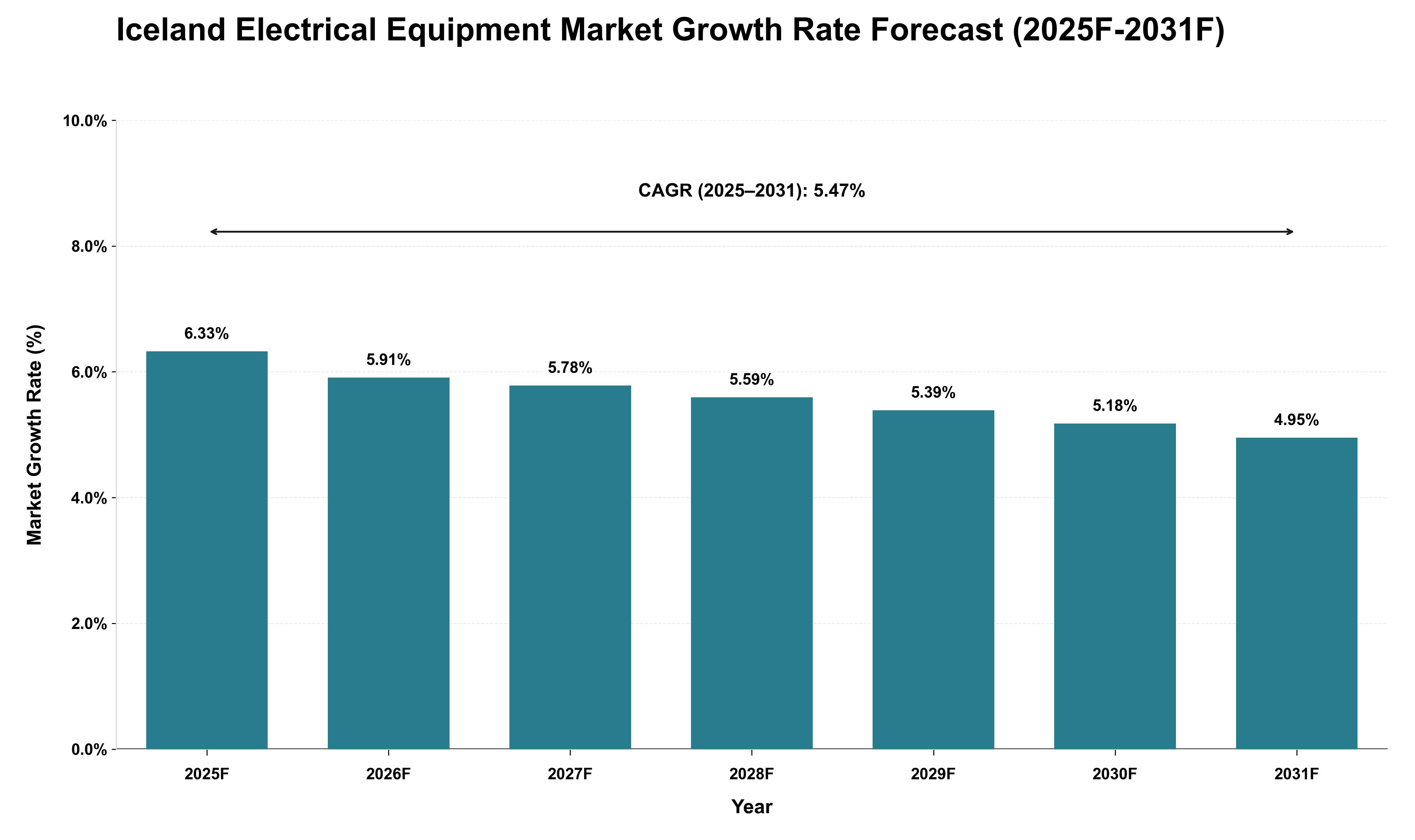
The forecasted growth trajectory for the Iceland electrical equipment market will exhibit a gradual deceleration, as indicated by the annual growth rates decreasing from 6.33% in 2025 to 4.95% by 2031. This trend suggests that while initial demand may be robust, driven by factors such as increased infrastructure investments and a shift towards renewable energy sources, the pace of expansion will likely moderate due to potential import dependencies and global supply chain dynamics. As Iceland continues to navigate its unique economic landscape, fluctuations in international commodity prices and currency exchange rates could further influence market performance. Additionally, cyclical trends in macroeconomic conditions may lead to varying consumer confidence levels, impacting purchasing behavior over this period. Overall, the projected CAGR of 5.47% reflects a resilient yet increasingly cautious outlook for the sector amidst evolving economic conditions.
Key Highlights of the Report:
- Iceland Electrical Equipment Market Outlook
- Market Size of Iceland Electrical Equipment Market, 2024
- Forecast of Iceland Electrical Equipment Market, 2031
- Historical Data and Forecast of Iceland Electrical Equipment Revenues & Volume for the Period 2021-2031
- Iceland Electrical Equipment Market Trend Evolution
- Iceland Electrical Equipment Market Drivers and Challenges
- Iceland Electrical Equipment Price Trends
- Iceland Electrical Equipment Porter`s Five Forces
- Iceland Electrical Equipment Industry Life Cycle
- Historical Data and Forecast of Iceland Electrical Equipment Market Revenues & Volume By Types for the Period 2021-2031
- Historical Data and Forecast of Iceland Electrical Equipment Market Revenues & Volume By Electronic and electrical wires and cables for the Period 2021-2031
- Historical Data and Forecast of Iceland Electrical Equipment Market Revenues & Volume By Batteries and accumulators for the Period 2021-2031
- Historical Data and Forecast of Iceland Electrical Equipment Market Revenues & Volume By Wiring devices for the Period 2021-2031
- Historical Data and Forecast of Iceland Electrical Equipment Market Revenues & Volume By Electric lighting equipment for the Period 2021-2031
- Historical Data and Forecast of Iceland Electrical Equipment Market Revenues & Volume By Others for the Period 2021-2031
- Historical Data and Forecast of Iceland Electrical Equipment Market Revenues & Volume By Applications for the Period 2021-2031
- Historical Data and Forecast of Iceland Electrical Equipment Market Revenues & Volume By Residential end-users for the Period 2021-2031
- Historical Data and Forecast of Iceland Electrical Equipment Market Revenues & Volume By Non-residential end-users for the Period 2021-2031
- Iceland Electrical Equipment Import Export Trade Statistics
- Market Opportunity Assessment By Types
- Market Opportunity Assessment By Applications
- Iceland Electrical Equipment Top Companies Market Share
- Iceland Electrical Equipment Competitive Benchmarking By Technical and Operational Parameters
- Iceland Electrical Equipment Company Profiles
- Iceland Electrical Equipment Key Strategic Recommendations






































