Iceland Radio Remote Control Equipment Market Growth Rate Analysis (2021 - 2031)
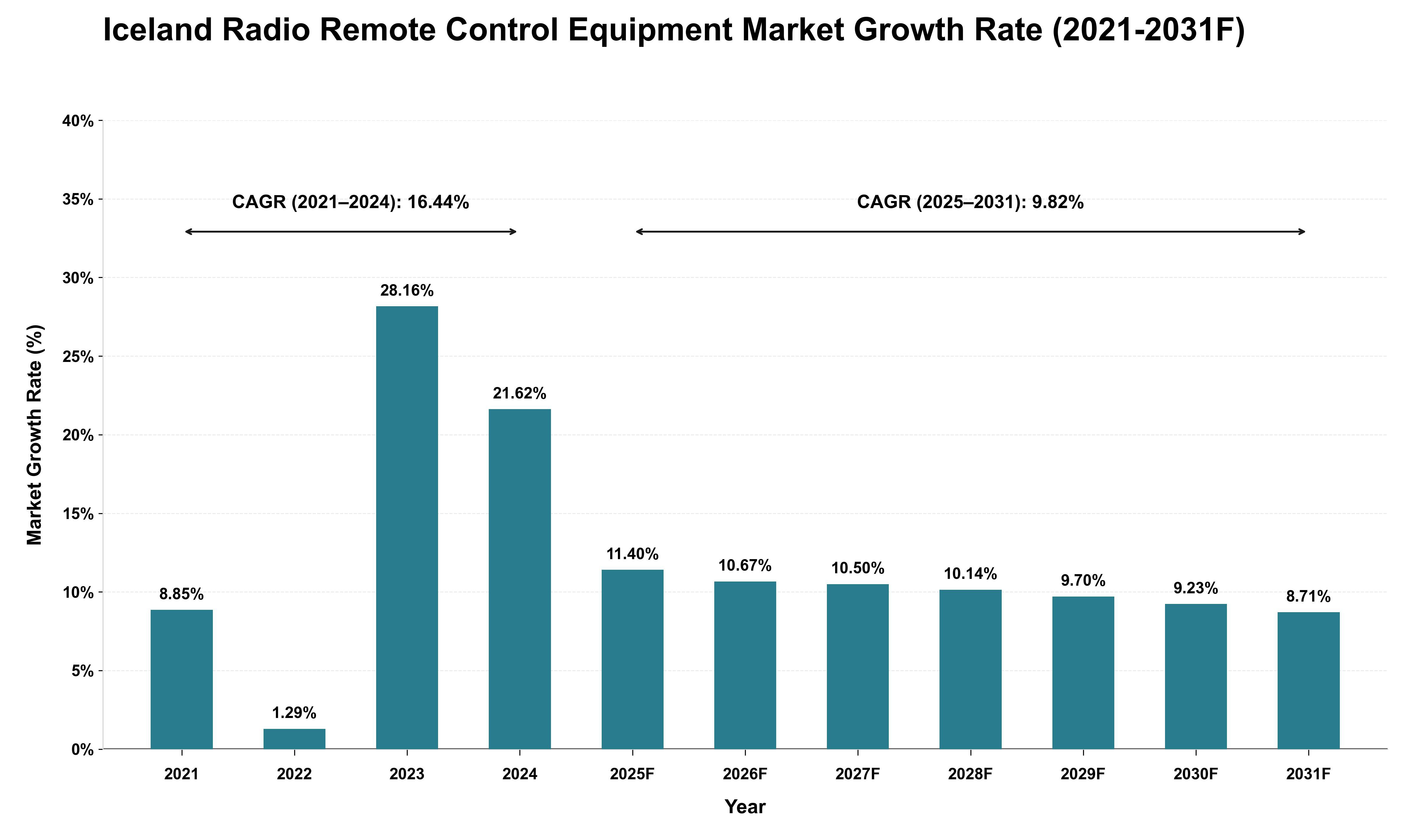
Between 2021 and 2024, the Iceland radio remote control equipment market experienced significant fluctuations in growth, driven by end-use demand shifts influenced by global supply chain disruptions and a post-pandemic recovery in various sectors. The initial growth of 8.85% in 2021 was followed by a sharp decline to 1.29% in 2022, likely reflecting the impact of global shipping container crises and component shortages. However, as markets reopened and consumer electronics demand surged, growth rebounded dramatically to 28.16% in 2023 and remained robust at 21.62% in 2024, culminating in a historical CAGR of 16.44%. Looking ahead to the forecast period from 2025 to 2031, growth is expected to moderate to a CAGR of 9.82%, as the market stabilizes amidst evolving technological advancements and shifts towards automation across industries, suggesting a more sustainable yet slower expansion trajectory as demand becomes increasingly aligned with broader economic cycles and import reliance dynamics.
Key Highlights of the Report:
- Iceland Radio Remote Control Equipment Market Outlook
- Market Size of Iceland Radio Remote Control Equipment Market, 2024
- Forecast of Iceland Radio Remote Control Equipment Market, 2031
- Historical Data and Forecast of Iceland Radio Remote Control Equipment Revenues & Volume for the Period 2021-2031
- Iceland Radio Remote Control Equipment Market Trend Evolution
- Iceland Radio Remote Control Equipment Market Drivers and Challenges
- Iceland Radio Remote Control Equipment Price Trends
- Iceland Radio Remote Control Equipment Porter`s Five Forces
- Iceland Radio Remote Control Equipment Industry Life Cycle
- Historical Data and Forecast of Iceland Radio Remote Control Equipment Market Revenues & Volume By Type for the Period 2021-2031
- Historical Data and Forecast of Iceland Radio Remote Control Equipment Market Revenues & Volume By Pushbutton for the Period 2021-2031
- Historical Data and Forecast of Iceland Radio Remote Control Equipment Market Revenues & Volume By Joystick for the Period 2021-2031
- Historical Data and Forecast of Iceland Radio Remote Control Equipment Market Revenues & Volume By Application for the Period 2021-2031
- Historical Data and Forecast of Iceland Radio Remote Control Equipment Market Revenues & Volume By Industry & Logistics for the Period 2021-2031
- Historical Data and Forecast of Iceland Radio Remote Control Equipment Market Revenues & Volume By Construction Crane for the Period 2021-2031
- Historical Data and Forecast of Iceland Radio Remote Control Equipment Market Revenues & Volume By Mobile Hydraulics for the Period 2021-2031
- Historical Data and Forecast of Iceland Radio Remote Control Equipment Market Revenues & Volume By Forestry for the Period 2021-2031
- Historical Data and Forecast of Iceland Radio Remote Control Equipment Market Revenues & Volume By Mining for the Period 2021-2031
- Historical Data and Forecast of Iceland Radio Remote Control Equipment Market Revenues & Volume By Others for the Period 2021-2031
- Iceland Radio Remote Control Equipment Import Export Trade Statistics
- Market Opportunity Assessment By Type
- Market Opportunity Assessment By Application
- Iceland Radio Remote Control Equipment Top Companies Market Share
- Iceland Radio Remote Control Equipment Competitive Benchmarking By Technical and Operational Parameters
- Iceland Radio Remote Control Equipment Company Profiles
- Iceland Radio Remote Control Equipment Key Strategic Recommendations






































