Iceland Watches Market Growth Rate Analysis (2025 - 2031)
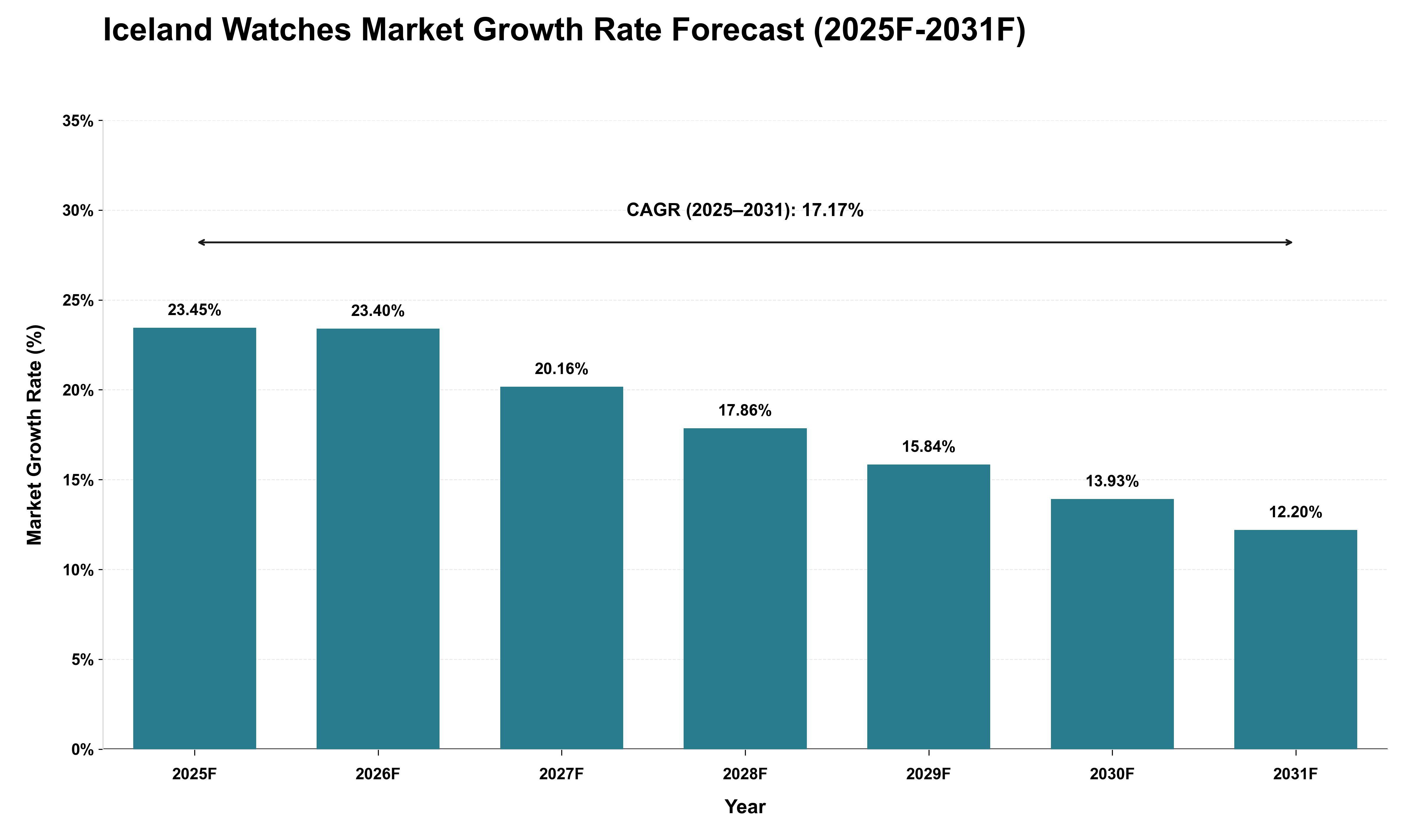
The Iceland watches market will experience robust growth driven by increasing consumer preferences for luxury and smartwatches, alongside a rising disposable income among the population. As global supply chains stabilize post-pandemic, import dependencies will shift, allowing for more diverse sourcing options that could enhance product availability and variety. The projected CAGR of 17.17% reflects a strong demand trajectory, particularly in the early forecast years where annual growth rates exceed 20%. This surge can be attributed to heightened interest in wearable technology and fashion accessories, which will likely attract younger demographics. By 2031, while growth rates are expected to moderate to 12.20%, the overall trend indicates sustained consumer engagement with innovative watch designs and functionalities. Consequently, manufacturers will need to adapt their strategies to capitalize on evolving end-use demands while navigating potential economic fluctuations that may influence consumer spending patterns.
Key Highlights of the Report:
- Iceland Watches Market Outlook
- Market Size of Iceland Watches Market, 2025
- Forecast of Iceland Watches Market, 2032
- Historical Data and Forecast of Iceland Watches Revenues & Volume for the Period 2022-2032F
- Iceland Watches Market Trend Evolution
- Iceland Watches Market Drivers and Challenges
- Iceland Watches Price Trends
- Iceland Watches Porter`s Five Forces
- Iceland Watches Industry Life Cycle
- Historical Data and Forecast of Iceland Watches Market Revenues & Volume By Type for the Period 2022-2032F
- Historical Data and Forecast of Iceland Watches Market Revenues & Volume By Smart Watches for the Period 2022-2032F
- Historical Data and Forecast of Iceland Watches Market Revenues & Volume By Luxury Watches for the Period 2022-2032F
- Historical Data and Forecast of Iceland Watches Market Revenues & Volume By Fitness Watches for the Period 2022-2032F
- Historical Data and Forecast of Iceland Watches Market Revenues & Volume By Operations for the Period 2022-2032F
- Historical Data and Forecast of Iceland Watches Market Revenues & Volume By Mechanical for the Period 2022-2032F
- Historical Data and Forecast of Iceland Watches Market Revenues & Volume By Quartz for the Period 2022-2032F
- Historical Data and Forecast of Iceland Watches Market Revenues & Volume By Distribution Channel for the Period 2022-2032F
- Historical Data and Forecast of Iceland Watches Market Revenues & Volume By Hypermarket/ Supermarket for the Period 2022-2032F
- Historical Data and Forecast of Iceland Watches Market Revenues & Volume By Convenience Stores for the Period 2022-2032F
- Historical Data and Forecast of Iceland Watches Market Revenues & Volume By Online for the Period 2022-2032F
- Historical Data and Forecast of Iceland Watches Market Revenues & Volume By End-Users for the Period 2022-2032F
- Historical Data and Forecast of Iceland Watches Market Revenues & Volume By Women for the Period 2022-2032F
- Historical Data and Forecast of Iceland Watches Market Revenues & Volume By Unisex for the Period 2022-2032F
- Iceland Watches Import Export Trade Statistics
- Market Opportunity Assessment By Type
- Market Opportunity Assessment By Operations
- Market Opportunity Assessment By Distribution Channel
- Market Opportunity Assessment By End-Users
- Iceland Watches Top Companies Market Share
- Iceland Watches Competitive Benchmarking By Technical and Operational Parameters
- Iceland Watches Company Profiles
- Iceland Watches Key Strategic Recommendations






































