India Accelerometer Market Growth Rate
According to 6Wresearch internal database and industry insights, the India Accelerometer Market is expected to grow at a compound annual growth rate (CAGR) of 8% during the forecast period (2026–2032).
India Accelerometer Market Year-wise Growth Rate and Key Drivers
This graph illustrates the annual growth rates of the India Accelerometer Market from 2021 to 2032, highlighting a steady upward trajectory and projected market expansion over the forecast period.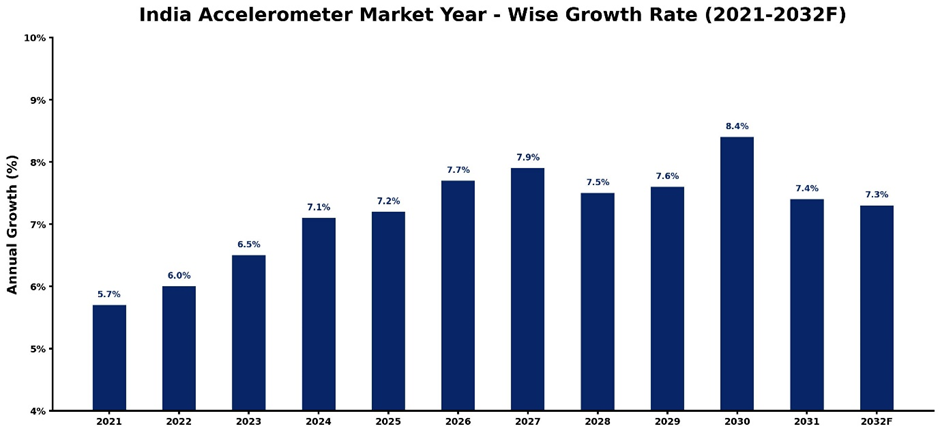
The following table summarizes the historical and forecasted growth rates of the India Accelerometer Market, along with the rationale behind each year’s performance.
| Year | Estimated Growth (%) | Market Rationale |
| 2021 | 5.7% | Electronics supply chain was stabilized. |
| 2022 | 6% | Rise in the demand for smartphone, and early growth of EV electronics. |
| 2023 | 6.5% | Increased use of IoT devices, and industrial sensors. |
| 2024 | 7.1% | Higher adoption of MEMS sensors in the consumer electronics. |
| 2025 | 7.2% | Growth in automotive safety systems, and push for Make in India. |
| 2026 | 7.7% | Strong adoption of MEMS accelerometers across automotive, and industrial automation. |
| 2027 | 7.9% | Faster EV penetration, and wide use of ADAS features in vehicles. |
| 2028 | 7.5% | Expansion of smart factories, and Industry 4.0 automation systems. |
| 2029 | 7.6% | Improved MEMS technology will reduce cost, and increase the sensor usage. |
| 2030 | 8.4% | Growth in drones, robotics, and semi-autonomous systems. |
| 2031 | 7.4% | Market will mature but the demand will stay strong in the automotive, and industrial sectors. |
| 2032 | 7.3% | Stable growth as IoT, and connected devices will reach the saturation level. |
Topics Covered in the India Accelerometer Market Report
The India Accelerometer Market report covers the market by type, axis, and end-use industry. The report provides an in-depth analysis of ongoing market trends, opportunities, and growth drivers, enabling stakeholders to align strategies with current and future market dynamics.
India Accelerometer Market Highlights
| Report Name | India Accelerometer Market |
| Forecast period | 2026-2032 |
| CAGR | 8% |
| Growing Sector | Automotive |
India Accelerometer Market Synopsis
The India Accelerometer Industry is anticipated to witness strong growth during the forecast period on account of rise in demand for motion sensing technologies across automotive safety systems, wearable devices, and industrial automation. The increase in adoption of smart manufacturing systems, IoT-enabled devices, and advanced driver assistance systems is significantly boosting the market expansion. The growth in consumer electronics manufacturing, along with government initiatives, is further supporting the integration of MEMS-based sensors. Additionally, the rise of smart infrastructure projects is expected to create new opportunities for accelerometer applications.
Evaluation of Growth Drivers in India Accelerometer Market
Below are some major drivers and their influence on the market dynamics:
| Drivers | Primary Segment Affected | Why It Matters (Evidence) |
| Growth of Consumer Electronics | Smartphones & Wearables | The increase in demand for motion sensing in fitness bands, smartphones, and AR/VR devices. |
| Expansion of Automotive Electronics | Automotive & EVs | The rise in use of ADAS, airbag systems, and vehicle stability control systems. |
| Industrial Automation | Manufacturing & Industry 4.0 | Accelerometers enable predictive maintenance, and machine efficiency. |
| Adoption of Drones & Robotics | Aerospace & Defense/Logistics | Motion sensing is critical for navigation, and automation systems. |
| Government Initiatives | Electronics Manufacturing | Policies promoting semiconductor manufacturing boost the domestic production of accelerometer. |
The India Accelerometer Market is projected to grow at a CAGR of 8% during 2026–2032 on account of integration of smart sensing technologies across industries. The rise in demand for connected devices, and precision monitoring systems will continue to drive the adoption. Government initiatives supporting semiconductor manufacturing will further strengthen the supply chain ecosystem. Continuous advancements in MEMS technology will also improve sensor performance while reducing overall costs, and accelerating the adoption across end-use industries.
Evaluation of Restraints in India Accelerometer Market
Below is the tabular representation of some major restraints and their influence on market dynamics:
| Restraints | Primary Segment Affected | What This Means (Evidence) |
| High Cost of Sensors | SMEs & OEMs | Advanced MEMS, and high-precision sensors increase the cost of the product. |
| Dependence on Imports | Electronics Manufacturing | India relies heavily on import of semiconductor components, and sensors. |
| Technical Complexity | R&D & Product Design | Integration of accelerometers requires advanced design expertise. |
| Environmental Sensitivity | Industrial Applications | Performance of accelerometer can be affected by temperature, vibration noise, and harsh conditions. |
| Supply Chain Constraints | Manufacturing Sector | Global semiconductor disruptions can impact the availability, and pricing of accelerometer. |
India Accelerometer Market Challenges
Despite strong growth prospects, India Accelerometer Market is facing several challenges such as high dependency on imported components, cost-sensitive market, and limited domestic semiconductor manufacturing capabilities. Companies can address these challenges through local manufacturing, R&D collaboration, partnerships, and supply chain diversification. Increasing focus on semiconductor self-reliance, and sensor innovation will further strengthen India’s position in the global MEMS, and sensing ecosystem.
India Accelerometer Market Trends
Listed below are the major trends responsible for India Accelerometer Market Growth:
- Rising Adoption of MEMS-Based Sensors: Growth in use of MEMS accelerometers in smartphones, and automotive systems due to their compact size, high precision, and low power consumption.
- Expansion of Automotive Safety Applications: The increase in integration of accelerometers in airbags, and ADAS systems as vehicles adopt advanced safety, and stability control technologies.
- Growth of IoT and Smart Devices Ecosystem: Accelerometers are used in IoT devices, smart homes, and industrial sensors for motion detection, and real-time monitoring.
- Increasing Use in Industrial Automation: The demand for accelerometers is rising for vibration monitoring, and machine health tracking to reduce the downtime, and improve the efficiency.
Investment Opportunities in the India Accelerometer Market
Given below are the investment opportunities available in India Accelerometer Market:
- MEMS Sensor Manufacturing Facilities: Investment can be made in local MEMS assembly units to reduce dependency on imports, and meet the rising demand from automotive sectors.
- Automotive Sensor Integration Solutions: Investment opportunities are available in developing accelerometer-based ADAS, and EV stability systems for fast-growing electric vehicle market.
- Industrial IoT and Predictive Maintenance Platforms: Investment can be made in vibration analytics, and machine monitoring solutions for manufacturing units adopting the industry 4.0 technologies.
Top 5 Leading Players in India Accelerometer Market
Stated below are some of the leading companies holding majority of India Accelerometer Market Share:
1. Analog Devices Inc.
| Company Name | Analog Devices Inc. |
|---|---|
| Established Year | 1965 |
| Headquarters | Wilmington, Massachusetts, USA |
| Official Website | Click Here |
Analog Devices is a major supplier of high-performance MEMS accelerometers used in industrial automation, automotive stability systems, and precision instrumentation. Its solutions are used in defense-grade sensing systems and advanced automotive electronics in India.
2. Bosch Sensortec GmbH
| Company Name | Bosch Sensortec GmbH |
|---|---|
| Established Year | 2005 |
| Headquarters | Reutlingen, Germany |
| Official Website | Click Here |
Bosch Sensortec is a global leader in MEMS motion sensors, especially accelerometers used in automotive applications. In India, its sensors are embedded in consumer electronics and ADAS-enabled vehicles, benefiting from strong OEM penetration and smartphone manufacturing growth.
3. STMicroelectronics
| Company Name | STMicroelectronics |
|---|---|
| Established Year | 1987 |
| Headquarters | Geneva, Switzerland |
| Official Website | Click Here |
STMicroelectronics is one of the largest MEMS sensor suppliers, providing accelerometers for automotive safety systems and industrial applications. In India, it plays a key role in supporting smartphone OEMs, EV ecosystems, and industrial IoT deployments.
4. Honeywell International Inc.
| Company Name | Honeywell International Inc. |
|---|---|
| Established Year | 1906 |
| Headquarters | Charlotte, North Carolina, USA |
| Official Website | Click Here |
Honeywell provides high-reliability accelerometers and inertial sensors for defense and industrial applications. In India, its products are used in aviation systems, defense platforms, and high-end industrial automation where safety compliance is critical.
5. Murata Manufacturing Co. Ltd.
| Company Name | Murata Manufacturing Co. Ltd. |
|---|---|
| Established Year | 1944 |
| Headquarters | Kyoto, Japan |
| Official Website | Click Here |
Murata is a leading supplier of compact MEMS accelerometers widely used in smartphones, automotive electronics, and wearable devices. In India, its components are extensively integrated into consumer electronics and automotive systems, benefiting from the country's expanding mobile manufacturing and EV ecosystem.
Government Initiatives being implemented in the India Accelerometer Market
According to Indian government data, the authorities are supporting the accelerometer market through Make in India initiative, which promotes domestic manufacturing of electronics, and sensors. The Production Linked Incentive Scheme for Electronics incentivizes the local production of semiconductor, and sensor. Semicon India Programme strengthens semiconductor, and MEMS ecosystem development. Additionally, Digital India drives the adoption of smart devices, increasing the demand for accelerometers, and supporting the growth of advanced sensing technologies in the country.
Future Insights of the India Accelerometer Market
The India Accelerometer Market is expected to grow steadily with rise in adoption in automotive safety systems, industrial automation, and consumer electronics. The increase in the demand for IoT-enabled devices, and smart infrastructure will further boost the usage. Advancements in MEMS technology will enhance accuracy, and reduce the cost. Government support for semiconductor manufacturing will strengthen the ecosystem. Overall, the market will shift toward the high-precision, low-power sensors integrated into intelligent system across industries.
Market Segmentation Analysis
The report offers a comprehensive study of the following market segments and their leading categories in India Accelerometer Market:
By Type - DC Response will Dominate the Market
According to Sachin, Senior Research Analyst, 6Wresearch, DC response accelerometers dominated the market till 2025, accounting for around 63% market share, driven by strong usage in automotive stability systems, and consumer electronics requiring precise low-frequency motion detection. This segment is projected to continue the dominance during 2026–2032, growing at a CAGR of around 8.3%, supported by rising adoption in ADAS, EV platforms, and IoT devices where stable motion sensing is critical for real-time applications.
By Axis - 3-Axis will lead the Market
3-Axis accelerometers dominated the market till 2025 with nearly 73% market share, due to their widespread integration in smartphones, drones, and automotive navigation systems requiring multi-directional motion tracking. This segment is expected to remain dominant throughout 2026–2032, registering a CAGR of about 9.2%, driven by increasing demand for high-precision spatial orientation in AR/VR devices, and advanced automotive safety, and navigation systems.
By End-Use Industry - Market Dominated by Consumer Electronics, Automotive Set for Rapid Expansion
Consumer electronics dominated the market till 2025 with approximately 39% market share, fueled by strong demand from smartphones, wearables, and gaming devices. However, during 2026–2032, the automotive segment is expected to emerge as the dominant segment, with a CAGR of around 9.5%, driven by rising adoption of EVs, ADAS technologies, and vehicle stability control, making accelerometers critical for next-generation mobility solutions.
Note: Market size estimations and growth projections presented in this report are based on 6Wresearch’s advanced forecasting approach, validated with industry datasets as of June 2026.
Key Attractiveness of the Report:
- 10 Years of Market Numbers
- Historical Data Starting from 2022 to 2025
- Base Year: 2025
- Forecast Data until 2032
- Key Performance Indicators Impacting the Market
- Major Upcoming Developments and Projects
Key Highlights of the Report:
- India Accelerometer Market Outlook
- Market Size of India Accelerometer Market, 2025
- Forecast of India Accelerometer Market, 2032
- Historical Data and Forecast of India Accelerometer Revenues & Volume for the Period 2022- 2032
- India Accelerometer Market Trend Evolution
- India Accelerometer Market Drivers and Challenges
- India Accelerometer Price Trends
- India Accelerometer Porter's Five Forces
- India Accelerometer Industry Life Cycle
- Historical Data and Forecast of India Accelerometer Market Revenues & Volume By Type for the Period 2022- 2032
- Historical Data and Forecast of India Accelerometer Market Revenues & Volume By AC Response for the Period 2022- 2032
- Historical Data and Forecast of India Accelerometer Market Revenues & Volume By DC Response for the Period 2022- 2032
- Historical Data and Forecast of India Accelerometer Market Revenues & Volume By Axis for the Period 2022- 2032
- Historical Data and Forecast of India Accelerometer Market Revenues & Volume By 1-Axis for the Period 2022- 2032
- Historical Data and Forecast of India Accelerometer Market Revenues & Volume By 2-Axis for the Period 2022- 2032
- Historical Data and Forecast of India Accelerometer Market Revenues & Volume By 3-Axis for the Period 2022- 2032
- Historical Data and Forecast of India Accelerometer Market Revenues & Volume By End-use Industry for the Period 2022- 2032
- Historical Data and Forecast of India Accelerometer Market Revenues & Volume By Consumer Electronics for the Period 2022- 2032
- Historical Data and Forecast of India Accelerometer Market Revenues & Volume By Automotive for the Period 2022- 2032
- Historical Data and Forecast of India Accelerometer Market Revenues & Volume By Healthcare for the Period 2022- 2032
- Historical Data and Forecast of India Accelerometer Market Revenues & Volume By Aerospace & Defense for the Period 2022- 2032
- Historical Data and Forecast of India Accelerometer Market Revenues & Volume By Industrial for the Period 2022- 2032
- Historical Data and Forecast of India Accelerometer Market Revenues & Volume By Others for the Period 2022- 2032
- India Accelerometer Import Export Trade Statistics
- Market Opportunity Assessment By Type
- Market Opportunity Assessment By Axis
- Market Opportunity Assessment By End-use Industry
- India Accelerometer Top Companies Market Share
- India Accelerometer Competitive Benchmarking By Technical and Operational Parameters
- India Accelerometer Company Profiles
- India Accelerometer Key Strategic Recommendations
Market Covered
The report offers an extensive study of the following market segments:
By Type
- AC Response
- DC Response
By Axis
- 1-Axis
- 2-Axis
- 3-Axis
By End-Use Industry
- Consumer Electronics
- Automotive
- Healthcare
- Aerospace & Defense
- Industrial
- Others






































