India Acrylic Elastomers Market Growth Rate
According to 6Wresearch internal database and industry insights, the India Acrylic Elastomers Market is projected to expand at a CAGR of approximately 9.7% during 2026–2032.
India Acrylic Elastomers Market Year-wise Growth Rate and Key Drivers (2022–2032)
This graph illustrates the annual growth rates of the India Acrylic Elastomers Market from 2022 to 2032, highlighting a steady upward trajectory and projected market expansion over the forecast period.
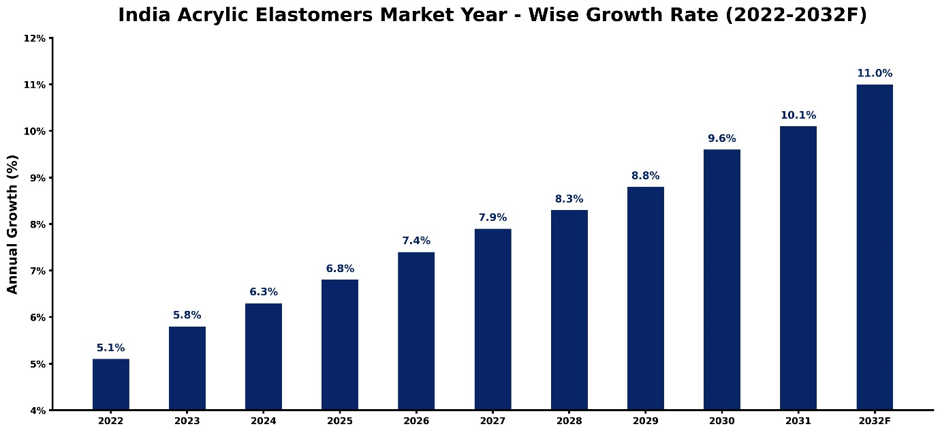
The following table presents the estimated annual growth rates of the market for each year, along with the key factors influencing market performance during the respective period. The values are intended to highlight year-wise drivers rather than provide a direct comparison between individual years.
| Year | Estimated Annual Growth (%) | Market Rationale |
| 2022 | 5.1% | Increasing vehicle production supported demand for durable elastomer components nationwide. |
| 2023 | 5.8% | Expanding automotive manufacturing increased adoption of heat-resistant elastomers across industries. |
| 2024 | 6.3% | Infrastructure growth increased demand for advanced sealing materials for equipment. |
| 2025 | 6.8% | Automotive electrification and manufacturing improvements increased durable elastomer adoption significantly. |
| 2026 | 7.4% | Growing demand for heat-resistant elastomers will accelerate automotive adoption further. |
| 2027 | 7.9% | Domestic vehicle production expansion is expected to support demand growth. |
| 2028 | 8.3% | Specialty elastomer use in machinery is expected to increase steadily. |
| 2029 | 8.8% | Lightweight vehicle requirements are strengthening demand for advanced elastomers nationwide. |
| 2030 | 9.6% | Industrial automation is increasing demand for reliable sealing solutions widely. |
| 2031 | 10.1% | High-performance elastomer adoption across industries is expected to expand further. |
| 2032 | 11% | Durable temperature-resistant elastomers are expected to support sustained market expansion. |
Topics Covered in the India Acrylic Elastomers Market Report
The India Acrylic Elastomers Market report provides detailed analysis across Type and Application segments. The report provides a detailed analysis of ongoing market trends, opportunities/high-growth areas, and market drivers that will help stakeholders align strategies based on current and future market dynamics.
India Acrylic Elastomers Market Highlights
| Report Name | India Acrylic Elastomers Market |
| Forecast period | 2026-2032 |
| CAGR | 9.7% |
| Growing Sector | Specialty Chemicals |
India Acrylic Elastomers Market Overview
The growth of the India Acrylic Elastomers Market is estimated to surge owing to increasing demand for high-performance elastomer materials in automotive, industrial, and construction applications. Acrylic elastomers are high-performance synthetic rubber materials designed to provide excellent resistance to heat, oil, oxidation, and weathering, while maintaining flexibility and durability under demanding conditions. Increasing adoption of advanced sealing components and flexible materials across end-use industries is further supporting market expansion and creating new opportunities for manufacturers during the forecast period.
Evaluation of Drivers in India Acrylic Elastomers Market (2026–2032)
Below mentioned are some major drivers and their influence on the market dynamics:
| Drivers | Primary Segment Affected | Why It Matters (Evidence) |
| Rising automotive production and component manufacturing | Automotive Application, Ethylene Acrylic Elastomers | Increasing vehicle manufacturing boosts demand for durable sealing components. |
| Growing demand for high-performance sealing materials | Acrylic Co-Monomer Elastomer, Industrial Application | Advanced elastomers improve equipment performance and operational reliability significantly. |
| Expansion of industrial manufacturing activities | Industrial Application | Machinery growth increases demand for durable elastomer components. |
| Increasing infrastructure and construction activities | Construction Application | Weather resistant and durable elastomer materials are required for infrastructure projects. |
| Development of advanced automotive technologies | Automotive Application | Modern vehicles require high-performance materials for improved component efficiency. |
The India Acrylic Elastomers Market growth is projected to reach at a CAGR of 9.7% during 2026–2032, due to increasing demand for durable elastomer solutions across automotive, industrial, and construction sectors. The market is expected to benefit from rising vehicle production, expanding manufacturing capabilities, and increasing preference for materials that provide superior resistance against heat, oil, and environmental conditions. The automotive component manufacturers, industrial equipment manufacturers and construction related industries are increasingly looking at the use of acrylic elastomers to improve product durability and performance.
Evaluation of Restraints in India Acrylic Elastomers Market
Below mentioned are some major restraints and their influence on market dynamics:
| Market Restraint | Primary Segment Affected | Why It Matters (Evidence) |
| High production costs compared to conventional elastomers | Acrylic Co-Monomer Elastomer, Ethylene Acrylic Elastomers | Advanced processing technologies increase specialty elastomer manufacturing expenses. |
| Availability of alternative elastomer materials | Automotive, Industrial Application | Alternative materials create competition across various application areas. |
| Raw material price fluctuations | Manufacturing Sector | Chemical price changes impact production costs and pricing strategies. |
| Limited awareness among small-scale industries | Industrial Application | Limited knowledge slows specialty elastomer adoption among smaller manufacturers. |
| Processing and compatibility challenges | Acrylic Co-Monomer Elastomer | Technical requirements complicate integration into existing manufacturing processes. |
Challenges in the India Acrylic Elastomers Market
The India Acrylic Elastomers Industry is facing challenges like high production costs, availability of substitute elastomer materials and fluctuation in raw material cost which may impact its growth path. Moreover, the usage of acrylic elastomers requires technical knowledge for the correct selection of materials, processing and customization according to application needs. Adoption rates may differ between large enterprises and other industrial users, which may affect the expansion of the market. Also challenges for manufacturers are product consistency, cost efficiency and the development of competitive solutions.
Trends in the India Acrylic Elastomers Market
Below mentioned are some of the trends shaping the India Acrylic Elastomers Market Growth are:
- Trend toward High-Performance Automotive Elastomers: Automotive manufacturers are increasingly adopting advanced elastomer materials that can withstand higher temperatures, oil exposure, and mechanical stress.
- Growing Demand for Lightweight and Durable Vehicle Components: The automotive industry is focusing on reducing vehicle weight while improving component performance.
- Increasing Use of Specialty Elastomers in Industrial Equipment: Industry is focusing on materials that can improve reliability of equipment and reduce the need for maintenance.
Investment Opportunities in the India Acrylic Elastomers Market
Some of the investment opportunities in the India Acrylic Elastomers Market are:
- Automotive component manufacturing: The growth of vehicle production and the increased demand for high-performance materials may present opportunities for investment in automotive components made from acrylic elastomers, including seals, hoses, and gaskets.
- Specialty Elastomer Manufacturing Facilities: Companies can establish state-of-the-art manufacturing facilities for acrylic elastomers to meet the growing domestic demand and to reduce dependence on imported specialty materials.
- Industrial Applications and Equipment Solutions: The production of acrylic elastomer parts for industrial machinery, processing equipment and engineering tasks can offer opportunities as industries look for durable materials with long service lives.
Leading Players in India Acrylic Elastomers Market
Stated below are some of the leading companies contributing significantly to the India Acrylic Elastomers Market Share:
1. DuPont
| Company Name | DuPont |
| Established Year | 1802 |
| Headquarters | Wilmington, Delaware, United States |
| Official Website | Click Here |
DuPont provides advanced material solutions, including specialty elastomers and performance polymers used in automotive, industrial, and engineering applications.
2. Zeon Corporation
| Company Name | Zeon Corporation |
| Established Year | 1950 |
| Headquarters | Tokyo, Japan |
| Official Website | Click Here |
Zeon Corporation develops specialty elastomers and synthetic rubber materials used across automotive, industrial, and electronics industries.
3. NOK Corporation
| Company Name | NOK Corporation |
| Established Year | 1939 |
| Headquarters | Tokyo, Japan |
| Official Website | - |
NOK Corporation specializes in sealing technologies and industrial rubber products used in automotive and machinery applications.
4. Dow Inc.
| Company Name | Dow Inc. |
| Established Year | 1897 |
| Headquarters | Midland, Michigan, United States |
| Official Website | Click Here |
Dow provides specialty materials and polymer solutions for various industrial applications.
Government Initiatives in the India Acrylic Elastomers Market
The government of India is promoting industrial development, manufacturing expansion, infrastructure development and specialty chemical production through initiatives that promote domestic capabilities and use of advanced materials. Schemes such as Production Linked Incentive Scheme, Make in India, Automotive Mission Plan and National Infrastructure Pipeline encourage manufacturing, electric vehicle production, infrastructure development and growth of the chemical sector. These initiatives help strengthen supply chains, boost the development of technology and provide opportunities for specialty materials such as acrylic elastomers, which are used in the automotive, industrial and construction sectors throughout India growing economy.
Future Insight of the India Acrylic Elastomers Market
The India Acrylic Elastomers Market is expected to grow steadily as industries demand durable materials with superior resistance and performance. India automotive sector contributes over 7% to GDP and supports demand for advanced components. India manufactures over 25 million vehicles annually, thus providing opportunities for acrylic elastomer applications in seals and gaskets. Adoption is being supported by growing industrial manufacturing, infrastructure development and specialty chemical investments. Companies are turning to innovation and customized solutions to improve durability and efficiency in the automotive industry and beyond.
Market Segmentation Analysis
The report offers a comprehensive study of the following market segments and their leading categories:
By Type – Market Dominated by Acrylic Co-Monomer Elastomer, Ethylene Acrylic Elastomers Expected to Witness Strong Growth
According to Sumit Sagar, Senior Research Analyst at 6Wresearch, till 2025, Acrylic Co-Monomer Elastomer dominated the India Acrylic Elastomers Market with an estimated 62% market share, driven by its widespread adoption in automotive sealing components, gaskets, hoses, and industrial applications requiring resistance against heat, oil, and oxidation. Ethylene Acrylic Elastomers are predicted to grow strongly from 2026 to 2032, with a Compound Annual Growth Rate (CAGR) of 7.4%. The growth is expected to be driven by the growing demand for advanced elastomer materials with better temperature resistance and durability especially in automotive and industrial applications.
By Application – Market Dominated by Automotive, Industrial Segment Expected to Witness Strong Growth
Till 2025, Automotive dominated the India Acrylic Elastomers Market with an estimated 54% market share, driven by increasing vehicle production, transmission systems, hoses, and gaskets. From 2026 to 2032, the Industrial segment is expected to witness stronger growth with a CAGR of 7.6%, supported by increasing industrial automation and rising demand for durable elastomer components in machinery and processing equipment.
Note: Market size estimations and growth projections presented in this report are based on 6Wresearch's proprietary forecasting methodology, utilizing the latest available industry data, government publications, and primary research inputs.
Key Attractiveness of the Report
- 10 Years of Market Numbers
- Historical Data Starting from 2022 to 2025
- Base Year: 2025
- Forecast Data until 2032
- Key Performance Indicators Impacting the Market
- Major Upcoming Developments and Projects
Key Highlights of the Report:
- India Acrylic Elastomers Market Outlook
- Market Size of India Acrylic Elastomers Market, 2025
- Forecast of India Acrylic Elastomers Market, 2032
- Historical Data and Forecast of India Acrylic Elastomers Revenues & Volume for the Period 2022 - 2032
- India Acrylic Elastomers Market Trend Evolution
- India Acrylic Elastomers Market Drivers and Challenges
- India Acrylic Elastomers Price Trends
- India Acrylic Elastomers Porter's Five Forces
- India Acrylic Elastomers Industry Life Cycle
- Historical Data and Forecast of India Acrylic Elastomers Market Revenues & Volume By Type for the Period 2022 - 2032
- Historical Data and Forecast of India Acrylic Elastomers Market Revenues & Volume By Acrylic Co-Monomer Elastomer for the Period 2022 - 2032
- Historical Data and Forecast of India Acrylic Elastomers Market Revenues & Volume By Ethylene Acrylic Elastomers for the Period 2022 - 2032
- Historical Data and Forecast of India Acrylic Elastomers Market Revenues & Volume By Application for the Period 2022 - 2032
- Historical Data and Forecast of India Acrylic Elastomers Market Revenues & Volume By Automotive for the Period 2022 - 2032
- Historical Data and Forecast of India Acrylic Elastomers Market Revenues & Volume By Construction for the Period 2022 - 2032
- Historical Data and Forecast of India Acrylic Elastomers Market Revenues & Volume By Industrial for the Period 2022 - 2032
- India Acrylic Elastomers Import Export Trade Statistics
- Market Opportunity Assessment By Type
- Market Opportunity Assessment By Application
- India Acrylic Elastomers Top Companies Market Share
- India Acrylic Elastomers Competitive Benchmarking By Technical and Operational Parameters
- India Acrylic Elastomers Company Profiles
- India Acrylic Elastomers Key Strategic Recommendations
Market Covered
The report offers an extensive study of the following market segments:
By Type
- Acrylic Co-Monomer Elastomer
- Ethylene Acrylic Elastomers
By Application
- Automotive
- Construction
- Industrial






































