India Aerospace & Defense C-class Parts Market Size, Share & Growth Rate
The India Aerospace & Defense C-class Parts Market was estimated at USD 654 Million in 2025 and is projected to reach USD 945 Million by 2032, growing at a CAGR of 5.4% from 2026 to 2032. This growth trajectory is primarily fueled by the ongoing expansion of India's aerospace and defense sectors, alongside rising domestic manufacturing capabilities. The increasing emphasis on high-quality, locally-sourced components further accelerates demand, positioning the C-class parts market as a pivotal element in the broader industry landscape.
India Aerospace & Defense C-class Parts Market Year-wise Growth Rate and Key Drivers
This graph highlights how the India Aerospace & Defense C-class Parts Market has steadily grown over the years, supported by major growth factors.
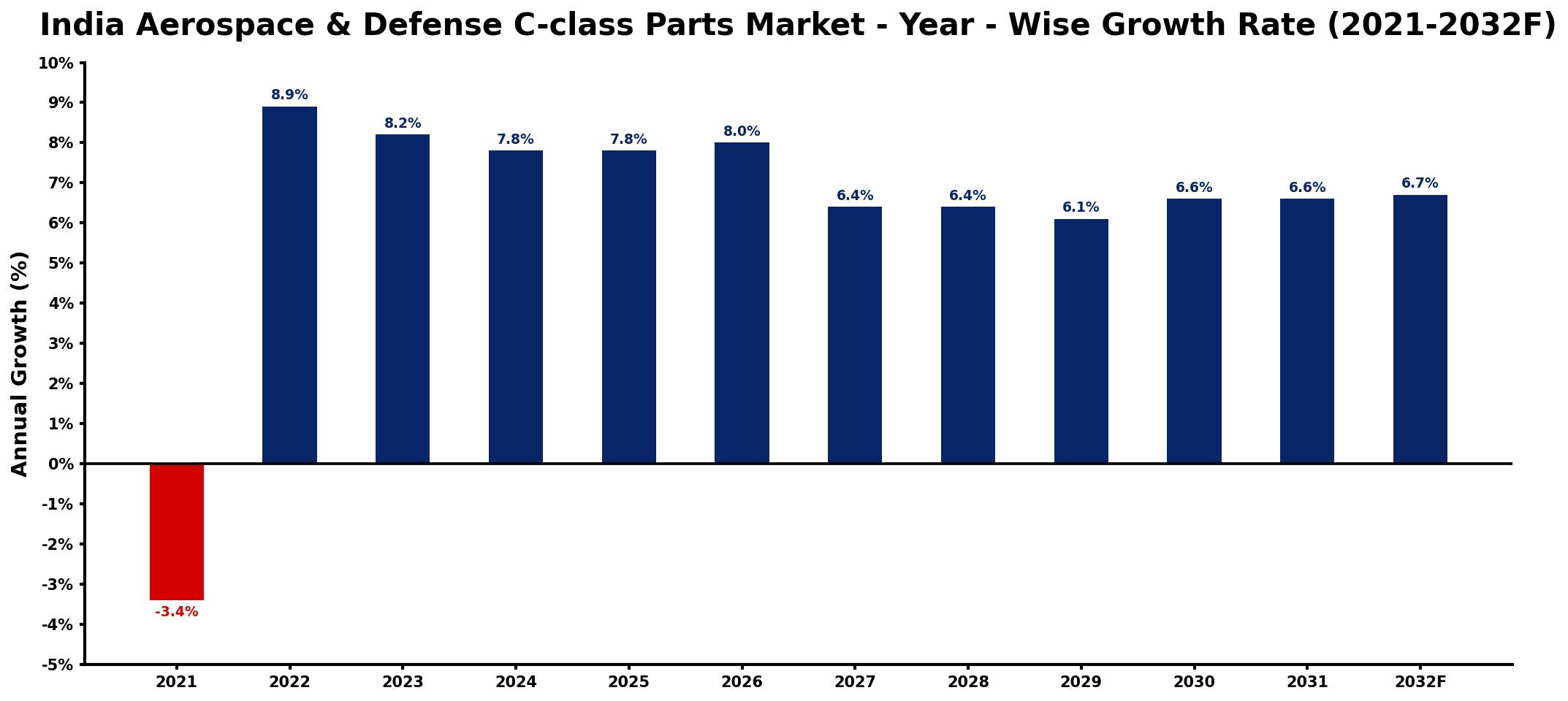
The table below presents the year‑wise growth rates along with the key drivers influencing the market
| Year | Growth Rate | Major Drivers |
| 2021 | -3.4% | decreased military spending on equipment |
| 2022 | 8.9% | growing emerging market penetration |
| 2023 | 8.2% | growing demand for modernization projects |
| 2024 | 7.8% | expansion of research and development |
| 2025 | 7.8% | rising private sector participation |
| 2026 | 8.0% | enhanced international collaboration efforts |
| 2027 | 6.4% | growing need for technological upgrades |
| 2028 | 6.4% | increased focus on indigenous manufacturing |
| 2029 | 6.1% | increased overall sector activity |
| 2030 | 6.6% | increased production capacity utilization |
| 2031 | 6.6% | increased investment in innovation |
| 2032 | 6.7% | rising focus on sustainability initiatives |
Note: Market size estimations and growth projections presented in this report are based on 6Wresearch's proprietary forecasting methodology, utilizing the latest available industry data, government publications, and primary research inputs.
India Aerospace & Defense C-class Parts Market Synopsis
In recent years, the India aerospace and defense C-class parts market has gained significant momentum, driven by the robust growth in aircraft manufacturing and defense equipment development. These small yet crucial components, including fasteners and fittings, are indispensable for ensuring the reliability and safety of aerospace and defense applications.
Moreover, the increasing focus on indigenous production and self-reliance in defense capabilities further supports the markets evolution. As the demand for advanced technology and precision engineering grows, manufacturers are adapting to meet stringent quality standards, cementing the importance of C-class parts in sustaining Indias aerospace and defense ambitions.
- The market is poised for robust growth, driven by increased investments in domestic aerospace and defense projects.
- Local sourcing initiatives are reshaping the supply chain dynamics, fostering the emergence of domestic C-class parts manufacturers.
- Technological advancements in manufacturing processes enhance the reliability and quality of parts, essential for compliance with industry standards.
- Government initiatives and defense modernization programs significantly influence market demand and development.
- The market's competitive landscape is marked by an ongoing emphasis on meeting stringent safety and quality regulations.
While the India aerospace and defense C-class parts market exhibits considerable growth potential, several real restraints hinder its progress. Competition from established domestic and international suppliers intensifies market dynamics, necessitating a focus on differentiation through quality and innovation. Additionally, the complexities associated with maintaining compliance with stringent international quality standards may deter some companies from entering the market. Furthermore, fluctuations in raw material prices pose challenges, impacting production costs and pricing strategies for manufacturers. As the sector matures, addressing these challenges will be key to sustaining growth and enhancing market competitiveness.
Several trends are shaping the landscape of the India aerospace and defense C-class parts market. There is an observable shift towards automation and advanced manufacturing techniques, enhancing the precision and efficiency of component production. Additionally, the increasing adoption of digital technologies and data analytics is revolutionizing supply chain management and quality control processes. The rising demand for lightweight and high-performance materials is also influencing the design and manufacturing of C-class parts, aligning with global sustainability goals. As these trends continue to evolve, they will significantly impact market dynamics and opportunities.
The opportunities within the India aerospace and defense C-class parts market are abundant, particularly for companies that prioritize innovation and quality. The ongoing government initiatives aimed at boosting indigenous manufacturing present a unique opportunity for local suppliers to establish themselves as key players in the supply chain. Furthermore, the focus on defense modernization and the establishment of new aerospace projects creates a demand for reliable, certified C-class parts. Companies that can offer advanced solutions tailored to the evolving needs of the aerospace and defense sectors are well-positioned to capitalize on this growth.
The Indian government has been proactive in fostering growth within the aerospace and defense sectors, introducing various initiatives and policies to enhance self-reliance. The "Make in India" campaign encourages domestic manufacturing, providing incentives for companies to localize production. Additionally, investments in research and development are being channeled into defense modernization programs, aimed at upgrading existing capabilities. By focusing on indigenous sourcing and technological advancements, the government is playing a critical role in shaping the market landscape for C-class parts.
Looking ahead to the period from 2026 to 2032, the India aerospace and defense C-class parts market is expected to experience substantial transformation driven by technological advancements and increased domestic production. As India continues to bolster its aerospace and defense capabilities, the demand for high-quality, reliable parts will intensify. Moreover, the trend towards greater collaboration between government and private sectors is likely to open new avenues for growth and innovation. In this evolving landscape, companies that adapt quickly to changing market needs and invest in advanced manufacturing technologies will stand to gain significantly.
Recent developments within the India aerospace and defense C-class parts market indicate a growing trend towards strategic partnerships and collaborations. Companies are increasingly focusing on joint ventures with technology providers to enhance their manufacturing capabilities and quality assurance processes. Additionally, ongoing government contracts aimed at modernizing defense infrastructure are expected to create further demand for reliable C-class components. As the market evolves, continuous investment in R&D is anticipated to lead to innovative solutions that meet the stringent requirements of the aerospace and defense industries.
- 10 Years of Market Numbers
- Historical Data Starting from 2022 to 2025
- Base Year: 2025
- Forecast Data until 2032
- Key Performance Indicators Impacting the Market
- Major Upcoming Developments and Projects
Key Highlights of the Report:
- India Aerospace & Defense C-class Parts Market Outlook
- Market Size of India Aerospace & Defense C-class Parts Market, 2025
- Forecast of India Aerospace & Defense C-class Parts Market, 2032
- Historical Data and Forecast of India Aerospace & Defense C-class Parts Revenues & Volume for the Period 2022-2032F
- India Aerospace & Defense C-class Parts Market Trend Evolution
- India Aerospace & Defense C-class Parts Market Drivers and Challenges
- India Aerospace & Defense C-class Parts Price Trends
- India Aerospace & Defense C-class Parts Porter's Five Forces
- India Aerospace & Defense C-class Parts Industry Life Cycle
- Historical Data and Forecast of India Aerospace & Defense C-class Parts Market Revenues & Volume By Product for the Period 2022-2032F
- Historical Data and Forecast of India Aerospace & Defense C-class Parts Market Revenues & Volume By Fasteners for the Period 2022-2032F
- Historical Data and Forecast of India Aerospace & Defense C-class Parts Market Revenues & Volume By Bearings for the Period 2022-2032F
- Historical Data and Forecast of India Aerospace & Defense C-class Parts Market Revenues & Volume By Electrical Parts for the Period 2022-2032F
- Historical Data and Forecast of India Aerospace & Defense C-class Parts Market Revenues & Volume By Machined Parts for the Period 2022-2032F
- Historical Data and Forecast of India Aerospace & Defense C-class Parts Market Revenues & Volume By Application for the Period 2022-2032F
- Historical Data and Forecast of India Aerospace & Defense C-class Parts Market Revenues & Volume By Engine for the Period 2022-2032F
- Historical Data and Forecast of India Aerospace & Defense C-class Parts Market Revenues & Volume By Aerostructure for the Period 2022-2032F
- Historical Data and Forecast of India Aerospace & Defense C-class Parts Market Revenues & Volume By Interiors for the Period 2022-2032F
- Historical Data and Forecast of India Aerospace & Defense C-class Parts Market Revenues & Volume By Equipment for the Period 2022-2032F
- Historical Data and Forecast of India Aerospace & Defense C-class Parts Market Revenues & Volume By Safety for the Period 2022-2032F
- Historical Data and Forecast of India Aerospace & Defense C-class Parts Market Revenues & Volume By Support for the Period 2022-2032F
- Historical Data and Forecast of India Aerospace & Defense C-class Parts Market Revenues & Volume By Avionics for the Period 2022-2032F
- Historical Data and Forecast of India Aerospace & Defense C-class Parts Market Revenues & Volume By End-use for the Period 2022-2032F
- Historical Data and Forecast of India Aerospace & Defense C-class Parts Market Revenues & Volume By Commercial for the Period 2022-2032F
- Historical Data and Forecast of India Aerospace & Defense C-class Parts Market Revenues & Volume By Military for the Period 2022-2032F
- Historical Data and Forecast of India Aerospace & Defense C-class Parts Market Revenues & Volume By Business & General Aviation for the Period 2022-2032F
- Historical Data and Forecast of India Aerospace & Defense C-class Parts Market Revenues & Volume By Others for the Period 2022-2032F
- India Aerospace & Defense C-class Parts Import Export Trade Statistics
- Market Opportunity Assessment By Product
- Market Opportunity Assessment By Application
- Market Opportunity Assessment By End-use
- India Aerospace & Defense C-class Parts Top Companies Market Share
- India Aerospace & Defense C-class Parts Competitive Benchmarking By Technical and Operational Parameters
- India Aerospace & Defense C-class Parts Company Profiles
- India Aerospace & Defense C-class Parts Key Strategic Recommendations






































