India Agricultural Tractor Market Growth Rate Analysis (2025 - 2031)
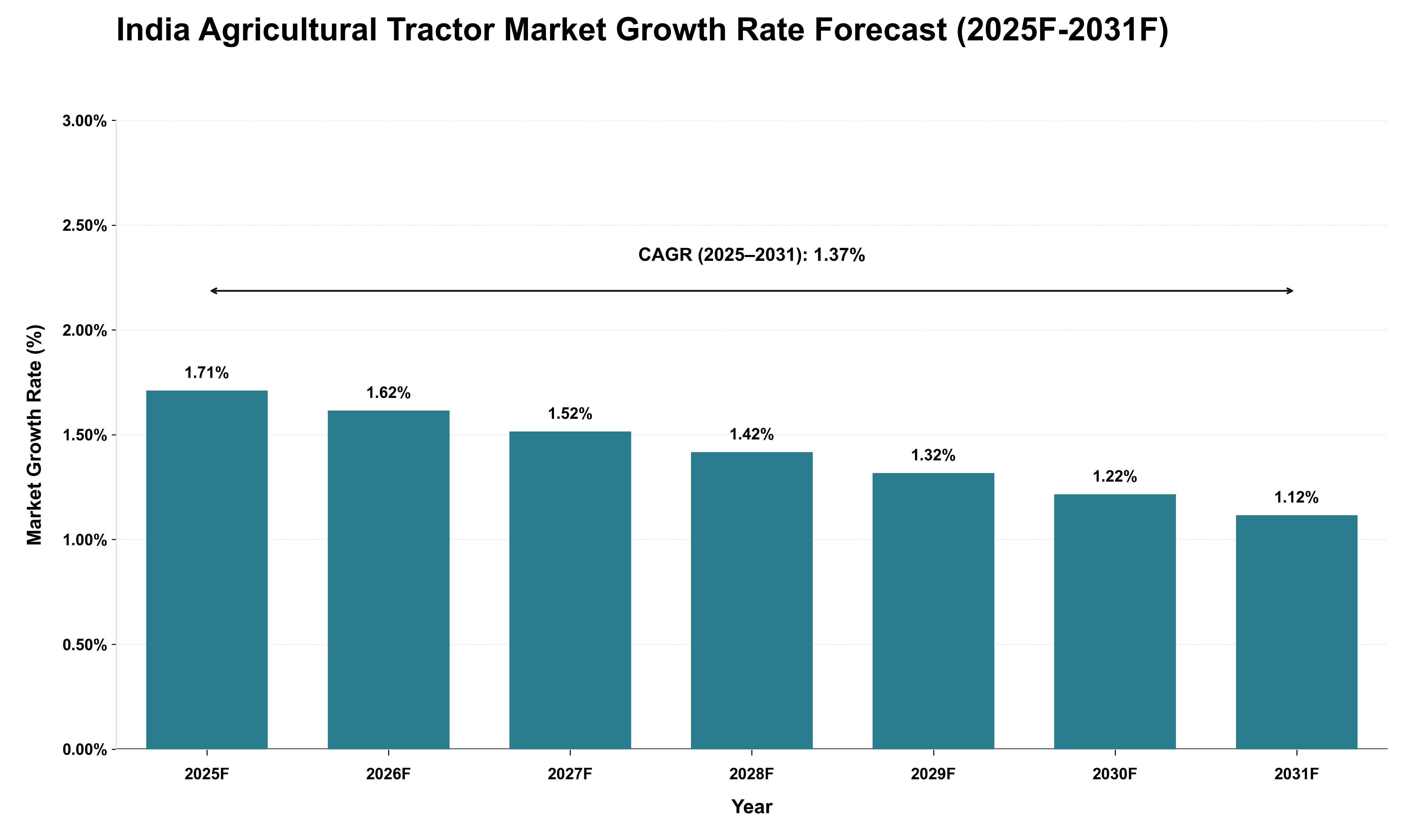
From 2025 onward, the Indian agricultural tractor market will experience a gradual deceleration in growth, with an anticipated CAGR of 1.37% reflecting evolving end-use demand dynamics. The initial years will see robust growth rates, peaking at 1.71% in 2025, driven by increasing mechanization in agriculture and rising labor costs that incentivize farmers to adopt more efficient technologies. However, as the market progresses through 2031, growth rates are expected to decline incrementally, reaching 1.12% by the end of the forecast period. This trend will likely be influenced by factors such as fluctuating commodity prices impacting farmers' purchasing power and potential shifts towards alternative farming practices or equipment. Additionally, import dependencies on advanced tractor technologies may create volatility in supply chains, further affecting demand patterns as domestic manufacturers strive to enhance competitiveness amidst these cyclical trends.
Key Highlights of the Report:
- India Agricultural Tractor Market Outlook
- Market Size of India Agricultural Tractor Market, 2024
- Forecast of India Agricultural Tractor Market, 2031
- Historical Data and Forecast of India Agricultural Tractor Revenues & Volume for the Period 2021- 2031
- India Agricultural Tractor Market Trend Evolution
- India Agricultural Tractor Market Drivers and Challenges
- India Agricultural Tractor Price Trends
- India Agricultural Tractor Porter's Five Forces
- India Agricultural Tractor Industry Life Cycle
- Historical Data and Forecast of India Agricultural Tractor Market Revenues & Volume By Engine Power for the Period 2021- 2031
- Historical Data and Forecast of India Agricultural Tractor Market Revenues & Volume By Lesser than 40 HP for the Period 2021- 2031
- Historical Data and Forecast of India Agricultural Tractor Market Revenues & Volume By 40 HP to 99 HP for the Period 2021- 2031
- Historical Data and Forecast of India Agricultural Tractor Market Revenues & Volume By 100 HP to 150 HP for the Period 2021- 2031
- Historical Data and Forecast of India Agricultural Tractor Market Revenues & Volume By 151 HP to 200 HP for the Period 2021- 2031
- Historical Data and Forecast of India Agricultural Tractor Market Revenues & Volume By 201 HP to 270 HP for the Period 2021- 2031
- Historical Data and Forecast of India Agricultural Tractor Market Revenues & Volume By 271 HP to 350 HP for the Period 2021- 2031
- Historical Data and Forecast of India Agricultural Tractor Market Revenues & Volume By Greater than 350 HP for the Period 2021- 2031
- Historical Data and Forecast of India Agricultural Tractor Market Revenues & Volume By Type for the Period 2021- 2031
- Historical Data and Forecast of India Agricultural Tractor Market Revenues & Volume By Orchard Tractors for the Period 2021- 2031
- Historical Data and Forecast of India Agricultural Tractor Market Revenues & Volume By Row-crop Tractors for the Period 2021- 2031
- Historical Data and Forecast of India Agricultural Tractor Market Revenues & Volume By Other Types for the Period 2021- 2031
- India Agricultural Tractor Import Export Trade Statistics
- Market Opportunity Assessment By Engine Power
- Market Opportunity Assessment By Type
- India Agricultural Tractor Top Companies Market Share
- India Agricultural Tractor Competitive Benchmarking By Technical and Operational Parameters
- India Agricultural Tractor Company Profiles
- India Agricultural Tractor Key Strategic Recommendations






































