India AI in Education Market Size & Growth Rate (2026-2032)
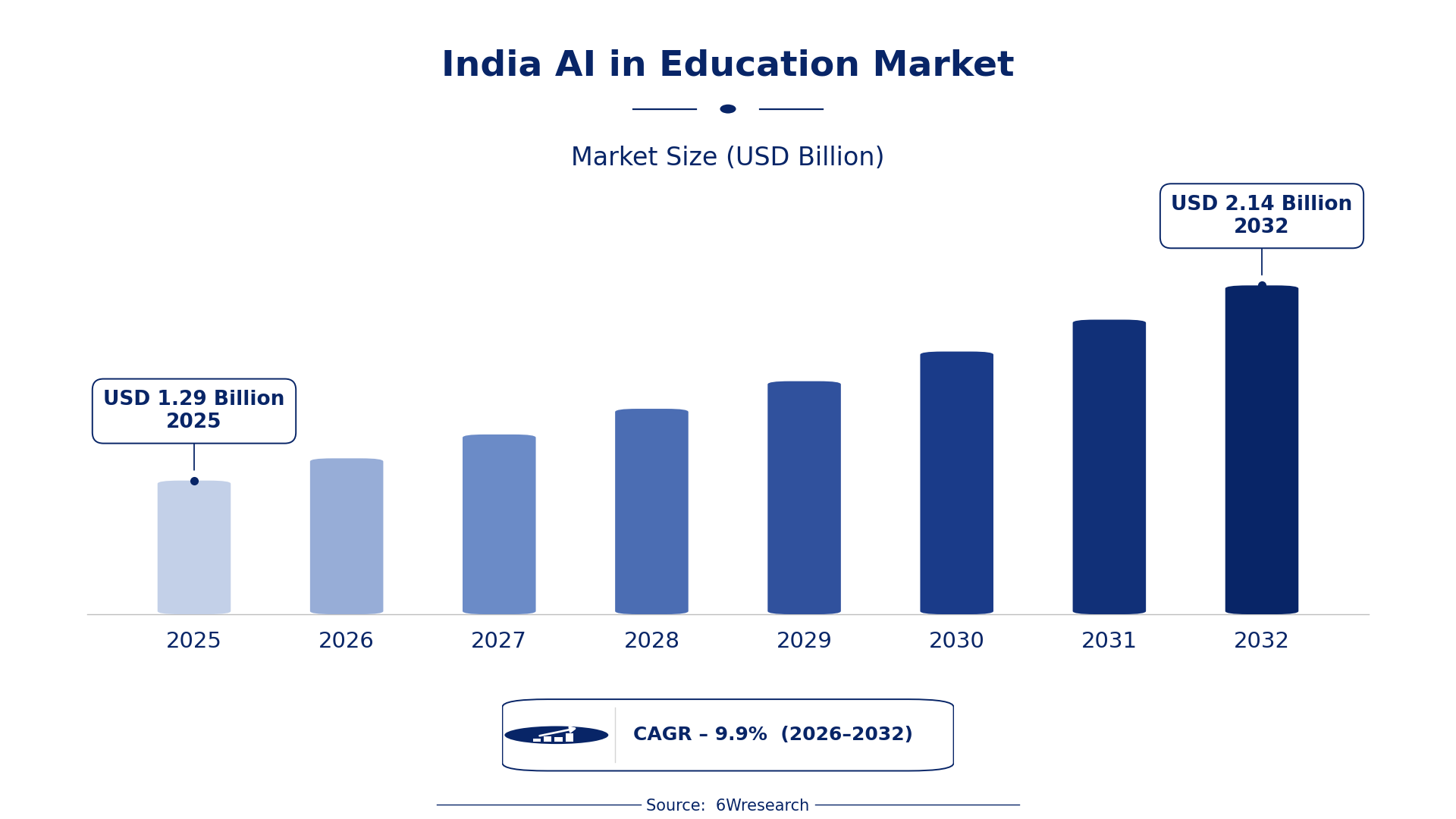
The India AI in Education Market was estimated at USD 1294 Million in 2025 and is projected to reach USD 2144 Million by 2032, growing at a CAGR of 9.9% from 2026 to 2032.
India AI in Education Market Synopsis
The most influential factor shaping the India AI in Education Market today is the increasing integration of technology within educational frameworks. This trend is driven by a need for personalized learning experiences and data-driven decision-making that enhances both teaching and learning outcomes.
As educational institutions and EdTech companies adopt AI technologies, the market is experiencing a transformation. From intelligent tutoring systems to automated grading, these innovations are not just enhancing educational delivery; they are reimagining the very essence of learning.
India AI in Education Market Year-wise Growth Rate and Key Drivers
This graph illustrates the annual growth rates of the India AI in Education Market from 2021 to 2032, highlighting a steady upward trajectory and projected expansion over the forecast period.
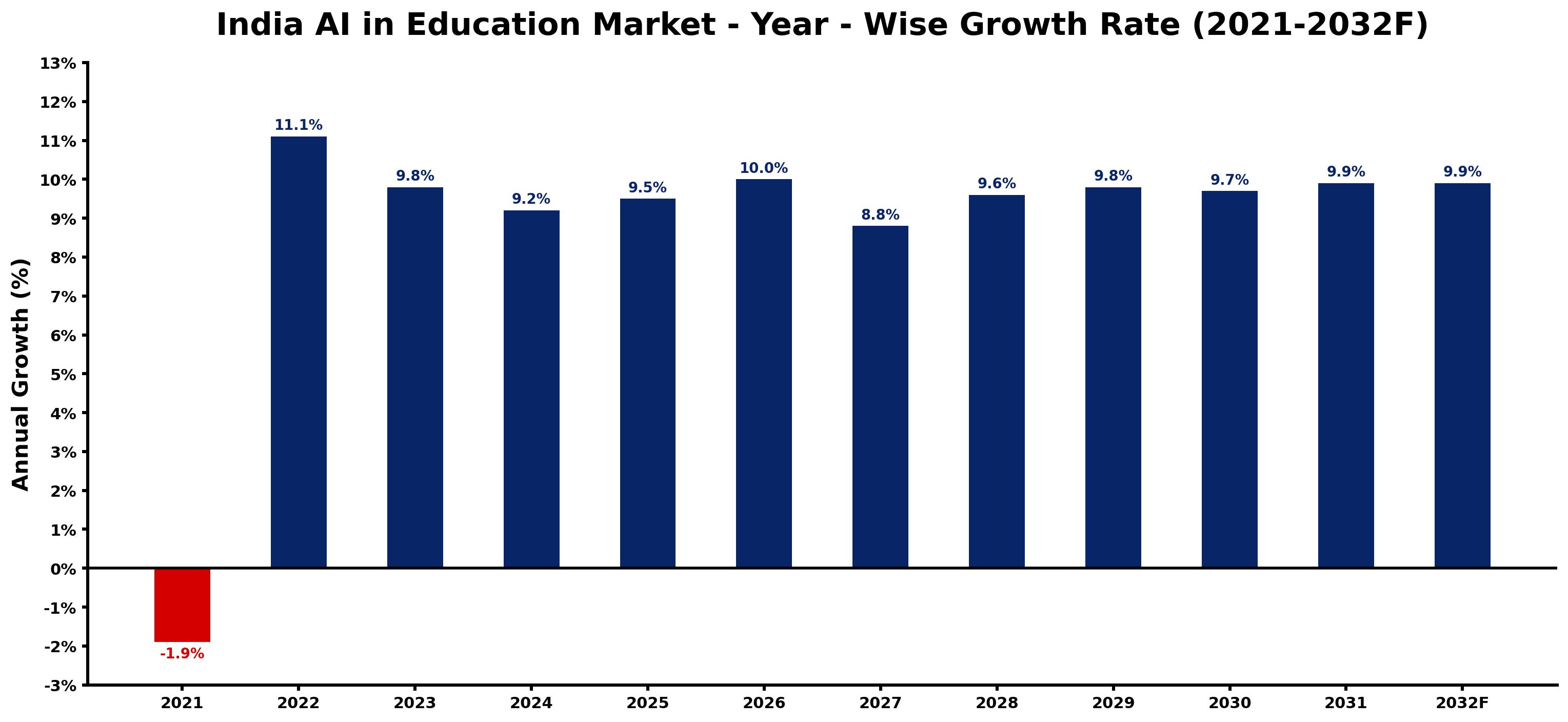
The table below presents the year‑wise growth rates along with the key drivers influencing the market
| Year | Growth Rate | Major Drivers |
| 2021 | -1.9% | COVID-19 disruptions led to decreased enrollment rates. |
| 2022 | 11.1% | National Education Policy promoting digital learning integration |
| 2023 | 9.8% | Increased investment in EdTech startups by Indian government |
| 2024 | 9.2% | Rising adoption of personalized learning platforms in schools |
| 2025 | 9.5% | Government grants for AI-based educational software development |
| 2026 | 10.0% | Collaboration with local universities on AI curriculum enhancements |
| 2027 | 8.8% | Surge in online tutoring platforms utilizing AI technology |
| 2028 | 9.6% | Growing focus on STEM education within Indian schools |
| 2029 | 9.8% | Corporate partnerships boosting AI training for teachers |
| 2030 | 9.7% | Increased smartphone penetration facilitating mobile learning solutions |
| 2031 | 9.9% | Rising interest in data-driven student performance analytics |
| 2032 | 9.9% | Emergence of AI-enabled career guidance services for students |
Note: Market size estimations and growth projections presented in this report are based on 6Wresearch's proprietary forecasting methodology, utilizing the latest available industry data, government publications, and primary research inputs.
India AI in Education Market Key Takeaways
Below are some of the specific key takeaways from the market, including:
- The Indian government’s push for digital education is accelerating AI adoption across various educational levels.
- Demand for personalized learning solutions is creating opportunities for innovative AI-driven platforms.
- Data privacy concerns and equitable access to technology remain significant challenges in the sector.
- AI's role in automating administrative tasks is freeing up educators to focus more on teaching.
- Major EdTech players are leading the charge in integrating AI into their educational offerings.
Evaluation of Restraints in India AI in Education Market
Despite its promising growth trajectory, the India AI in Education Market faces considerable restraints. One of the most pressing issues is ensuring equitable access to AI-driven educational tools across diverse socio-economic backgrounds. The vast disparity in technological infrastructure can hinder the widespread adoption of AI solutions.
Additionally, privacy concerns regarding student data usage present a significant barrier. Stakeholders in education must navigate these complex issues to unlock the full potential of AI in enhancing educational outcomes.
India AI in Education Market Trends
Several trends are shaping the demand and technology in the India AI in Education Market. Firstly, the shift towards hybrid learning models is prompting educational institutions to integrate AI tools that facilitate online and offline learning experiences.
Another notable trend is the growing emphasis on data analytics. Educational institutions are increasingly utilizing AI-driven analytics to track student performance and identify areas needing intervention, fostering a more proactive approach to education.
India AI in Education Market Opportunities
Opportunities for growth in this market are substantial. The rising demand for personalized learning experiences creates a fertile ground for innovative AI applications. Companies that can develop adaptive learning technologies are likely to capture significant market share.
on top of that, collaboration between government bodies and private sector players can lead to the development of more inclusive educational frameworks, ensuring that AI technologies reach underserved populations.
Government Initiatives in the India AI in Education Market
Government initiatives are pivotal in shaping the AI in Education Market in India. The emphasis on digital education reforms has set a strong foundation for AI technologies to flourish within academic institutions. Current policies prioritize enhancing educational access and quality through innovative tech solutions.
- A recently completed initiative focused on upgrading digital infrastructure in rural schools, facilitating better access to online learning resources.
- Ongoing programs are aimed at integrating AI tools in teacher training modules, helping educators effectively utilize technology in their classrooms.
- A planned national curriculum overhaul is set to incorporate AI-driven assessment methodologies by 2027.
- Current projects are underway to establish AI research centers in collaboration with universities to foster innovation in educational technology.
Future Insights of the India AI in Education Market
Looking ahead to 2026-2032, the India AI in Education Market is expected to expand significantly. Innovations in AI technology will lead to more sophisticated educational tools that enhance student engagement and learning outcomes. As institutions continue to adopt these technologies, the market will likely see an influx of investment aimed at developing new applications and improving existing platforms.
In addition, the collaboration between public and private sectors is anticipated to grow, fostering an environment conducive to the development of scalable AI solutions that cater to the diverse needs of the Indian education system.
India AI in Education Market Latest Developments
In the past year, the India AI in Education Market has witnessed dynamic developments that signal a shift towards more innovative educational methodologies. Major players are investing in technology upgrades and collaborative initiatives to enhance educational delivery and accessibility.
- A new AI-powered personalized learning platform was launched in early 2025, designed to tailor educational content to individual learning styles.
- An ongoing initiative aimed at integrating AI tools into assessment processes has shown promising results in improving academic performance among students.
- A partnership between educational institutions and tech companies is currently underway, focused on developing AI-driven tools for real-time feedback in classrooms.
- Plans for an upcoming AI-based mentorship program are expected to roll out by late 2026, connecting students with industry experts.
India AI in Education Market - Key Attractiveness of the Report
- 10 Years of Market Numbers
- Historical Data Starting from 2022 to 2025
- Base Year: 2025
- Forecast Data until 2032
- Key Performance Indicators Impacting the Market
- Major Upcoming Developments and Projects
Key Highlights of the Report:
- India AI in Education Market Outlook
- Market Size of India AI in Education Market, 2025
- Forecast of India AI in Education Market, 2032
- Historical Data and Forecast of India AI in Education Revenues & Volume for the Period 2022-2032F
- India AI in Education Market Trend Evolution
- India AI in Education Market Drivers and Challenges
- India AI in Education Price Trends
- India AI in Education Porter's Five Forces
- India AI in Education Industry Life Cycle
- Historical Data and Forecast of India AI in Education Market Revenues & Volume By Technology for the Period 2022-2032F
- Historical Data and Forecast of India AI in Education Market Revenues & Volume By Deep Learning and Machine Learning for the Period 2022-2032F
- Historical Data and Forecast of India AI in Education Market Revenues & Volume By Natural Language Processing (NLP) for the Period 2022-2032F
- Historical Data and Forecast of India AI in Education Market Revenues & Volume By Component for the Period 2022-2032F
- Historical Data and Forecast of India AI in Education Market Revenues & Volume By Solutions for the Period 2022-2032F
- Historical Data and Forecast of India AI in Education Market Revenues & Volume By Services for the Period 2022-2032F
- Historical Data and Forecast of India AI in Education Market Revenues & Volume By Application for the Period 2022-2032F
- Historical Data and Forecast of India AI in Education Market Revenues & Volume By Virtual Facilitators and Learning Environments for the Period 2022-2032F
- Historical Data and Forecast of India AI in Education Market Revenues & Volume By Intelligent Tutoring Systems (ITS) for the Period 2022-2032F
- Historical Data and Forecast of India AI in Education Market Revenues & Volume By Content Delivery Systems for the Period 2022-2032F
- Historical Data and Forecast of India AI in Education Market Revenues & Volume By Fraud and Risk Management for the Period 2022-2032F
- Historical Data and Forecast of India AI in Education Market Revenues & Volume By Student-initiated learning for the Period 2022-2032F
- Historical Data and Forecast of India AI in Education Market Revenues & Volume By Others for the Period 2022-2032F
- Historical Data and Forecast of India AI in Education Market Revenues & Volume By Deployment for the Period 2022-2032F
- Historical Data and Forecast of India AI in Education Market Revenues & Volume By Cloud for the Period 2022-2032F
- Historical Data and Forecast of India AI in Education Market Revenues & Volume By On-premises for the Period 2022-2032F
- Historical Data and Forecast of India AI in Education Market Revenues & Volume By End for the Period 2022-2032F
- Historical Data and Forecast of India AI in Education Market Revenues & Volume By Educational Institutes for the Period 2022-2032F
- Historical Data and Forecast of India AI in Education Market Revenues & Volume By Educational Publishers for the Period 2022-2032F
- Historical Data and Forecast of India AI in Education Market Revenues & Volume By Others for the Period 2022-2032F
- India AI in Education Import Export Trade Statistics
- Market Opportunity Assessment By Technology
- Market Opportunity Assessment By Component
- Market Opportunity Assessment By Application
- Market Opportunity Assessment By Deployment
- Market Opportunity Assessment By End
- India AI in Education Top Companies Market Share
- India AI in Education Competitive Benchmarking By Technical and Operational Parameters
- India AI in Education Company Profiles
- India AI in Education Key Strategic Recommendations






































