India AI in IoT Market Size & Growth Rate (2026-2032)
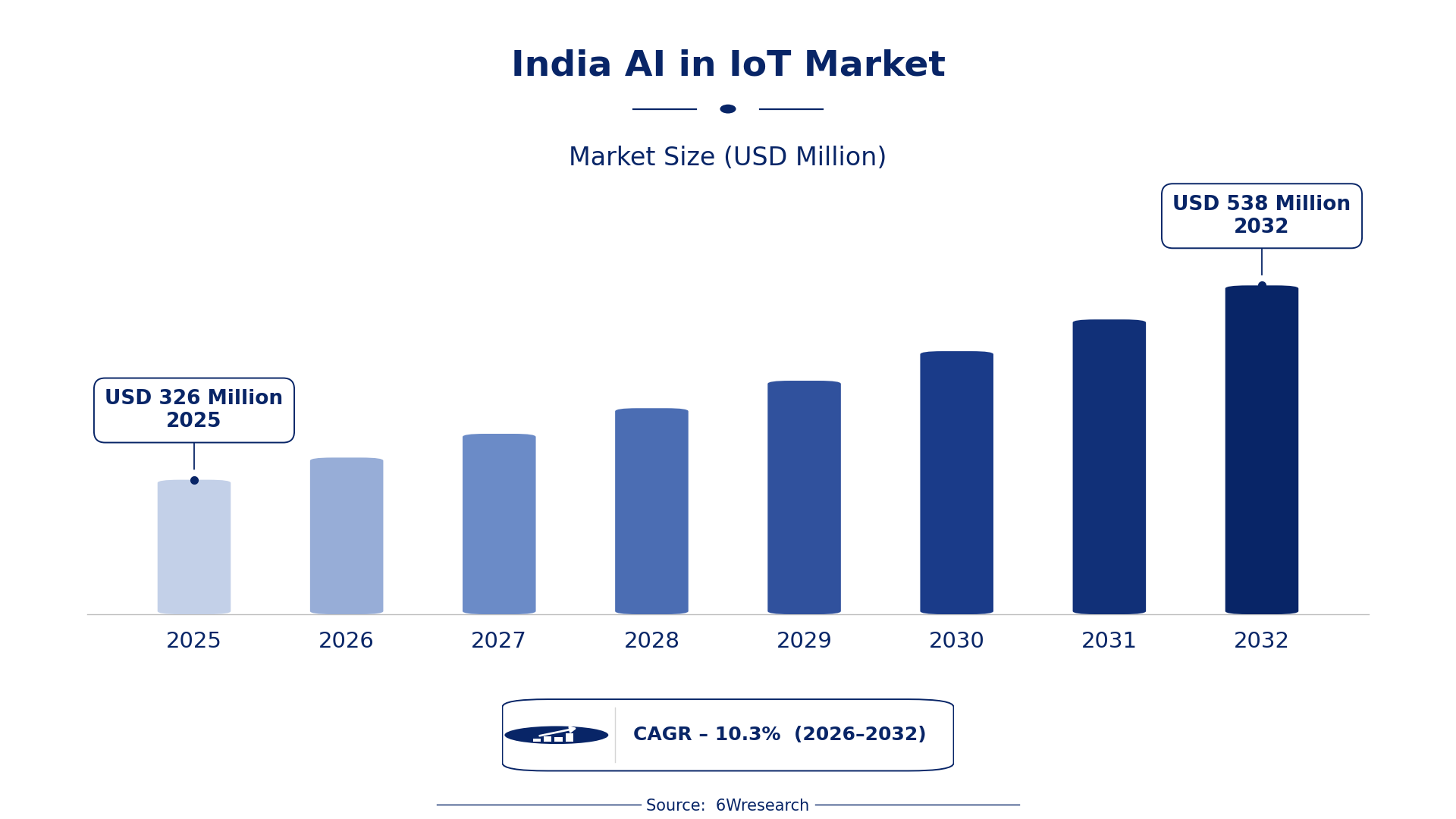
The India AI in IoT Market was estimated at USD 326 Million in 2025 and is projected to reach USD 538 Million by 2032, growing at a CAGR of 10.3% from 2026 to 2032.
India AI in IoT Market Synopsis
In India, the integration of artificial intelligence with the Internet of Things is revolutionizing industries. Businesses across sectors are increasingly adopting AI in IoT to process and analyze the vast data generated by smart devices, leading to improved efficiency and decision-making.
This market is witnessing a surge as organizations leverage AI capabilities for predictive maintenance and enhanced automation. Key industries like healthcare, agriculture, and smart cities are at the forefront of this technological convergence, highlighting the potential for sustained growth.
India AI in IoT Market Year-wise Growth Rate and Key Drivers
This graph illustrates the annual growth rates of the India AI in IoT Market from 2021 to 2032, highlighting a steady upward trajectory and projected expansion over the forecast period.
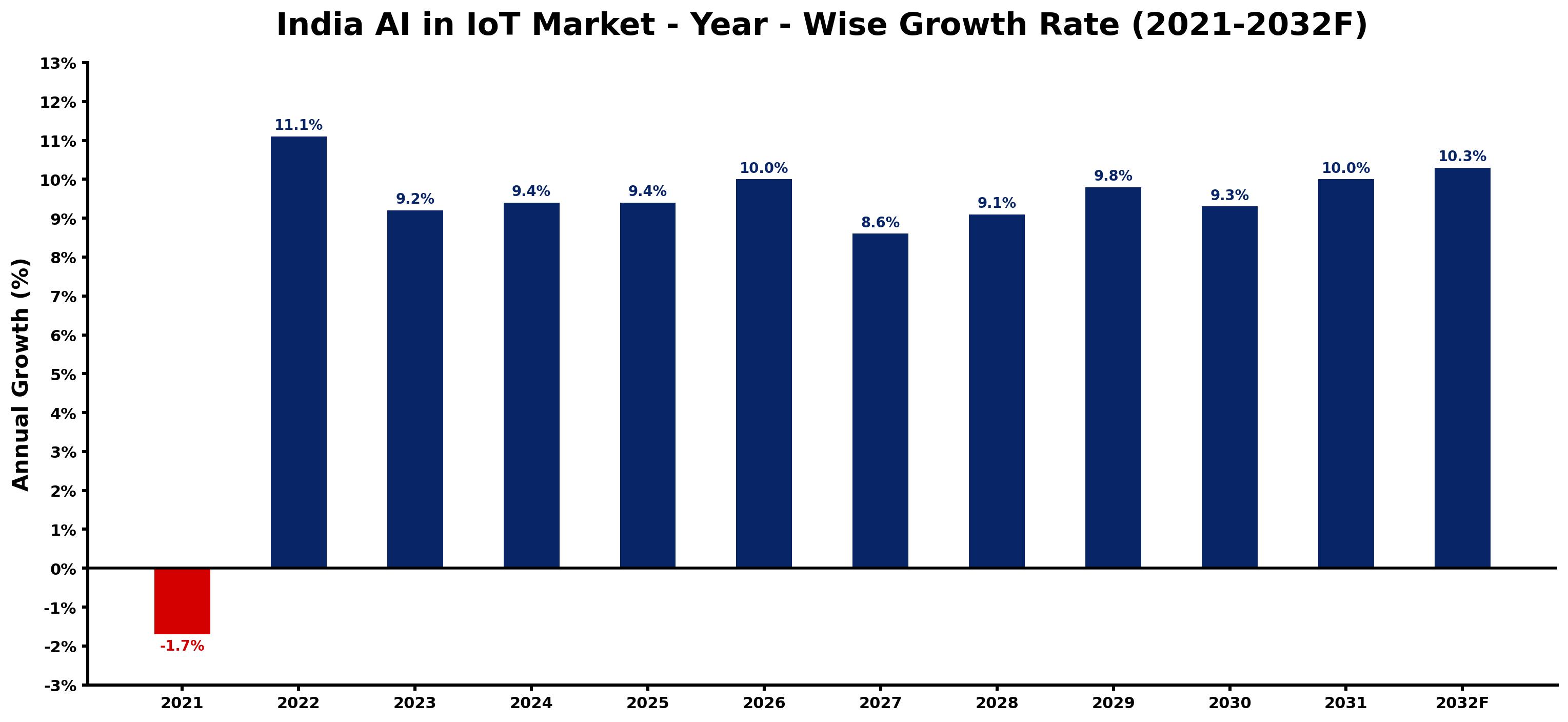
The table below presents the year‑wise growth rates along with the key drivers influencing the market
| Year | Growth Rate | Major Drivers |
| 2021 | -1.7% | Global chip shortage hindered IoT device production in India |
| 2022 | 11.1% | Government's Digital India initiative boosting IoT adoption. |
| 2023 | 9.2% | Increased investment in smart agriculture technologies nationwide. |
| 2024 | 9.4% | Higher government spending on smart city projects incentivizing IoT. |
| 2025 | 9.4% | Increased local startups innovating in AI for IoT solutions. |
| 2026 | 10.0% | Adoption of AI-enabled healthcare devices improving patient monitoring. |
| 2027 | 8.6% | Growing interest in industrial automation enhancing IoT functionalities. |
| 2028 | 9.1% | Sustained demand for real-time data analytics in businesses. |
| 2029 | 9.8% | Investment in renewable energy IoT solutions attracting funding. |
| 2030 | 9.3% | Rising popularity of connected vehicles driving AI integration. |
| 2031 | 10.0% | Government push for smart grids enhancing energy efficiency. |
| 2032 | 10.3% | Increased collaboration between tech firms for IoT advancements. |
Note: Market size estimations and growth projections presented in this report are based on 6Wresearch's proprietary forecasting methodology, utilizing the latest available industry data, government publications, and primary research inputs.
India AI in IoT Market Key Takeaways
Below are some of the specific key takeaways from the market, including:
- The market is driven by the need for real-time data analysis and automation across various sectors.
- AI technologies are enabling better predictive maintenance, reducing downtime in industrial operations.
- The increasing number of IoT devices is accelerating the demand for AI-driven solutions.
- Challenges related to interoperability and data security remain significant hurdles for market growth.
- Government initiatives are actively supporting the development and deployment of AI in IoT technologies.
Evaluation of Restraints in India AI in IoT Market
While the India AI in IoT market shows promise, it faces notable restraints that could impede its growth trajectory. A lack of standardization among various IoT devices complicates integration efforts, often leading to increased costs for businesses. Data security remains a pressing concern, particularly as sensitive information is frequently transmitted over networks. Additionally, infrastructure limitations in certain regions hinder the effective deployment of AI solutions, exacerbating the challenges associated with connectivity. Finally, the scarcity of skilled professionals proficient in both AI and IoT technologies poses a significant barrier to widespread adoption.
India AI in IoT Market Trends
Several trends are shaping the India AI in IoT market. Firstly, the rise of edge computing is allowing data processing closer to the source, enhancing real-time decision-making capabilities. Secondly, there is a growing focus on energy efficiency as businesses seek to optimize resource usage through intelligent automation. Thirdly, the application of AI in predictive analytics is becoming increasingly common, enabling companies to foresee maintenance needs and reduce operational costs. Lastly, the push for smart city initiatives is driving investments in AI-powered IoT solutions, aiming to improve urban infrastructure and services.
India AI in IoT Market Opportunities
The India AI in IoT market presents numerous opportunities for growth and investment. Companies can capitalize on the increasing demand for smart solutions in sectors such as agriculture, where AI can optimize crop management through real-time data analysis. The healthcare sector stands to benefit from AI-enabled IoT devices that monitor patient health, providing valuable insights and enhancing patient care. Additionally, the industrial automation space offers prospects for AI applications that improve production efficiency and safety. With the government's push for digital transformation, businesses can leverage public-private partnerships to accelerate the development of innovative AI in IoT solutions.
Government Initiatives in the India AI in IoT Market
Government initiatives play a crucial role in shaping the India AI in IoT market. The regulatory environment is becoming increasingly supportive, with policies aimed at fostering innovation and infrastructure development in this sector. As India moves toward a digital economy, public-sector priorities focus on enhancing connectivity and expanding IoT applications across various industries.
- A national digital infrastructure upgrade programme launched in early 2023 aims to enhance connectivity for IoT devices across urban and rural areas.
- Currently ongoing is a public-private initiative focused on developing AI standards and protocols to improve interoperability among IoT devices.
- A planned initiative expected to roll out by 2026 seeks to promote AI research and development in collaboration with academic institutions.
- The government has introduced funding schemes in 2024 to support startups developing innovative AI-driven IoT solutions.
- Another recently completed initiative involved the establishment of IoT testbeds to facilitate the development and deployment of smart technologies.
Future Insights of the India AI in IoT Market
Looking ahead to 2026-2032, the India AI in IoT market is expected to experience substantial growth driven by technological advancements and increasing adoption rates. As organizations recognize the value of AI in enhancing operational efficiency, investments in this domain will likely accelerate. The continued evolution of IoT technologies, coupled with government support for digital initiatives, will pave the way for innovative applications across various sectors. By 2032, the market's expansion is anticipated to be fueled by the integration of AI with next-generation IoT devices, creating new opportunities for businesses to optimize processes and drive competitive advantage.
India AI in IoT Market Latest Developments
The last 12-14 months have seen significant activity in the India AI in IoT market, as organizations strive to adopt cutting-edge technologies to remain competitive. Companies are increasingly launching new AI-powered IoT solutions tailored to specific industry needs, and partnerships are forming to enhance innovation in this space.
- A major technology vendor announced a partnership in early 2023 with a leading telecommunications company to develop AI-driven smart city solutions.
- A regional operator is currently rolling out an AI-based predictive maintenance tool for industrial applications, expected to be completed by mid-2025.
- A new IoT analytics platform was launched in late 2023, providing businesses with insights to optimize operations through AI integration.
- An initiative aimed at improving data security for IoT devices is underway, with pilot programs currently being tested in select urban areas.
- A rollout of AI-enhanced smart agriculture tools is planned for late 2024, targeting farmers to increase crop yield through data analytics.
India AI in IoT Market - Key Attractiveness of the Report
- 10 Years of Market Numbers
- Historical Data Starting from 2022 to 2025
- Base Year: 2025
- Forecast Data until 2032
- Key Performance Indicators Impacting the Market
- Major Upcoming Developments and Projects
Key Highlights of the Report:
- India AI in IoT Market Outlook
- Market Size of India AI in IoT Market, 2025
- Forecast of India AI in IoT Market, 2032
- Historical Data and Forecast of India AI in IoT Revenues & Volume for the Period 2022-2032F
- India AI in IoT Market Trend Evolution
- India AI in IoT Market Drivers and Challenges
- India AI in IoT Price Trends
- India AI in IoT Porter's Five Forces
- India AI in IoT Industry Life Cycle
- Historical Data and Forecast of India AI in IoT Market Revenues & Volume By Component for the Period 2022-2032F
- Historical Data and Forecast of India AI in IoT Market Revenues & Volume By Platforms for the Period 2022-2032F
- Historical Data and Forecast of India AI in IoT Market Revenues & Volume By Software Solutions for the Period 2022-2032F
- Historical Data and Forecast of India AI in IoT Market Revenues & Volume By Services for the Period 2022-2032F
- Historical Data and Forecast of India AI in IoT Market Revenues & Volume By Vertical for the Period 2022-2032F
- Historical Data and Forecast of India AI in IoT Market Revenues & Volume By Manufacturing for the Period 2022-2032F
- Historical Data and Forecast of India AI in IoT Market Revenues & Volume By Energy and Utilities for the Period 2022-2032F
- Historical Data and Forecast of India AI in IoT Market Revenues & Volume By Transportation and Mobility for the Period 2022-2032F
- Historical Data and Forecast of India AI in IoT Market Revenues & Volume By BFSI for the Period 2022-2032F
- Historical Data and Forecast of India AI in IoT Market Revenues & Volume By Government and Defense for the Period 2022-2032F
- Historical Data and Forecast of India AI in IoT Market Revenues & Volume By Retail for the Period 2022-2032F
- Historical Data and Forecast of India AI in IoT Market Revenues & Volume By Healthcare and Life Sciences for the Period 2022-2032F
- Historical Data and Forecast of India AI in IoT Market Revenues & Volume By Telecom for the Period 2022-2032F
- Historical Data and Forecast of India AI in IoT Market Revenues & Volume By Technology for the Period 2022-2032F
- Historical Data and Forecast of India AI in IoT Market Revenues & Volume By ML and Deep Learning for the Period 2022-2032F
- Historical Data and Forecast of India AI in IoT Market Revenues & Volume By NLP for the Period 2022-2032F
- India AI in IoT Import Export Trade Statistics
- Market Opportunity Assessment By Component
- Market Opportunity Assessment By Vertical
- Market Opportunity Assessment By Technology
- India AI in IoT Top Companies Market Share
- India AI in IoT Competitive Benchmarking By Technical and Operational Parameters
- India AI in IoT Company Profiles
- India AI in IoT Key Strategic Recommendations






































