India Algorithmic Trading Market Size & Growth Rate (2026-2032)
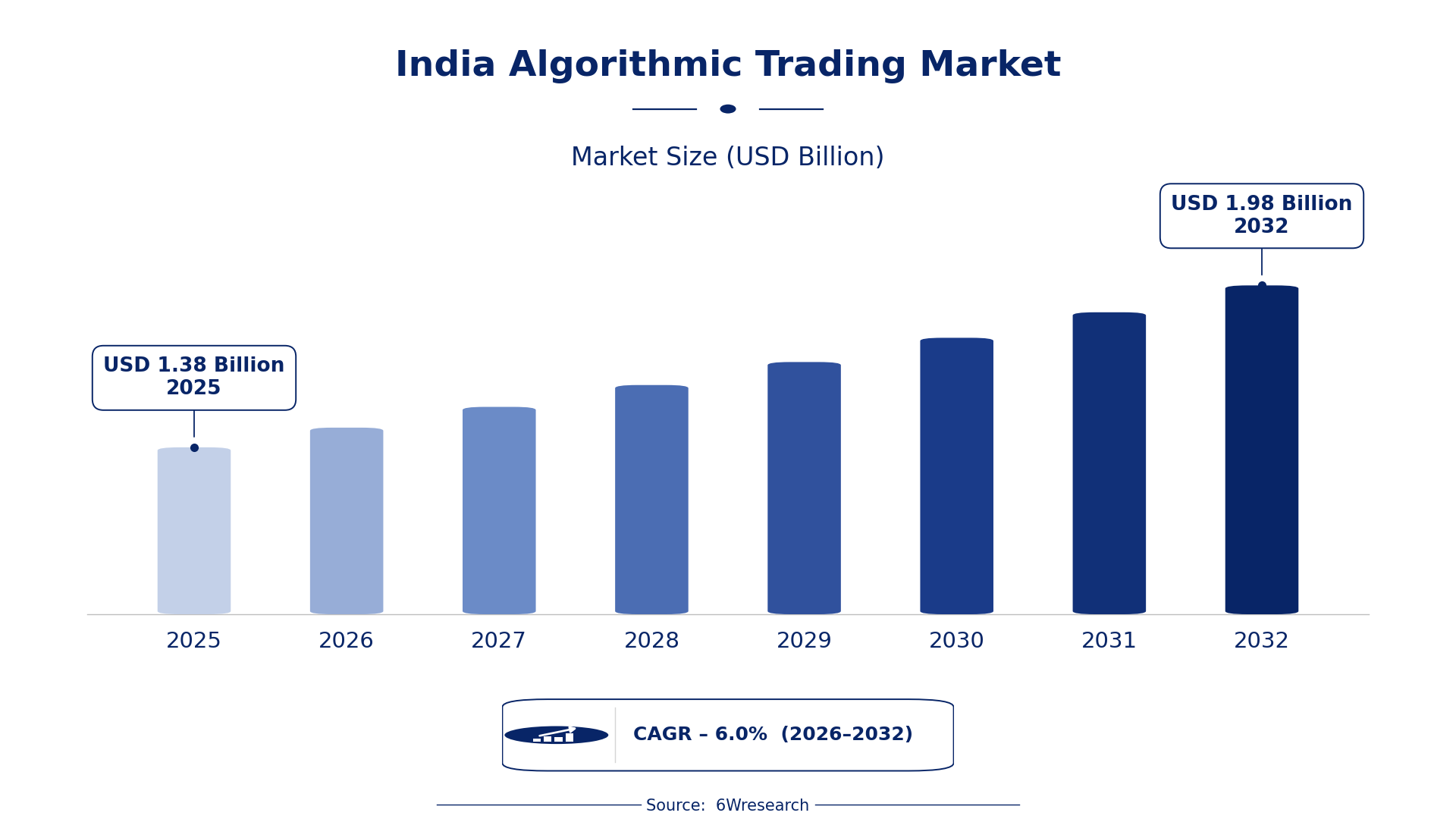
The India Algorithmic Trading Market was estimated at USD 1379 Million in 2025 and is projected to reach USD 1981 Million by 2032, growing at a CAGR of 6.0% from 2026 to 2032.
India Algorithmic Trading Market Synopsis
The automation of trading strategies is the primary force driving growth in the India Algorithmic Trading Market. As investors and financial institutions increasingly seek speed and precision in executing trades, algorithmic trading solutions have become indispensable tools for market participants.
The rise in trading volumes across Indian financial markets is further propelling the demand for algorithmic trading. With heightened competition and a pressing need for efficient trading practices, stakeholders are turning to advanced algorithms to optimize their trading performance.
India Algorithmic Trading Market Year-wise Growth Rate and Key Drivers
This graph illustrates the annual growth rates of the India Algorithmic Trading Market from 2021 to 2032, highlighting a steady upward trajectory and projected expansion over the forecast period.
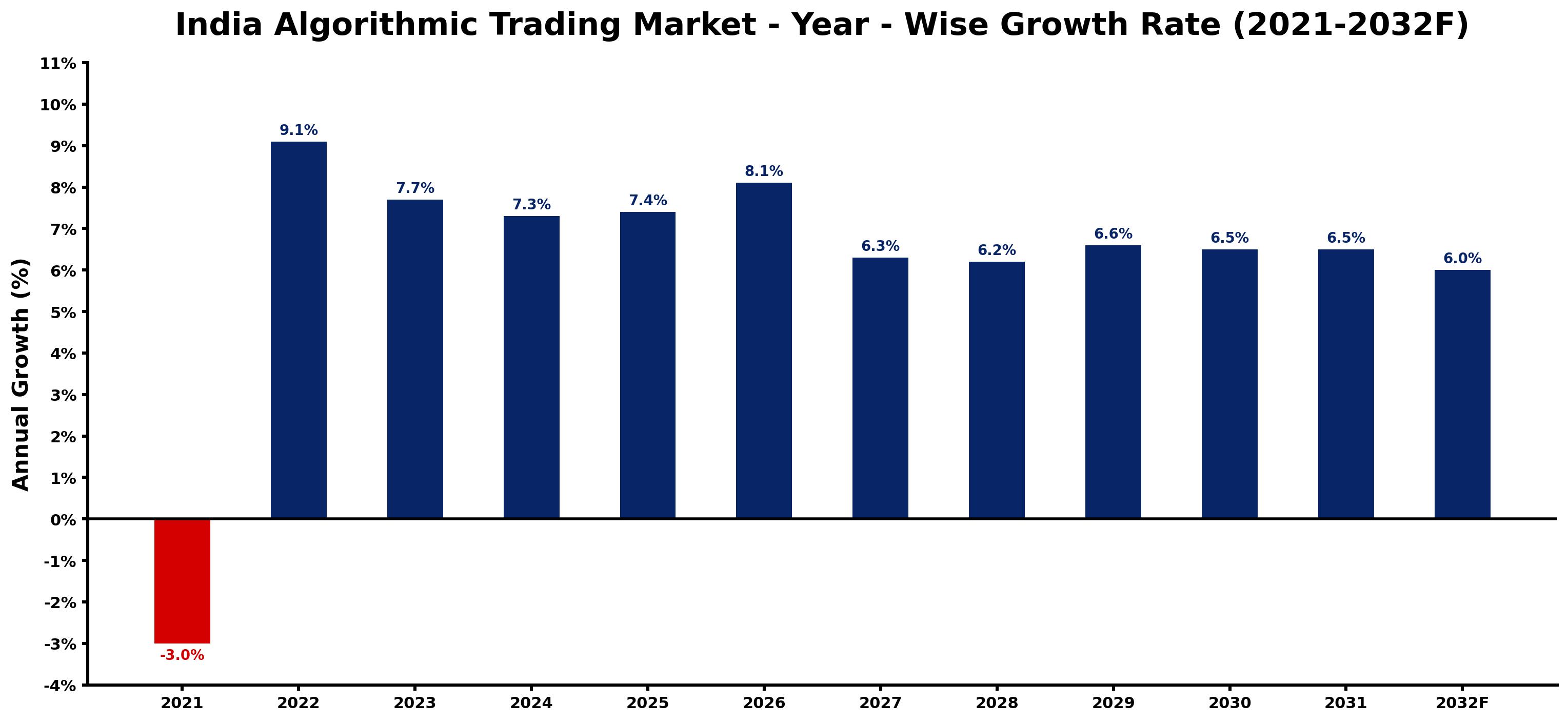
The table below presents the year‑wise growth rates along with the key drivers influencing the market
| Year | Growth Rate | Major Drivers |
| 2021 | -3.0% | Securities and Exchange Board of India restrictions imposed. |
| 2022 | 9.1% | Securities and Exchange Board of India encourages algorithmic strategies. |
| 2023 | 7.7% | Increase in retail investor participation due to digital platforms. |
| 2024 | 7.3% | Advancements in high-frequency trading technology adoption. |
| 2025 | 7.4% | Growing popularity of machine learning in market predictions. |
| 2026 | 8.1% | Enhanced regulatory framework for algorithmic trading in stocks. |
| 2027 | 6.3% | Rise in demand for efficient trading solutions by brokers. |
| 2028 | 6.2% | Increase in quantitative analysis courses among financial professionals. |
| 2029 | 6.6% | Surge in fintech startups focusing on trading algorithms. |
| 2030 | 6.5% | Government initiatives promoting digital financial literacy programs. |
| 2031 | 6.5% | Increased collaboration between universities and trading firms. |
| 2032 | 6.0% | Higher investment in cybersecurity for algorithmic platforms. |
Note: Market size estimations and growth projections presented in this report are based on 6Wresearch's proprietary forecasting methodology, utilizing the latest available industry data, government publications, and primary research inputs.
India Algorithmic Trading Market Key Takeaways
Below are some of the specific key takeaways from the market, including:
- The market is driven by the quest for speed and efficiency in trade execution.
- Technological infrastructure and low-latency capabilities are crucial for success.
- COVID-19 has accelerated the adoption of algorithmic trading strategies.
- Investment in research and development is vital for maintaining a competitive edge.
- Regulatory compliance remains a complex challenge for market participants.
Evaluation of Restraints in India Algorithmic Trading Market
While the India Algorithmic Trading Market is thriving, it faces real constraints. A key limitation is the necessity for sophisticated technological infrastructure that supports low-latency trading. The costs associated with developing and maintaining these systems can be prohibitively high for many traders.
on top of that, navigating the intricate web of market regulations poses a significant hurdle. Compliance with these regulations can be cumbersome, requiring substantial investments in legal and operational frameworks. The challenge is compounded by the need for effective risk management strategies to prevent market manipulation, which demands ongoing investment in innovation.
India Algorithmic Trading Market Trends
Several trends are shaping the India Algorithmic Trading Market. The integration of artificial intelligence and machine learning into trading algorithms is gaining traction, enabling traders to enhance their decision-making processes. Additionally, there is a growing interest in developing algorithmic strategies that can adapt to market volatility, especially in light of recent economic uncertainties.
on top of that, the emphasis on data analytics is becoming increasingly pronounced. Traders are now focusing on harnessing big data to inform their trading strategies, allowing for more accurate predictions and improved performance in highly competitive markets.
India Algorithmic Trading Market Opportunities
The India Algorithmic Trading Market is ripe with opportunities for growth and investment. As more financial institutions embrace automation, there is a heightened demand for sophisticated algorithmic trading platforms that can cater to diverse trading strategies. Companies that can develop tailored solutions to meet specific market needs will find ample room for expansion.
Additionally, the ongoing digital transformation within the financial sector presents a wealth of opportunities for technology providers. Collaborations between fintech firms and traditional financial institutions could lead to innovative trading solutions that enhance overall market efficiency.
Government Initiatives in the India Algorithmic Trading Market
The Indian government is actively shaping the Algorithmic Trading Market through various initiatives aimed at enhancing technological infrastructure and regulatory clarity. These public policy efforts are crucial, as they foster a conducive environment for investment and innovation in the sector.
- A national digital infrastructure upgrade programme launched in 2023 focuses on enhancing connectivity and speed for trading platforms.
- Currently ongoing efforts to streamline regulatory frameworks are designed to simplify compliance requirements for algorithmic trading participants.
- Planned initiatives to promote fintech innovation by 2025 aim to encourage the development of new algorithmic trading solutions.
- A recently completed initiative to enhance cybersecurity measures within financial markets is expected to bolster investor confidence in algorithmic trading.
- Ongoing dialogues between regulatory bodies and industry stakeholders aim to address emerging challenges in market manipulation and risk management.
Future Insights of the India Algorithmic Trading Market
Looking ahead to 2026-2032, the India Algorithmic Trading Market is set for significant evolution. As technological advancements continue to reshape trading practices, expect to see increased automation and the integration of cutting-edge analytics into trading strategies. The growing emphasis on data-driven decision-making will likely propel further investment in algorithmic trading solutions.
on top of that, as regulatory clarity improves, more participants may enter the market, enhancing competition. This influx will likely lead to innovative trading solutions that cater to a broader range of investors and traders, ensuring sustained market growth.
India Algorithmic Trading Market Latest Developments
Recent developments in the India Algorithmic Trading Market indicate a dynamic shift towards enhanced trading solutions and technological integration. Over the past year, the emphasis on innovation and efficiency has become increasingly pronounced, with numerous initiatives aimed at improving trading capabilities.
- A major technology vendor launched a new algorithmic trading platform in early 2023, designed to offer advanced analytics and real-time trading capabilities.
- An initiative that began in mid-2023 focuses on enhancing the speed and reliability of trading systems through upgrades in technological infrastructure.
- A partnership between fintech companies and financial institutions is currently underway, aimed at developing tailored algorithmic trading solutions for specific market segments.
- A rollout expected to begin in early 2024 will introduce enhanced regulatory compliance tools designed to assist traders in adhering to new standards.
- A service upgrade initiated in late 2023 aims to improve user experience for algorithmic trading platforms, focusing on intuitive design and functionality.
India Algorithmic Trading Market - Key Attractiveness of the Report
- 10 Years of Market Numbers
- Historical Data Starting from 2022 to 2025
- Base Year: 2025
- Forecast Data until 2032
- Key Performance Indicators Impacting the Market
- Major Upcoming Developments and Projects
Key Highlights of the Report:
- India Algorithmic Trading Market Outlook
- Market Size of India Algorithmic Trading Market, 2025
- Forecast of India Algorithmic Trading Market, 2032
- Historical Data and Forecast of India Algorithmic Trading Revenues & Volume for the Period 2022-2032F
- India Algorithmic Trading Market Trend Evolution
- India Algorithmic Trading Market Drivers and Challenges
- India Algorithmic Trading Price Trends
- India Algorithmic Trading Porter's Five Forces
- India Algorithmic Trading Industry Life Cycle
- Historical Data and Forecast of India Algorithmic Trading Market Revenues & Volume By Trading Type for the Period 2022-2032F
- Historical Data and Forecast of India Algorithmic Trading Market Revenues & Volume By Foreign Exchange (FOREX) for the Period 2022-2032F
- Historical Data and Forecast of India Algorithmic Trading Market Revenues & Volume By Stock Markets for the Period 2022-2032F
- Historical Data and Forecast of India Algorithmic Trading Market Revenues & Volume By Exchange-Traded Fund (ETF) for the Period 2022-2032F
- Historical Data and Forecast of India Algorithmic Trading Market Revenues & Volume By Bonds for the Period 2022-2032F
- Historical Data and Forecast of India Algorithmic Trading Market Revenues & Volume By Cryptocurrencies for the Period 2022-2032F
- Historical Data and Forecast of India Algorithmic Trading Market Revenues & Volume By Others for the Period 2022-2032F
- Historical Data and Forecast of India Algorithmic Trading Market Revenues & Volume By Deployment Mode for the Period 2022-2032F
- Historical Data and Forecast of India Algorithmic Trading Market Revenues & Volume By Cloud for the Period 2022-2032F
- Historical Data and Forecast of India Algorithmic Trading Market Revenues & Volume By On-premises for the Period 2022-2032F
- Historical Data and Forecast of India Algorithmic Trading Market Revenues & Volume By Component for the Period 2022-2032F
- Historical Data and Forecast of India Algorithmic Trading Market Revenues & Volume By Solutions for the Period 2022-2032F
- Historical Data and Forecast of India Algorithmic Trading Market Revenues & Volume By Services for the Period 2022-2032F
- Historical Data and Forecast of India Algorithmic Trading Market Revenues & Volume By Enterprise Size for the Period 2022-2032F
- Historical Data and Forecast of India Algorithmic Trading Market Revenues & Volume By Small and Medium-sized Enterprises (SMEs) for the Period 2022-2032F
- Historical Data and Forecast of India Algorithmic Trading Market Revenues & Volume By Large Enterprises for the Period 2022-2032F
- India Algorithmic Trading Import Export Trade Statistics
- Market Opportunity Assessment By Trading Type
- Market Opportunity Assessment By Deployment Mode
- Market Opportunity Assessment By Component
- Market Opportunity Assessment By Enterprise Size
- India Algorithmic Trading Top Companies Market Share
- India Algorithmic Trading Competitive Benchmarking By Technical and Operational Parameters
- India Algorithmic Trading Company Profiles
- India Algorithmic Trading Key Strategic Recommendations






































