India Anti-money Laundering Market Size & Growth Rate (2026-2032)
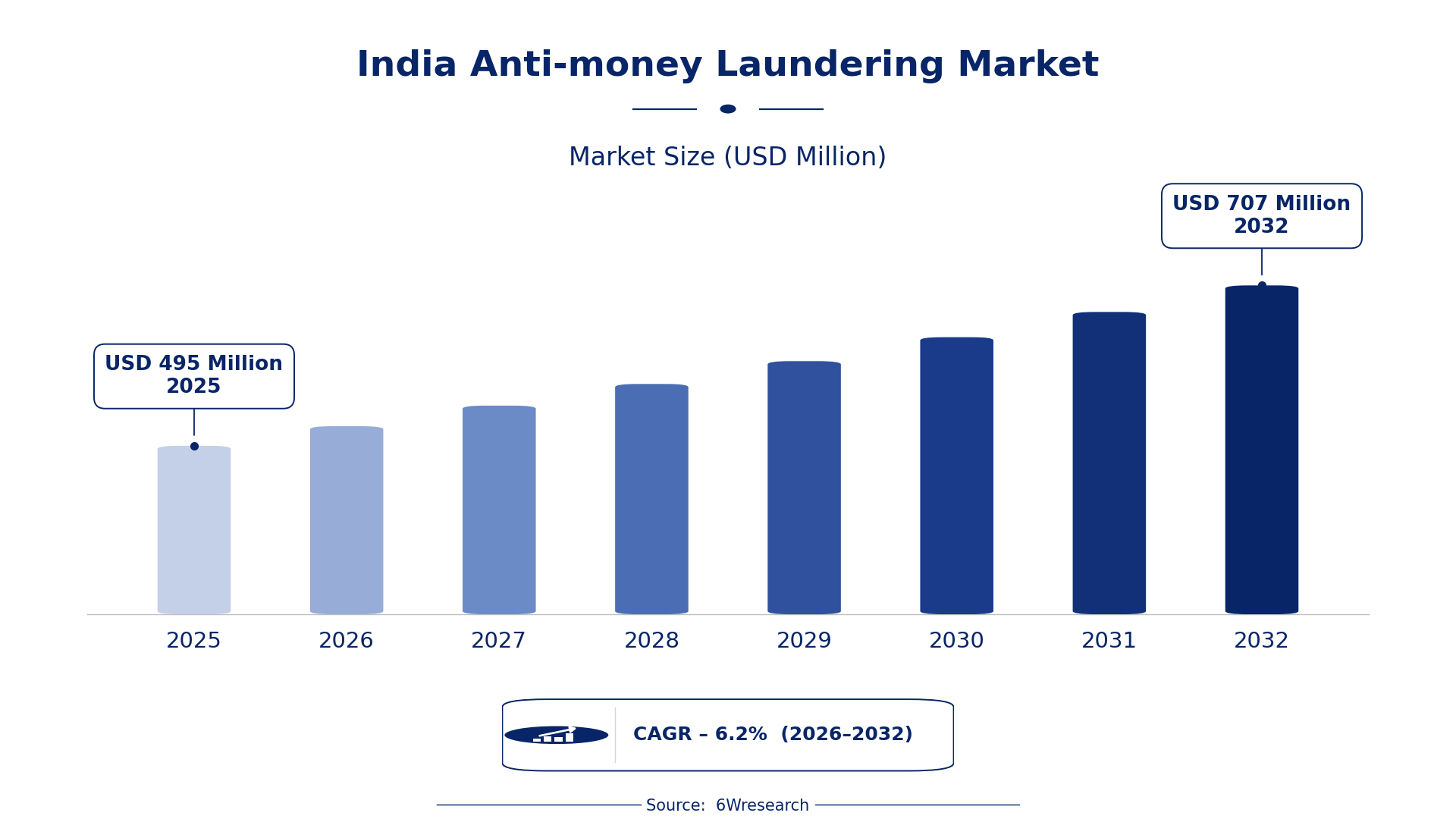
The India Anti-money Laundering Market was estimated at USD 495 Million in 2025 and is projected to reach USD 707 Million by 2032, growing at a CAGR of 6.2% from 2026 to 2032.
India Anti-money Laundering Market Synopsis
The India Anti-money Laundering market has surged in recent years as regulatory scrutiny intensifies and financial institutions ramp up compliance efforts. This momentum is indicative of a broader recognition of the necessity to prevent financial crimes. As we move forward, the trajectory suggests that this market will not only grow but also evolve with technological advancements and heightened regulatory frameworks.
The landscape is shifting, with an increasing reliance on technology such as machine learning and AI to detect suspicious activities. The demand for solutions like KYC and transaction monitoring is becoming indispensable for institutions striving for integrity. As the regulatory environment continues to tighten, firms that invest in comprehensive AML strategies will be better positioned to thrive.
India Anti-money Laundering Market Year-wise Growth Rate and Key Drivers
This graph illustrates the annual growth rates of the India Anti-money Laundering Market from 2021 to 2032, highlighting a steady upward trajectory and projected expansion over the forecast period.
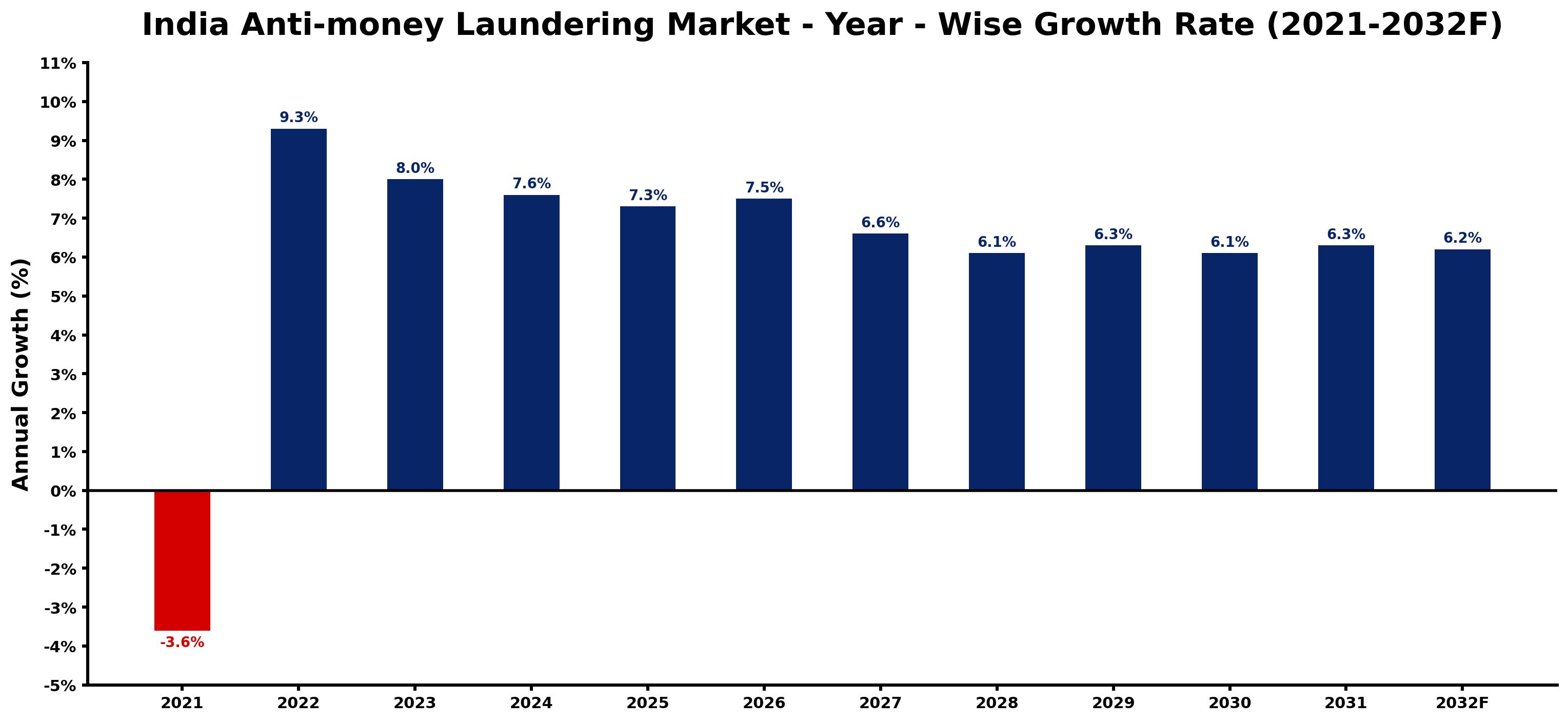
The table below presents the year‑wise growth rates along with the key drivers influencing the market
| Year | Growth Rate | Major Drivers |
| 2021 | -3.6% | Implementation delays by Financial Intelligence Unit of India |
| 2022 | 9.3% | Implementation of stricter KYC regulations by RBI. |
| 2023 | 8.0% | Increase in digital payment fraud prompting compliance demands. |
| 2024 | 7.6% | Launch of India’s National Anti-Money Laundering Campaign. |
| 2025 | 7.3% | Growing bank adoption of AI-driven transaction monitoring. |
| 2026 | 7.5% | Strengthened penalties for non-compliance by financial institutions. |
| 2027 | 6.6% | Emergence of FinTech solutions enhancing AML capabilities. |
| 2028 | 6.1% | Increased customer awareness about money laundering risks. |
| 2029 | 6.3% | New guidelines from SEBI for market surveillance improvements. |
| 2030 | 6.1% | Rise in international trade necessitating stronger AML practices. |
| 2031 | 6.3% | Government incentives for technology to enhance compliance. |
| 2032 | 6.2% | Enhanced cooperation between agencies for cross-border AML efforts. |
Note: Market size estimations and growth projections presented in this report are based on 6Wresearch's proprietary forecasting methodology, utilizing the latest available industry data, government publications, and primary research inputs.
India Anti-money Laundering Market Key Takeaways
Below are some of the specific key takeaways from the market, including:
- Growing emphasis on compliance with international AML standards is driving investments in AML technologies.
- The increase in online transactions presents both risks and opportunities for AML solutions providers.
- Financial institutions are prioritizing advanced data analytics to combat sophisticated money laundering tactics.
- Government initiatives are fostering a more robust regulatory framework, enhancing market attractiveness.
- The integration of next-gen technologies is crucial to improving the efficacy of existing AML systems.
Evaluation of Restraints in India Anti-money Laundering Market
While the India Anti-money Laundering market is on an upward trajectory, it faces substantial restraints that could hinder growth. The evolving tactics of money launderers challenge the effectiveness of existing AML solutions, requiring continuous adaptation. Additionally, as regulations tighten, the compliance burden on financial institutions can become overwhelming. There’s also the risk of resource strain due to the high volume of transactions and the potential for false positives in detection systems. This complex interplay of challenges demands a strategic approach for firms to maintain their compliance and operational integrity.
India Anti-money Laundering Market Trends
A few key trends are shaping the future of the India Anti-money Laundering market. First, the rise of digital banking and fintech has led to an increased number of transactions, which necessitates sophisticated monitoring tools. Secondly, artificial intelligence and machine learning are becoming more integrated into AML processes, enabling more precise detection of unusual patterns. Lastly, there is a greater focus on enhancing customer due diligence procedures to build trust and transparency within the financial ecosystem.
India Anti-money Laundering Market Opportunities
Opportunities abound for businesses that can innovate within the India Anti-money Laundering market. The expanding digital finance sector offers a fertile ground for AML solution providers to tailor services that cater specifically to the unique challenges posed by online transactions. Additionally, partnerships with regulatory bodies to streamline compliance processes can create win-win scenarios for both parties. There’s also room for growth in the development of specialized training programs to equip financial professionals with the skills needed to navigate evolving regulations.
Government Initiatives in the India Anti-money Laundering Market
The Indian government is actively shaping the Anti-money Laundering market through enhanced regulatory frameworks and proactive measures. The push for stringent compliance standards is aimed at curbing financial crime and safeguarding the integrity of the financial system. Recent initiatives illustrate a commitment to aligning with global AML standards, which is crucial for fostering investor confidence and maintaining economic stability.
- A comprehensive regulatory framework was introduced in 2025 mandating stricter reporting requirements for financial institutions.
- Currently underway is a national initiative focused on improving inter-agency collaboration to detect and prevent money laundering activities.
- Upcoming initiatives planned for 2026 include a public-private partnership aimed at upgrading technology infrastructure in AML compliance.
- The establishment of a dedicated task force in 2024 to monitor compliance and provide guidance for financial institutions.
- A training program launched in 2023 aims to equip AML professionals with the latest tools and techniques to combat financial crimes.
Future Insights of the India Anti-money Laundering Market
Looking ahead to 2026-2032, the India Anti-money Laundering market is expected to evolve significantly. As technology progresses, the integration of advanced analytics and artificial intelligence will become standard practice in AML operations. Regulatory bodies will likely continue tightening compliance standards, creating a consistent demand for innovative solutions. Firms that can adapt quickly to these changes and leverage technology will find ample opportunities for growth and differentiation in a competitive landscape.
India Anti-money Laundering Market Latest Developments
In the past year, the India Anti-money Laundering market has seen several noteworthy developments. The regulatory landscape has shifted as the government has intensified its focus on compliance and anti-fraud measures. Financial institutions have responded by adopting cutting-edge technologies and enhancing their AML strategies to meet rising standards. These actions are indicative of a proactive industry mindset aimed at thwarting financial crimes.
- A major technology vendor announced the rollout of a new AML software solution in late 2025, designed to enhance transaction monitoring capabilities.
- In early 2025, a prominent bank upgraded its KYC procedures to integrate advanced biometric verification techniques, improving compliance efforts.
- An ongoing initiative began in mid-2025 to implement a national database for tracking suspicious financial transactions across banks.
- Plans are in place for a new partnership between fintech startups and traditional banks aimed at streamlining AML compliance processes, expected to launch in Q2 2026.
- A regulatory audit initiated in late 2025 is currently underway, assessing the compliance readiness of various financial institutions in the sector.
India Anti-money Laundering Market - Key Attractiveness of the Report
- 10 Years of Market Numbers
- Historical Data Starting from 2022 to 2025
- Base Year: 2025
- Forecast Data until 2032
- Key Performance Indicators Impacting the Market
- Major Upcoming Developments and Projects
Key Highlights of the Report:
- India Anti-money Laundering Market Outlook
- Market Size of India Anti-money Laundering Market, 2025
- Forecast of India Anti-money Laundering Market, 2032
- Historical Data and Forecast of India Anti-money Laundering Revenues & Volume for the Period 2022-2032F
- India Anti-money Laundering Market Trend Evolution
- India Anti-money Laundering Market Drivers and Challenges
- India Anti-money Laundering Price Trends
- India Anti-money Laundering Porter's Five Forces
- India Anti-money Laundering Industry Life Cycle
- Historical Data and Forecast of India Anti-money Laundering Market Revenues & Volume By Component for the Period 2022-2032F
- Historical Data and Forecast of India Anti-money Laundering Market Revenues & Volume By Services for the Period 2022-2032F
- Historical Data and Forecast of India Anti-money Laundering Market Revenues & Volume By Solutions for the Period 2022-2032F
- Historical Data and Forecast of India Anti-money Laundering Market Revenues & Volume By Deployment Mode for the Period 2022-2032F
- Historical Data and Forecast of India Anti-money Laundering Market Revenues & Volume By On-Premises for the Period 2022-2032F
- Historical Data and Forecast of India Anti-money Laundering Market Revenues & Volume By Cloud for the Period 2022-2032F
- Historical Data and Forecast of India Anti-money Laundering Market Revenues & Volume By End User for the Period 2022-2032F
- Historical Data and Forecast of India Anti-money Laundering Market Revenues & Volume By Banking & Financial Institutes for the Period 2022-2032F
- Historical Data and Forecast of India Anti-money Laundering Market Revenues & Volume By Insurance for the Period 2022-2032F
- Historical Data and Forecast of India Anti-money Laundering Market Revenues & Volume By Gaming & Gambling for the Period 2022-2032F
- Historical Data and Forecast of India Anti-money Laundering Market Revenues & Volume By Organization Size for the Period 2022-2032F
- Historical Data and Forecast of India Anti-money Laundering Market Revenues & Volume By Large Enterprises for the Period 2022-2032F
- Historical Data and Forecast of India Anti-money Laundering Market Revenues & Volume By SMEs for the Period 2022-2032F
- India Anti-money Laundering Import Export Trade Statistics
- Market Opportunity Assessment By Component
- Market Opportunity Assessment By Deployment Mode
- Market Opportunity Assessment By End User
- Market Opportunity Assessment By Organization Size
- India Anti-money Laundering Top Companies Market Share
- India Anti-money Laundering Competitive Benchmarking By Technical and Operational Parameters
- India Anti-money Laundering Company Profiles
- India Anti-money Laundering Key Strategic Recommendations






































