India Anti Reflective Glass Market Size, Share & Growth Rate
The India Anti Reflective Glass Market was estimated at USD 1477 Million in 2025 and is projected to reach USD 2124 Million by 2032, growing at a CAGR of 5.3% from 2026 to 2032. This positive trajectory is fueled by an increasing demand for enhanced optical performance across various applications, including consumer electronics and architectural designs. Additionally, the surge in construction activities and the automotive industry's inclination towards modern design elements are significantly contributing to market growth.
India Anti Reflective Glass Market Year-wise Growth Rate and Key Drivers
This graph highlights how the India Anti Reflective Glass Market has steadily grown over the years, supported by major growth factors.
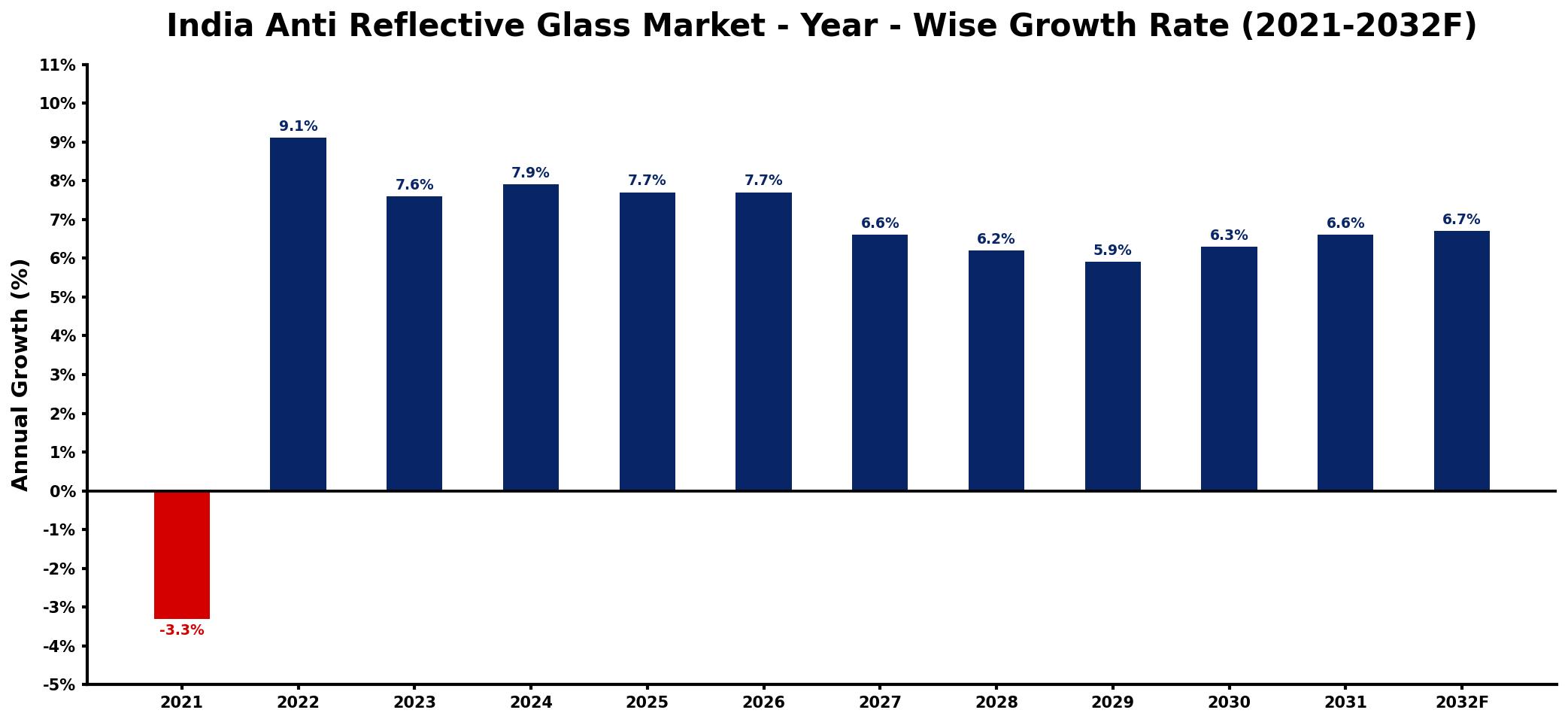
The table below presents the year‑wise growth rates along with the key drivers influencing the market
| Year | Growth Rate | Major Drivers |
| 2021 | -3.3% | Lower consumer spending on construction |
| 2022 | 9.1% | Rising demand from automotive sector |
| 2023 | 7.6% | Growing architectural design innovations |
| 2024 | 7.9% | Increase in solar energy projects |
| 2025 | 7.7% | Expansion of electronics manufacturing sector |
| 2026 | 7.7% | Surge in luxury residential projects |
| 2027 | 6.6% | Boost in infrastructure development initiatives |
| 2028 | 6.2% | Higher demand for energy efficiency |
| 2029 | 5.9% | Growing popularity of smart homes |
| 2030 | 6.3% | Increased focus on sustainability practices |
| 2031 | 6.6% | Rising investments in green technologies |
| 2032 | 6.7% | increased capital investment inflows |
Note: Market size estimations and growth projections presented in this report are based on 6Wresearch's proprietary forecasting methodology, utilizing the latest available industry data, government publications, and primary research inputs.
India Anti Reflective Glass Market Synopsis
The most powerful force currently shaping the India Anti Reflective Glass Market is the rising awareness surrounding energy efficiency. As energy-saving solutions become a priority for both consumers and businesses, the appeal of anti-reflective glass grows, primarily due to its ability to improve lighting performance and reduce energy costs. This market is also seeing heightened demand from the automotive sector, where anti-reflective glass enhances visibility and safety.
Furthermore, the growing adoption of smart technologies in architecture is pushing the integration of anti-reflective glass in large windows and facades, as it not only beautifies buildings but also fosters natural light transmission. The continuous evolution in manufacturing techniques is fostering innovation, making anti-reflective coatings more accessible across various industries.
India Anti Reflective Glass Market Key Takeaways
- The market is on a robust growth path driven by significant investments in consumer electronics and automotive sectors.
- Growing construction activities are leading to an increased demand for anti-reflective glass in architectural applications.
- Rising energy efficiency awareness among consumers is propelling the adoption of anti-reflective glass products.
- The automotive industry is leveraging anti-reflective glass for enhanced safety and driving experiences.
- Innovative manufacturing processes are expected to lower costs and expand applications across various sectors.
Evaluation of Restraints in India Anti Reflective Glass Market
The India Anti Reflective Glass Market is currently experiencing limitations due to high manufacturing costs associated with anti-reflective coatings. This pricing challenge may deter some potential buyers, particularly in sectors sensitive to cost. Additionally, the delicate nature of anti-reflective glass requires special care in maintenance. Improper cleaning methods can lead to coating damage, ultimately reducing visibility and performance. Raising awareness regarding proper maintenance and educating end-users will be vital in overcoming these barriers.
India Anti Reflective Glass Market Trends
One of the defining trends in the India Anti Reflective Glass Market is the increasing incorporation of smart technology in architecture. Innovations such as dynamic glazing and integrated anti-reflective coatings are gaining traction, enhancing both aesthetics and functionality. Another emerging trend is the growing demand for anti-reflective solutions in renewable energy applications, especially in solar panels where maximizing light absorption is crucial.
India Anti Reflective Glass Market Opportunities
The market presents ample opportunities for growth, particularly within the renewable energy sector. The ongoing push for sustainable energy solutions opens avenues for anti-reflective glass applications in solar technologies. Moreover, the demand for high-performance anti-reflective coatings in electronic devices is on the rise, offering a significant opportunity for innovation and expansion in this market segment. Collaborations with architectural firms to develop customized solutions can also unlock new business avenues.
Government Initiatives in the India Anti Reflective Glass Market
The Indian government is actively promoting energy efficiency through various programs and incentives, which favor the adoption of advanced building materials, including anti-reflective glass. Policies aimed at enhancing renewable energy usage and reducing carbon footprints are creating a conducive environment for market growth. Additionally, public spending on infrastructure development aligns with the increasing demand for innovative building solutions, further boosting the anti-reflective glass market.
Future Insights of the India Anti Reflective Glass Market
Looking ahead to 2026-2032, the India Anti Reflective Glass Market is poised for considerable advancements driven by technological innovations and expanding applications across sectors. The rising integration of smart building technologies will likely encourage the use of anti-reflective glass in modern architectures, while the automotive industry's focus on safety will fuel demand for such solutions in vehicle manufacturing. As manufacturers continue to optimize production costs, broader market accessibility can be anticipated, promoting sustained growth.
India Anti Reflective Glass Market Latest Developments (2025 - 2026)
Recent developments within the India Anti Reflective Glass Market indicate a growing trend towards partnerships between manufacturers and technology firms to innovate anti-reflective coatings. As industry players seek to enhance product durability and performance, R&D investments are becoming increasingly significant. Additionally, the rise of e-commerce platforms for direct consumer engagement is influencing distribution strategies, allowing for better market penetration and customer outreach.
India Anti Reflective Glass Market - Key Attractiveness of the Report
- 10 Years of Market Numbers
- Historical Data Starting from 2022 to 2025
- Base Year: 2025
- Forecast Data until 2032
- Key Performance Indicators Impacting the Market
- Major Upcoming Developments and Projects
Key Highlights of the Report:
- India Anti Reflective Glass Market Outlook
- Market Size of India Anti Reflective Glass Market, 2025
- Forecast of India Anti Reflective Glass Market, 2032
- Historical Data and Forecast of India Anti Reflective Glass Revenues & Volume for the Period 2022-2032F
- India Anti Reflective Glass Market Trend Evolution
- India Anti Reflective Glass Market Drivers and Challenges
- India Anti Reflective Glass Price Trends
- India Anti Reflective Glass Porter's Five Forces
- India Anti Reflective Glass Industry Life Cycle
- Historical Data and Forecast of India Anti Reflective Glass Market Revenues & Volume By Type for the Period 2022-2032F
- Historical Data and Forecast of India Anti Reflective Glass Market Revenues & Volume By Double Layers for the Period 2022-2032F
- Historical Data and Forecast of India Anti Reflective Glass Market Revenues & Volume By Four Layers for the Period 2022-2032F
- Historical Data and Forecast of India Anti Reflective Glass Market Revenues & Volume By Others for the Period 2022-2032F
- Historical Data and Forecast of India Anti Reflective Glass Market Revenues & Volume By Application for the Period 2022-2032F
- Historical Data and Forecast of India Anti Reflective Glass Market Revenues & Volume By Architectural Windows for the Period 2022-2032F
- Historical Data and Forecast of India Anti Reflective Glass Market Revenues & Volume By Instrumentation Windows for the Period 2022-2032F
- Historical Data and Forecast of India Anti Reflective Glass Market Revenues & Volume By Electronic Displays for the Period 2022-2032F
- Historical Data and Forecast of India Anti Reflective Glass Market Revenues & Volume By Picture Framing Glass for the Period 2022-2032F
- Historical Data and Forecast of India Anti Reflective Glass Market Revenues & Volume By Showcase Glass for the Period 2022-2032F
- Historical Data and Forecast of India Anti Reflective Glass Market Revenues & Volume By Cold Storage Displays for the Period 2022-2032F
- Historical Data and Forecast of India Anti Reflective Glass Market Revenues & Volume By Lamps Glass for the Period 2022-2032F
- Historical Data and Forecast of India Anti Reflective Glass Market Revenues & Volume By Others for the Period 2022-2032F
- India Anti Reflective Glass Import Export Trade Statistics
- Market Opportunity Assessment By Type
- Market Opportunity Assessment By Application
- India Anti Reflective Glass Top Companies Market Share
- India Anti Reflective Glass Competitive Benchmarking By Technical and Operational Parameters
- India Anti Reflective Glass Company Profiles
- India Anti Reflective Glass Key Strategic Recommendations






































