India App Analytics Market Size & Growth Rate (2026-2032)
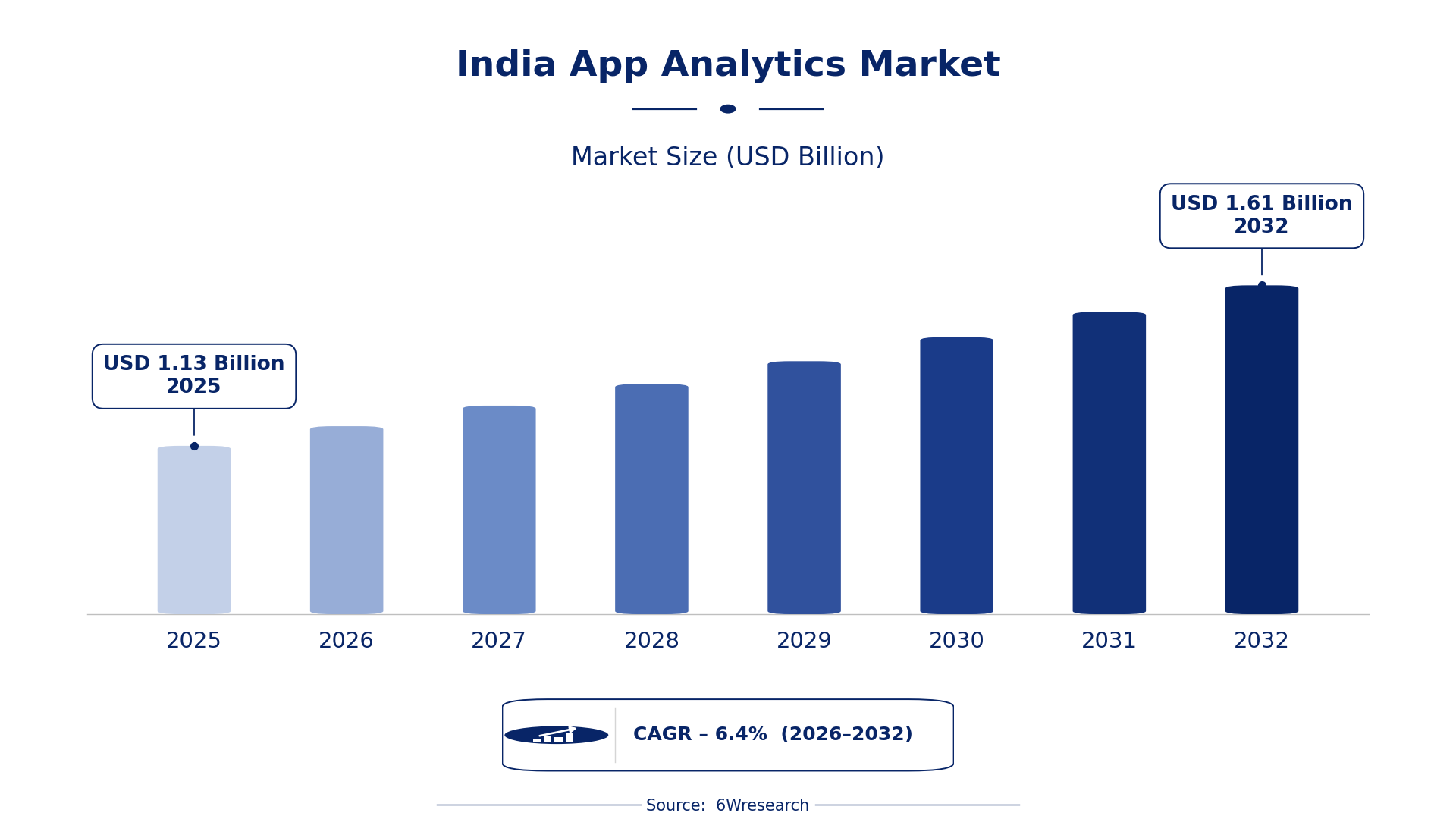
The India App Analytics Market was estimated at USD 1127 Million in 2025 and is projected to reach USD 1610 Million by 2032, growing at a CAGR of 6.4% from 2026 to 2032.
India App Analytics Market Synopsis
The India App Analytics Market is witnessing a surge fueled by the increasing reliance on mobile applications across various sectors. As businesses strive to enhance user engagement and retention, analytics tools have become essential for understanding user behavior and app performance.
With e-commerce, gaming, and fintech leading the charge, the demand for sophisticated app analytics solutions is escalating. Companies are increasingly recognizing the importance of data-driven strategies to stay competitive in this growing market.
India App Analytics Market Year-wise Growth Rate and Key Drivers
This graph illustrates the annual growth rates of the India App Analytics Market from 2021 to 2032, highlighting a steady upward trajectory and projected expansion over the forecast period.
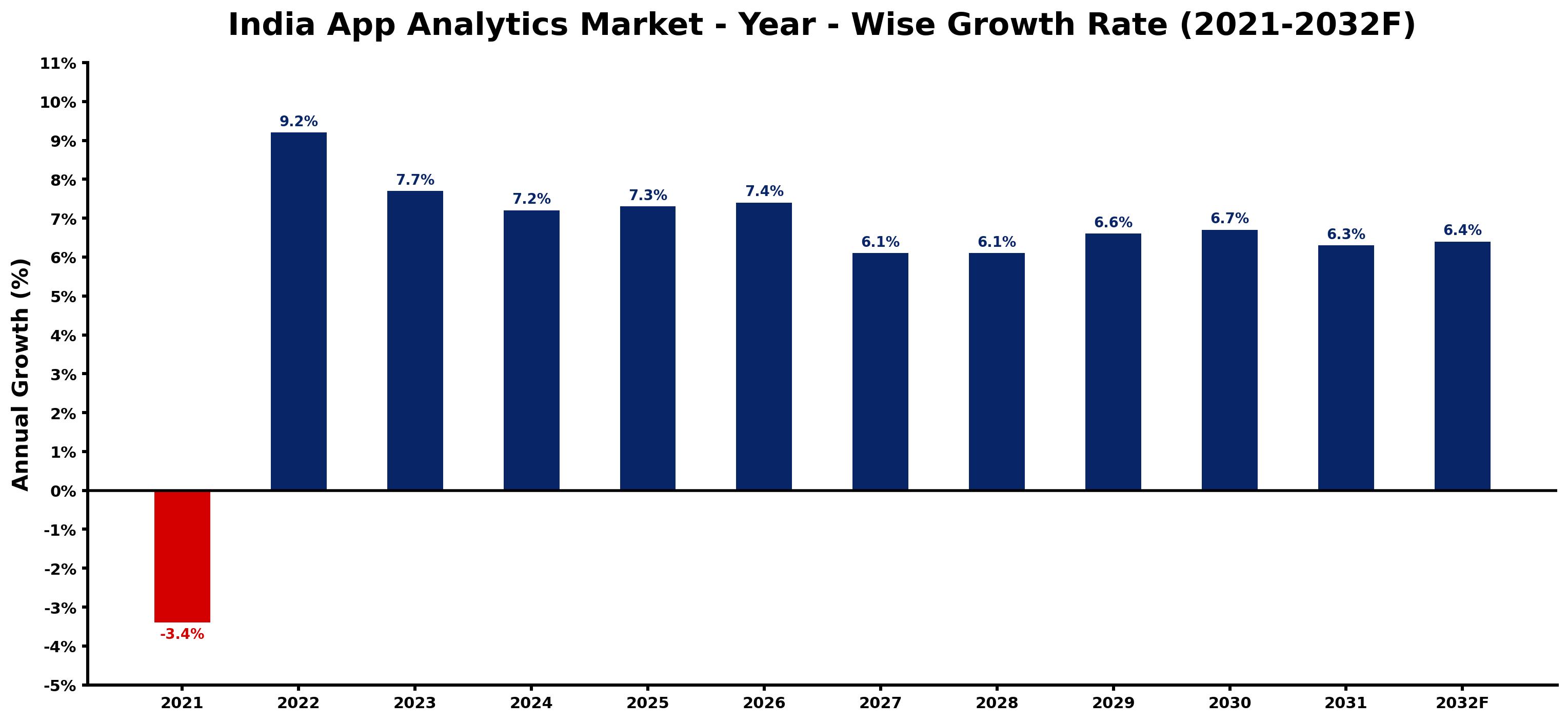
The table below presents the year‑wise growth rates along with the key drivers influencing the market
| Year | Growth Rate | Major Drivers |
| 2021 | -3.4% | Implementation of stringent data privacy regulations by MeitY. |
| 2022 | 9.2% | Rising smartphone adoption fueling app user engagement. |
| 2023 | 7.7% | Increased focus on data privacy regulations influencing analytics tools. |
| 2024 | 7.2% | Growing mobile-first consumer behavior driving app performance evaluation. |
| 2025 | 7.3% | Surge in remote work boosting demand for productivity apps. |
| 2026 | 7.4% | E-commerce sector growth necessitating detailed user behavior tracking. |
| 2027 | 6.1% | Emergence of regional apps enhancing localized market insights. |
| 2028 | 6.1% | Rising investment in AI for enhanced app usability metrics. |
| 2029 | 6.6% | Increased online gaming popularity driving analytics for engagement. |
| 2030 | 6.7% | Government push for digital literacy enhancing app usage. |
| 2031 | 6.3% | Surging interest in health-tech apps requiring performance metrics. |
| 2032 | 6.4% | Growing interest in fintech apps supporting user analytics needs. |
Note: Market size estimations and growth projections presented in this report are based on 6Wresearch's proprietary forecasting methodology, utilizing the latest available industry data, government publications, and primary research inputs.
India App Analytics Market Key Takeaways
Below are some of the specific key takeaways from the market, including:
- The market is driven by the increasing adoption of mobile apps and the need for effective user engagement strategies.
- Data privacy and security concerns present ongoing challenges for app developers and marketers.
- The COVID-19 pandemic accelerated the demand for app analytics tools, highlighting their importance in adapting to changing user behaviors.
- Emerging technologies, such as AI and machine learning, are enhancing the capabilities of app analytics solutions.
- Government initiatives focusing on digital transformation are expected to further boost the market.
Evaluation of Restraints in India App Analytics Market
Despite its robust growth, the India App Analytics Market faces several constraints that could hinder its potential. A primary concern is the stringent data protection regulations, which necessitate stringent compliance measures from app developers. The fragmented nature of data across multiple platforms also complicates the analysis, making it difficult for businesses to gain a comprehensive understanding of user behavior. Additionally, monetization strategies for free apps remain a contentious issue, as developers seek to balance user experience with revenue generation while ensuring continuous app optimization.
India App Analytics Market Trends
The market is increasingly leaning towards integrating advanced technologies like artificial intelligence and machine learning, which are significantly enhancing data analysis capabilities. Real-time analytics is becoming a key focus, as businesses demand immediate insights to adapt strategies swiftly. on top of that, the rise of user-centric design is pushing analytics tools to evolve, providing deeper insights into user preferences and behaviors. The emphasis on data privacy is also shaping the development of analytics solutions, pushing companies to prioritize secure data handling practices.
India App Analytics Market Opportunities
There are substantial growth opportunities in the India App Analytics Market, particularly for companies that can innovate around user engagement strategies. As businesses increasingly shift to mobile-first models, those offering analytics tools tailored to specific industries—like e-commerce or gaming—are well-positioned for success. Additionally, partnerships with telecom providers and digital platforms can facilitate broader access to analytics tools, driving adoption rates. The growing emphasis on personalized user experiences opens doors for analytics solutions that provide granular insights into user interactions.
Government Initiatives in the India App Analytics Market
Government policies are playing a crucial role in shaping the India App Analytics Market. With a strong focus on digital transformation, the Indian government is promoting initiatives that enhance the digital infrastructure and encourage the adoption of analytics tools. This regulatory environment is crucial for fostering innovation and ensuring compliance within the sector, ultimately benefiting app developers and businesses.
- A recent initiative aimed at upgrading national digital infrastructure to improve access to analytics tools has been launched, enhancing connectivity across urban and rural areas.
- Currently, the government is rolling out a program focused on data protection compliance, which aims to create standardized guidelines for data handling in app analytics.
- A planned public-private partnership initiative is expected to be introduced by 2026, aimed at facilitating investment in analytics technologies for startups.
- The introduction of tax incentives for companies investing in app analytics solutions is underway, encouraging more businesses to adopt these technologies.
Future Insights of the India App Analytics Market
From 2026 to 2032, the India App Analytics Market is expected to experience substantial growth driven by the continuous evolution of mobile applications and the increasing need for data-driven decision-making. As businesses become more data-centric, the demand for sophisticated analytics tools will rise, particularly those that can provide real-time insights. The integration of emerging technologies will likely redefine the capabilities of app analytics, making it imperative for companies to stay ahead of the curve. put simply, the market's trajectory is optimistic, with ample opportunities for innovation and growth.
India App Analytics Market Latest Developments
Recent activity in the India App Analytics Market indicates a dynamic environment, with various players focusing on enhancing their offerings. Over the past year, the industry has seen a flurry of innovations aimed at improving user insights and data handling capabilities. This trend reflects the growing importance of app analytics as businesses seek to refine their strategies based on user behavior data.
- A major technology vendor launched a new analytics platform in early 2025, designed to enhance real-time user engagement tracking for mobile applications.
- An ongoing collaboration between analytics providers and educational institutions aims to develop training programs focused on app analytics skills, which began in mid-2025.
- A regional operator announced plans for an upcoming analytics tool rollout, expected to begin in late 2026, targeting small and medium enterprises.
- In Q2 2025, a significant software upgrade was completed, enhancing the predictive capabilities of existing analytics tools for app developers.
India App Analytics Market - Key Attractiveness of the Report
- 10 Years of Market Numbers
- Historical Data Starting from 2022 to 2025
- Base Year: 2025
- Forecast Data until 2032
- Key Performance Indicators Impacting the Market
- Major Upcoming Developments and Projects
Key Highlights of the Report:
- India App Analytics Market Outlook
- Market Size of India App Analytics Market, 2025
- Forecast of India App Analytics Market, 2032
- Historical Data and Forecast of India App Analytics Revenues & Volume for the Period 2022-2032F
- India App Analytics Market Trend Evolution
- India App Analytics Market Drivers and Challenges
- India App Analytics Price Trends
- India App Analytics Porter's Five Forces
- India App Analytics Industry Life Cycle
- Historical Data and Forecast of India App Analytics Market Revenues & Volume By Component for the Period 2022-2032F
- Historical Data and Forecast of India App Analytics Market Revenues & Volume By Software for the Period 2022-2032F
- Historical Data and Forecast of India App Analytics Market Revenues & Volume By Services for the Period 2022-2032F
- Historical Data and Forecast of India App Analytics Market Revenues & Volume By Application for the Period 2022-2032F
- Historical Data and Forecast of India App Analytics Market Revenues & Volume By Revenue analytics for the Period 2022-2032F
- Historical Data and Forecast of India App Analytics Market Revenues & Volume By App performance analytics and operations for the Period 2022-2032F
- Historical Data and Forecast of India App Analytics Market Revenues & Volume By User analytics for the Period 2022-2032F
- Historical Data and Forecast of India App Analytics Market Revenues & Volume By Ad monitoring and marketing analytics for the Period 2022-2032F
- Historical Data and Forecast of India App Analytics Market Revenues & Volume By Type for the Period 2022-2032F
- Historical Data and Forecast of India App Analytics Market Revenues & Volume By Mobile app analytics for the Period 2022-2032F
- Historical Data and Forecast of India App Analytics Market Revenues & Volume By Web app analytics for the Period 2022-2032F
- Historical Data and Forecast of India App Analytics Market Revenues & Volume By Vertical for the Period 2022-2032F
- Historical Data and Forecast of India App Analytics Market Revenues & Volume By Banking, Financial Services, and Insurance (BFSI) for the Period 2022-2032F
- Historical Data and Forecast of India App Analytics Market Revenues & Volume By Retail for the Period 2022-2032F
- Historical Data and Forecast of India App Analytics Market Revenues & Volume By Media and entertainment for the Period 2022-2032F
- Historical Data and Forecast of India App Analytics Market Revenues & Volume By Logistics, travel, and transportation for the Period 2022-2032F
- Historical Data and Forecast of India App Analytics Market Revenues & Volume By Telecom and IT for the Period 2022-2032F
- Historical Data and Forecast of India App Analytics Market Revenues & Volume By Others for the Period 2022-2032F
- India App Analytics Import Export Trade Statistics
- Market Opportunity Assessment By Component
- Market Opportunity Assessment By Application
- Market Opportunity Assessment By Type
- Market Opportunity Assessment By Vertical
- India App Analytics Top Companies Market Share
- India App Analytics Competitive Benchmarking By Technical and Operational Parameters
- India App Analytics Company Profiles
- India App Analytics Key Strategic Recommendations






































