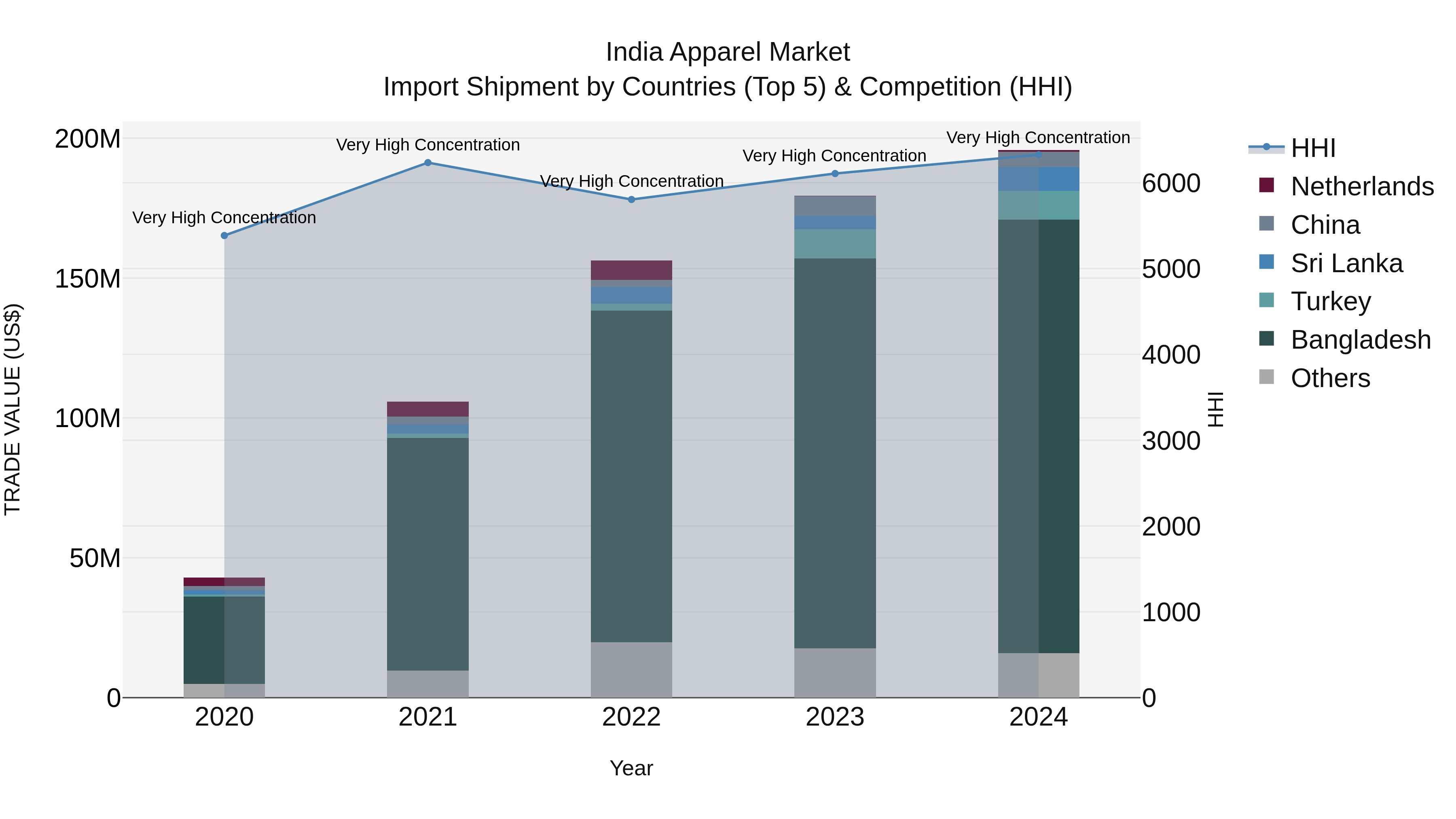
India Apparel Market Top 5 Importing Countries and Market Competition (HHI) Analysis
India`s apparel import market continued to see significant growth in 2024, with top exporting countries including Bangladesh, Turkey, Sri Lanka, China, and Vietnam. The high Herfindahl-Hirschman Index (HHI) indicates a concentrated market, while the impressive Compound Annual Growth Rate (CAGR) of 46.16% from 2020 to 2024 highlights the sector`s robust expansion. Furthermore, the growth rate of 9.12% from 2023 to 2024 suggests sustained momentum in apparel imports, reflecting strong demand and trade relationships with key exporting nations.
India Apparel Market Growth Rate
According to 6Wresearch internal database and industry insights, the India Apparel Market is projected to grow at a compound annual growth rate (CAGR) of 6.5% during the forecast period (2025-2031).
India Apparel Market Highlights
| Report Name | India Apparel Market |
| Forecast period | 2025-2031 |
| CAGR | 6.5% |
| Growing Sector | Textile and Fashion |
Topics Covered in the India Apparel Market Report
The India Apparel Market report thoroughly covers the market by types and end user. The market report provides an unbiased and detailed analysis of ongoing market trends, opportunities/high growth areas, and market drivers, which would help stakeholders to devise and align their market strategies according to the current and future market dynamics.
India Apparel Market Synopsis
The India Apparel Market has experienced momentum growth over the past few years due to rising disposable income, changing fashion trends, and the increasing presence of global and local brands. The growing e-commerce access and rising demand for premium and eco-efficient products have further boosted market expansion. Along with that, the market is bolstered by government initiatives aimed at promoting the textile sector and improving the overall manufacturing environment in India.
India Apparel Market Growth Drivers
Below mentioned are some prominent drivers and their influence on the market dynamics:
| Driver | Primary Segments Affected | Why it Matters |
| Increasing Disposable Income | Men, Women, Kids | As people earn more, they are buying more premium and branded clothes. |
| E-commerce Growth | Casual Wear, Sports Wear, Night Wear | Online shopping has made it convenient for people to buy clothes, increasing demand in all sectors. |
| Rising Fashion Consciousness | Women, Men | People are upgrading their wardrobes more often due to changing fashion trends and personal style. |
| Government Support for Textiles | All Apparel Segments | Government programs like "Make in India" and the "Textile Upgradation Fund Scheme" are supporting local clothing production. |
| Shift Towards Sustainable Fashion | Casual Wear, Formal Wear | More consumers are choosing eco-friendly and ethically made clothes, boosting demand for sustainable fashion. |
The India Apparel Market is projected to grow at a CAGR of 6.5% during the forecast period of 2025-2031. The growth of the apparel market in India is compelled by rising disposable incomes, the increasing demand for fashion-forward and branded clothing, and a growing middle-class population. Along with that, rapid expansion of online retail platforms has made it convenient for customers across the nation to access from a huge variety of apparel options, further driving market growth. The growing influence of global fashion trends and government efforts to promote domestic manufacturing is also a contributing factor. Furthermore, the transition toward sustainable and eco-friendly apparel is gaining momentum, reflecting changing consumer preferences.
India Apparel Market Restraints
Below mentioned are some major restraints and their influence on the market dynamics:
| Restraints | Primary Segments Affected | What this Means |
| High Raw Material Costs | All Apparel Segments | Rising costs of raw materials, especially natural fibers like cotton and wool, increase production expenses. |
| Labor Shortages | Manufacturing | Shortage of labor especially in rural areas, can generate delays in production and increased operational costs. |
| Price Sensitivity | Mass Market Apparel, Casual Wear | Customers cognizant of their money can minimize on their spending, hindering with the growth of high-end and luxury markets. |
| Counterfeit Products | Branded Apparel | The presence of counterfeit products in the market reduces brand value and affects consumer confidence. |
| Fluctuating Demand | Seasonal Wear, Formal Wear | Demand for certain types of apparel is highly seasonal, which causes inventory management and sales challenges. |
India Apparel Market Challenges
The India Apparel Industry encounter several challenges, which includes fluctuating raw material prices, which impact production costs. Along with that, competition from international brands and fast fashion poses pressure on local manufacturers. Growing demand for environment friendly manufacturing requires significant investment in sustainable practices. Moreover, logistical and supply chain ineffectiveness, especially in rural areas, obstructs on-time distribution and availability of clothing products.
India Apparel Market Trends
Some emerging trends shaping the market landscape are:
- Sustainable Fashion: Great number of consumers are gravitating toward clothes that are made from environment efficient materials like organic cotton and recycled fabrics.
- Digital Transformation: E-commerce sites continue to improve consumers shopping experience by incorporating features like virtual try-ons and AI-driven suggestions.
- Athleisure Trend: The rise of athleisure and comfortable clothes, particularly among the younger generation, is propelling the need for activewear and casual clothes.
- Influencer Impact: Individuals purchasing clothes based on what's prevailing on social media such as Instagram and TikTok, has made them prefer styles that are in fad and endorsed by celebrities.
- Made in India: There is an increasing demand for clothes produced in India, and programs like "Atmanirbhar Bharat" are striving domestic production.
Investment Opportunities in the India Apparel Market
Some of the key investment opportunities in the India Apparel Market are:
- E-commerce and Digital Platforms: Investment in e-commerce platforms and technology-driven retail solutions is expected to grow. Enhanced online experiences, such as virtual try-ons and AR-based shopping, provide opportunities for growth.
- Sustainable Manufacturing: Companies focusing on sustainable practices, eco-friendly materials, and low-carbon production will see a rise in consumer demand and brand loyalty.
- Local Manufacturing: The "Make in India" initiative creates an opportunity for apparel brands to set up manufacturing units locally, benefiting from subsidies and incentives.
- Luxury and Premium Segment: There is a rising demand for high-end fashion in urban areas. Investing in luxury brands or establishing premium retail stores could capture this niche market.
Top 5 Leading Companies in the India Apparel Market
Here is a comprehensive list of key players dominating the India Apparel Market Share:
1. Reliance Retail
| Company Name | Reliance Retail |
|---|---|
| Headquarters | Mumbai, India |
| Established Year | 2006 |
| Official Website | Click Here |
Reliance Retail is a dominant player in the Indian apparel market with a wide range of brands in its portfolio, including both domestic and international labels. The company has expanded its footprint with a strong presence in offline and online retail channels.
2. Aditya Birla Fashion & Retail Limited
| Company Name | Aditya Birla Fashion & Retail Limited |
|---|---|
| Headquarters | Mumbai, India |
| Established Year | 2007 |
| Official Website | Click Here |
This company owns several prominent apparel brands like Van Heusen, Allen Solly, and Pantaloons. It is a major player in both the premium and mass-market segments, catering to various customer demographics across the country.
3. Arvind Limited
| Company Name | Arvind Limited |
|---|---|
| Headquarters | Ahmedabad, India |
| Established Year | 1931 |
| Official Website | Click Here |
Arvind Limited is one of the leading apparel manufacturers in India, offering both ready-to-wear and customized clothing solutions. It has a strong presence in both the domestic and export markets and operates with top international brands like GAP, Tommy Hilfiger, and more.
4. Shoppers Stop Ltd.
| Company Name | Shoppers Stop Ltd. |
|---|---|
| Headquarters | Mumbai, India |
| Established Year | 1991 |
| Official Website | Click Here |
Shoppers Stop is a well-established retail chain offering a wide array of apparel, cosmetics, and home products. The company operates both brick-and-mortar stores and an online platform, catering to a diverse customer base.
5. H&M India
| Company Name | H&M India |
|---|---|
| Headquarters | Gurgaon, India |
| Established Year | 2015 |
| Official Website | Click Here |
H&M has gained a significant share in the Indian apparel market, offering fashionable, affordable clothing for men, women, and kids. Its rapid expansion into tier-II and tier-III cities has contributed to its success.
Government Regulations in the India Apparel Market
According to Indian Government data, the market growth is reshaped with the support of favourable policies. The authorities have formulated several initiatives such as the “Make in India”, “Textile Upgradation Fund Scheme”, and “National Textiles Policy” that play an essential role in encouraging domestic manufacturing and exports of apparel. These programs encourage the nation to make greater use of its own potential and rely less on imports, to create jobs in the textile industry. The government supports environmentally friendly practices, such as the Extended Producer Responsibility (EPR) for managing textile waste. This also makes individuals consider purchasing clothes that are good for the environment.
Future Insights of the India Apparel Market
The India Apparel Market is expected to continue expanding upward considering individuals' rising incomes, urbanization, and evolving consumer preferences. Along with that, the rise of e-commerce and digital retail solutions will further shape the market landscape. As consumers become more invested in fashion and the demand for eco-friendly and ethically produced clothes grows, the market is likely to transform toward the production of such kinds of clothes. Additionally, the rising power of social media and celebrity endorsements will further propel apparel trends and consumer spending.
Market Segmentation Analysis
The report offers a comprehensive study of the subsequent market segments and their leading categories.
Women’s Apparel to Lead the Market - By End User
According to Mansi Ahuja, Senior Research Analyst, 6Wresearch, women’s apparel is expected to dominate the India apparel market due to increasing fashion consciousness, evolving preferences, and a growing demand for trendy clothing.
Casual Wear to Dominate the Market - By Type
Casual wear is projected to dominate the India apparel market, driven by its increasing popularity among all age groups. With the rise of the work-from-home culture and lifestyle changes, consumers are opting for comfort-driven clothing, particularly in urban areas.
Key Attractiveness of the Report
- 10 Years of Market Numbers
- Historical Data Starting from 2021 to 2024
- Base Year: 2024
- Forecast Data until 2031
- Key Performance Indicators Impacting the Market
- Major Upcoming Developments and Projects
Key Highlights of the Report:
- India Apparel Market Outlook
- Market Size of India Apparel Market, 2024
- Forecast of India Apparel Market, 2031
- Historical Data and Forecast of India Apparel Revenues & Volume for the Period 2021-2031
- India Apparel Market Trend Evolution
- India Apparel Market Drivers and Challenges
- India Apparel Price Trends
- India Apparel Porter's Five Forces
- India Apparel Industry Life Cycle
- Historical Data and Forecast of India Apparel Market Revenues & Volume By End User for the Period 2021-2031
- Historical Data and Forecast of India Apparel Market Revenues & Volume By Men for the Period 2021-2031
- Historical Data and Forecast of India Apparel Market Revenues & Volume By Women for the Period 2021-2031
- Historical Data and Forecast of India Apparel Market Revenues & Volume By Kids for the Period 2021-2031
- Historical Data and Forecast of India Apparel Market Revenues & Volume By Type for the Period 2021-2031
- Historical Data and Forecast of India Apparel Market Revenues & Volume By Formal Wear for the Period 2021-2031
- Historical Data and Forecast of India Apparel Market Revenues & Volume By Casual Wear for the Period 2021-2031
- Historical Data and Forecast of India Apparel Market Revenues & Volume By Sports Wear for the Period 2021-2031
- Historical Data and Forecast of India Apparel Market Revenues & Volume By Night Wear for the Period 2021-2031
- Historical Data and Forecast of India Apparel Market Revenues & Volume By Other for the Period 2021-2031
- India Apparel Import Export Trade Statistics
- Market Opportunity Assessment By End User
- Market Opportunity Assessment By Type
- India Apparel Top Companies Market Share
- India Apparel Competitive Benchmarking By Technical and Operational Parameters
- India Apparel Company Profiles
- India Apparel Key Strategic Recommendations
Market Covered
The market report has been segmented and sub segmented into the following categories:
By End User
- Men
- Women
- Kids
By Type
- Formal Wear
- Casual Wear
- Sports Wear
- Night Wear
- Other






































