India Application Performance Management Market Size & Growth Rate (2026-2032)
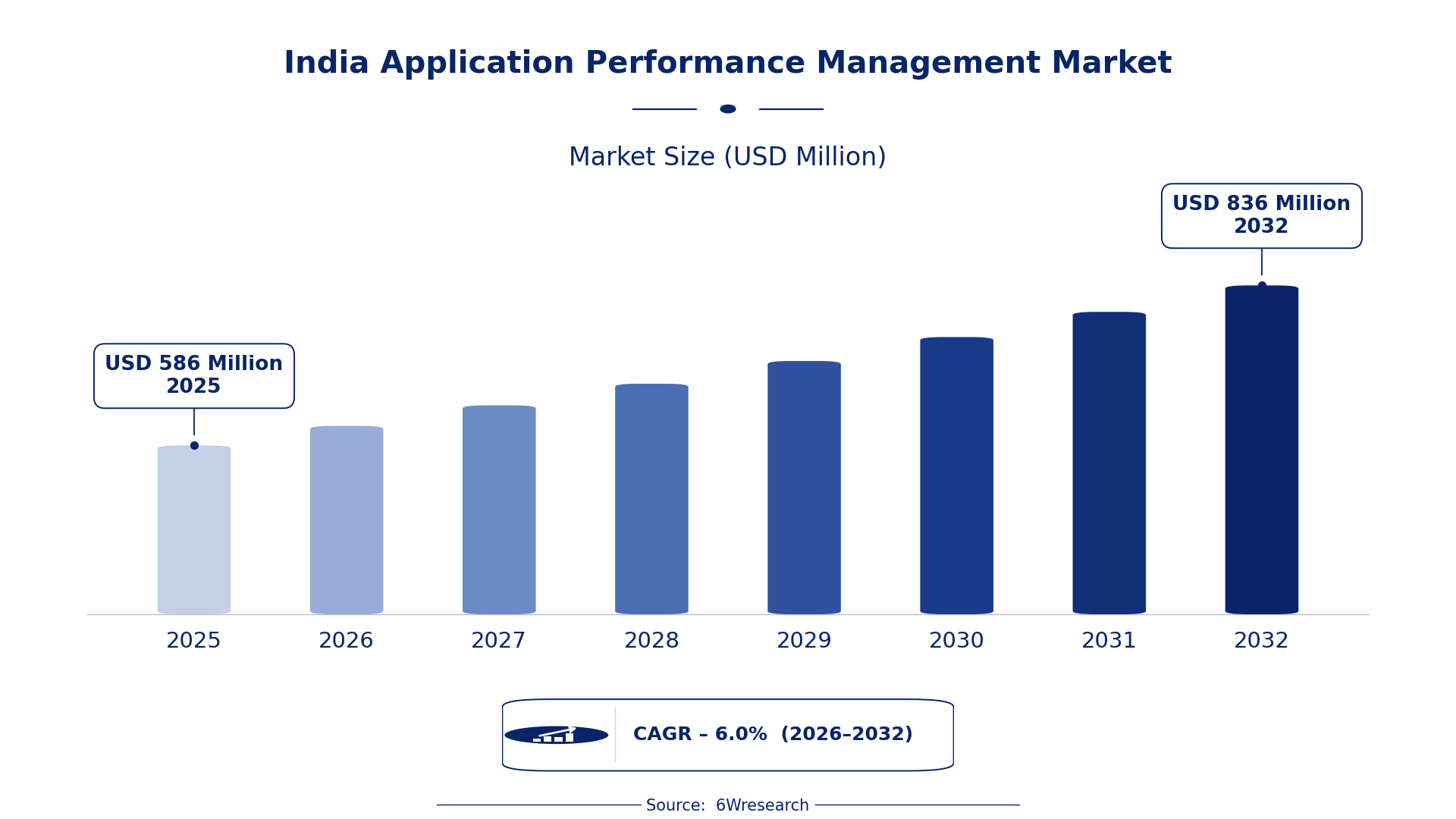
The India Application Performance Management Market was estimated at USD 586 Million in 2025 and is projected to reach USD 836 Million by 2032, growing at a CAGR of 6.0% from 2026 to 2032.
India Application Performance Management Market Synopsis
The demand for Application Performance Management (APM) solutions in India is surging as organizations increasingly depend on digital applications. With the rise of e-commerce and mobile platforms, businesses are recognizing that application performance directly impacts user satisfaction and retention.
As digital transformation accelerates, companies are transitioning to cloud-based services, which necessitate effective APM tools. These tools not only provide insights into application performance but also facilitate timely troubleshooting, ultimately enhancing customer experiences across various sectors.
India Application Performance Management Market Year-wise Growth Rate and Key Drivers
This graph illustrates the annual growth rates of the India Application Performance Management Market from 2021 to 2032, highlighting a steady upward trajectory and projected expansion over the forecast period.
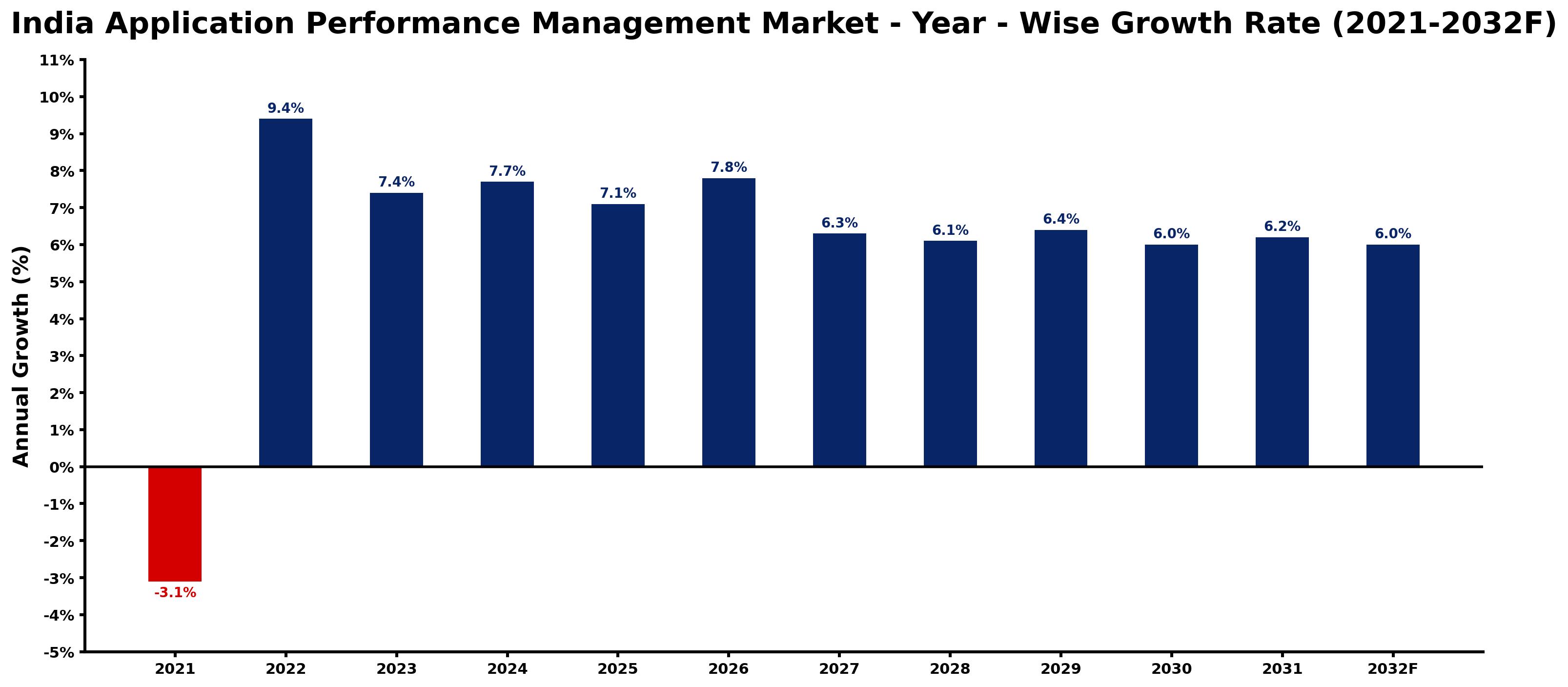
The table below presents the year‑wise growth rates along with the key drivers influencing the market
| Year | Growth Rate | Major Drivers |
| 2021 | -3.1% | New GDPR-like regulations hindered data management practices. |
| 2022 | 9.4% | Growth in remote work driving application performance needs. |
| 2023 | 7.4% | Adoption of cloud services by Indian enterprises increasing. |
| 2024 | 7.7% | Rise in mobile application usage among Indian consumers. |
| 2025 | 7.1% | Government policies promoting digital infrastructure enhancements. |
| 2026 | 7.8% | Surge in e-commerce pushing application responsiveness requirements. |
| 2027 | 6.3% | Increased investment in AI-driven analytics for applications. |
| 2028 | 6.1% | Emergence of startup ecosystem demanding performance optimization. |
| 2029 | 6.4% | Shift towards microservices architecture in software development. |
| 2030 | 6.0% | Growing emphasis on customer experience in digital services. |
| 2031 | 6.2% | Regulatory compliance driving monitoring and performance management. |
| 2032 | 6.0% | Focus on data security enhancing application performance tools. |
Note: Market size estimations and growth projections presented in this report are based on 6Wresearch's proprietary forecasting methodology, utilizing the latest available industry data, government publications, and primary research inputs.
India Application Performance Management Market Key Takeaways
Below are some of the specific key takeaways from the market, including:
- Growing reliance on digital services is driving APM adoption across industries.
- Cloud-based solutions are becoming essential for monitoring application performance.
- Increased e-commerce activities are a major factor in APM market growth.
- Real-time analytics and insights are prioritized for enhancing user experience.
- Key players are continuously innovating to address evolving customer needs.
Evaluation of Restraints in India Application Performance Management Market
Despite the promising growth trajectory, the APM market in India faces several constraints. One of the primary challenges is the complexity of integrating APM solutions with existing IT infrastructure. Many organizations struggle with compatibility issues, which can slow down implementation and reduce the overall effectiveness of APM tools.
on top of that, the lack of skilled professionals capable of managing and interpreting APM data hampers the ability of organizations to fully utilize these tools. Without adequate expertise, businesses may find it difficult to derive actionable insights from performance metrics, potentially limiting the benefits of APM investments.
India Application Performance Management Market Trends
A notable trend in the India Application Performance Management market is the shift towards AI-driven analytics. Companies are increasingly utilizing artificial intelligence to enhance monitoring capabilities, enabling proactive identification of performance issues before they escalate. This shift not only improves efficiency but also reduces downtime, which is critical in maintaining customer satisfaction.
Another emerging trend is the growing emphasis on user experience (UX) metrics. Organizations are recognizing that application performance directly correlates with user satisfaction, prompting a greater focus on optimizing UX alongside technical performance indicators.
India Application Performance Management Market Opportunities
The market presents substantial opportunities for growth, particularly in sectors undergoing digital transformation. Industries like healthcare, retail, and finance are increasingly adopting APM solutions to enhance operational efficiency and customer engagement. Startups and SMEs also represent a significant growth segment, as they seek cost-effective APM tools to compete in a digital-first environment.
on top of that, advancements in cloud technology are opening new avenues for APM vendors to offer scalable solutions that cater to varying business sizes and needs, creating a fertile ground for innovation and investment.
Government Initiatives in the India Application Performance Management Market
The Indian government is actively fostering an environment conducive to digital innovation, which directly impacts the Application Performance Management market. Policies aimed at enhancing digital infrastructure and promoting technology adoption in public and private sectors are crucial for the market's growth. As the government prioritizes initiatives that support digital services, APM solutions will gain further traction.
- A recent initiative launched in 2023 focuses on upgrading national digital infrastructure to support enhanced application performance across sectors.
- Ongoing efforts to promote public-private partnerships aim to improve technology accessibility, including APM solutions, particularly for small and medium enterprises.
- A planned regulatory framework expected by 2025 will emphasize quality standards for software applications, thereby increasing the demand for APM tools.
- Current digital literacy campaigns are underway to equip businesses with the skills needed to effectively implement and utilize APM solutions.
Future Insights of the India Application Performance Management Market
Looking ahead, the India Application Performance Management market is set for continued expansion. The increasing integration of AI and machine learning technologies will further enhance the capabilities of APM solutions, allowing for more sophisticated performance management and predictive analytics. As organizations place greater importance on user experience, APM tools will evolve to meet these demands, making them indispensable for businesses striving for excellence in application performance.
India Application Performance Management Market Latest Developments
In the past year, the India Application Performance Management market has witnessed a flurry of activity, highlighting the urgency for businesses to adopt efficient performance management solutions. Companies are prioritizing investments in APM to bolster their digital capabilities and improve customer satisfaction. The trend indicates a growing recognition of APM's importance in the digital age.
- A major technology vendor announced the rollout of a new APM solution in late 2023, featuring advanced AI analytics for real-time monitoring.
- An initiative that began in Q3 2023 is currently underway, focusing on enhancing collaboration between tech startups and established firms to develop innovative APM tools.
- A leading regional operator is expected to launch a comprehensive APM service package by early 2024 to cater to SMEs seeking robust application performance solutions.
- A partnership between two major players was formalized in mid-2023, aimed at integrating their APM tools for improved data sharing and analytics.
India Application Performance Management Market - Key Attractiveness of the Report
- 10 Years of Market Numbers
- Historical Data Starting from 2022 to 2025
- Base Year: 2025
- Forecast Data until 2032
- Key Performance Indicators Impacting the Market
- Major Upcoming Developments and Projects
Key Highlights of the Report:
- India Application Performance Management Market Outlook
- Market Size of India Application Performance Management Market, 2025
- Forecast of India Application Performance Management Market, 2032
- Historical Data and Forecast of India Application Performance Management Revenues & Volume for the Period 2022-2032F
- India Application Performance Management Market Trend Evolution
- India Application Performance Management Market Drivers and Challenges
- India Application Performance Management Price Trends
- India Application Performance Management Porter's Five Forces
- India Application Performance Management Industry Life Cycle
- Historical Data and Forecast of India Application Performance Management Market Revenues & Volume By Platform for the Period 2022-2032F
- Historical Data and Forecast of India Application Performance Management Market Revenues & Volume By Software for the Period 2022-2032F
- Historical Data and Forecast of India Application Performance Management Market Revenues & Volume By Services for the Period 2022-2032F
- Historical Data and Forecast of India Application Performance Management Market Revenues & Volume By Access type for the Period 2022-2032F
- Historical Data and Forecast of India Application Performance Management Market Revenues & Volume By Web for the Period 2022-2032F
- Historical Data and Forecast of India Application Performance Management Market Revenues & Volume By Mobile for the Period 2022-2032F
- Historical Data and Forecast of India Application Performance Management Market Revenues & Volume By Deployment Mode for the Period 2022-2032F
- Historical Data and Forecast of India Application Performance Management Market Revenues & Volume By On-premise for the Period 2022-2032F
- Historical Data and Forecast of India Application Performance Management Market Revenues & Volume By Cloud for the Period 2022-2032F
- Historical Data and Forecast of India Application Performance Management Market Revenues & Volume By Hybrid for the Period 2022-2032F
- Historical Data and Forecast of India Application Performance Management Market Revenues & Volume By Vertical for the Period 2022-2032F
- Historical Data and Forecast of India Application Performance Management Market Revenues & Volume By BFSI for the Period 2022-2032F
- Historical Data and Forecast of India Application Performance Management Market Revenues & Volume By Manufacturing for the Period 2022-2032F
- Historical Data and Forecast of India Application Performance Management Market Revenues & Volume By Government for the Period 2022-2032F
- Historical Data and Forecast of India Application Performance Management Market Revenues & Volume By Healthcare for the Period 2022-2032F
- Historical Data and Forecast of India Application Performance Management Market Revenues & Volume By Retail for the Period 2022-2032F
- Historical Data and Forecast of India Application Performance Management Market Revenues & Volume By IT and telecom for the Period 2022-2032F
- Historical Data and Forecast of India Application Performance Management Market Revenues & Volume By Logistics for the Period 2022-2032F
- Historical Data and Forecast of India Application Performance Management Market Revenues & Volume By Media and entertainment for the Period 2022-2032F
- India Application Performance Management Import Export Trade Statistics
- Market Opportunity Assessment By Platform
- Market Opportunity Assessment By Access type
- Market Opportunity Assessment By Deployment Mode
- Market Opportunity Assessment By Vertical
- India Application Performance Management Top Companies Market Share
- India Application Performance Management Competitive Benchmarking By Technical and Operational Parameters
- India Application Performance Management Company Profiles
- India Application Performance Management Key Strategic Recommendations






































