India Artificial Intelligence in Accounting Market Size & Growth Rate (2026-2032)
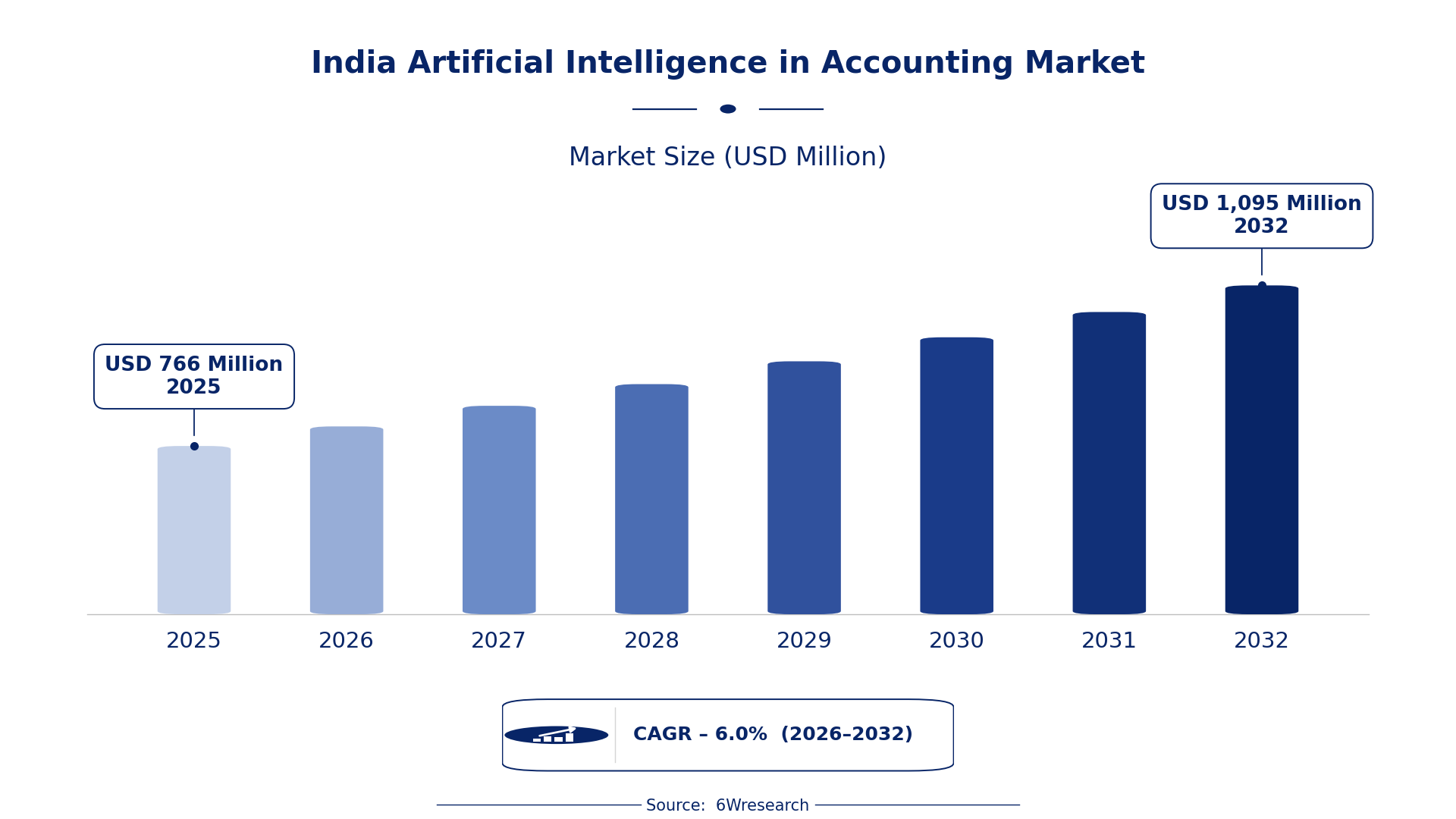
The India Artificial Intelligence in Accounting Market was estimated at USD 766 Million in 2025 and is projected to reach USD 1095 Million by 2032, growing at a CAGR of 6.0% from 2026 to 2032.
India Artificial Intelligence in Accounting Market Synopsis
Artificial intelligence is redefining the accounting sector in India, as businesses increasingly adopt AI-driven solutions for enhanced accuracy and efficiency. Automation of routine tasks is allowing firms to focus on strategic financial management, setting a new standard in the industry.
The demand for AI in accounting is driven by a growing need for compliance and error reduction amid complex financial regulations. Companies are investing in AI technologies to streamline operations and improve decision-making processes, marking a significant shift in how financial data is managed.
India Artificial Intelligence in Accounting Market Year-wise Growth Rate and Key Drivers
This graph illustrates the annual growth rates of the India Artificial Intelligence in Accounting Market from 2021 to 2032, highlighting a steady upward trajectory and projected expansion over the forecast period.
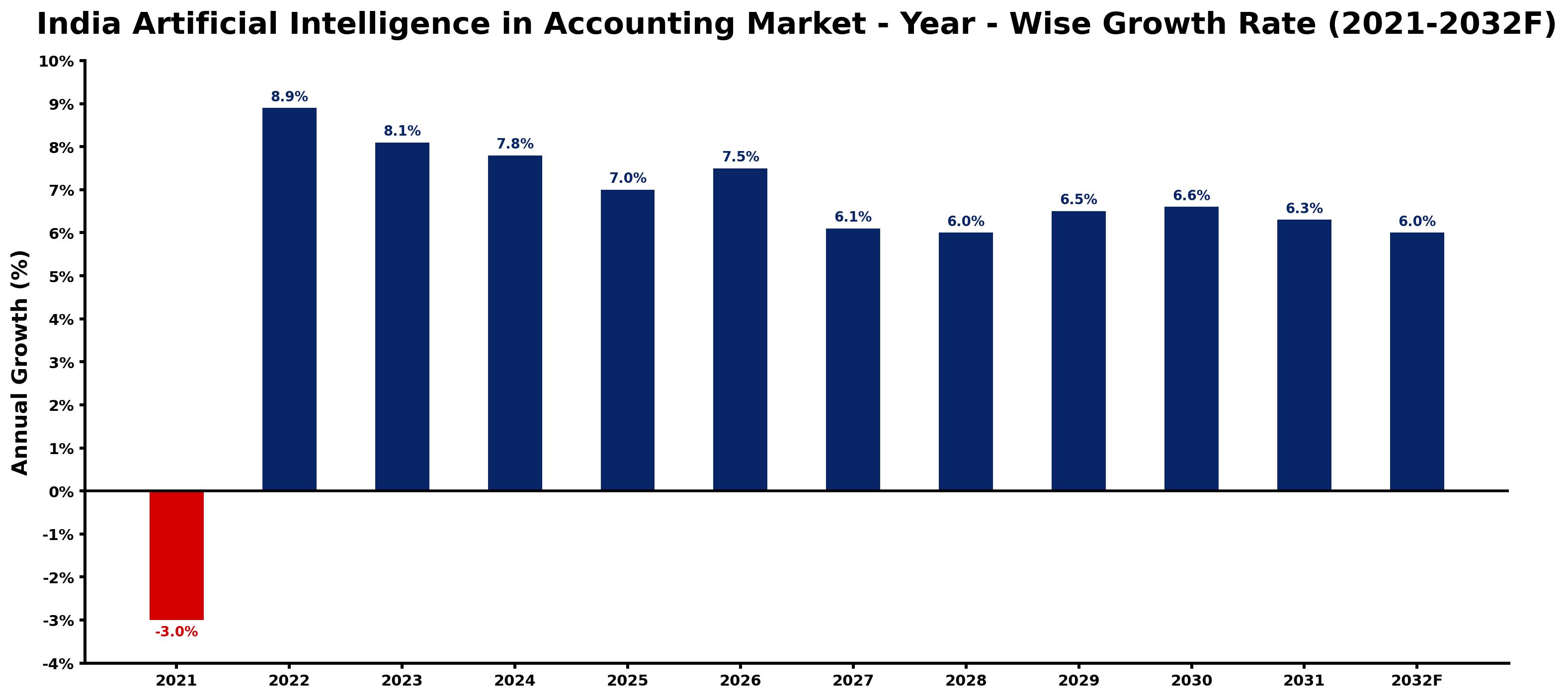
The table below presents the year‑wise growth rates along with the key drivers influencing the market
| Year | Growth Rate | Major Drivers |
| 2021 | -3.0% | High compliance costs under GST regulations deter adoption. |
| 2022 | 8.9% | Implementation of GST compliance automation tools in accounting. |
| 2023 | 8.1% | Increased adoption of AI for financial fraud detection. |
| 2024 | 7.8% | Growing push for digital transformation in financial services. |
| 2025 | 7.0% | Increase in skilled workforce for AI-driven accounting tools. |
| 2026 | 7.5% | Government incentives for tech adoption in business accounting. |
| 2027 | 6.1% | Demand for real-time financial analytics in enterprises. |
| 2028 | 6.0% | Rise of fintech partnerships enhancing AI solutions. |
| 2029 | 6.5% | Regulatory support for AI innovations in financial reporting. |
| 2030 | 6.6% | Adoption of machine learning for tax optimization strategies. |
| 2031 | 6.3% | Focus on compliance automation driven by regulatory changes. |
| 2032 | 6.0% | Improved accuracy and efficiency in bookkeeping using AI. |
Note: Market size estimations and growth projections presented in this report are based on 6Wresearch's proprietary forecasting methodology, utilizing the latest available industry data, government publications, and primary research inputs.
India Artificial Intelligence in Accounting Market Key Takeaways
Below are some of the specific key takeaways from the market, including:
- AI technologies are automating traditional accounting tasks, leading to greater efficiency.
- Businesses are increasingly prioritizing AI to meet regulatory compliance demands.
- The market is expanding rapidly due to the shift towards digital financial management.
- Concerns about job displacement and integration with legacy systems remain significant challenges.
- The COVID-19 pandemic has accelerated the adoption of AI tools in accounting.
Evaluation of Restraints in India Artificial Intelligence in Accounting Market
Resistance to change is one of the primary barriers facing the adoption of AI in accounting. Many firms cling to traditional methods, fearing job losses and potential inaccuracies in AI-generated reports. The absence of a comprehensive regulatory framework for AI in accounting further complicates matters, creating inconsistencies in how financial data is reported. Concerns around data security, especially with sensitive information, also hinder adoption. on top of that, integrating AI solutions with existing legacy systems presents both technical and financial challenges that organizations must navigate.
India Artificial Intelligence in Accounting Market Trends
The market is experiencing several notable trends that are shaping its future. Increased investment in cloud-based AI solutions is evident, as organizations seek scalable and flexible accounting tools. Additionally, there is a growing emphasis on predictive analytics, allowing firms to anticipate financial trends and make informed decisions. The rise of remote working has also driven demand for AI solutions that support collaboration and real-time financial reporting.
India Artificial Intelligence in Accounting Market Opportunities
Genuine growth opportunities lie in sectors where regulatory complexities are high, such as finance and healthcare. As businesses continue to grapple with compliance requirements, AI can offer tailored solutions that simplify these processes. on top of that, the development of industry-specific AI applications presents a significant avenue for investment. Companies that focus on creating user-friendly interfaces will likely capture a larger share of the market, as accessibility becomes increasingly important.
Government Initiatives in the India Artificial Intelligence in Accounting Market
The Indian government is actively promoting AI adoption across various sectors, including accounting. With a focus on digital transformation, public policy is aligning with the needs of businesses seeking to modernize their financial management practices. Regulations are gradually evolving to support AI integration, making it essential for organizations to stay informed about legislative changes.
- A national digital infrastructure upgrade programme launched in 2023 aims to enhance connectivity for businesses adopting AI technologies.
- Current initiatives are underway to establish a regulatory framework that ensures AI's safe use in financial reporting, expected to be finalized by late 2025.
- Plans for a public-private partnership aimed at creating AI training programs for accounting professionals are set to be rolled out in 2026.
- Ongoing efforts to promote transparency in AI-driven financial operations are part of a broader push to enhance trust in automated accounting solutions.
- The government has introduced tax incentives for companies that invest in AI technologies, fostering a more supportive environment for innovation.
Future Insights of the India Artificial Intelligence in Accounting Market
Looking forward to 2026-2032, the India Artificial Intelligence in Accounting Market is set for substantial growth. The increasing complexity of financial regulations will drive businesses to seek AI solutions that provide not only automation but also deeper insights into financial data. As firms prioritize strategic decision-making, the role of AI in accounting will expand, leading to the emergence of more sophisticated applications that cater to specific industry needs. The convergence of AI with other technologies, such as blockchain, will further enhance the transparency and security of financial transactions.
India Artificial Intelligence in Accounting Market Latest Developments
In the past year, the India Artificial Intelligence in Accounting Market has seen a surge in activity as companies rush to adopt AI solutions. The urgency for improved operational efficiency and compliance has resulted in numerous initiatives aimed at integrating AI into accounting processes. As businesses pivot towards automation, a flurry of developments is reshaping the market.
- A leading technology vendor launched an AI-driven accounting platform in early 2025, enabling real-time financial reporting and analytics.
- Partnerships between accounting firms and AI startups have become increasingly common, with several collaborations currently underway to enhance service offerings.
- By mid-2026, a regional firm is expected to roll out a suite of AI tools designed specifically for small and medium enterprises, addressing their unique accounting needs.
- Ongoing enhancements to existing AI solutions are being implemented to improve user experience and data security, reflecting the industry's response to client feedback.
- A major financial institution is currently testing an AI application that automates compliance checks, with plans for a broader rollout in late 2025.
India Artificial Intelligence in Accounting Market - Key Attractiveness of the Report
- 10 Years of Market Numbers
- Historical Data Starting from 2022 to 2025
- Base Year: 2025
- Forecast Data until 2032
- Key Performance Indicators Impacting the Market
- Major Upcoming Developments and Projects
Key Highlights of the Report:
- India Artificial Intelligence in Accounting Market Outlook
- Market Size of India Artificial Intelligence in Accounting Market, 2025
- Forecast of India Artificial Intelligence in Accounting Market, 2032
- Historical Data and Forecast of India Artificial Intelligence in Accounting Revenues & Volume for the Period 2022-2032F
- India Artificial Intelligence in Accounting Market Trend Evolution
- India Artificial Intelligence in Accounting Market Drivers and Challenges
- India Artificial Intelligence in Accounting Price Trends
- India Artificial Intelligence in Accounting Porter's Five Forces
- India Artificial Intelligence in Accounting Industry Life Cycle
- Historical Data and Forecast of India Artificial Intelligence in Accounting Market Revenues & Volume By Application for the Period 2022-2032F
- Historical Data and Forecast of India Artificial Intelligence in Accounting Market Revenues & Volume By Automated Bookkeeping for the Period 2022-2032F
- Historical Data and Forecast of India Artificial Intelligence in Accounting Market Revenues & Volume By Invoice Classification and Approvals for the Period 2022-2032F
- Historical Data and Forecast of India Artificial Intelligence in Accounting Market Revenues & Volume By Fraud and Risk Management for the Period 2022-2032F
- Historical Data and Forecast of India Artificial Intelligence in Accounting Market Revenues & Volume By Reporting for the Period 2022-2032F
- Historical Data and Forecast of India Artificial Intelligence in Accounting Market Revenues & Volume By Others for the Period 2022-2032F
- Historical Data and Forecast of India Artificial Intelligence in Accounting Market Revenues & Volume By Component for the Period 2022-2032F
- Historical Data and Forecast of India Artificial Intelligence in Accounting Market Revenues & Volume By Solutions for the Period 2022-2032F
- Historical Data and Forecast of India Artificial Intelligence in Accounting Market Revenues & Volume By Services for the Period 2022-2032F
- Historical Data and Forecast of India Artificial Intelligence in Accounting Market Revenues & Volume By Technology for the Period 2022-2032F
- Historical Data and Forecast of India Artificial Intelligence in Accounting Market Revenues & Volume By Machine Learning (ML) and Deep Learning for the Period 2022-2032F
- Historical Data and Forecast of India Artificial Intelligence in Accounting Market Revenues & Volume By NLP for the Period 2022-2032F
- Historical Data and Forecast of India Artificial Intelligence in Accounting Market Revenues & Volume By Deployment Mode for the Period 2022-2032F
- Historical Data and Forecast of India Artificial Intelligence in Accounting Market Revenues & Volume By On-premises for the Period 2022-2032F
- Historical Data and Forecast of India Artificial Intelligence in Accounting Market Revenues & Volume By Cloud for the Period 2022-2032F
- Historical Data and Forecast of India Artificial Intelligence in Accounting Market Revenues & Volume By Enterprise Size for the Period 2022-2032F
- Historical Data and Forecast of India Artificial Intelligence in Accounting Market Revenues & Volume By Large Enterprises for the Period 2022-2032F
- Historical Data and Forecast of India Artificial Intelligence in Accounting Market Revenues & Volume By Small and Medium-Sized Enterprises (SMEs) for the Period 2022-2032F
- India Artificial Intelligence in Accounting Import Export Trade Statistics
- Market Opportunity Assessment By Application
- Market Opportunity Assessment By Component
- Market Opportunity Assessment By Technology
- Market Opportunity Assessment By Deployment Mode
- Market Opportunity Assessment By Enterprise Size
- India Artificial Intelligence in Accounting Top Companies Market Share
- India Artificial Intelligence in Accounting Competitive Benchmarking By Technical and Operational Parameters
- India Artificial Intelligence in Accounting Company Profiles
- India Artificial Intelligence in Accounting Key Strategic Recommendations






































