India Artificial Intelligence Platform Market Size & Growth Rate (2026-2032)
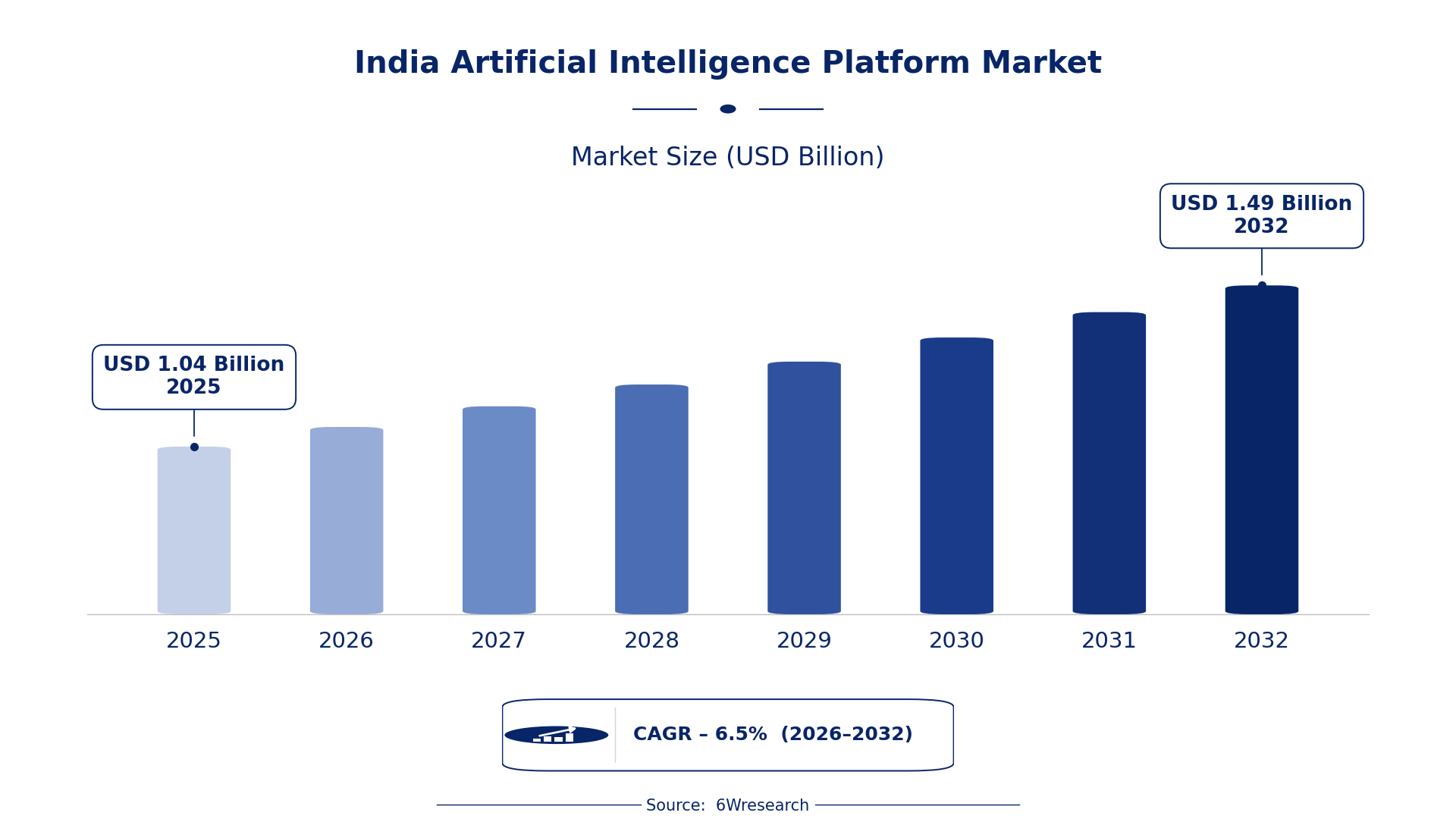
The India Artificial Intelligence Platform Market was estimated at USD 1038 Million in 2025 and is projected to reach USD 1487 Million by 2032, growing at a CAGR of 6.5% from 2026 to 2032.
India Artificial Intelligence Platform Market Synopsis
The India Artificial Intelligence Platform market is witnessing a surge in adoption, driven by the increasing need for automation and data-driven decision-making across various industries. Companies are turning to AI platforms to improve efficiency and enhance customer experiences, making this technology a fundamental part of their growth strategy.
Particularly in sectors like healthcare, finance, and e-commerce, AI platforms are transforming how businesses operate. The availability of skilled professionals and advancements in machine learning technologies are propelling this growth, allowing businesses to extract actionable insights from vast datasets.
India Artificial Intelligence Platform Market Year-wise Growth Rate and Key Drivers
This graph illustrates the annual growth rates of the India Artificial Intelligence Platform Market from 2021 to 2032, highlighting a steady upward trajectory and projected expansion over the forecast period.
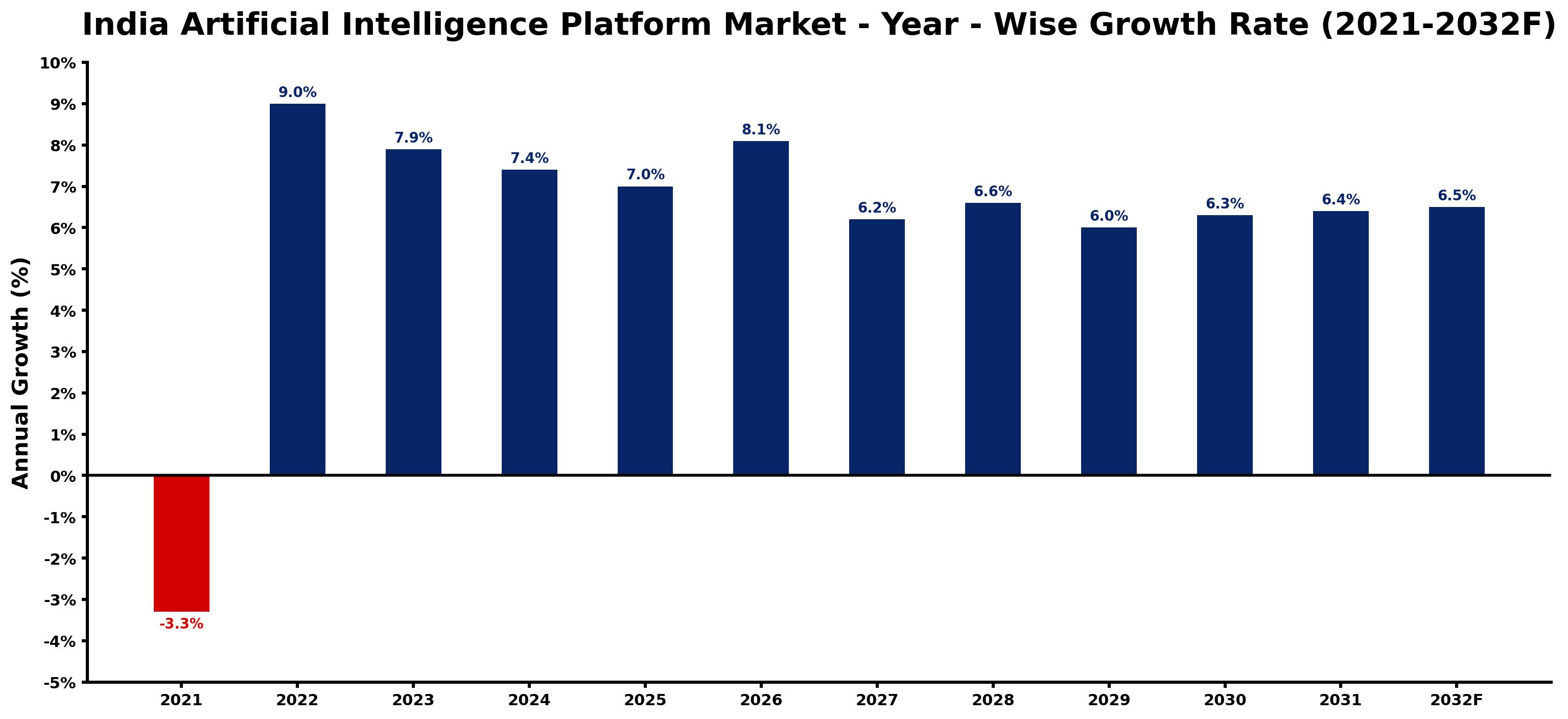
The table below presents the year‑wise growth rates along with the key drivers influencing the market
| Year | Growth Rate | Major Drivers |
| 2021 | -3.3% | Delayed adoption due to Indian data privacy regulations. |
| 2022 | 9.0% | Increased government funding for AI startups and innovation. |
| 2023 | 7.9% | Adoption of AI technologies in smart city projects. |
| 2024 | 7.4% | Launch of India's National AI Mission initiative. |
| 2025 | 7.0% | Growth of AI use in personalized customer experiences. |
| 2026 | 8.1% | Demand for AI-based supply chain optimization solutions. |
| 2027 | 6.2% | Increasing investment in AI for cybersecurity enhancements. |
| 2028 | 6.6% | Rising popularity of AI in educational technology tools. |
| 2029 | 6.0% | Government initiatives promoting AI in renewable energy sector. |
| 2030 | 6.3% | Integration of AI in urban mobility solutions. |
| 2031 | 6.4% | Focus on AI for improving public health data analytics. |
| 2032 | 6.5% | Growing interest in AI-powered language processing applications. |
Note: Market size estimations and growth projections presented in this report are based on 6Wresearch's proprietary forecasting methodology, utilizing the latest available industry data, government publications, and primary research inputs.
India Artificial Intelligence Platform Market Key Takeaways
Below are some of the specific key takeaways from the market, including:
- The market is fueled by the pressing need for enhanced automation and data analysis capabilities.
- Healthcare and finance are leading sectors in AI adoption, leveraging platforms for improved outcomes.
- Emerging startups are playing a vital role in driving innovation within the AI platform space.
- Challenges related to data privacy and integration with existing systems remain significant hurdles.
- Government initiatives are increasingly shaping the regulatory environment for AI technologies.
Evaluation of Restraints in India Artificial Intelligence Platform Market
Despite the promising growth trajectory, the India Artificial Intelligence Platform market faces notable restraints. The rapidly evolving nature of AI technology necessitates continuous adaptation, which can be resource-intensive for businesses. Data privacy concerns have become paramount, especially with stringent regulations emerging globally. on top of that, the requirement for substantial computational resources to deploy AI applications raises scalability issues, particularly for smaller enterprises. Integrating these platforms with legacy IT systems poses additional technical challenges, often hindering the seamless implementation of AI solutions.
India Artificial Intelligence Platform Market Trends
A few trends are currently shaping the demand for AI platforms in India. The shift towards cloud-based AI solutions is prominent, allowing businesses to access powerful computing resources without heavy upfront investments. Additionally, the increasing focus on ethical AI practices is gaining traction as companies strive for transparency in their AI initiatives. The rise of low-code and no-code platforms is also notable, enabling non-technical users to deploy AI solutions easily. These trends indicate that the market is not just growing but evolving in response to both technological advancements and societal expectations.
India Artificial Intelligence Platform Market Opportunities
Opportunities for investment and growth in the India Artificial Intelligence Platform market are abundant. The healthcare sector, particularly in telemedicine and diagnostics, presents significant potential for AI applications. on top of that, the push for smart city initiatives creates a demand for AI solutions that optimize urban infrastructure and enhance public services. As businesses increasingly seek customized AI solutions tailored to specific industry needs, there is a ripe landscape for innovative startups and established players to capitalize on this demand.
Government Initiatives in the India Artificial Intelligence Platform Market
The Indian government is actively shaping the AI ecosystem through a series of strategic initiatives. Public policy is focusing on creating a conducive environment for AI innovation, emphasizing the importance of regulatory frameworks and infrastructure development. As the nation seeks to position itself as a global leader in AI technology, these initiatives are critical in addressing both opportunities and challenges in the sector.
- A national digital infrastructure upgrade programme launched recently aims to enhance connectivity and data access across urban and rural areas.
- Current efforts include a regulatory framework to ensure ethical AI practices, expected to be finalized by mid-2026.
- Planned initiatives involve a public-private partnership model aimed at funding AI research and development projects in key sectors.
- The government is currently rolling out a skill development programme focused on AI education and training for the workforce.
- A recently completed initiative established a national AI research fund to support innovative projects and startups.
Future Insights of the India Artificial Intelligence Platform Market
Looking ahead to 2026-2032, the India Artificial Intelligence Platform market is expected to continue on its growth path. The increasing integration of AI into core business processes will likely become a norm, fostering greater efficiency and innovation. Companies will focus on developing tailored solutions that align with industry-specific needs, further driving demand. As regulatory frameworks mature and ethical considerations gain prominence, businesses will have to balance innovation with responsible AI practices. The interplay between technological advancements and regulatory support will shape the future dynamics of this market.
India Artificial Intelligence Platform Market Latest Developments
Recent developments in the India Artificial Intelligence Platform market indicate a vibrant and dynamic environment. Over the last year, various initiatives and technological advancements have emerged, signaling a strong commitment to AI integration across sectors.
- A leading technology vendor announced a partnership in late 2025 to develop AI-driven solutions for the finance sector, enhancing fraud detection capabilities.
- In Q1 2026, a major regional player launched an AI-powered analytics platform tailored for the healthcare industry, focusing on patient data management.
- An ongoing initiative from mid-2025 aims to implement AI solutions in supply chain optimization for several e-commerce companies.
- Plans for a rollout of AI training modules in educational institutions are expected to commence in early 2026.
- A tech firm is currently upgrading its AI tools to enhance data security, with implementation slated for late 2026.
India Artificial Intelligence Platform Market - Key Attractiveness of the Report
- 10 Years of Market Numbers
- Historical Data Starting from 2022 to 2025
- Base Year: 2025
- Forecast Data until 2032
- Key Performance Indicators Impacting the Market
- Major Upcoming Developments and Projects
Key Highlights of the Report:
- India Artificial Intelligence Platform Market Outlook
- Market Size of India Artificial Intelligence Platform Market, 2025
- Forecast of India Artificial Intelligence Platform Market, 2032
- Historical Data and Forecast of India Artificial Intelligence Platform Revenues & Volume for the Period 2022-2032F
- India Artificial Intelligence Platform Market Trend Evolution
- India Artificial Intelligence Platform Market Drivers and Challenges
- India Artificial Intelligence Platform Price Trends
- India Artificial Intelligence Platform Porter's Five Forces
- India Artificial Intelligence Platform Industry Life Cycle
- Historical Data and Forecast of India Artificial Intelligence Platform Market Revenues & Volume By Component for the Period 2022-2032F
- Historical Data and Forecast of India Artificial Intelligence Platform Market Revenues & Volume By Tools for the Period 2022-2032F
- Historical Data and Forecast of India Artificial Intelligence Platform Market Revenues & Volume By Services for the Period 2022-2032F
- Historical Data and Forecast of India Artificial Intelligence Platform Market Revenues & Volume By Application for the Period 2022-2032F
- Historical Data and Forecast of India Artificial Intelligence Platform Market Revenues & Volume By Forecasts and prescriptive models for the Period 2022-2032F
- Historical Data and Forecast of India Artificial Intelligence Platform Market Revenues & Volume By Chatbots for the Period 2022-2032F
- Historical Data and Forecast of India Artificial Intelligence Platform Market Revenues & Volume By Speech recognition for the Period 2022-2032F
- Historical Data and Forecast of India Artificial Intelligence Platform Market Revenues & Volume By Text recognition for the Period 2022-2032F
- Historical Data and Forecast of India Artificial Intelligence Platform Market Revenues & Volume By Others for the Period 2022-2032F
- Historical Data and Forecast of India Artificial Intelligence Platform Market Revenues & Volume By Deployment Mode for the Period 2022-2032F
- Historical Data and Forecast of India Artificial Intelligence Platform Market Revenues & Volume By Cloud for the Period 2022-2032F
- Historical Data and Forecast of India Artificial Intelligence Platform Market Revenues & Volume By On-Premises for the Period 2022-2032F
- Historical Data and Forecast of India Artificial Intelligence Platform Market Revenues & Volume By Tools for the Period 2022-2032F
- Historical Data and Forecast of India Artificial Intelligence Platform Market Revenues & Volume By NLP for the Period 2022-2032F
- Historical Data and Forecast of India Artificial Intelligence Platform Market Revenues & Volume By ML for the Period 2022-2032F
- India Artificial Intelligence Platform Import Export Trade Statistics
- Market Opportunity Assessment By Component
- Market Opportunity Assessment By Application
- Market Opportunity Assessment By Deployment Mode
- Market Opportunity Assessment By Tools
- India Artificial Intelligence Platform Top Companies Market Share
- India Artificial Intelligence Platform Competitive Benchmarking By Technical and Operational Parameters
- India Artificial Intelligence Platform Company Profiles
- India Artificial Intelligence Platform Key Strategic Recommendations






































