India Auto Parts And Accessories Market Size, Share & Growth Rate
The India Auto Parts And Accessories Market was estimated at USD 1444 Million in 2025 and is projected to reach USD 2067 Million by 2032, growing at a CAGR of 5.3% from 2026 to 2032. This anticipated growth is propelled by an expanding automotive sector, characterized by an increasing number of vehicles on Indian roads and a rising appetite for vehicle personalization. Coupled with the burgeoning e-commerce landscape, which facilitates convenient access to a variety of auto parts, the market's growth trajectory appears robust.
India Auto Parts And Accessories Market Year-wise Growth Rate and Key Drivers
This graph highlights how the India Auto Parts And Accessories Market has steadily grown over the years, supported by major growth factors.
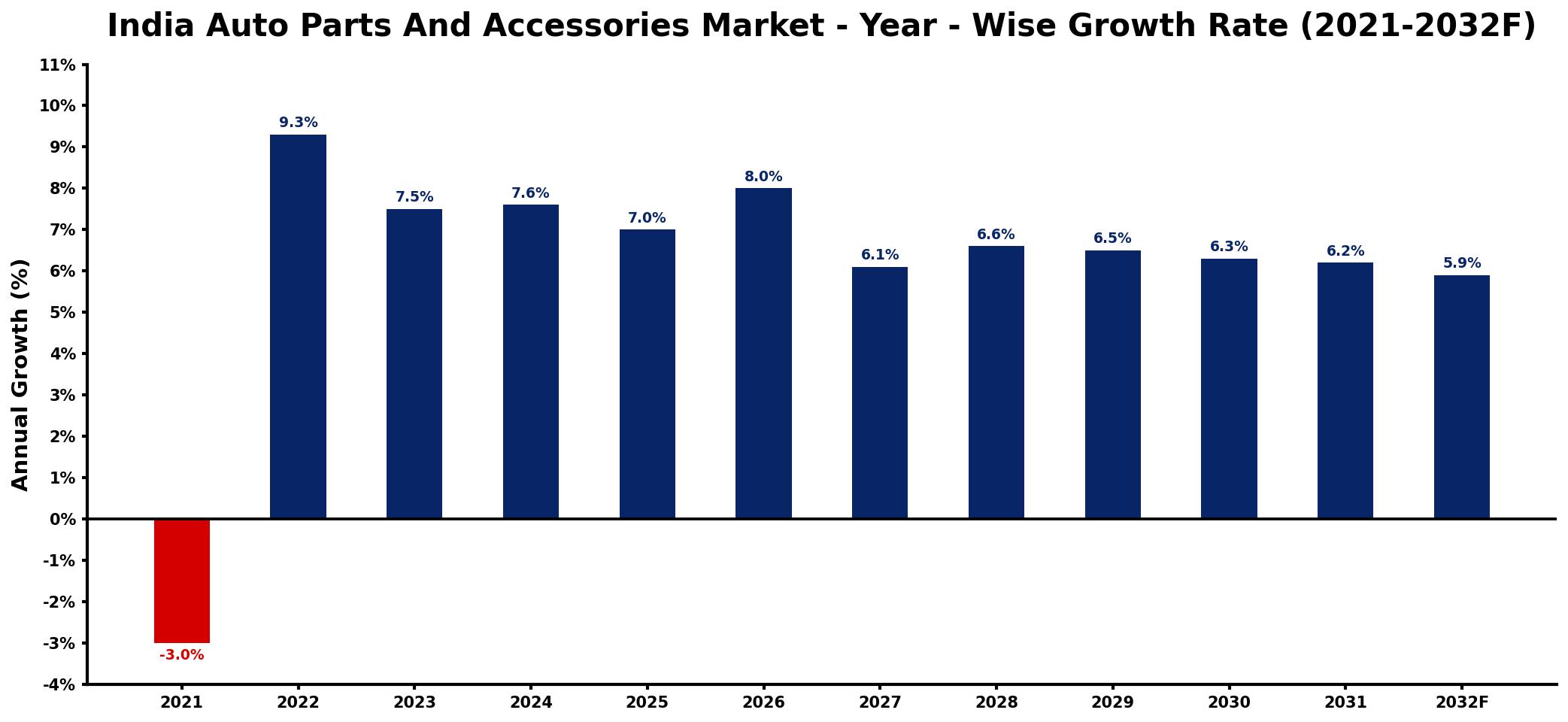
The table below presents the year‑wise growth rates along with the key drivers influencing the market
| Year | Growth Rate | Major Drivers |
| 2021 | -3.0% | decreased consumer spending on vehicles |
| 2022 | 9.3% | rising demand for electric vehicles |
| 2023 | 7.5% | increased investments in manufacturing |
| 2024 | 7.6% | growing emphasis on sustainability practices |
| 2025 | 7.0% | expansion of online retail channels |
| 2026 | 8.0% | expanding industrial usage applications |
| 2027 | 6.1% | enhanced vehicle safety regulations implemented |
| 2028 | 6.6% | growing demand for vehicle customization |
| 2029 | 6.5% | rising infrastructure development spending |
| 2030 | 6.3% | increased focus on fuel efficiency |
| 2031 | 6.2% | rising consumer awareness on quality |
| 2032 | 5.9% | increased capital investment inflows |
Note: Market size estimations and growth projections presented in this report are based on 6Wresearch's proprietary forecasting methodology, utilizing the latest available industry data, government publications, and primary research inputs.
India Auto Parts And Accessories Market Synopsis
The Indian automotive aftermarket for auto parts and accessories is becoming increasingly vital as vehicle ownership rises across urban and rural landscapes. This surge in vehicle registrations is driving demand for replacement parts, servicing components, and aftermarket accessories, stimulating further investment within the sector.
Additionally, the push for electric vehicles has opened new avenues for manufacturers to innovate. Not only does this trend cater to the environmental needs of modern consumers, but it also requires a fresh approach to product development, adapting to new technologies and changing consumer behaviors.
India Auto Parts And Accessories Market Key Takeaways
- The market is witnessing a significant demand surge driven by increased vehicle ownership and customization trends.
- The rise of e-commerce is enhancing consumer access to a diverse range of auto parts.
- Government initiatives promoting electric vehicles are reshaping the market landscape.
- Innovative product development is essential for manufacturers to meet evolving consumer preferences.
- The industry faces challenges from counterfeit products, necessitating rigorous quality assurance measures.
Evaluation of Restraints in India Auto Parts And Accessories Market
Despite the promising growth potential, the India Auto Parts and Accessories Market grapples with several challenges. The shift towards environmentally friendly alternatives and sustainability is paramount, as manufacturers must innovate to meet the requirements of electric and hybrid vehicles. Furthermore, the proliferation of counterfeit auto parts poses significant risks not only to vehicle safety and performance but also to consumer trust. The fragmented nature of the market also leads to pricing pressures, compelling manufacturers to emphasize differentiation and quality while navigating the competitive landscape. Additionally, as consumer preferences shift towards online retail, companies must adopt effective digital strategies to capture and engage their target audience.
India Auto Parts And Accessories Market Trends
Several trends are shaping the India Auto Parts and Accessories Market landscape. The growing fascination with vehicle customization is driving demand for a wide range of aftermarket products. Additionally, the integration of advanced technologies, such as IoT and AI, in auto parts is enhancing vehicle performance and consumer experience. E-commerce platforms are revolutionizing the way consumers access parts, leading to increased sales volumes and greater market penetration. Furthermore, the emphasis on sustainability is prompting manufacturers to explore eco-friendly materials and production methods.
India Auto Parts And Accessories Market Opportunities
The shift towards electric vehicles presents substantial growth opportunities for the auto parts market. Manufacturers who invest in research and development to create innovative and sustainable automotive solutions can capture significant market share. The expansion of online retail platforms also allows businesses to reach a broader customer base, tapping into emerging markets where vehicle ownership is on the rise. Collaboration between industry stakeholders can foster innovation and quality assurance, driving market success.
Government Initiatives in the India Auto Parts And Accessories Market
The Indian government has been proactive in supporting the automotive sector through various policies and initiatives aimed at promoting electric vehicles and sustainable transportation solutions. Incentives for manufacturers transitioning to green technology and enhanced investment in infrastructure are pivotal for market growth. Programs encouraging research and development in eco-friendly automotive solutions further bolster the industry, ensuring alignment with global sustainability standards.
Future Insights of the India Auto Parts And Accessories Market
From 2026 to 2032, the India Auto Parts and Accessories Market is poised for continued growth, driven by both domestic demand and export opportunities. The adoption of electric and hybrid vehicles will necessitate a transformation in product offerings, with manufacturers focusing on quality and sustainability. Technological advancements will play a crucial role in shaping the future, as smart components and connected technologies redefine consumer experiences. The market's adaptability to these trends will determine its competitive edge in a rapidly evolving landscape.
India Auto Parts And Accessories Market Latest Developments (2025 - 2026)
Recent developments in the India Auto Parts and Accessories Market indicate a heightened focus on integrating technology into product offerings. Manufacturers are increasingly exploring partnerships to enhance innovation, with several companies announcing initiatives aimed at creating sustainable parts. E-commerce platforms are expanding their capabilities, enhancing customer experience and accessibility. The transition to electric vehicles is further influencing product development strategies, with companies pivoting towards eco-friendly solutions to align with market demands.
India Auto Parts And Accessories Market - Key Attractiveness of the Report
- 10 Years of Market Numbers
- Historical Data Starting from 2022 to 2025
- Base Year: 2025
- Forecast Data until 2032
- Key Performance Indicators Impacting the Market
- Major Upcoming Developments and Projects
Key Highlights of the Report:
- India Auto Parts And Accessories Market Outlook
- Market Size of India Auto Parts And Accessories Market, 2025
- Forecast of India Auto Parts And Accessories Market, 2032
- Historical Data and Forecast of India Auto Parts And Accessories Revenues & Volume for the Period 2022-2032F
- India Auto Parts And Accessories Market Trend Evolution
- India Auto Parts And Accessories Market Drivers and Challenges
- India Auto Parts And Accessories Price Trends
- India Auto Parts And Accessories Porter's Five Forces
- India Auto Parts And Accessories Industry Life Cycle
- Historical Data and Forecast of India Auto Parts And Accessories Market Revenues & Volume By Product for the Period 2022-2032F
- Historical Data and Forecast of India Auto Parts And Accessories Market Revenues & Volume By Driveline & Powertrain for the Period 2022-2032F
- Historical Data and Forecast of India Auto Parts And Accessories Market Revenues & Volume By Interiors & Exteriors for the Period 2022-2032F
- Historical Data and Forecast of India Auto Parts And Accessories Market Revenues & Volume By Electronics for the Period 2022-2032F
- Historical Data and Forecast of India Auto Parts And Accessories Market Revenues & Volume By Bodies & Chassis for the Period 2022-2032F
- Historical Data and Forecast of India Auto Parts And Accessories Market Revenues & Volume By Wheel & Tires for the Period 2022-2032F
- Historical Data and Forecast of India Auto Parts And Accessories Market Revenues & Volume By Others for the Period 2022-2032F
- Historical Data and Forecast of India Auto Parts And Accessories Market Revenues & Volume By Application for the Period 2022-2032F
- Historical Data and Forecast of India Auto Parts And Accessories Market Revenues & Volume By OEMs for the Period 2022-2032F
- Historical Data and Forecast of India Auto Parts And Accessories Market Revenues & Volume By Aftermarket for the Period 2022-2032F
- India Auto Parts And Accessories Import Export Trade Statistics
- Market Opportunity Assessment By Product
- Market Opportunity Assessment By Application
- India Auto Parts And Accessories Top Companies Market Share
- India Auto Parts And Accessories Competitive Benchmarking By Technical and Operational Parameters
- India Auto Parts And Accessories Company Profiles
- India Auto Parts And Accessories Key Strategic Recommendations






































