India Automotive Brake Pads Market Top 5 Importing Countries and Market Competition (HHI) Analysis
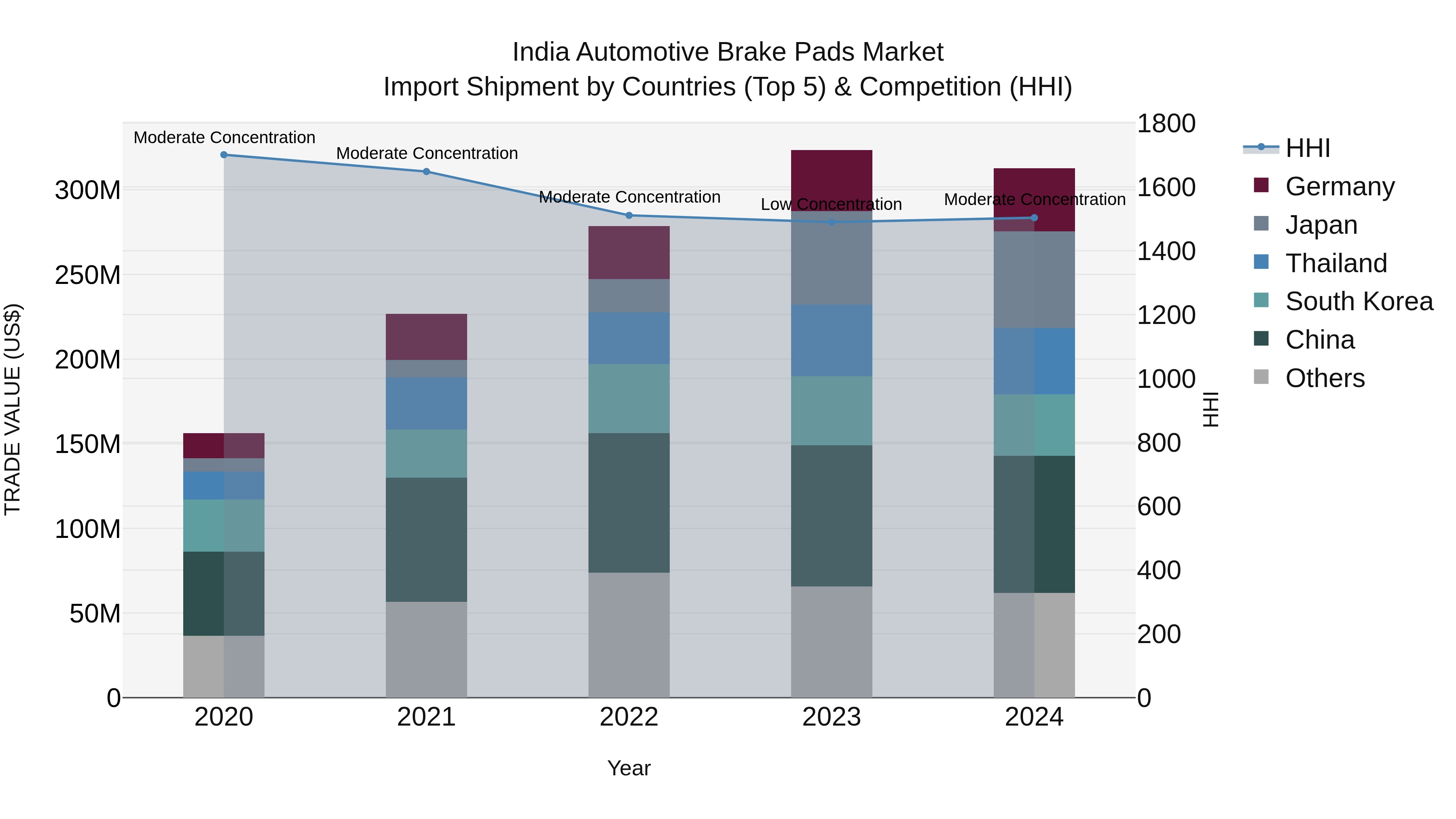
In 2024, India saw a significant increase in automotive brake pads imports, with key suppliers including China, Japan, Thailand, Germany, and South Korea. The market exhibited a shift from low to moderate concentration, indicating a more diverse supplier base. Despite a slight decline in growth rate from 2023, the compound annual growth rate (CAGR) for 2020-24 remained strong at 18.96%. This trend suggests a growing demand for high-quality brake pads in the Indian automotive market, driving competition among key exporting countries.
India Automotive Brake Pads Market Overview
The automotive brake pads market in India is closely related to vehicle safety and performance. Brake pads are critical for stopping a vehicle efficiently and safely. As India automotive industry continues to grow, the market for brake pads sees a parallel expansion. The emphasis is on providing reliable, long-lasting brake pads that meet the diverse requirements of various vehicle types and road conditions. Continuous innovation and quality improvements are key trends in this market.
Drivers of the Market
The India automotive brake pads market is driven by the same factors as the brake linings market, with a focus on brake pad components used in automotive braking systems to ensure vehicle safety and performance.
Challenges of the Market
Similar to brake linings, the brake pads market in India must contend with stringent safety regulations. Meeting these standards can be costly, and there is a need for continuous innovation to develop brake pads suitable for various vehicle types, including electric vehicles. The market also faces pressure to reduce noise, vibrations, and harshness (NVH) levels, which is a complex technical challenge. Moreover, maintaining consistent quality while managing cost constraints is an ongoing concern.
COVID-19 Impact on the Market
The COVID-19 pandemic significantly impacted the India automotive brake pads market, causing a notable decline in demand and production. Lockdowns, supply chain disruptions, and reduced consumer spending due to economic uncertainties led to a slowdown in the automotive sector. Vehicle sales plummeted, and the aftermarket for brake pads suffered as vehicle usage decreased. Manufacturers faced challenges in maintaining operations due to labor shortages and logistic constraints. With a gradual recovery as restrictions eased, the market is witnessing a slow resurgence, but full restoration to pre-pandemic levels is a gradual process, contingent upon economic rebound and consumer confidence.
Key Players in the Market
In the India Automotive Brake Pads market, leading manufacturers play a pivotal role in supplying quality brake pads to the automotive sector. Notable players include Bosch Limited, Brakes India Private Limited, TVS Brake Linings Limited, and Rane Brake Lining Limited. These companies offer a diverse range of brake pads designed for various vehicle types, ensuring reliable and efficient braking performance on India roads.
Key Highlights of the Report:
- India Automotive Brake Pads Market Outlook
- Market Size of India Automotive Brake Pads Market, 2024
- Forecast of India Automotive Brake Pads Market, 2031
- Historical Data and Forecast of India Automotive Brake Pads Revenues & Volume for the Period 2021-2031
- India Automotive Brake Pads Market Trend Evolution
- India Automotive Brake Pads Market Drivers and Challenges
- India Automotive Brake Pads Price Trends
- India Automotive Brake Pads Porter's Five Forces
- India Automotive Brake Pads Industry Life Cycle
- Historical Data and Forecast of India Automotive Brake Pads Market Revenues & Volume By Vehicle for the Period 2021-2031
- Historical Data and Forecast of India Automotive Brake Pads Market Revenues & Volume By Passenger Car for the Period 2021-2031
- Historical Data and Forecast of India Automotive Brake Pads Market Revenues & Volume By LCV for the Period 2021-2031
- Historical Data and Forecast of India Automotive Brake Pads Market Revenues & Volume By HCV for the Period 2021-2031
- Historical Data and Forecast of India Automotive Brake Pads Market Revenues & Volume By Two-wheelers for the Period 2021-2031
- Historical Data and Forecast of India Automotive Brake Pads Market Revenues & Volume By Material for the Period 2021-2031
- Historical Data and Forecast of India Automotive Brake Pads Market Revenues & Volume By Semi-metallic for the Period 2021-2031
- Historical Data and Forecast of India Automotive Brake Pads Market Revenues & Volume By Non-asbestos Organic (NAO) for the Period 2021-2031
- Historical Data and Forecast of India Automotive Brake Pads Market Revenues & Volume By Low-metallic NAO for the Period 2021-2031
- Historical Data and Forecast of India Automotive Brake Pads Market Revenues & Volume By Ceramic for the Period 2021-2031
- Historical Data and Forecast of India Automotive Brake Pads Market Revenues & Volume By Sales Outlet for the Period 2021-2031
- Historical Data and Forecast of India Automotive Brake Pads Market Revenues & Volume By OEM for the Period 2021-2031
- Historical Data and Forecast of India Automotive Brake Pads Market Revenues & Volume By Aftermarket for the Period 2021-2031
- Historical Data and Forecast of India Automotive Brake Pads Market Revenues & Volume By Position for the Period 2021-2031
- Historical Data and Forecast of India Automotive Brake Pads Market Revenues & Volume By Front for the Period 2021-2031
- Historical Data and Forecast of India Automotive Brake Pads Market Revenues & Volume By Front & Rear for the Period 2021-2031
- India Automotive Brake Pads Import Export Trade Statistics
- Market Opportunity Assessment By Vehicle
- Market Opportunity Assessment By Material
- Market Opportunity Assessment By Sales Outlet
- Market Opportunity Assessment By Position
- India Automotive Brake Pads Top Companies Market Share
- India Automotive Brake Pads Competitive Benchmarking By Technical and Operational Parameters
- India Automotive Brake Pads Company Profiles
- India Automotive Brake Pads Key Strategic Recommendations






































