India Ceiling Tiles Market Top 5 Importing Countries and Market Competition (HHI) Analysis
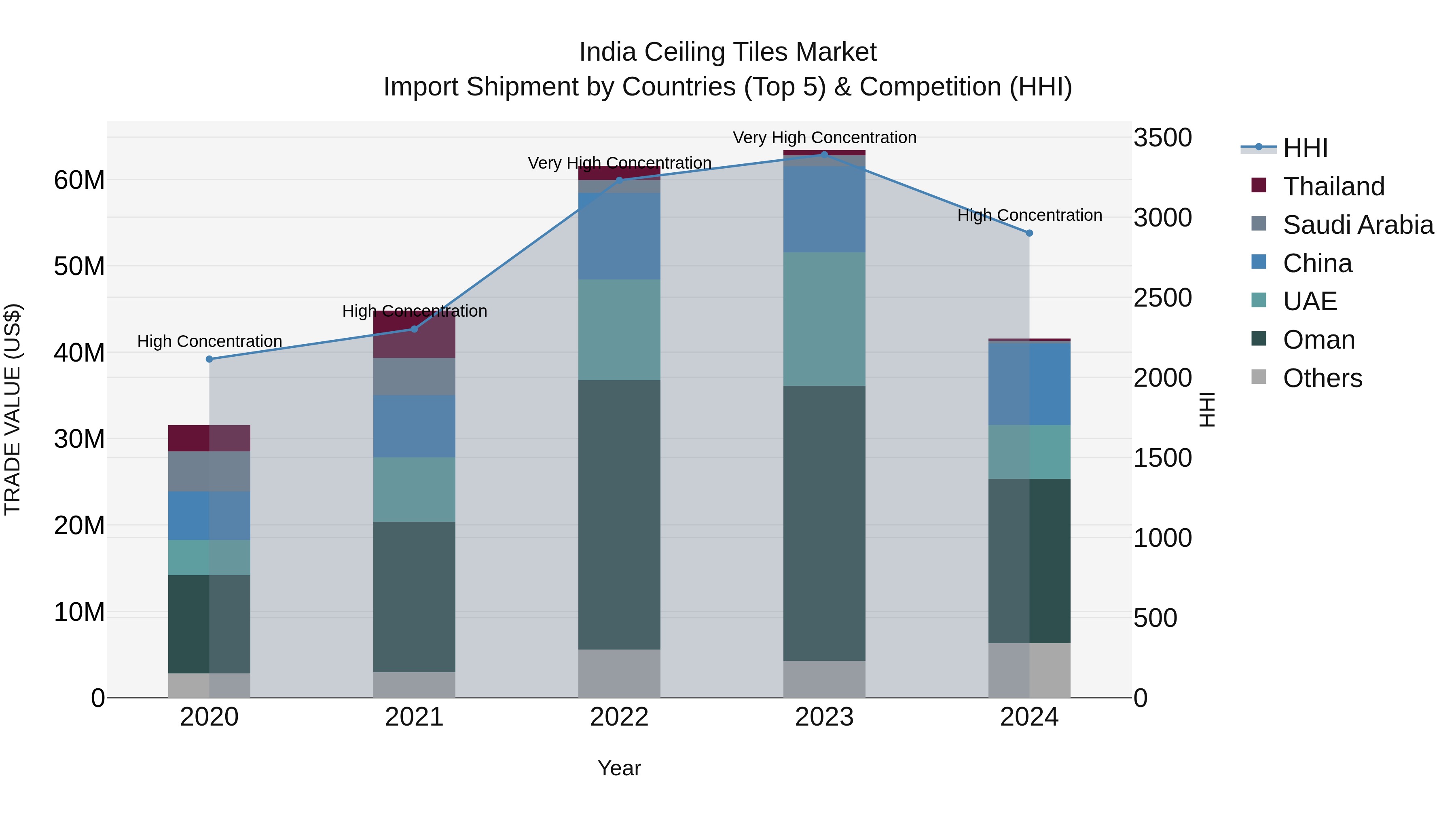
The India ceiling tiles import market saw a shift in concentration levels from very high in 2023 to high in 2024, indicating a more diversified import source base. Top exporting countries such as Oman, China, UAE, Germany, and Indonesia played a significant role in supplying ceiling tiles to India. Despite a negative growth rate of -34.4% in 2024, the compound annual growth rate (CAGR) from 2020 to 2024 stood at a healthy 7.15%, showcasing a steady expansion in the market over the years. This dynamic landscape suggests evolving trends and opportunities for both suppliers and importers in the ceiling tiles sector.
India Ceiling Tiles Market Highlights
| Report Name | India Ceiling Tiles Market |
| Forecast period | 2025-2031 |
| CAGR | ~5.95% (according to recent industry reports for 2025-2033) (Imarc Group) |
| Growing Sector | Non-Residential Construction |
Topics Covered in the India Ceiling Tiles Market Report
India Ceiling Tiles Market report thoroughly covers the market by material type and application. The market report provides an unbiased and detailed analysis of ongoing market trends, opportunities/high growth areas, and market drivers, which would help stakeholders devise and align their market strategies according to the current and future market dynamics.
India Ceiling Tiles Market Synopsis
The India ceiling tiles market is expected to register steady growth. The market is driven by rising construction activity in residential and, significantly, non-residential segments (offices, retail, hospitality, healthcare), increasing urbanisation, demand for acoustic/thermal efficient interiors, and aesthetic upgrades in ceilings. Government initiatives to boost infrastructure, affordable housing and smart cities also support adoption of ceiling tiles. Improvements in manufacturing, more diverse material types (gypsum, mineral fibre, metallic), and supply chain reach are further fueling growth.
Evaluation of Growth Drivers in the India Ceiling Tiles Market
Below mentioned some growth drivers and their impact on market dynamics:
| Drivers | Primary Segments Affected | Why It Matters |
| Growth in commercial / infrastructure projects | Application (Non-Residential) | More new buildings = higher demand for ceiling tiles. |
| Urban housing growth and home-renovation | Application (Residential) | Rising income & urban homes upgrade ceilings. |
| Demand for acoustic, fire-safe, energy-efficient interiors | Material Type (Mineral Wool, Metal, Gypsum, Others) | Premium materials gain share, boosting value. |
| Government programmes (smart cities, affordable housing, infrastructure) | All segments | Stimulates building activity and product uptake. |
| Availability of diverse materials & finish-to-ceiling tile innovations | Material Type | Allows better design choices and broader appeal. |
The India Ceiling Tiles Market is projected to grow significantly, with a CAGR of approximately 5.95% during the forecast period of 2025-2031. The ceiling tiles market in India is expanding due to strong construction activity in non-residential sectors, increasing renovation/upgrade demand in residential spaces, a shift toward higher performance ceiling materials (acoustic, fire-resistant), and favorable policy support for infrastructure and urban housing. The proliferation of supply chains into Tier-2/3 cities and improved value‐chain manufacturing also contribute to market growth.
Evaluation of Restraints in the India Ceiling Tiles Market
Below mentioned are some major restraints and their influence on market dynamics:
| Restraints | Primary Segments Affected | What This Means |
| High cost of premium material variants | Material Type | Slows uptake of higher-margin products in cost-sensitive markets. |
| Fragmented unorganised supply & low standardisation | All Segments | Impacts quality, limits organised players’ share. |
| Slow replacement cycles in residential sector | Application (Residential) | Limits growth in mature home-markets. |
| Dependence on imports for specialised ceiling tiles/materials | Material Type | Exposes to supply risk and higher input cost. |
| Regulatory / fire-safety compliance costs | Application (Non-Residential) & Material Type | Adds cost for manufacturers and buyers, limiting adoption. |
India Ceiling Tiles Market Challenges
In the Indian ceiling tiles sector, challenges include competition from low cost/unorganised players who undercut pricing, thereby limiting margin growth for organised players. Adoption of premium ceiling tile materials remains uneven across regions, especially in Tier-3/rural markets. Also, many residential end-users delay replacement or upgrades of ceiling systems, giving slower refresh cycles. Moreover, reliance on imported specialty materials and the cost of compliance for fire/acoustic standards remain barriers for some manufacturers and end-users.
India Ceiling Tiles Market Trends
Some major trends contributing to the development of the India Ceiling Tiles Market growth are:
- Shift to Premium & Functional Materials: Increasing use of mineral fibre, gypsum, metal ceiling tiles offering acoustic/fire-resistant and aesthetic benefits. (Imarc Group)
- Growth in Non-Residential Applications: Offices, retail, hospitals demand ceiling tile systems for modern interiors and performance (sound, fire, lighting). (Imarc Group)
- Focus on Aesthetics & Interior Design: Ceilings moving from purely functional to design-element (finishes, patterns, modular systems).
- Regional Expansion & Tier-2/Tier-3 Penetration: As construction spreads beyond major metros, ceiling tile penetration increases in smaller cities and towns.
- Government-led Infrastructure & Housing Initiatives: Smart cities, affordable housing programmes stimulate demand for ceilings in new builds and public infrastructure. (Imarc Group)
Investment Opportunities in the India Ceiling Tiles Industry
Here are some investment opportunities in the India ceiling tiles industry:
- Manufacturing of high-performance ceiling tile materials: Invest in production of gypsum, metal, mineral wool tiles catering to acoustic/fire demands.
- Distribution & installation services in tier-2/3 markets: Build network and value-added services (ceiling tile supply + installation) to capitalise on regional growth.
- Product innovation and decorative finishing: Develop designer ceiling tile lines or modular systems for premium interiors and commercial spaces.
- Backward integration for raw materials: Secure supply of specialty materials (e.g., mineral wool, metal) or localise components to lower costs and improve margins.
- Targeting institutional & infrastructure projects: Position as supplier for hospitals, airports, malls, offices where ceiling tile specifications are higher and project size bigger.
Top 5 Leading Players in the India Ceiling Tiles Market
Here are some top companies contributing to India Ceiling Tiles Market share:
1. Saint‑Gobain Gyproc India Ltd.
| CompanyName | Saint‑Gobain Gyproc India Ltd. |
|---|---|
| Established Year | 1949 |
| Headquarters | Part of Saint-Gobain Group |
| Official Website | Click Here |
Saint-Gobain Gyproc is a key player in ceiling tile and interior plasterboard systems in India, offering wide range of gypsum ceiling tile solutions and system-ceiling products for residential and commercial buildings.
2. Knauf AMF GmbH & Co. KG (India operations)
| CompanyName | Knauf AMF GmbH & Co. KG (India operations) |
|---|---|
| Established | International firm with Indian manufacturing |
| Headquarters | Chennai, India |
| Official Website | Click Here |
Knauf AMF specialises in mineral fibre and metal ceiling tile systems, supplying to modern commercial projects and infrastructure.
3. Everest Industries Ltd.
| CompanyName | Everest Industries Ltd. |
|---|---|
| Established Year | 1934 |
| Headquarters | Nagpur, India |
| Official Website | - |
Everest Industries produces lightweight ceiling tile panels and roof-systems for commercial/residential use, with focus on system‐integration and ease of installation.
4. India Gypsum Pvt. Ltd.
| CompanyName | India Gypsum Pvt. Ltd. |
|---|---|
| Established Year | (part of Danfoss/India Gypsum) |
| Headquarters | Pune, India |
| Official Website | Click Here |
India Gypsum offers gypsum board and ceiling tile solutions, catering to both residential and commercial segments, and focusing on standardised systems.
5. USG Boral Building Products India Pvt. Ltd.
| CompanyName | USG Boral Building Products India Pvt. Ltd. |
|---|---|
| Established Year | 1949 |
| Headquarters | JV between USG Corporation & Boral |
| Official Website | - |
USG Boral supplies ceiling tile and grid systems, focusing on premium acoustic and fire-rated ceilings targeted at institutional and hospitality segments.
Government Regulations Introduced in the India Ceiling Tiles Market
According to Indian government data, regulatory and supportive policy measures significantly influence the ceiling tiles market. The Bureau of Energy Efficiency (BEE) and other building-codes promote energy-efficient and fire-safe building materials, which indirectly drives adoption of ceiling tile systems with insulation/acoustic/fire benefits. Government initiatives such as the Smart Cities Mission and the Pradhan Mantri Awas Yojana (PMAY) support large scale housing and infrastructure construction, elevating demand for ceiling tiles. The “Make in India” and “Atmanirbhar Bharat” manufacturing push also encourages domestic production of building-interior materials.
Future Insights of the India Ceiling Tiles Market
The outlook for the Indian ceiling tiles market appears favourable, with steady growth forecast ahead. The market will benefit from sustained construction activity in residential, commercial and infrastructure segments, increased replacement and renovation demand, growing interest for premium/functional ceiling systems (acoustic, fire, design), and wider regional penetration into tier-2/3 cities. Manufacturers who invest in product innovation, installation support and distribution reach will be positioned well. However, managing cost pressures, raw material volatility, and channel fragmentation will remain important for long-term success.
Market Segmentation Analysis
The report offers a comprehensive study of the subsequent market segments and their leading categories.
By Material Type (Mineral Wool, Metal, Gypsum, Others)
- Dominating category: Gypsum. Among the material types for ceiling tiles in India, gypsum board/ceiling tile systems dominate due to their widespread use, ease of installation, cost-effectiveness and adaptability in both residential and non-residential applications. They provide good fire‐resistance and interior finish quality, making them a preferred choice across many building projects. Reports note gypsum as a major sub-segment. (Imarc Group)
- Detailed: Gypsum ceiling tiles and boards are broadly manufactured in India, enjoy strong distribution and installation network, and are accepted by developers and contractors. Their scalable production, relatively lower cost compared with metal/wood, and compatibility with modular ceiling grids make them dominant. Although mineral wool and metal ceiling tiles are growing (thanks to acoustics, fire and premium sectors), gypsum remains the highest volume material type.
By Application (Residential, Non-Residential)
- Dominating category: Non-Residential. In the India ceiling tiles market, the non-residential application segment holds the largest share due to strong demand from commercial offices, retail malls, educational/healthcare institutions and hospitality sectors that place high emphasis on ceiling systems (acoustic, fire, aesthetics) and often use ceiling tile panels. (Imarc Group)
- Detailed: Non-residential buildings typically use higher-spec ceiling tiles (better acoustic, fire‐rated) and larger areas, which drives higher volumes and value. Growth in corporate offices, shopping malls, hospitals and public infrastructure lifts demand substantially. The residential application segment is growing as well, but non-residential currently dominates in terms of both value and specification.






































