New Zealand Ceiling Tiles Market Top 5 Importing Countries and Market Competition (HHI) Analysis
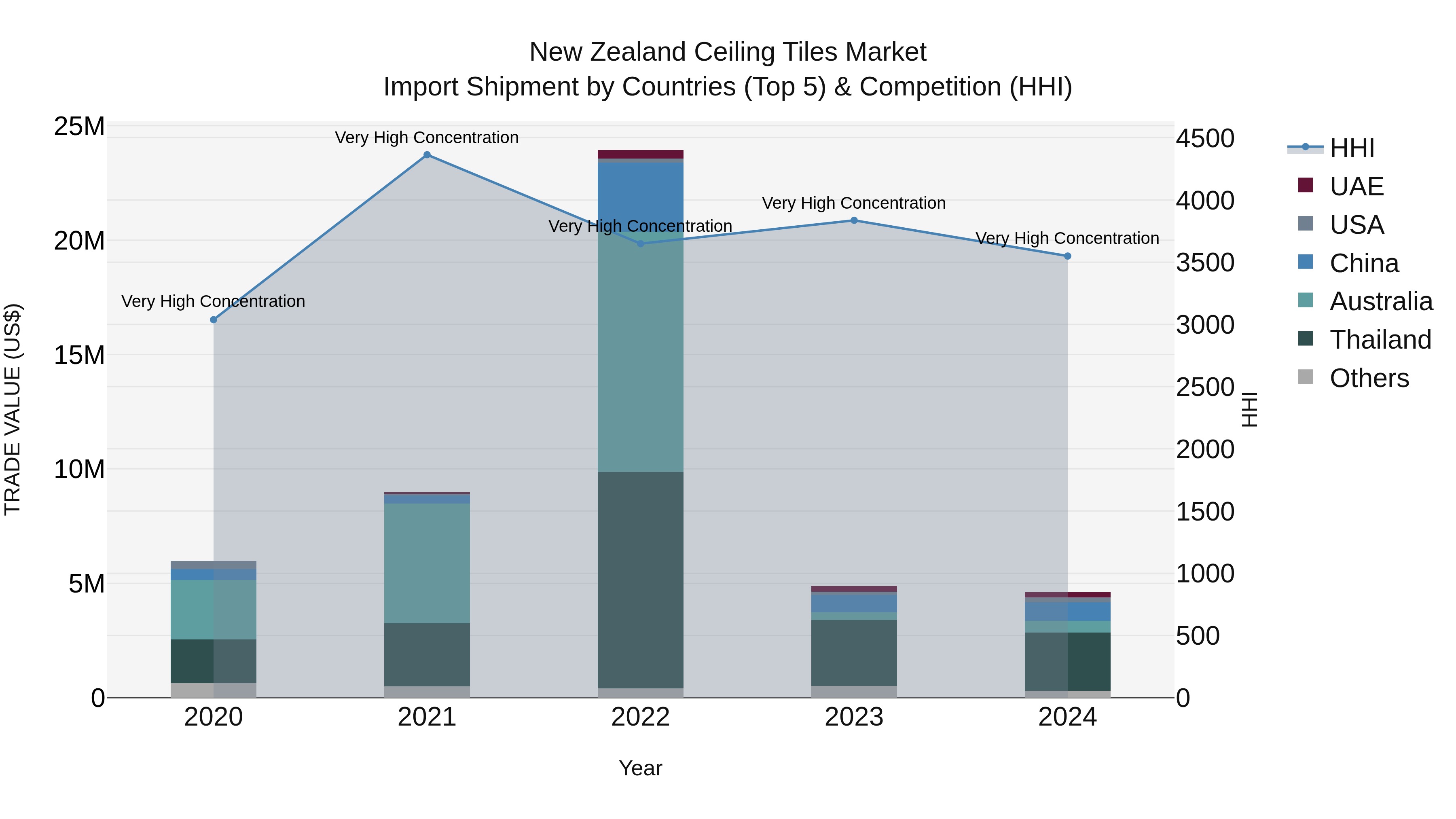
The import shipments of ceiling tiles into New Zealand continued to be dominated by top exporting countries such as Thailand, China, Australia, UAE, and USA in 2024, showcasing a high level of concentration in the market. Despite a negative Compound Annual Growth Rate (CAGR) of -6.31% over the period 2020-2024, the industry experienced a slightly improved growth rate of -5.54% from 2023 to 2024. This data suggests a challenging market environment for ceiling tile imports in New Zealand, highlighting the need for strategic adjustments and market insights for industry players.
New Zealand Ceiling Tiles Market Overview
Ceiling tiles are essential components in interior construction, offering acoustic insulation, thermal performance, and aesthetic enhancement for commercial and residential spaces. In New Zealand, the ceiling tiles market is driven by factors such as urbanization, infrastructure development. In New Zealand, the ceiling tiles market has witnessed steady growth in recent years due to increasing construction activities in both residential and commercial sectors. With a focus on aesthetics and sustainability, there is a growing demand for innovative and eco-friendly ceiling solutions.
Drivers of the market
Ceiling tiles are essential components of interior design and acoustics in buildings. The New Zealand ceiling tiles market offers a variety of materials, designs, and finishes to enhance aesthetics and improve sound insulation in residential, commercial, and institutional spaces.
Challenges of the market
The New Zealand ceiling tiles market encounters challenges in balancing aesthetics with functionality. With increasing emphasis on sustainable solutions, demand shifts towards eco-friendly materials pose both opportunities and obstacles for manufacturers.
Government Policy of the market
The ceiling tiles market is shaped by government policies supporting the construction industry and sustainable building practices. Regulations on building materials and support for the development of green buildings drive demand for advanced ceiling tiles.
Key Highlights of the Report:
- New Zealand Ceiling Tiles Market Outlook
- Market Size of New Zealand Ceiling Tiles Market, 2024
- Forecast of New Zealand Ceiling Tiles Market, 2031
- Historical Data and Forecast of New Zealand Ceiling Tiles Revenues & Volume for the Period 2021-2031
- New Zealand Ceiling Tiles Market Trend Evolution
- New Zealand Ceiling Tiles Market Drivers and Challenges
- New Zealand Ceiling Tiles Price Trends
- New Zealand Ceiling Tiles Porter`s Five Forces
- New Zealand Ceiling Tiles Industry Life Cycle
- Historical Data and Forecast of New Zealand Ceiling Tiles Market Revenues & Volume By Material Type for the Period 2021-2031
- Historical Data and Forecast of New Zealand Ceiling Tiles Market Revenues & Volume By Mineral Wool for the Period 2021-2031
- Historical Data and Forecast of New Zealand Ceiling Tiles Market Revenues & Volume By Metal for the Period 2021-2031
- Historical Data and Forecast of New Zealand Ceiling Tiles Market Revenues & Volume By Gypsum for the Period 2021-2031
- Historical Data and Forecast of New Zealand Ceiling Tiles Market Revenues & Volume By Others for the Period 2021-2031
- Historical Data and Forecast of New Zealand Ceiling Tiles Market Revenues & Volume By Application for the Period 2021-2031
- Historical Data and Forecast of New Zealand Ceiling Tiles Market Revenues & Volume By Residential for the Period 2021-2031
- Historical Data and Forecast of New Zealand Ceiling Tiles Market Revenues & Volume By Non-residential for the Period 2021-2031
- New Zealand Ceiling Tiles Import Export Trade Statistics
- Market Opportunity Assessment By Material Type
- Market Opportunity Assessment By Application
- New Zealand Ceiling Tiles Top Companies Market Share
- New Zealand Ceiling Tiles Competitive Benchmarking By Technical and Operational Parameters
- New Zealand Ceiling Tiles Company Profiles
- New Zealand Ceiling Tiles Key Strategic Recommendations






































