India Chlorofluorocarbon Market Size, Share & Growth Rate
The India Chlorofluorocarbon Market was estimated at USD 841 Million in 2025 and is projected to reach USD 1207 Million by 2032, growing at a CAGR of 5.3% from 2026 to 2032. This upward trajectory is primarily driven by the increasing demand for refrigeration and air conditioning, sectors that are rapidly expanding in the Indian economy. Additionally, the transition to alternative refrigerants, aligned with global environmental standards, is influencing manufacturers and consumers alike to adopt newer, more sustainable technologies.
India Chlorofluorocarbon Market Year-wise Growth Rate and Key Drivers
This graph highlights how the India Chlorofluorocarbon Market has steadily grown over the years, supported by major growth factors.
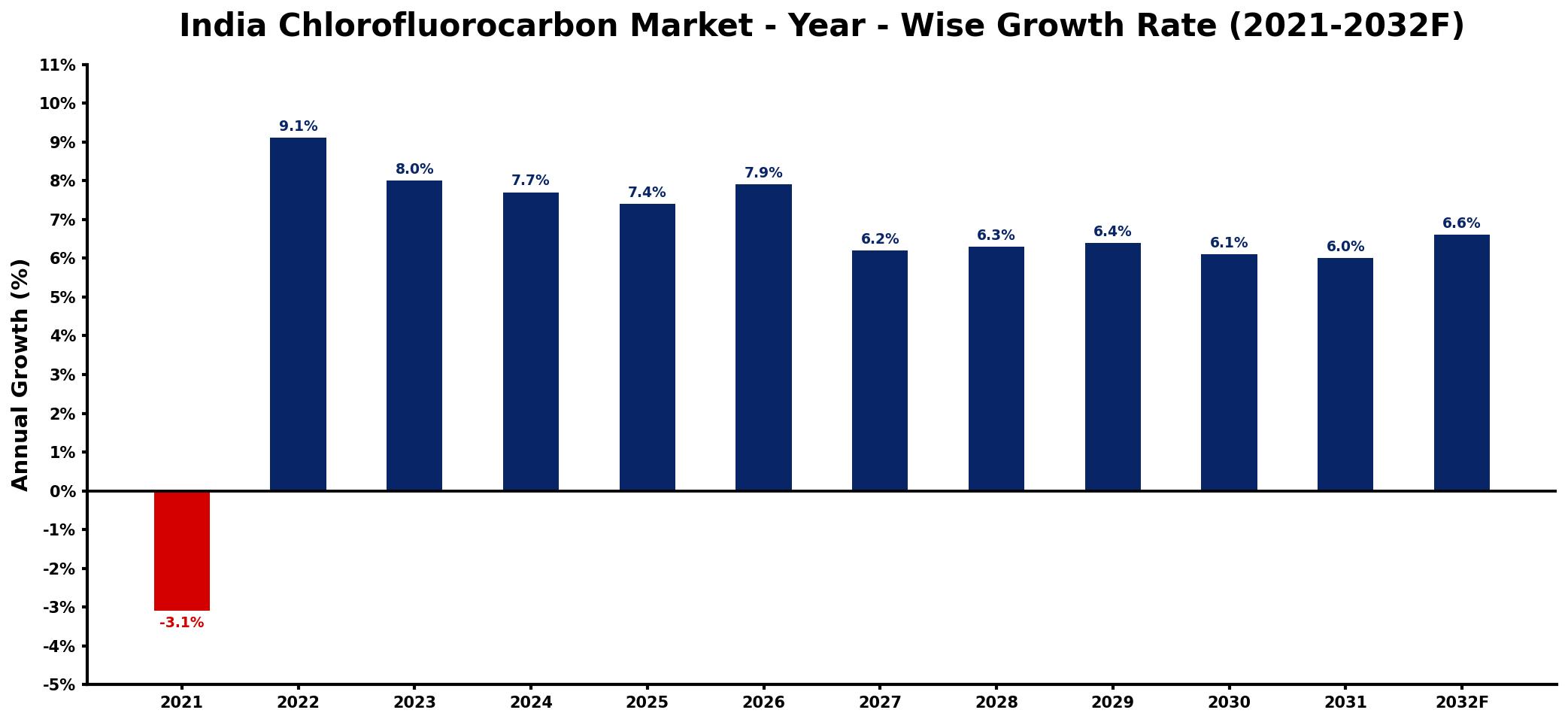
The table below presents the year‑wise growth rates along with the key drivers influencing the market
| Year | Growth Rate | Major Drivers |
| 2021 | -3.1% | Demand for alternatives decreases significantly |
| 2022 | 9.1% | Increased investments in refrigeration sectors |
| 2023 | 8.0% | Growing adoption of eco-friendly technologies |
| 2024 | 7.7% | Expansion of HVAC market applications |
| 2025 | 7.4% | Rising consumer awareness on sustainability |
| 2026 | 7.9% | Boost in industrial cooling solutions |
| 2027 | 6.2% | Enhancements in manufacturing processes efficiency |
| 2028 | 6.3% | Surge in export opportunities abroad |
| 2029 | 6.4% | Development of innovative replacement substances |
| 2030 | 6.1% | Strengthened regulatory support for compliance |
| 2031 | 6.0% | Rising demand from automotive sector |
| 2032 | 6.6% | growing emerging market penetration |
Note: Market size estimations and growth projections presented in this report are based on 6Wresearch's proprietary forecasting methodology, utilizing the latest available industry data, government publications, and primary research inputs.
India Chlorofluorocarbon Market Synopsis
The strongest force shaping the India Chlorofluorocarbon Market is the phase-out of CFCs under international environmental agreements like the Montreal Protocol. This regulation has pushed industries to explore and implement environmentally friendly alternatives, such as hydrofluorocarbons (HFCs) and hydrochlorofluorocarbons (HCFCs), which are increasingly becoming the standard in HVACR applications.
Market dynamics are also influenced by the growing awareness surrounding environmental sustainability, prompting consumers to prioritize energy-efficient refrigeration and cooling systems. The ongoing shift towards low-global-warming-potential refrigerants highlights the urgency for innovation and adaptation within the sector, contributing to the overall growth of the market.
India Chlorofluorocarbon Market Key Takeaways
- The market is transitioning due to regulatory pressures and environmental concerns.
- Demand for energy-efficient systems is at an all-time high, facilitating market growth.
- Adoption of alternative refrigerants is reshaping product offerings in the industry.
- Increasing investments in sustainable cooling technologies are expected to drive innovation.
- Consumer awareness around climate change is leading to an increased preference for eco-friendly products.
Evaluation of Restraints in India Chlorofluorocarbon Market
Despite the positive outlook, the India Chlorofluorocarbon Market encounters several restraints that may impact its growth trajectory. One primary concern is the high cost associated with developing and adopting eco-friendly alternatives. Many manufacturers face challenges in upgrading existing infrastructure to accommodate new refrigerants, which can be prohibitively expensive. Furthermore, the need for proper handling and disposal methods for existing CFCs complicates the transition process and may deter some companies from fully embracing change.
India Chlorofluorocarbon Market Trends
Several trends are currently shaping the India Chlorofluorocarbon Market. The growing preference for sustainable and energy-efficient technologies is driving innovation, leading to the development of new refrigerant solutions. Additionally, the cold chain sector is expanding, fueled by rising food safety regulations and increasing consumer demand for perishable goods. This demand is in turn fostering the requirement for modern refrigeration technologies, which increasingly favor low-GWP refrigerants.
India Chlorofluorocarbon Market Opportunities
The ongoing transformation in the India Chlorofluorocarbon Market presents various growth and investment opportunities. Companies focusing on R&D for next-generation refrigerants stand to benefit significantly from evolving regulations and consumer preferences. Additionally, the integration of smart technologies in HVACR systems presents avenues for innovation and competitive advantage. Emerging markets in rural and semi-urban areas also provide opportunities for expanding air conditioning and refrigeration services.
Government Initiatives in the India Chlorofluorocarbon Market
The Indian government is actively promoting initiatives aimed at reducing the use of ozone-depleting substances, in line with global environmental standards. Policies encouraging the adoption of alternative refrigerants are being developed, accompanied by public spending on research and infrastructure upgrades. Government programs and incentives targeting energy efficiency in cooling technologies are also fostering a more sustainable approach to refrigeration.
Future Insights of the India Chlorofluorocarbon Market
From 2026 to 2032, the India Chlorofluorocarbon Market is poised for a period of dynamic transformation, driven largely by regulatory compliance and environmental sustainability. As companies adapt to new refrigerant technologies, the emphasis will likely shift towards innovations that marry performance with eco-friendliness. The integration of smart technology in HVACR systems will become more prevalent, setting the stage for a more advanced market landscape that emphasizes both efficiency and environmental responsibility.
India Chlorofluorocarbon Market Latest Developments (2025 - 2026)
Recent developments in the India Chlorofluorocarbon Market indicate a continued focus on phasing out CFCs, with manufacturers increasingly adopting HFCs and HCFCs. As companies innovate in sustainable cooling technologies, there is a marked push towards smart systems that incorporate IoT capabilities for better efficiency. Regulatory frameworks are being updated to further encourage compliance, leading to new partnerships and collaborations aimed at advancing research and development.
India Chlorofluorocarbon Market - Key Attractiveness of the Report
- 10 Years of Market Numbers
- Historical Data Starting from 2022 to 2025
- Base Year: 2025
- Forecast Data until 2032
- Key Performance Indicators Impacting the Market
- Major Upcoming Developments and Projects
Key Highlights of the Report:
- India Chlorofluorocarbon Market Outlook
- Market Size of India Chlorofluorocarbon Market, 2025
- Forecast of India Chlorofluorocarbon Market, 2032
- Historical Data and Forecast of India Chlorofluorocarbon Revenues & Volume for the Period 2022-2032F
- India Chlorofluorocarbon Market Trend Evolution
- India Chlorofluorocarbon Market Drivers and Challenges
- India Chlorofluorocarbon Price Trends
- India Chlorofluorocarbon Porter's Five Forces
- India Chlorofluorocarbon Industry Life Cycle
- Historical Data and Forecast of India Chlorofluorocarbon Market Revenues & Volume By Type for the Period 2022-2032F
- Historical Data and Forecast of India Chlorofluorocarbon Market Revenues & Volume By CFC-11 for the Period 2022-2032F
- Historical Data and Forecast of India Chlorofluorocarbon Market Revenues & Volume By CFC-12 for the Period 2022-2032F
- Historical Data and Forecast of India Chlorofluorocarbon Market Revenues & Volume By CFC-113 for the Period 2022-2032F
- Historical Data and Forecast of India Chlorofluorocarbon Market Revenues & Volume By CFC-114 for the Period 2022-2032F
- Historical Data and Forecast of India Chlorofluorocarbon Market Revenues & Volume By CFC-115 for the Period 2022-2032F
- Historical Data and Forecast of India Chlorofluorocarbon Market Revenues & Volume By Others for the Period 2022-2032F
- Historical Data and Forecast of India Chlorofluorocarbon Market Revenues & Volume By Application for the Period 2022-2032F
- Historical Data and Forecast of India Chlorofluorocarbon Market Revenues & Volume By Aerosol Propellants for the Period 2022-2032F
- Historical Data and Forecast of India Chlorofluorocarbon Market Revenues & Volume By Blowing Agent for the Period 2022-2032F
- Historical Data and Forecast of India Chlorofluorocarbon Market Revenues & Volume By Refrigerants for the Period 2022-2032F
- Historical Data and Forecast of India Chlorofluorocarbon Market Revenues & Volume By Others for the Period 2022-2032F
- India Chlorofluorocarbon Import Export Trade Statistics
- Market Opportunity Assessment By Type
- Market Opportunity Assessment By Application
- India Chlorofluorocarbon Top Companies Market Share
- India Chlorofluorocarbon Competitive Benchmarking By Technical and Operational Parameters
- India Chlorofluorocarbon Company Profiles
- India Chlorofluorocarbon Key Strategic Recommendations






































