India Cloud CRM Market Size & Growth Rate (2026-2032)
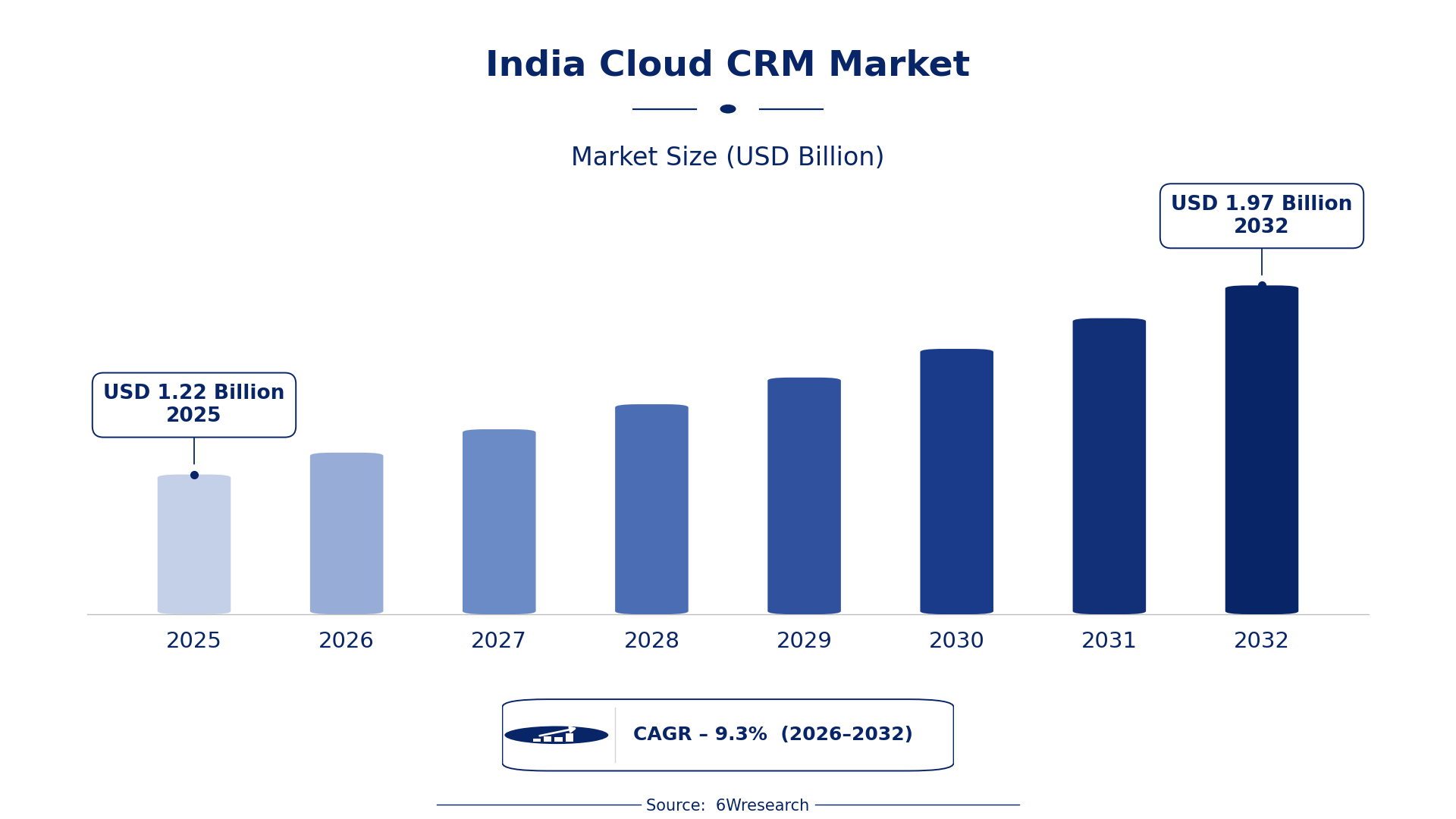
The India Cloud CRM Market was estimated at USD 1224 Million in 2025 and is projected to reach USD 1969 Million by 2032, growing at a CAGR of 9.3% from 2026 to 2032.
India Cloud CRM Market Synopsis
The driving force behind the India Cloud CRM Market today is the urgent need for businesses to enhance customer engagement and satisfaction. As organizations increasingly adopt customer-centric strategies, cloud-based CRM solutions have become indispensable in optimizing interactions and streamlining operations.
With the proliferation of digital channels and evolving customer expectations, Indian companies are recognizing the critical importance of data accessibility and analytics. Cloud CRM offers not only the scalability required to accommodate growth but also the analytical tools necessary to refine marketing and sales strategies.
India Cloud CRM Market Year-wise Growth Rate and Key Drivers
This graph illustrates the annual growth rates of the India Cloud CRM Market from 2021 to 2032, highlighting a steady upward trajectory and projected expansion over the forecast period.
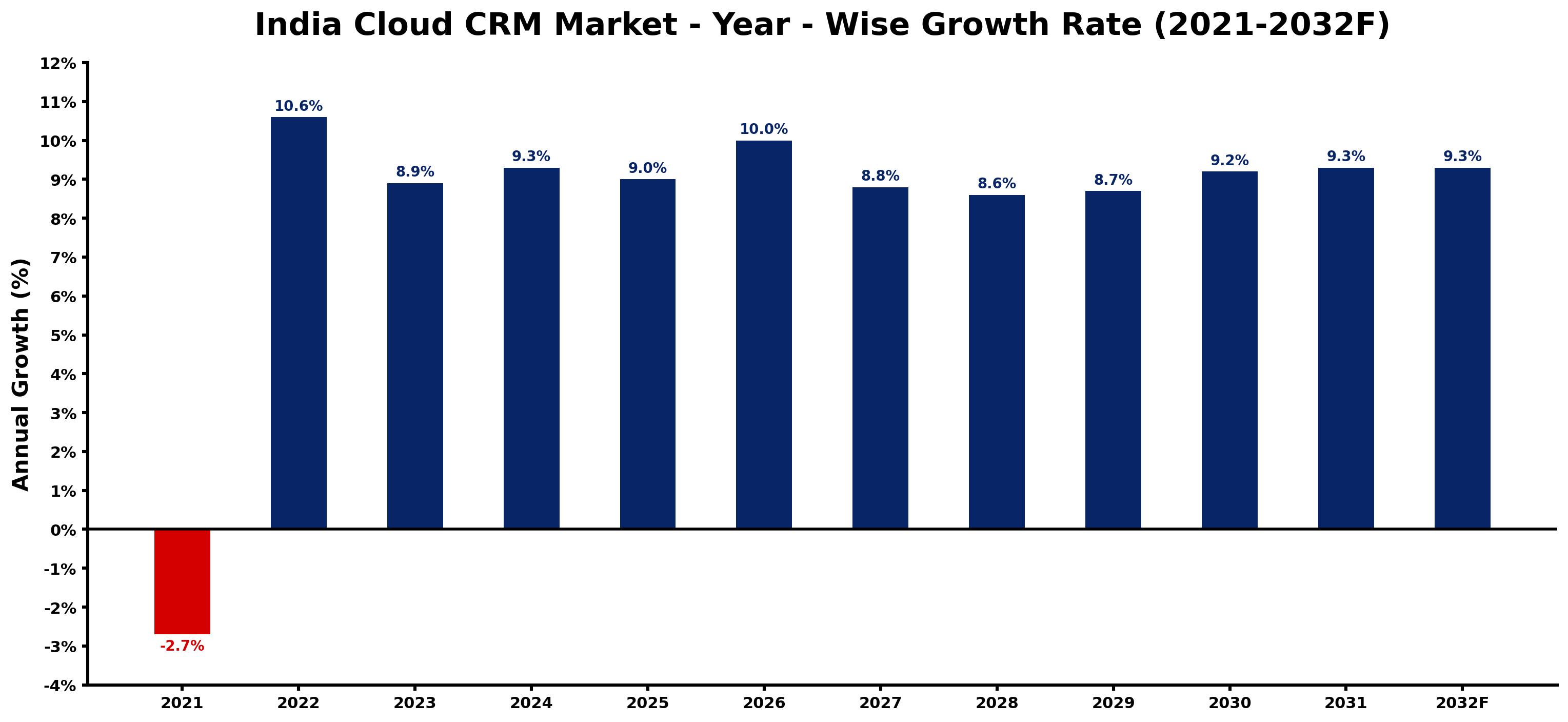
The table below presents the year‑wise growth rates along with the key drivers influencing the market
| Year | Growth Rate | Major Drivers |
| 2021 | -2.7% | Government's stricter data localization requirements hindered adoption. |
| 2022 | 10.6% | Government's Digital India initiative boosting cloud adoption. |
| 2023 | 8.9% | Increased adoption of e-commerce platforms driving CRM needs. |
| 2024 | 9.3% | Surge in remote work fueling cloud service investments. |
| 2025 | 9.0% | Growing mobile internet penetration enhancing CRM accessibility. |
| 2026 | 10.0% | Enhanced data privacy regulations prompting CRM software upgrades. |
| 2027 | 8.8% | Local SMEs increasingly investing in customer engagement tools. |
| 2028 | 8.6% | Emergence of AI-driven analytics in customer relationship management. |
| 2029 | 8.7% | Rising competition in retail sector necessitating CRM solutions. |
| 2030 | 9.2% | Government-supported startups accelerating technology integration in businesses. |
| 2031 | 9.3% | Intensified focus on customer experience elevating CRM demand. |
| 2032 | 9.3% | Digital transformation initiatives across industries increasing CRM usage. |
Note: Market size estimations and growth projections presented in this report are based on 6Wresearch's proprietary forecasting methodology, utilizing the latest available industry data, government publications, and primary research inputs.
India Cloud CRM Market Key Takeaways
Below are some of the specific key takeaways from the market, including:
- The market is driven by the need for centralized customer data management.
- Scalability and accessibility are top priorities for businesses adopting cloud CRM solutions.
- High customer expectations are pushing organizations to enhance their CRM capabilities.
- Data security concerns remain a significant barrier to widespread adoption.
- The e-commerce and retail sectors are leading in cloud CRM implementation.
Evaluation of Restraints in India Cloud CRM Market
While growth in the India Cloud CRM Market is impressive, several challenges continue to stifle its full potential. Data security and privacy are at the forefront of concerns, as businesses hesitate to migrate sensitive information to the cloud. Compliance with regulations, particularly GDPR, complicates matters further. The integration of cloud solutions with existing legacy systems presents another hurdle, often resulting in increased costs and extended transition periods. Connectivity issues in rural areas also hinder adoption, creating a divide that limits the reach of cloud CRM benefits.
India Cloud CRM Market Trends
Emerging trends are reshaping the cloud CRM market in India. There's a noticeable shift toward AI-driven analytics, enabling businesses to derive actionable insights from customer interactions. Additionally, the integration of omnichannel strategies is becoming standard practice, allowing organizations to interact with customers seamlessly across various platforms. The rise of mobile CRM solutions is also noteworthy, as businesses aim to enhance accessibility for their sales and customer service teams.
India Cloud CRM Market Opportunities
The potential for growth in the India Cloud CRM Market is substantial. Companies willing to invest in advanced CRM systems will find opportunities to improve customer engagement and retention. The increasing adoption of e-commerce provides a fertile ground for cloud CRM solutions to thrive. on top of that, organizations focusing on personalized marketing will benefit from the rich analytics capabilities offered by these platforms, allowing them to tailor their strategies effectively.
Government Initiatives in the India Cloud CRM Market
Government policy plays a crucial role in shaping the India Cloud CRM Market. With a focus on digital transformation and data security, regulatory frameworks are being established to guide businesses in their CRM adoption journey. These initiatives aim to bolster customer trust and enhance the overall business environment, making it essential for organizations to stay informed about ongoing and upcoming policies.
- A regulatory framework introduced in 2025 mandating data transparency for cloud services.
- A national digital infrastructure upgrade programme currently underway to enhance internet accessibility.
- Support initiatives for small and medium enterprises to adopt cloud technologies, launched in early 2026.
- Upcoming policies aimed at incentivizing businesses that invest in data protection measures.
- A public-private partnership aimed at improving CRM literacy and skills in the workforce, planned for mid-2027.
Future Insights of the India Cloud CRM Market
As we look ahead to 2026-2032, the India Cloud CRM Market is set for robust expansion. With digital transformation firmly on the agenda for many organizations, the demand for cloud-based CRM solutions will only intensify. Companies that prioritize customer experience through innovative CRM strategies will lead the way. As technology evolves, we expect to see greater integration of AI, machine learning, and data analytics, driving more efficient and personalized customer interactions.
India Cloud CRM Market Latest Developments
Recent activity in the India Cloud CRM Market reflects a dynamic and rapidly evolving environment. Companies are increasingly investing in cutting-edge technologies to enhance their CRM offerings. This has led to new partnerships and product launches aimed at better serving customer needs and improving operational efficiencies.
- A major technology vendor announced the launch of a new AI-driven CRM platform in early 2025, aimed at small businesses.
- A partnership formed in mid-2025 between two regional players to create an integrated CRM solution for the retail sector, currently underway.
- An initiative that began in late 2025 focuses on educating businesses about the benefits of cloud CRM, which remains ongoing.
- A rollout of an advanced mobile CRM application expected to begin in Q2 2026, targeting field sales teams.
- A planned expansion of cloud CRM services to rural areas, anticipated to launch in 2027, aiming to bridge the connectivity gap.
India Cloud CRM Market - Key Attractiveness of the Report
- 10 Years of Market Numbers
- Historical Data Starting from 2022 to 2025
- Base Year: 2025
- Forecast Data until 2032
- Key Performance Indicators Impacting the Market
- Major Upcoming Developments and Projects
Key Highlights of the Report:
- India Cloud CRM Market Outlook
- Market Size of India Cloud CRM Market, 2025
- Forecast of India Cloud CRM Market, 2032
- Historical Data and Forecast of India Cloud CRM Revenues & Volume for the Period 2022-2032F
- India Cloud CRM Market Trend Evolution
- India Cloud CRM Market Drivers and Challenges
- India Cloud CRM Price Trends
- India Cloud CRM Porter's Five Forces
- India Cloud CRM Industry Life Cycle
- Historical Data and Forecast of India Cloud CRM Market Revenues & Volume By Vertical for the Period 2022-2032F
- Historical Data and Forecast of India Cloud CRM Market Revenues & Volume By Nonprofit for the Period 2022-2032F
- Historical Data and Forecast of India Cloud CRM Market Revenues & Volume By Higher Education for the Period 2022-2032F
- Historical Data and Forecast of India Cloud CRM Market Revenues & Volume By Nonprofit Sub Vertical for the Period 2022-2032F
- Historical Data and Forecast of India Cloud CRM Market Revenues & Volume By Education for the Period 2022-2032F
- Historical Data and Forecast of India Cloud CRM Market Revenues & Volume By Research and Innovation for the Period 2022-2032F
- Historical Data and Forecast of India Cloud CRM Market Revenues & Volume By Social Affairs for the Period 2022-2032F
- Historical Data and Forecast of India Cloud CRM Market Revenues & Volume By Children and Youth for the Period 2022-2032F
- Historical Data and Forecast of India Cloud CRM Market Revenues & Volume By Art and Culture for the Period 2022-2032F
- Historical Data and Forecast of India Cloud CRM Market Revenues & Volume By Others for the Period 2022-2032F
- India Cloud CRM Import Export Trade Statistics
- Market Opportunity Assessment By Vertical
- Market Opportunity Assessment By Nonprofit Sub Vertical
- India Cloud CRM Top Companies Market Share
- India Cloud CRM Competitive Benchmarking By Technical and Operational Parameters
- India Cloud CRM Company Profiles
- India Cloud CRM Key Strategic Recommendations






































