India Cloud Infrastructure Services Market Size & Growth Rate (2026-2032)
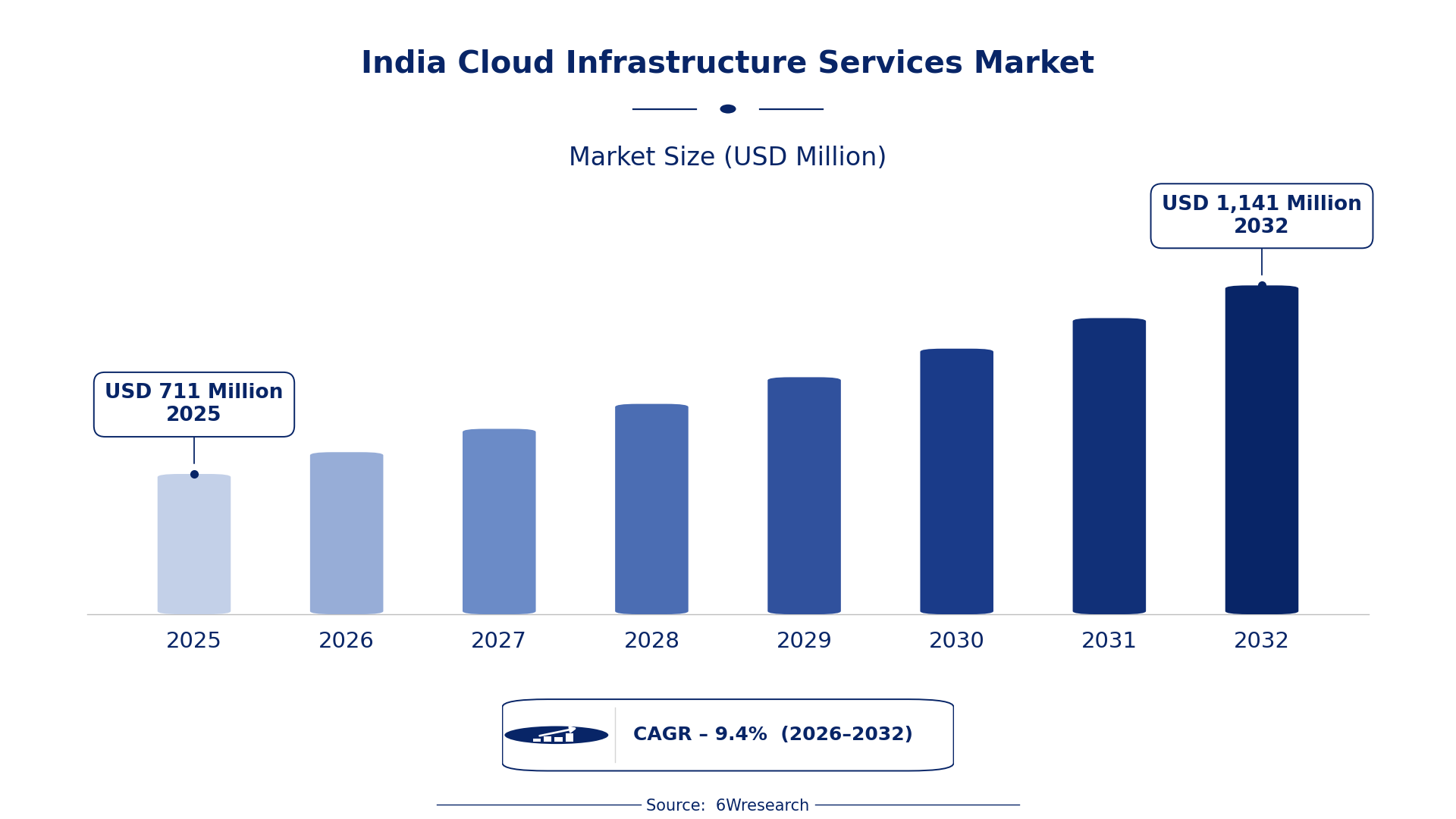
The India Cloud Infrastructure Services Market was estimated at USD 711 Million in 2025 and is projected to reach USD 1141 Million by 2032, growing at a CAGR of 9.4% from 2026 to 2032.
India Cloud Infrastructure Services Market Synopsis
The ongoing digital transformation across various sectors is the primary force driving the India Cloud Infrastructure Services Market. Organizations are increasingly recognizing the advantages of migrating to cloud-based solutions, which provide enhanced scalability, flexibility, and cost efficiency.
As more businesses transition their IT operations to the cloud, the demand for Infrastructure as a Service (IaaS) is growing rapidly. This shift is not just a trend; it's becoming a fundamental component of IT strategy for many companies aiming to remain competitive in a fast-paced digital environment.
India Cloud Infrastructure Services Market Year-wise Growth Rate and Key Drivers
This graph illustrates the annual growth rates of the India Cloud Infrastructure Services Market from 2021 to 2032, highlighting a steady upward trajectory and projected expansion over the forecast period.
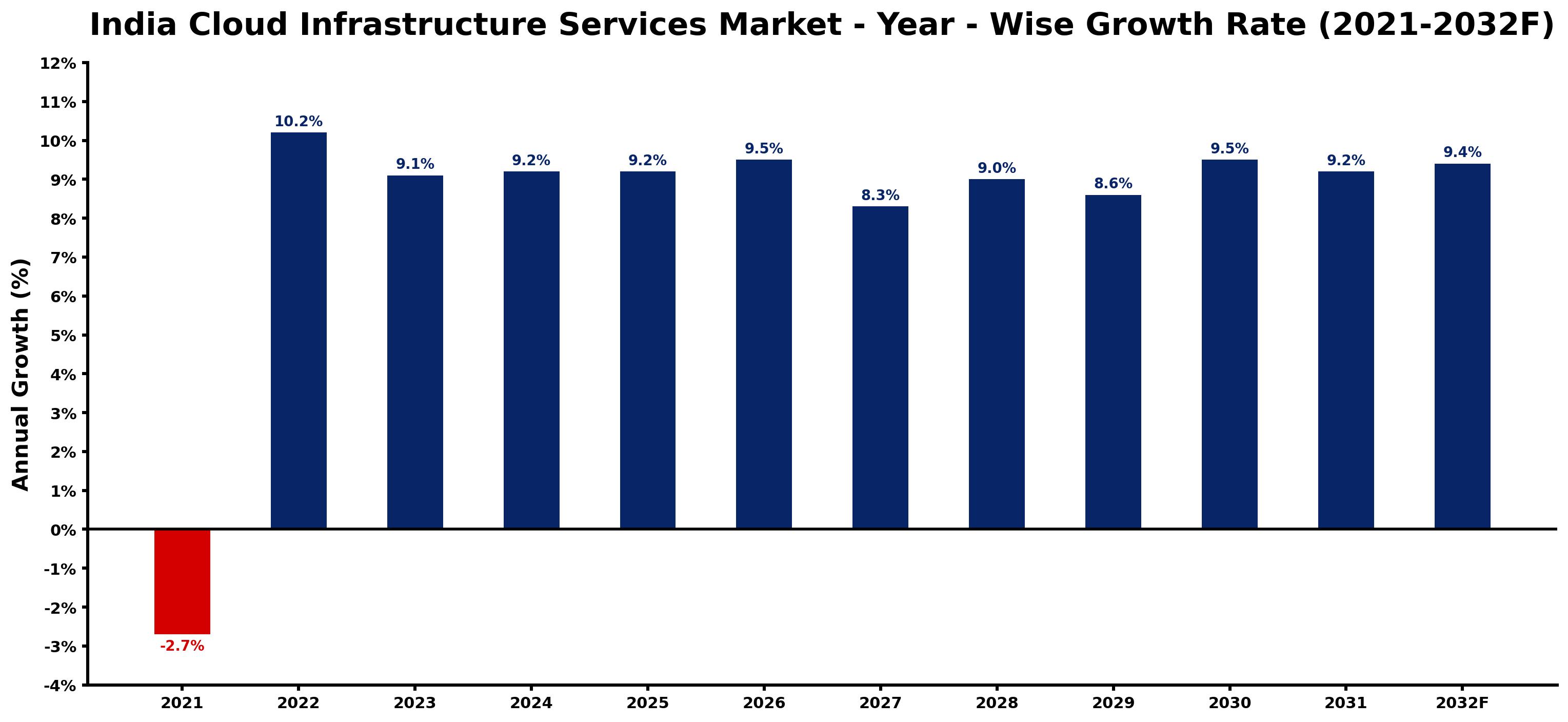
The table below presents the year‑wise growth rates along with the key drivers influencing the market
| Year | Growth Rate | Major Drivers |
| 2021 | -2.7% | Delayed approvals from TRAI hindered new data center projects. |
| 2022 | 10.2% | Increased adoption of digital payment platforms nationwide |
| 2023 | 9.1% | Government initiatives promoting 'Digital India' campaign |
| 2024 | 9.2% | Surge in remote working demand post-pandemic |
| 2025 | 9.2% | Rise in localized data center investments in India |
| 2026 | 9.5% | Regulatory push for data localization by local authorities |
| 2027 | 8.3% | Growing e-commerce sector driving cloud service needs |
| 2028 | 9.0% | Emerging startups leveraging cloud for rapid scaling |
| 2029 | 8.6% | Increased internet penetration in rural areas boosting demand |
| 2030 | 9.5% | Focus on cybersecurity leading to cloud service expansions |
| 2031 | 9.2% | Growing adoption of AI technologies in enterprises |
| 2032 | 9.4% | Government support for SMEs to adopt cloud solutions |
Note: Market size estimations and growth projections presented in this report are based on 6Wresearch's proprietary forecasting methodology, utilizing the latest available industry data, government publications, and primary research inputs.
India Cloud Infrastructure Services Market Key Takeaways
Below are some of the specific key takeaways from the market, including:
- The market is witnessing a robust shift toward cloud adoption, driven by operational efficiency needs.
- Infrastructure as a Service (IaaS) is the fastest-growing segment within the cloud services market.
- Cost reduction remains a significant motivator for businesses transitioning to cloud solutions.
- The increasing prevalence of hybrid and multi-cloud strategies is reshaping how organizations manage their IT resources.
- Data governance and compliance are critical factors influencing cloud adoption strategies.
Evaluation of Restraints in India Cloud Infrastructure Services Market
Several factors are limiting the growth of the India Cloud Infrastructure Services Market. One major concern is the resistance to change within organizations that fear job losses due to automation and cloud migration. The apprehension surrounding the displacement of traditional roles in data management can hinder the adoption of autonomous platforms. on top of that, compliance with local and international data regulations remains a pressing challenge, as companies must ensure that their cloud solutions meet stringent data governance standards to avoid legal repercussions.
India Cloud Infrastructure Services Market Trends
A few trends are emerging that will shape the future of the India Cloud Infrastructure Services Market. The rise of hybrid and multi-cloud environments indicates a shift in how organizations plan to distribute their workloads across different cloud platforms. Additionally, there is an increasing focus on data privacy and security, prompting businesses to prioritize compliance and governance in their cloud strategies. The ongoing pandemic has also accelerated cloud adoption, with many companies recognizing the need for agile and scalable IT solutions.
India Cloud Infrastructure Services Market Opportunities
The market presents numerous opportunities for growth, particularly in sectors such as healthcare, finance, and retail, where cloud solutions can enhance operational efficiency and customer engagement. Organizations are increasingly looking to invest in advanced cloud technologies, such as Artificial Intelligence (AI) and Machine Learning (ML), to further optimize their operations. on top of that, the demand for managed services is on the rise, as businesses seek expert assistance in navigating their cloud environments.
Government Initiatives in the India Cloud Infrastructure Services Market
Government policies are playing a crucial role in shaping the India Cloud Infrastructure Services Market. With a focus on digital transformation and modernization, the Indian government is fostering a supportive environment for cloud adoption. Regulatory frameworks and initiatives aimed at improving data security and enhancing digital infrastructure are vital for encouraging businesses to migrate to the cloud.
- A national digital infrastructure upgrade programme launched in early 2025 aims to enhance connectivity and support cloud adoption across various sectors.
- A regulatory framework introduced in 2025 mandates stricter data governance and compliance standards for cloud service providers operating in India.
- A planned public-private initiative expected to expand access to cloud services in rural and underserved regions is currently underway, targeting completion by late 2026.
- The "Digital India" initiative continues to support the growth of cloud services through investments in technology and infrastructure development.
Future Insights of the India Cloud Infrastructure Services Market
Looking ahead to 2026-2032, the India Cloud Infrastructure Services Market is expected to continue its upward trajectory. As organizations increasingly prioritize digital transformation, the demand for scalable and efficient cloud solutions will grow. The integration of emerging technologies like AI and ML into cloud offerings will also drive innovation and competitive differentiation. With the government’s support and evolving consumer expectations, the market is set to become a cornerstone of India’s digital economy.
India Cloud Infrastructure Services Market Latest Developments
In the past year, the India Cloud Infrastructure Services Market has seen significant activity as companies adapt to a changing environment. The focus has been on enhancing service offerings and expanding capabilities to meet growing customer demands. This environment of rapid change is fostering innovation and investment in cloud infrastructure.
- A leading regional operator launched a new suite of cloud services in Q1 2025, designed to cater to small and medium-sized enterprises.
- In mid-2025, a major technology vendor announced an expansion of its cloud infrastructure, increasing its data center presence across key Indian cities.
- A partnership between two cloud service providers to develop integrated solutions is currently underway, expected to be finalized by late 2025.
- A new regulatory compliance tool aimed at streamlining data governance for cloud users is planned for release in early 2026.
India Cloud Infrastructure Services Market - Key Attractiveness of the Report
- 10 Years of Market Numbers
- Historical Data Starting from 2022 to 2025
- Base Year: 2025
- Forecast Data until 2032
- Key Performance Indicators Impacting the Market
- Major Upcoming Developments and Projects
Key Highlights of the Report:
- India Cloud Infrastructure Services Market Outlook
- Market Size of India Cloud Infrastructure Services Market, 2025
- Forecast of India Cloud Infrastructure Services Market, 2032
- Historical Data and Forecast of India Cloud Infrastructure Services Revenues & Volume for the Period 2022-2032F
- India Cloud Infrastructure Services Market Trend Evolution
- India Cloud Infrastructure Services Market Drivers and Challenges
- India Cloud Infrastructure Services Price Trends
- India Cloud Infrastructure Services Porter's Five Forces
- India Cloud Infrastructure Services Industry Life Cycle
- Historical Data and Forecast of India Cloud Infrastructure Services Market Revenues & Volume By Service Type for the Period 2022-2032F
- Historical Data and Forecast of India Cloud Infrastructure Services Market Revenues & Volume By Compute as a Service for the Period 2022-2032F
- Historical Data and Forecast of India Cloud Infrastructure Services Market Revenues & Volume By Storage as a Service for the Period 2022-2032F
- Historical Data and Forecast of India Cloud Infrastructure Services Market Revenues & Volume By Disaster Recovery and Backup as a Service for the Period 2022-2032F
- Historical Data and Forecast of India Cloud Infrastructure Services Market Revenues & Volume By Networking as a Service for the Period 2022-2032F
- Historical Data and Forecast of India Cloud Infrastructure Services Market Revenues & Volume By Desktop as a Service for the Period 2022-2032F
- Historical Data and Forecast of India Cloud Infrastructure Services Market Revenues & Volume By Managed Hosting for the Period 2022-2032F
- Historical Data and Forecast of India Cloud Infrastructure Services Market Revenues & Volume By Deployment Type for the Period 2022-2032F
- Historical Data and Forecast of India Cloud Infrastructure Services Market Revenues & Volume By On-premises for the Period 2022-2032F
- Historical Data and Forecast of India Cloud Infrastructure Services Market Revenues & Volume By Cloud for the Period 2022-2032F
- Historical Data and Forecast of India Cloud Infrastructure Services Market Revenues & Volume By Organization Size for the Period 2022-2032F
- Historical Data and Forecast of India Cloud Infrastructure Services Market Revenues & Volume By Small and Medium-sized Enterprises (SMEs) for the Period 2022-2032F
- Historical Data and Forecast of India Cloud Infrastructure Services Market Revenues & Volume By Large Enterprises for the Period 2022-2032F
- Historical Data and Forecast of India Cloud Infrastructure Services Market Revenues & Volume By Vertical for the Period 2022-2032F
- Historical Data and Forecast of India Cloud Infrastructure Services Market Revenues & Volume By Banking, Financial Services, and Insurance (BFSI) for the Period 2022-2032F
- Historical Data and Forecast of India Cloud Infrastructure Services Market Revenues & Volume By IT and Telecommunications for the Period 2022-2032F
- Historical Data and Forecast of India Cloud Infrastructure Services Market Revenues & Volume By Government and Public Sector for the Period 2022-2032F
- Historical Data and Forecast of India Cloud Infrastructure Services Market Revenues & Volume By Retail and Consumer Goods for the Period 2022-2032F
- Historical Data and Forecast of India Cloud Infrastructure Services Market Revenues & Volume By Manufacturing for the Period 2022-2032F
- Historical Data and Forecast of India Cloud Infrastructure Services Market Revenues & Volume By Energy and Utilities for the Period 2022-2032F
- Historical Data and Forecast of India Cloud Infrastructure Services Market Revenues & Volume By Media and Entertainment for the Period 2022-2032F
- Historical Data and Forecast of India Cloud Infrastructure Services Market Revenues & Volume By Healthcare and Life Sciences for the Period 2022-2032F
- India Cloud Infrastructure Services Import Export Trade Statistics
- Market Opportunity Assessment By Service Type
- Market Opportunity Assessment By Deployment Type
- Market Opportunity Assessment By Organization Size
- Market Opportunity Assessment By Vertical
- India Cloud Infrastructure Services Top Companies Market Share
- India Cloud Infrastructure Services Competitive Benchmarking By Technical and Operational Parameters
- India Cloud Infrastructure Services Company Profiles
- India Cloud Infrastructure Services Key Strategic Recommendations






































