India Cognitive Analytics Market Size & Growth Rate (2026-2032)
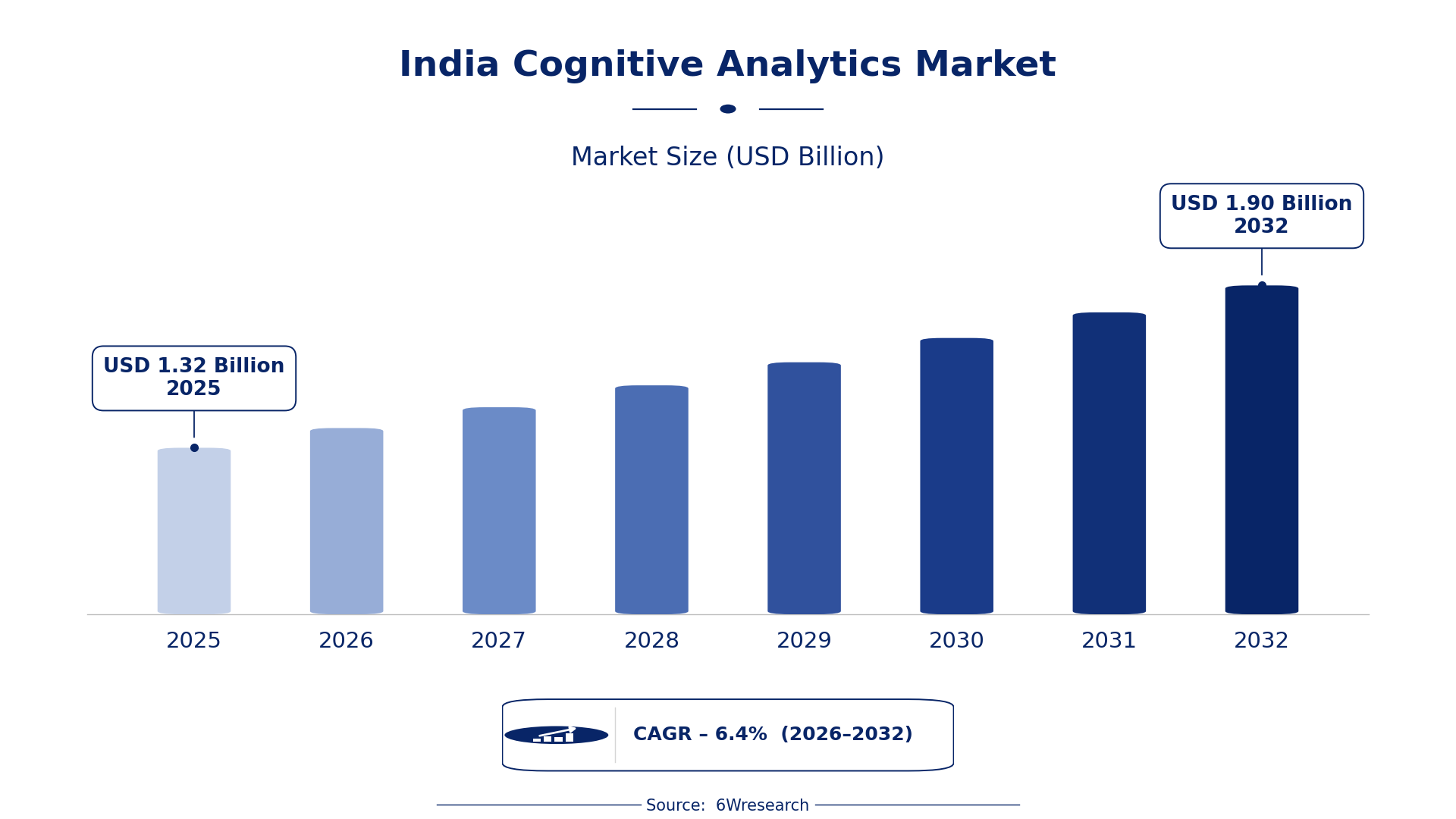
The India Cognitive Analytics Market was estimated at USD 1319 Million in 2025 and is projected to reach USD 1898 Million by 2032, growing at a CAGR of 6.4% from 2026 to 2032.
India Cognitive Analytics Market Synopsis
The demand for cognitive analytics in India is surging as organizations recognize the necessity of utilizing advanced technologies to interpret vast amounts of data. Businesses are increasingly turning to cognitive analytics solutions to enhance customer interactions and streamline operations, pushing traditional analytics to the backseat.
Key sectors such as healthcare, finance, and retail are at the forefront of this adoption. Companies are not just seeking data but are actively pursuing deeper insights that can lead to predictive analytics, thereby fostering innovation and improving decision-making processes across industries.
India Cognitive Analytics Market Year-wise Growth Rate and Key Drivers
This graph illustrates the annual growth rates of the India Cognitive Analytics Market from 2021 to 2032, highlighting a steady upward trajectory and projected expansion over the forecast period.
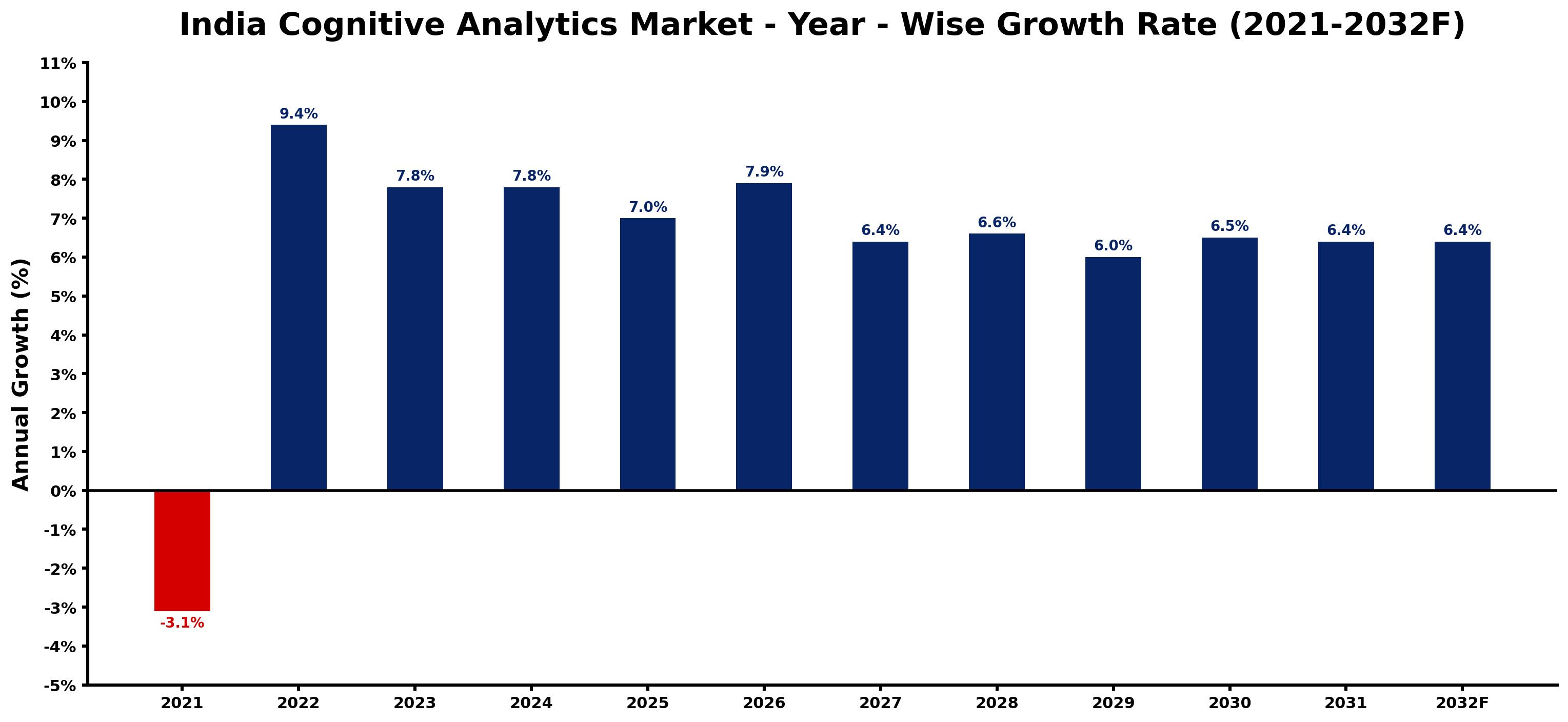
The table below presents the year‑wise growth rates along with the key drivers influencing the market
| Year | Growth Rate | Major Drivers |
| 2021 | -3.1% | Delays in AI policy implementation by NITI Aayog |
| 2022 | 9.4% | Proliferation of enterprise AI solutions across industries. |
| 2023 | 7.8% | Government policies supporting rural digital literacy programs. |
| 2024 | 7.8% | Surge in cloud adoption enabling cognitive analytics integration. |
| 2025 | 7.0% | Emergence of smart manufacturing enhancing data-driven decisions. |
| 2026 | 7.9% | Focus on healthcare AI improving patient care analytics. |
| 2027 | 6.4% | Growing fintech sector driving demand for predictive insights. |
| 2028 | 6.6% | Increased e-commerce activities necessitating customer behavior analysis. |
| 2029 | 6.0% | Corporate mandates for data-driven strategies reinforcing analytics usage. |
| 2030 | 6.5% | Rise of IoT devices generating vast data for analysis. |
| 2031 | 6.4% | Venture capital investments in analytics startups accelerating growth. |
| 2032 | 6.4% | Increased emphasis on cybersecurity driving analytics solutions. |
Note: Market size estimations and growth projections presented in this report are based on 6Wresearch's proprietary forecasting methodology, utilizing the latest available industry data, government publications, and primary research inputs.
India Cognitive Analytics Market Key Takeaways
Below are some of the specific key takeaways from the market, including:
- Rising interest in machine learning and natural language processing is driving market growth.
- Organizations are focusing on improving customer experience through advanced analytics.
- Investment in AI and cognitive technologies is expected to accelerate in the coming years.
- Healthcare and finance sectors are leading the charge in cognitive analytics adoption.
- Privacy and ethical use of analytics remain critical challenges for stakeholders.
Evaluation of Restraints in India Cognitive Analytics Market
Current challenges in the India Cognitive Analytics market stem from the complexity of natural language processing and the intricacies involved in machine learning. Many organizations struggle with data privacy concerns, and ensuring ethical use of analytics has become a crucial issue. Companies must also contend with a shortage of skilled professionals who can effectively implement and utilize cognitive analytics technologies. These factors can hinder market growth and adoption rates.India Cognitive Analytics Market Trends
The trend towards automation is reshaping how businesses operate. Firms are increasingly implementing cognitive analytics solutions to automate decision-making processes and enhance operational efficiency. There is also a noticeable shift towards integrating AI capabilities within existing frameworks to improve data management. As companies continue to prioritize customer-centric strategies, the demand for personalized analytics experiences is growing, leading to increased investment in AI-driven technologies.India Cognitive Analytics Market Opportunities
Opportunities for growth in the India Cognitive Analytics market are abundant. The healthcare sector, for instance, presents a unique avenue for innovation through predictive analytics, enabling better patient outcomes. Additionally, as more companies seek to enhance their data-driven strategies, there’s significant potential for investment in cloud-based cognitive analytics solutions. The focus on small and medium enterprises (SMEs) adapting cognitive technologies is also a promising area for market expansion.Government Initiatives in the India Cognitive Analytics Market
Government support is playing a pivotal role in shaping the India Cognitive Analytics Market. With a focus on digital transformation, the Indian government is actively promoting policies that facilitate the adoption of advanced analytics technologies across various sectors. These initiatives aim to bolster innovation, enhance cybersecurity measures, and address the ethical concerns surrounding data use.
- A recently completed initiative involves the launch of a national digital infrastructure upgrade program aimed at enhancing data accessibility across sectors.
- A current initiative includes ongoing efforts to develop a regulatory framework that ensures transparency and ethical standards in AI and analytics practices.
- Planned for the coming years is a public-private partnership expected to expand AI research funding, focusing on cognitive analytics applications in healthcare.
- Ongoing support for skill development programs to create a workforce adept in cognitive computing technologies is currently underway.
- The government has initiated a review of existing data privacy laws to better align them with the rapid advancements in cognitive analytics.
Future Insights of the India Cognitive Analytics Market
Looking ahead to 2026-2032, the India Cognitive Analytics Market is set to experience notable advancements driven by technological innovations and increased investment. As organizations strive for deeper insights and more personalized experiences, the integration of AI and cognitive technologies will be crucial. The market will likely witness a greater emphasis on ethical considerations and data governance, which will shape the landscape of cognitive analytics in India.India Cognitive Analytics Market Latest Developments
Recent activity in the India Cognitive Analytics Market reflects a strong commitment to innovation and expansion. Over the past year, companies have been actively enhancing their offerings, leading to a surge in cognitive analytics solutions tailored for various industries.
- A major technology vendor launched an advanced cognitive analytics platform in early 2025, aimed at streamlining operations for SMEs.
- An ongoing partnership between local analytics firms and international tech companies is focused on developing AI-driven solutions for the healthcare sector, which began in late 2024.
- A rollout expected to begin in mid-2026 will introduce new machine learning algorithms designed to improve customer engagement metrics across retail.
- A regional operator is enhancing its data analytics capabilities with a new service upgrade scheduled for completion by late 2025.
- An initiative that began in early 2025 is focused on creating an industry consortium to establish best practices in ethical analytics use.
India Cognitive Analytics Market - Key Attractiveness of the Report
- 10 Years of Market Numbers
- Historical Data Starting from 2022 to 2025
- Base Year: 2025
- Forecast Data until 2032
- Key Performance Indicators Impacting the Market
- Major Upcoming Developments and Projects
Key Highlights of the Report:
- India Cognitive Analytics Market Outlook
- Market Size of India Cognitive Analytics Market, 2025
- Forecast of India Cognitive Analytics Market, 2032
- Historical Data and Forecast of India Cognitive Analytics Revenues & Volume for the Period 2022-2032F
- India Cognitive Analytics Market Trend Evolution
- India Cognitive Analytics Market Drivers and Challenges
- India Cognitive Analytics Price Trends
- India Cognitive Analytics Porter's Five Forces
- India Cognitive Analytics Industry Life Cycle
- Historical Data and Forecast of India Cognitive Analytics Market Revenues & Volume By Application for the Period 2022-2032F
- Historical Data and Forecast of India Cognitive Analytics Market Revenues & Volume By Automation for the Period 2022-2032F
- Historical Data and Forecast of India Cognitive Analytics Market Revenues & Volume By Intelligent Virtual Assistants for the Period 2022-2032F
- Historical Data and Forecast of India Cognitive Analytics Market Revenues & Volume By Behavioral Analysis for the Period 2022-2032F
- Historical Data and Forecast of India Cognitive Analytics Market Revenues & Volume By Biometrics for the Period 2022-2032F
- Historical Data and Forecast of India Cognitive Analytics Market Revenues & Volume By Others for the Period 2022-2032F
- Historical Data and Forecast of India Cognitive Analytics Market Revenues & Volume By Component for the Period 2022-2032F
- Historical Data and Forecast of India Cognitive Analytics Market Revenues & Volume By Platform for the Period 2022-2032F
- Historical Data and Forecast of India Cognitive Analytics Market Revenues & Volume By Service for the Period 2022-2032F
- Historical Data and Forecast of India Cognitive Analytics Market Revenues & Volume By Technology for the Period 2022-2032F
- Historical Data and Forecast of India Cognitive Analytics Market Revenues & Volume By Machine Learning (ML) for the Period 2022-2032F
- Historical Data and Forecast of India Cognitive Analytics Market Revenues & Volume By Human Computer Interaction for the Period 2022-2032F
- Historical Data and Forecast of India Cognitive Analytics Market Revenues & Volume By Natural Language Processing (NLP) for the Period 2022-2032F
- Historical Data and Forecast of India Cognitive Analytics Market Revenues & Volume By Deep Learning for the Period 2022-2032F
- Historical Data and Forecast of India Cognitive Analytics Market Revenues & Volume By Deployment Mode for the Period 2022-2032F
- Historical Data and Forecast of India Cognitive Analytics Market Revenues & Volume By On-premise for the Period 2022-2032F
- Historical Data and Forecast of India Cognitive Analytics Market Revenues & Volume By Cloud for the Period 2022-2032F
- Historical Data and Forecast of India Cognitive Analytics Market Revenues & Volume By Hybrid for the Period 2022-2032F
- Historical Data and Forecast of India Cognitive Analytics Market Revenues & Volume By Industry for the Period 2022-2032F
- Historical Data and Forecast of India Cognitive Analytics Market Revenues & Volume By BFSI for the Period 2022-2032F
- Historical Data and Forecast of India Cognitive Analytics Market Revenues & Volume By Retail and eCommerce for the Period 2022-2032F
- Historical Data and Forecast of India Cognitive Analytics Market Revenues & Volume By Telecommunication and IT for the Period 2022-2032F
- Historical Data and Forecast of India Cognitive Analytics Market Revenues & Volume By Healthcare and Life Sciences for the Period 2022-2032F
- Historical Data and Forecast of India Cognitive Analytics Market Revenues & Volume By Manufacturing for the Period 2022-2032F
- Historical Data and Forecast of India Cognitive Analytics Market Revenues & Volume By Government and Defense for the Period 2022-2032F
- Historical Data and Forecast of India Cognitive Analytics Market Revenues & Volume By Media and Entertainment for the Period 2022-2032F
- Historical Data and Forecast of India Cognitive Analytics Market Revenues & Volume By Organization Size for the Period 2022-2032F
- Historical Data and Forecast of India Cognitive Analytics Market Revenues & Volume By Large Enterprises for the Period 2022-2032F
- Historical Data and Forecast of India Cognitive Analytics Market Revenues & Volume By Small and Medium-Sized Enterprises (SMEs) for the Period 2022-2032F
- India Cognitive Analytics Import Export Trade Statistics
- Market Opportunity Assessment By Application
- Market Opportunity Assessment By Component
- Market Opportunity Assessment By Technology
- Market Opportunity Assessment By Deployment Mode
- Market Opportunity Assessment By Industry
- Market Opportunity Assessment By Organization Size
- India Cognitive Analytics Top Companies Market Share
- India Cognitive Analytics Competitive Benchmarking By Technical and Operational Parameters
- India Cognitive Analytics Company Profiles
- India Cognitive Analytics Key Strategic Recommendations






































