India Container Security Market Size & Growth Rate (2026-2032)
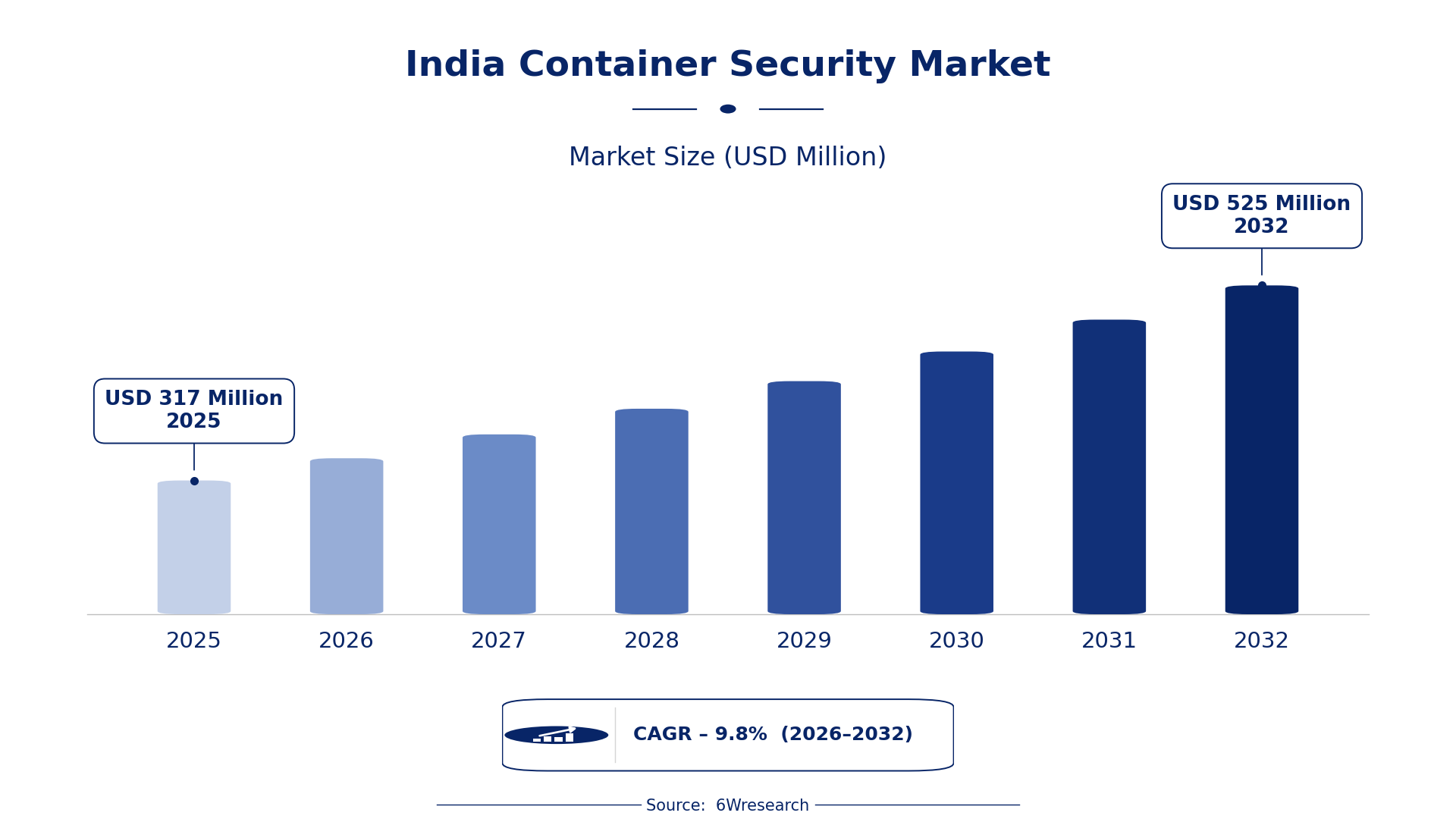
The India Container Security Market was estimated at USD 317 Million in 2025 and is projected to reach USD 525 Million by 2032, growing at a CAGR of 9.8% from 2026 to 2032.
India Container Security Market Synopsis
The India Container Security market is experiencing a surge, driven by the rapid adoption of containerization across various sectors. As businesses increasingly recognize the benefits of container technology for deploying applications, the demand for security measures tailored to these environments is growing. However, the path forward is not without its hurdles.
Amid this growth, organizations face the daunting challenge of maintaining security in dynamic container environments. The necessity for continuous monitoring and the integration of security practices into development pipelines complicate the picture. Despite these challenges, the market is on track for significant growth as container adoption becomes more mainstream.
India Container Security Market Year-wise Growth Rate and Key Drivers
This graph illustrates the annual growth rates of the India Container Security Market from 2021 to 2032, highlighting a steady upward trajectory and projected expansion over the forecast period.
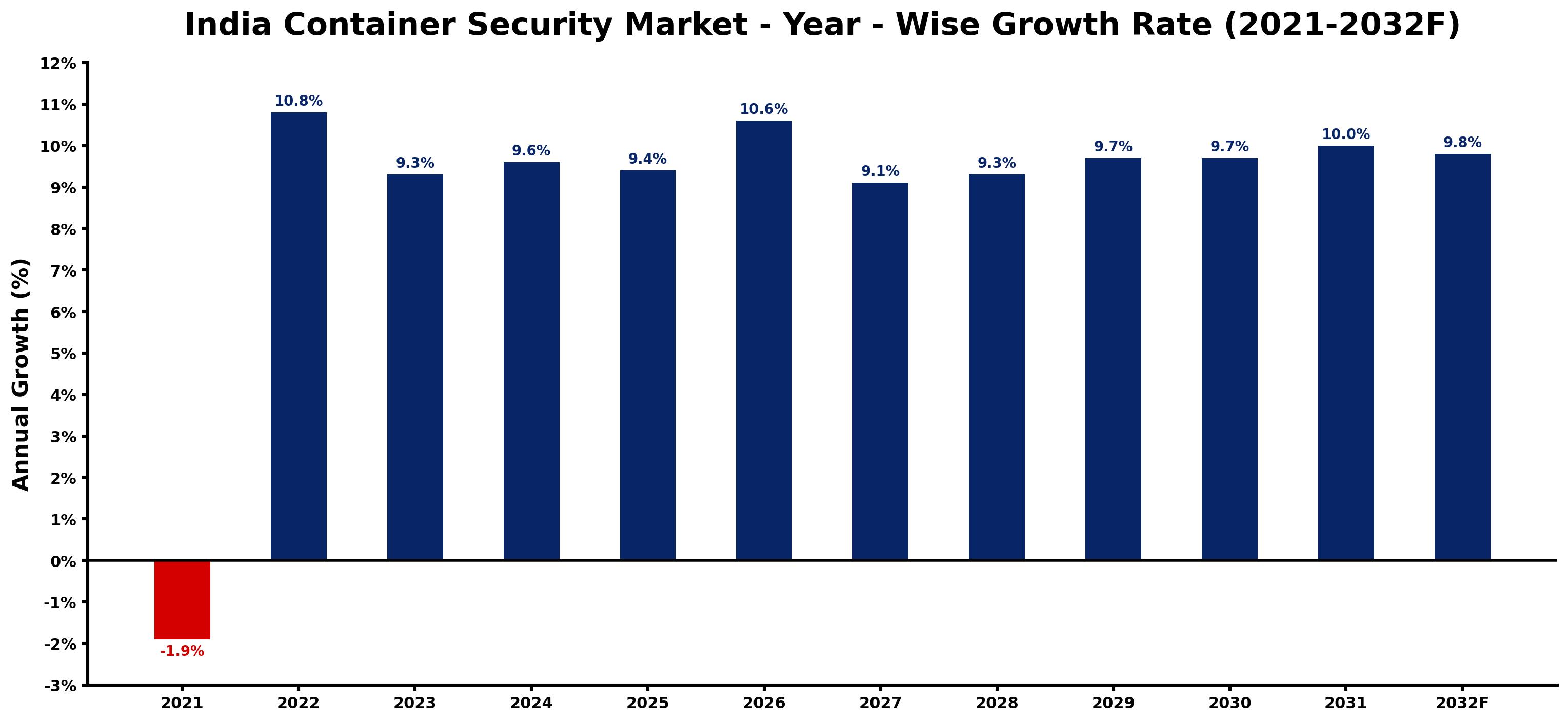
The table below presents the year‑wise growth rates along with the key drivers influencing the market
| Year | Growth Rate | Major Drivers |
| 2021 | -1.9% | Increased scrutiny from the Customs Department of India |
| 2022 | 10.8% | Implementation of Customs Act enhancing container security measures. |
| 2023 | 9.3% | Increased foreign trade leading to higher container shipments. |
| 2024 | 9.6% | Investments in port security technology by major terminals. |
| 2025 | 9.4% | Growth in e-commerce driving demand for secure containers. |
| 2026 | 10.6% | Government initiatives promoting blockchain for tracking shipments. |
| 2027 | 9.1% | Enhanced coastal security measures boosting container inspections. |
| 2028 | 9.3% | Rising concerns over theft and pilferage in logistics. |
| 2029 | 9.7% | Collaboration with international security agencies strengthening protocols. |
| 2030 | 9.7% | Adoption of IoT devices for container monitoring. |
| 2031 | 10.0% | Regulatory push for better cargo screening technologies. |
| 2032 | 9.8% | Increased globalization prompting secure logistics frameworks. |
Note: Market size estimations and growth projections presented in this report are based on 6Wresearch's proprietary forecasting methodology, utilizing the latest available industry data, government publications, and primary research inputs.
India Container Security Market Key Takeaways
Below are some of the specific key takeaways from the market, including:
- The market is projected to grow significantly due to rising containerization practices.
- Organizations are increasingly prioritizing security to protect applications running in container environments.
- Investment in container security solutions is crucial to mitigate risks associated with vulnerabilities.
- Continuous monitoring and integration with DevOps practices are essential for effective security management.
- The market is likely to see increased innovation and competition from emerging players.
Evaluation of Restraints in India Container Security Market
Despite the promising growth trajectory, the India Container Security market faces several limitations that may impede its progress. One major challenge is the inherent dynamism of container environments, which complicates the security landscape. Ensuring comprehensive security throughout the container lifecycle requires sophisticated monitoring and management solutions. Additionally, the cultural shift required to integrate security into existing DevOps and CI/CD workflows poses a significant barrier to adoption. As organizations strive to implement robust security measures, these challenges must be addressed to unlock the market's full potential.
India Container Security Market Trends
Several trends are currently shaping the demand for container security solutions in India. First, the shift towards microservices architectures is prompting organizations to rethink their security strategies, necessitating tools that cater specifically to these environments. There is also a growing emphasis on automation in security practices, as businesses seek to improve efficiency while reducing human error. Lastly, the rise of cloud-native applications is driving the need for comprehensive security solutions that can adapt to various deployment models.
India Container Security Market Opportunities
The India Container Security market presents numerous growth opportunities for stakeholders. As businesses continue to embrace containerization, there's a substantial need for security solutions that address specific vulnerabilities associated with this technology. Additionally, advancements in AI and machine learning can offer innovative approaches to threat detection and response. Collaboration between technology vendors and organizations can foster the development of tailored security solutions that meet emerging needs, paving the way for sustained investment in this sector.
Government Initiatives in the India Container Security Market
The Indian government plays a critical role in shaping the container security market through various initiatives aimed at enhancing cybersecurity. With a focus on creating a secure digital infrastructure, government policies are increasingly emphasizing the importance of safeguarding containerized applications. This proactive stance is vital for encouraging businesses to invest in robust security measures, ensuring that the country remains competitive in the global digital economy.
- A regulatory framework introduced in 2025 mandates enhanced security protocols for all containerized applications.
- A national cybersecurity initiative, currently underway, focuses on promoting awareness and education regarding container security practices among businesses.
- The government has launched a program aimed at providing incentives for organizations that adopt best practices in container security.
- A planned public-private partnership, expected to begin in late 2026, seeks to develop advanced security technologies tailored for container environments.
Future Insights of the India Container Security Market
Looking ahead to 2026-2032, the India Container Security market is set for a transformative period. As containerization becomes a core component of IT strategies, security measures will evolve to meet more sophisticated threats. A collaborative approach between developers and security teams will become increasingly essential, ensuring that security is embedded into the fabric of application development. Expect a surge in investment and innovation as organizations recognize the critical need to secure their containerized applications.
India Container Security Market Latest Developments
The last 12-14 months have seen noteworthy movements in the India Container Security market, reflecting the urgency with which organizations are addressing security challenges. Major players have begun rolling out comprehensive solutions designed to integrate with existing infrastructure while enhancing security measures. This heightened focus on security is driven by the increasing adoption of container technologies across various sectors.
- A new security solution was launched in early 2025, specifically targeting vulnerabilities in cloud-native containerized applications.
- A major technology vendor is currently expanding its container security offerings through partnerships with local firms, aiming for broader market penetration.
- An initiative focused on training and certification in container security for IT professionals was announced and is expected to commence in Q2 2026.
- A pilot project for an advanced threat detection system for containerized environments is currently underway, with results anticipated by mid-2026.
India Container Security Market - Key Attractiveness of the Report
- 10 Years of Market Numbers
- Historical Data Starting from 2022 to 2025
- Base Year: 2025
- Forecast Data until 2032
- Key Performance Indicators Impacting the Market
- Major Upcoming Developments and Projects
Key Highlights of the Report:
- India Container Security Market Outlook
- Market Size of India Container Security Market, 2025
- Forecast of India Container Security Market, 2032
- Historical Data and Forecast of India Container Security Revenues & Volume for the Period 2022-2032F
- India Container Security Market Trend Evolution
- India Container Security Market Drivers and Challenges
- India Container Security Price Trends
- India Container Security Porter's Five Forces
- India Container Security Industry Life Cycle
- Historical Data and Forecast of India Container Security Market Revenues & Volume By Component for the Period 2022-2032F
- Historical Data and Forecast of India Container Security Market Revenues & Volume By Container Security Products for the Period 2022-2032F
- Historical Data and Forecast of India Container Security Market Revenues & Volume By Services (Professional, Managed) for the Period 2022-2032F
- Historical Data and Forecast of India Container Security Market Revenues & Volume By Deployment Type for the Period 2022-2032F
- Historical Data and Forecast of India Container Security Market Revenues & Volume By Cloud for the Period 2022-2032F
- Historical Data and Forecast of India Container Security Market Revenues & Volume By On-premises for the Period 2022-2032F
- Historical Data and Forecast of India Container Security Market Revenues & Volume By Vertical for the Period 2022-2032F
- Historical Data and Forecast of India Container Security Market Revenues & Volume By BFSI for the Period 2022-2032F
- Historical Data and Forecast of India Container Security Market Revenues & Volume By Retail for the Period 2022-2032F
- Historical Data and Forecast of India Container Security Market Revenues & Volume By Government for the Period 2022-2032F
- Historical Data and Forecast of India Container Security Market Revenues & Volume By Healthcare for the Period 2022-2032F
- India Container Security Import Export Trade Statistics
- Market Opportunity Assessment By Component
- Market Opportunity Assessment By Deployment Type
- Market Opportunity Assessment By Vertical
- India Container Security Top Companies Market Share
- India Container Security Competitive Benchmarking By Technical and Operational Parameters
- India Container Security Company Profiles
- India Container Security Key Strategic Recommendations






































