India Converted Paper Products Market Summary
The india converted paper products market was estimated at USD 315 Million in 2025 and is projected to reach USD 452 Million by 2032, growing at a CAGR of 7.7% from 2026 to 2032.
India Converted Paper Products Market Year-wise Growth Rate and Key Drivers
This graph highlights how the India Converted Paper Products Market has steadily grown over the past five years, supported by major growth factors.
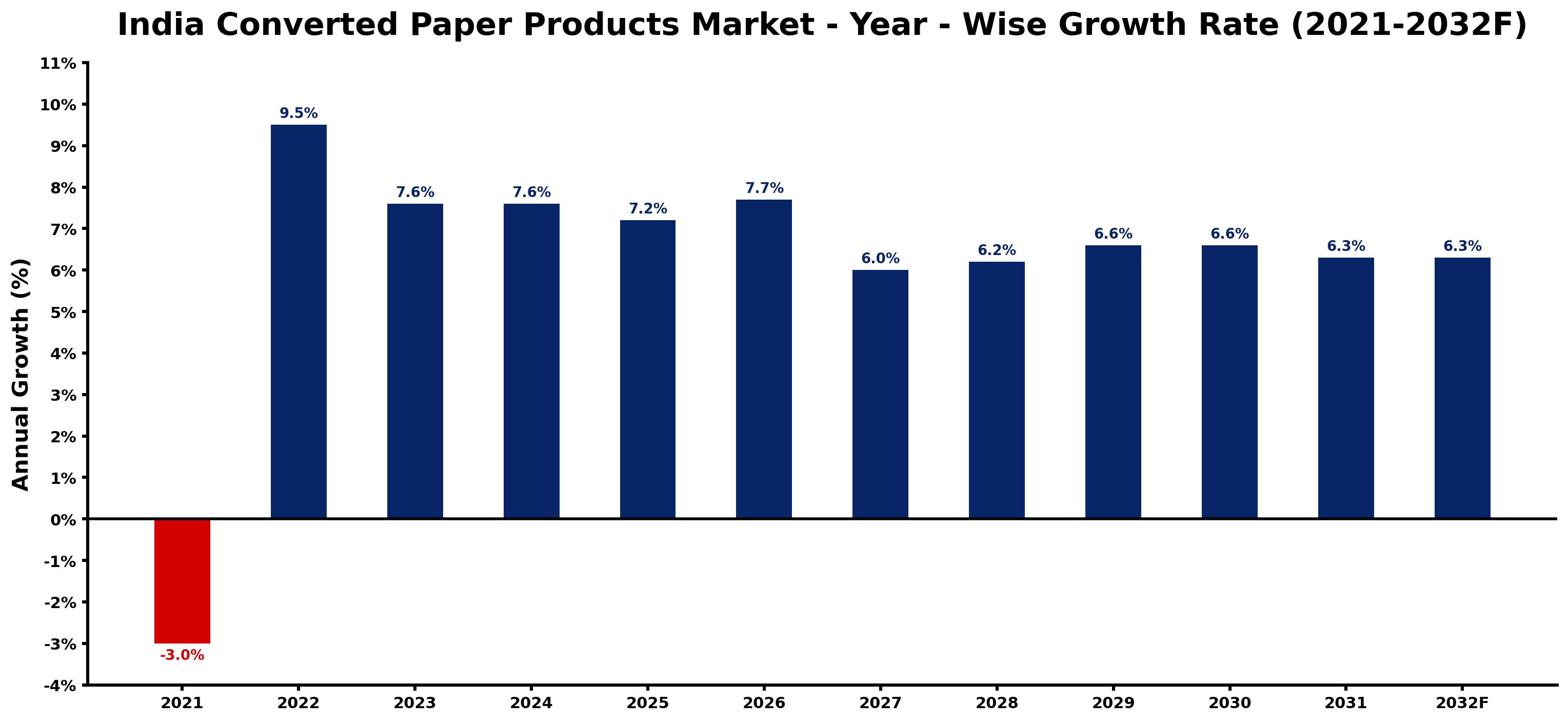
The table below presents the year wise growth rates along with the key drivers influencing the market
| Year | Growth Rate | Major Drivers |
| 2021 | -3.0% | Increased digitalization led to a significant decline in demand for traditional paper products across various sectors. |
| 2022 | 9.5% | Manufacturers began investing in advanced machinery to enhance production efficiency substantially. |
| 2023 | 7.6% | Urbanization trends drive consumer preferences for eco-friendly paper products across urban centers. |
| 2024 | 7.6% | Retail sectors increasingly favor biodegradable packaging to align with environmental consciousness. |
| 2025 | 7.2% | E-commerce expansion necessitates innovative packaging solutions to boost customer experience effectively. |
| 2026 | 7.7% | Local businesses prioritize sourcing recycled paper products, promoting a circular economy model. |
| 2027 | 6.0% | Technological innovations streamline supply chains, reducing costs while improving product quality. |
| 2028 | 6.2% | Education campaigns highlight sustainability benefits, influencing consumer habits towards eco-friendly choices. |
| 2029 | 6.6% | Corporate social responsibility initiatives encourage firms to adopt environmentally sustainable practices. |
| 2030 | 6.6% | Investment in renewable energy sources enhances the production capabilities of paper manufacturers. |
| 2031 | 6.3% | International trade agreements facilitate market access for high-quality converted paper products. |
| 2032 | 6.3% | Consumer awareness of environmental impacts drives increased demand for converted paper packaging. |
Note - Market size estimations and growth projections presented in this report are based on 6Wresearch's advanced forecasting approach, validated with industry datasets as of June 2026.
India Converted Paper Products Market Synopsis
The India Converted Paper Products Market is projected to reach 7.7% and witness significant growth during the forecast period (2026-2032). This expansion is primarily driven by the increased demand for packaging solutions, heightened literacy rates, and growing public awareness regarding hygiene and sanitation standards. India's position as one of the leading producers of writing and printing paper, along with its reputation for low-cost production capabilities, positions it favorably in the global market.
India Converted Paper Products Market Growth Drivers
Several key factors are influencing the growth trajectory of the India Converted Paper Products Market:
- Increasing Demand for Eco-Friendly Packaging: The expanding e-commerce sector and the fast-moving consumer goods (FMCG) industry are shifting towards biodegradable and eco-friendly packaging solutions, propelling the demand for paper-based products.
- Rise in Disposable Income: As disposable incomes rise across urban and semi-urban areas, consumers are increasingly purchasing stationery and related products, enhancing overall market growth.
- Higher Literacy Rates: An increase in literacy rates has led to a surge in educational institutions, resulting in greater consumption of stationery such as notebooks, exercise books, and other educational materials.
- Health and Hygiene Awareness: Growing public consciousness regarding hygiene is driving the demand for sanitary products, significantly contributing to market expansion.
- Government Support for Sustainable Practices: Various government policies and initiatives promoting environmental sustainability are encouraging the adoption of paper products over plastic alternatives, further stimulating market growth.
India Converted Paper Products Market Challenges and Restraints
Despite the positive growth outlook, the India Converted Paper Products Market faces several challenges that could impede progress:
- Availability of Substitutes: The presence of cheaper substitutes, particularly plastics, poses a competitive threat to paper products. Although there is a shift towards sustainable options, the initial cost and convenience of alternatives can deter widespread adoption.
- High Production Costs: Rising labor costs and volatile taxation policies present significant challenges for manufacturers, placing pressure on profit margins and making it difficult to compete with international markets.
- Environmental Concerns: While paper products are more sustainable than plastics, intensive production processes can still be environmentally damaging, prompting scrutiny from regulatory bodies and consumers alike.
- Market Volatility: Fluctuations in raw material prices can impact production costs, which may deter investment and growth in the paper products sector.
- Technological Advancements: The fast-paced evolution of manufacturing technologies necessitates continuous investment in updates to remain competitive, placing additional financial burdens on smaller firms.
India Converted Paper Products Market Trends and Opportunities
The India Converted Paper Products Market is poised for notable trends and opportunities that can further bolster growth:
- Digital Transformation: The integration of digitization in operations is evolving traditional production methods. Companies are investing in automation, which can enhance efficiency and reduce costs, opening doors for new market entrants.
- Sustainable Product Innovation: Manufacturers are exploring innovative paper products that cater to specific market needs, such as recyclable materials and biodegradable packaging options, which align with consumer preferences for sustainability.
- Growth in Niche Markets: Demand is rising in niche segments like specialty papers, which are used in high-end packaging and premium stationery, providing lucrative opportunities for businesses targeting these sectors.
- Expansion of Retail Channels: The increase in organized retail and online shopping platforms offers manufacturers improved access to consumers, facilitating greater distribution of paper products.
- Collaborations and Partnerships: Strategic alliances between manufacturers and e-commerce platforms can enhance market reach, streamline supply chains, and foster innovative product development.
India Converted Paper Products Market Government Investment and Initiatives
The Indian government is actively supporting the growth of the Converted Paper Products Market through various initiatives and policies:
- Incentives for Sustainable Practices: The government has implemented financial incentives for companies that invest in sustainable manufacturing processes, encouraging eco-friendly production methods in the paper industry.
- Public Awareness Campaigns: Initiatives aimed at promoting hygiene and sanitation have heightened demand for paper products, particularly in the educational and healthcare sectors.
- Investment in Infrastructure: The government is investing in enhancing infrastructure in rural areas, which can improve access to paper products and stimulate regional market growth.
- Regulatory Frameworks: Policies aimed at reducing plastic usage are creating a favorable environment for paper products, as companies seek to comply with increasingly stringent regulations.
- Support for Research and Development: Government funding for research into new paper products and sustainable resources is paving the way for innovation within the industry.
India Converted Paper Products Market Latest Developments (May 2025 - June 2026)
The period from May 2025 to June 2026 has seen significant shifts within the India Converted Paper Products Market, reflecting global trends and local needs:
- Increased Focus on Sustainability: There has been a notable surge in initiatives aimed at reducing carbon footprints, with more manufacturers committing to sustainable practices in their production processes.
- Adoption of Advanced Technologies: The industry is witnessing the integration of AI and IoT technologies in manufacturing, enhancing operational efficiency and product quality.
- Expansion of E-Commerce Packaging Solutions: The growth of e-commerce has driven innovations in packaging, leading to the development of specialized paper products designed for safe and sustainable delivery.
- Collaboration with NGOs: Many companies are partnering with non-governmental organizations to promote recycling and environmental education, fostering a more responsible consumption culture.
- Government Policy Revisions: New policies aimed at promoting renewable resources and sustainable manufacturing have been rolled out, impacting pricing and production dynamics across the market.
India Converted Paper Products Market - Key Attractiveness of the Report
- 10 Years of Market Numbers
- Historical Data Starting from 2022 to 2025
- Base Year: 2025
- Forecast Data until 2032
- Key Performance Indicators Impacting the Market
- Major Upcoming Developments and Projects
Key Highlights of the Report:
- India Converted Paper Products Market Outlook
- Market Size of India Converted Paper Products Market, 2025
- Forecast of India Converted Paper Products Market, 2032
- Historical Data and Forecast of India Converted Paper Products Revenues & Volume for the Period 2022-2032F
- India Converted Paper Products Market Trend Evolution
- India Converted Paper Products Market Drivers and Challenges
- India Converted Paper Products Price Trends
- India Converted Paper Products Porter's Five Forces
- India Converted Paper Products Industry Life Cycle
- Historical Data and Forecast of India Converted Paper Products Market Revenues & Volume By Type for the Period 2022-2032F
- Historical Data and Forecast of India Converted Paper Products Market Revenues & Volume By Paperboard Container for the Period 2022-2032F
- Historical Data and Forecast of India Converted Paper Products Market Revenues & Volume By Sanitary Paper Product for the Period 2022-2032F
- Historical Data and Forecast of India Converted Paper Products Market Revenues & Volume By Stationery Product for the Period 2022-2032F
- Historical Data and Forecast of India Converted Paper Products Market Revenues & Volume By Paper Bag And Coated And Treated Paper for the Period 2022-2032F
- Historical Data and Forecast of India Converted Paper Products Market Revenues & Volume By Other for the Period 2022-2032F
- Historical Data and Forecast of India Converted Paper Products Market Revenues & Volume By End-Users for the Period 2022-2032F
- Historical Data and Forecast of India Converted Paper Products Market Revenues & Volume By Packaging & Wrapping for the Period 2022-2032F
- Historical Data and Forecast of India Converted Paper Products Market Revenues & Volume By Food Service for the Period 2022-2032F
- Historical Data and Forecast of India Converted Paper Products Market Revenues & Volume By Printing for the Period 2022-2032F
- Historical Data and Forecast of India Converted Paper Products Market Revenues & Volume By Others for the Period 2022-2032F
- India Converted Paper Products Import Export Trade Statistics
- Market Opportunity Assessment By Type
- Market Opportunity Assessment By End-Users
- India Converted Paper Products Top Companies Market Share
- India Converted Paper Products Competitive Benchmarking By Technical and Operational Parameters
- India Converted Paper Products Company Profiles
- India Converted Paper Products Key Strategic Recommendations






































