India Cultured Meat Market Size, Share & Growth Rate
The India Cultured Meat Market was estimated at USD 1104 Million in 2025 and is projected to reach USD 1580 Million by 2032, growing at a CAGR of 5.3% from 2026 to 2032. This substantial growth trajectory can be attributed to an increase in consumer awareness surrounding the health benefits and sustainability of cultured meat. Additionally, the expanding trend towards plant-based diets has opened avenues for lab-grown alternatives, positioning cultured meat as a viable solution to meet evolving dietary preferences.
India Cultured Meat Market Growth Rate Analysis (2021-2032)
The Indian cultured meat market has exhibited a notable rebound, climbing from a contraction of -3.1% in 2021 to an impressive 9.3% growth in 2022. This recovery reflects rising consumer demand influenced by health consciousness and sustainability concerns. The growth momentum is projected to continue, with 8.1% in 2023 and a steady descent to 7.1% by 2025, as investments in innovative technologies and infrastructure mature. The market's expansion is bolstered by supportive government policies aiming to facilitate food security and environmental preservation. Despite the anticipated gradual decline in growth rates to 5.9% by 2029, the persistent interest in lab-grown options will likely sustain a robust trajectory through the next decade.
India Cultured Meat Market Year-wise Growth Rate and Key Drivers
This graph highlights how the India Cultured Meat Market has steadily grown over the past five years, supported by major growth factors.
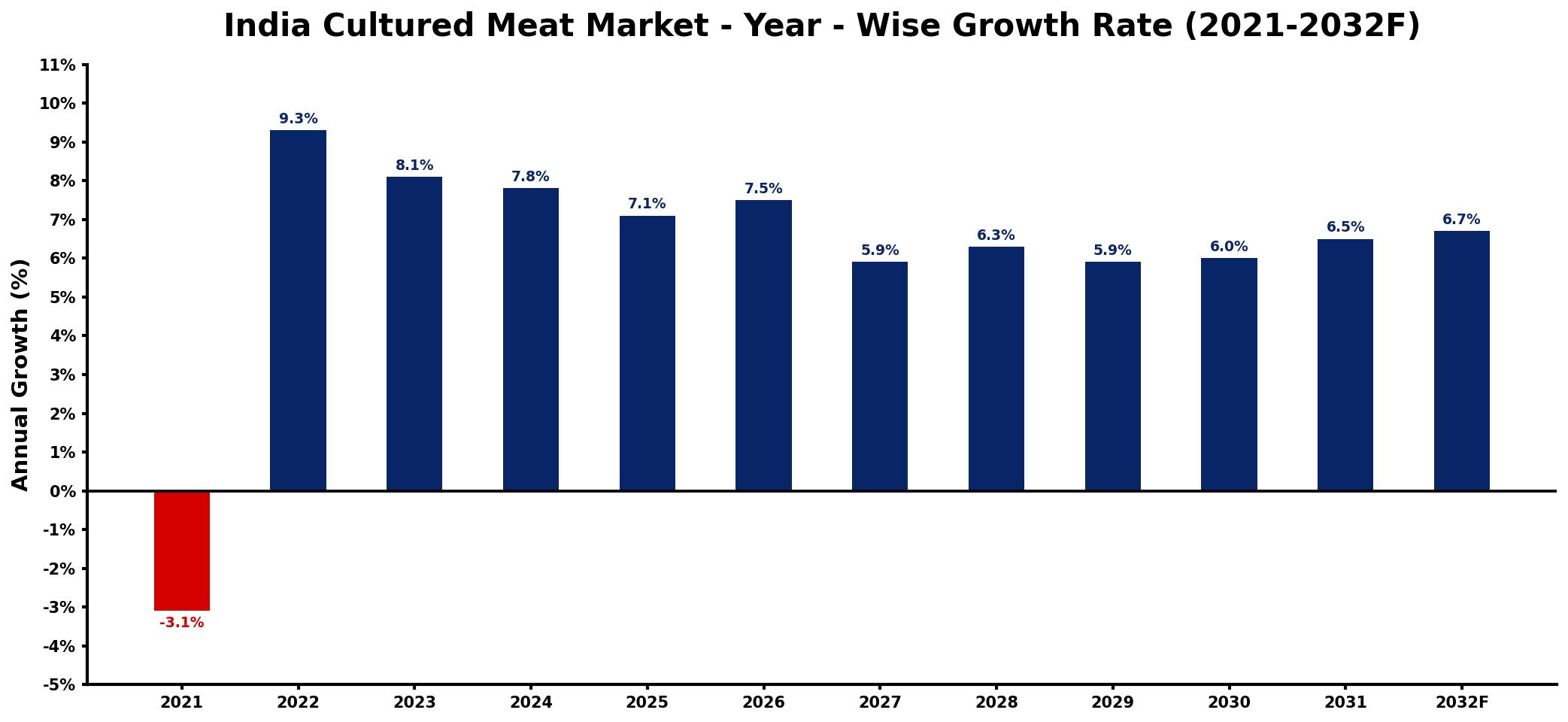
The table below presents the year‑wise growth rates along with the key drivers influencing the market
| Year | Growth Rate | Major Drivers |
| 2021 | -3.1% | decreased consumer interest in alternatives |
| 2022 | 9.3% | increased investment in alternative proteins |
| 2023 | 8.1% | growing demand for sustainable options |
| 2024 | 7.8% | expansion of production facilities planned |
| 2025 | 7.1% | rising awareness of environmental impacts |
| 2026 | 7.5% | enhanced technology for production efficiency |
| 2027 | 5.9% | broadened distribution channels emerging |
| 2028 | 6.3% | collaboration between startups and investors |
| 2029 | 5.9% | increased regulatory support for alternatives |
| 2030 | 6.0% | growing consumer acceptance of innovations |
| 2031 | 6.5% | increased pharmaceutical industry usage |
| 2032 | 6.7% | strengthened partnerships with retailers |
Note: Market size estimations and growth projections presented in this report are based on 6Wresearch's proprietary forecasting methodology, utilizing the latest available industry data, government publications, and primary research inputs.
India Cultured Meat Market Synopsis
The landscape of the India Cultured Meat Market is rapidly evolving as consumers become more conscious of their dietary choices. Recent shifts towards vegetarian and vegan lifestyles further amplify the demand for innovative alternatives to traditional meat products.
At present, the market grapples with several challenges, including high production costs and regulatory hurdles that can deter potential investors. Despite this, advancements in technology and increased investment in R&D promise to pave the way for a more robust industry in the coming years.
India Cultured Meat Market Key Takeaways
- The market is gaining traction due to a surge in consumer awareness about sustainable eating.
- Technological innovations are enhancing the feasibility of lab-grown meat production.
- Regulatory frameworks and public perception remain significant barriers to widespread acceptance.
- High operational costs and funding shortages pose challenges for scalability.
- Demand for vegan and vegetarian diets is a key driver of market growth.
Evaluation of Restraints in India Cultured Meat Market
Despite the promising outlook for the India Cultured Meat Market, several real constraints hinder its rapid growth. One of the foremost challenges is the high cost associated with setting up lab-grown meat production facilities, which can be prohibitive for many potential entrants. Regulatory hurdles further complicate matters, as stringent guidelines and lengthy approval processes can delay product launches and market entry. Additionally, public perception remains a barrier; many consumers are still hesitant to embrace lab-grown alternatives over conventional meat, primarily due to concerns over safety and naturalness. The limited availability of skilled personnel and adequate funding resources further restricts the industry's capacity to scale effectively.
India Cultured Meat Market Trends
Several emerging trends are reshaping the India Cultured Meat Market. One significant trend is the growing consumer demand for transparency in food production, pushing companies to provide detailed information about sourcing and production practices. Moreover, a rise in collaborations between startups and established food manufacturers is accelerating technological advancements and driving innovation. Another notable trend is the incorporation of advanced biotechnologies aimed at reducing production costs, which will likely enhance market competitiveness.
India Cultured Meat Market Opportunities
The India Cultured Meat Market presents substantial growth and investment opportunities, particularly in the R&D sector. With continued innovations in cell culture technology, there is potential for more cost-effective production methods that could significantly lower prices for consumers. Additionally, partnerships with governmental organizations could foster supportive policies and funding that incentivize further advancements. Exploring export opportunities in countries with rising demands for sustainable food sources can also provide a lucrative avenue for growth.
Government Initiatives in the India Cultured Meat Market
The Indian government is gradually recognizing the potential of cultured meat as a sustainable food source. Various public initiatives are being introduced to support research and development in alternative proteins, along with efforts to streamline regulatory processes for lab-grown products. These initiatives include funding programs aimed at fostering innovation within the sector, as well as educational campaigns to enhance consumer awareness and acceptance of cultured meat alternatives.
Future Insights of the India Cultured Meat Market
Looking ahead to the period between 2026 and 2032, the India Cultured Meat Market is poised for notable transformation. As technological advancements continue to emerge, production efficiencies are likely to improve, resulting in reduced costs. Consumer acceptance of lab-grown meat is expected to gradually increase as education initiatives bear fruit, driving demand. Consequently, with the convergence of these trends, the market is anticipated to witness a more prominent role in Indias food landscape, catering to both ethical and sustainability concerns.
India Cultured Meat Market Latest Developments (2025 - 2026)
In recent months, the India Cultured Meat Market has witnessed exciting advancements, particularly in the realm of technological innovations. Various organizations have been focusing on enhancing production methodologies, leading to improved yields and lower costs. Additionally, collaborations with international partners are on the rise, promoting knowledge exchange and bolstering local capabilities. These developments indicate a positive trend towards a more sustainable and commercially viable cultured meat sector.
India Cultured Meat Market - Key Attractiveness of the Report
- 10 Years of Market Numbers
- Historical Data Starting from 2022 to 2025
- Base Year: 2025
- Forecast Data until 2032
- Key Performance Indicators Impacting the Market
- Major Upcoming Developments and Projects
Key Highlights of the Report:
- India Cultured Meat Market Outlook
- Market Size of India Cultured Meat Market, 2025
- Forecast of India Cultured Meat Market, 2032
- Historical Data and Forecast of India Cultured Meat Revenues & Volume for the Period 2022-2032F
- India Cultured Meat Market Trend Evolution
- India Cultured Meat Market Drivers and Challenges
- India Cultured Meat Price Trends
- India Cultured Meat Porter's Five Forces
- India Cultured Meat Industry Life Cycle
- Historical Data and Forecast of India Cultured Meat Market Revenues & Volume By Product Type for the Period 2022-2032F
- Historical Data and Forecast of India Cultured Meat Market Revenues & Volume By Poultry for the Period 2022-2032F
- Historical Data and Forecast of India Cultured Meat Market Revenues & Volume By Beef for the Period 2022-2032F
- Historical Data and Forecast of India Cultured Meat Market Revenues & Volume By Seafood for the Period 2022-2032F
- Historical Data and Forecast of India Cultured Meat Market Revenues & Volume By Pork for the Period 2022-2032F
- Historical Data and Forecast of India Cultured Meat Market Revenues & Volume By Duck for the Period 2022-2032F
- Historical Data and Forecast of India Cultured Meat Market Revenues & Volume By End-Use for the Period 2022-2032F
- Historical Data and Forecast of India Cultured Meat Market Revenues & Volume By Nuggets for the Period 2022-2032F
- Historical Data and Forecast of India Cultured Meat Market Revenues & Volume By Burgers for the Period 2022-2032F
- Historical Data and Forecast of India Cultured Meat Market Revenues & Volume By Meatballs for the Period 2022-2032F
- Historical Data and Forecast of India Cultured Meat Market Revenues & Volume By Sausage for the Period 2022-2032F
- Historical Data and Forecast of India Cultured Meat Market Revenues & Volume By Hot dogs for the Period 2022-2032F
- Historical Data and Forecast of India Cultured Meat Market Revenues & Volume By Others for the Period 2022-2032F
- India Cultured Meat Import Export Trade Statistics
- Market Opportunity Assessment By Product Type
- Market Opportunity Assessment By End-Use
- India Cultured Meat Top Companies Market Share
- India Cultured Meat Competitive Benchmarking By Technical and Operational Parameters
- India Cultured Meat Company Profiles
- India Cultured Meat Key Strategic Recommendations






































