India Data Governance Market Size & Growth Rate (2026-2032)
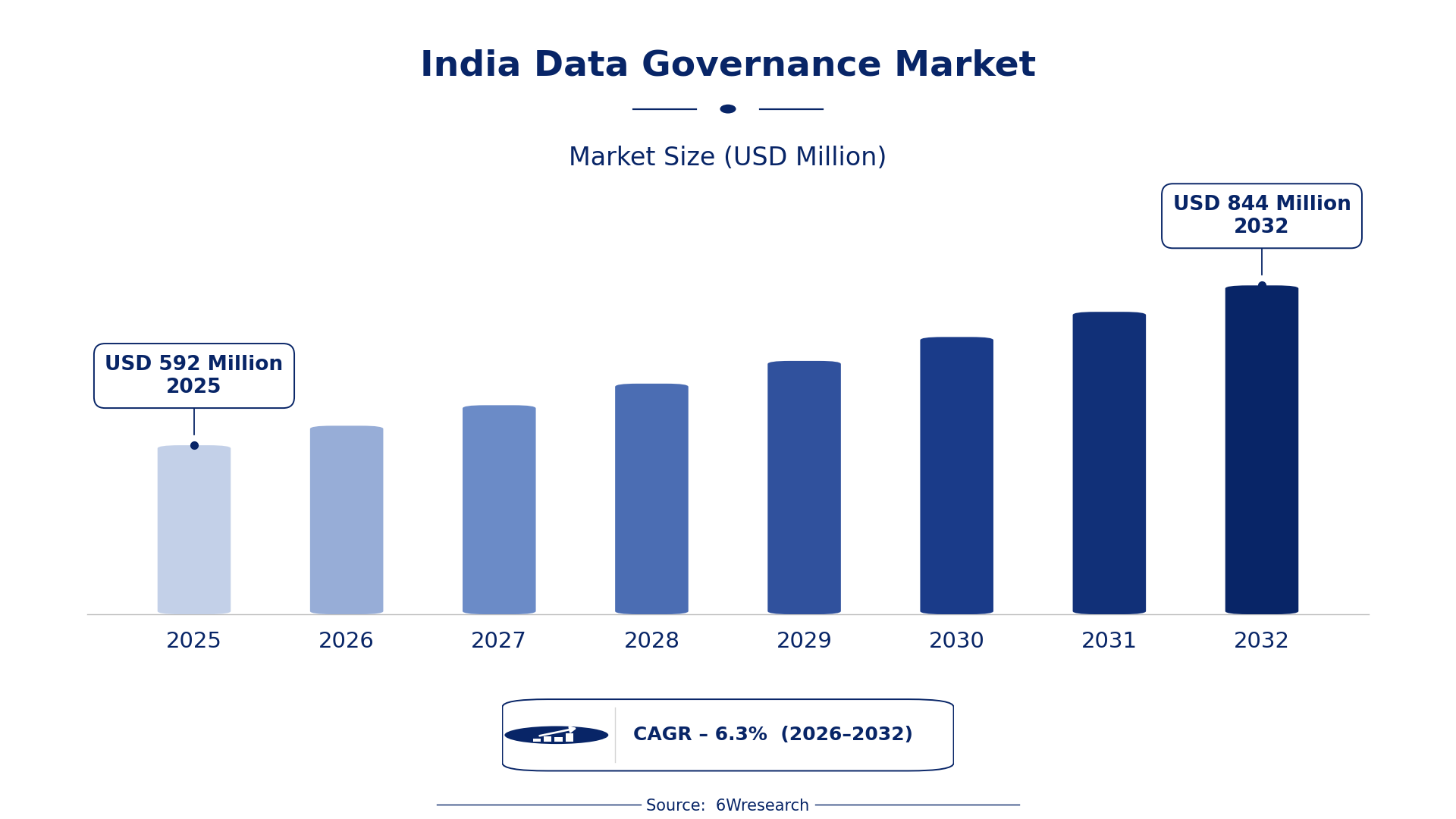
The India Data Governance Market was estimated at USD 592 Million in 2025 and is projected to reach USD 844 Million by 2032, growing at a CAGR of 6.3% from 2026 to 2032.
India Data Governance Market Synopsis
The India Data Governance Market has experienced notable momentum as organizations recognize the imperative need for stringent data management practices. With the surge of data generation and the associated regulatory scrutiny, businesses are now actively seeking solutions to ensure compliance and data integrity.
Looking ahead, the market is set to evolve further as digital transformation accelerates across sectors. The convergence of advanced technologies and heightened regulatory frameworks will drive demand for sophisticated governance solutions, creating a fertile environment for growth.
India Data Governance Market Year-wise Growth Rate and Key Drivers
This graph illustrates the annual growth rates of the India Data Governance Market from 2021 to 2032, highlighting a steady upward trajectory and projected expansion over the forecast period.
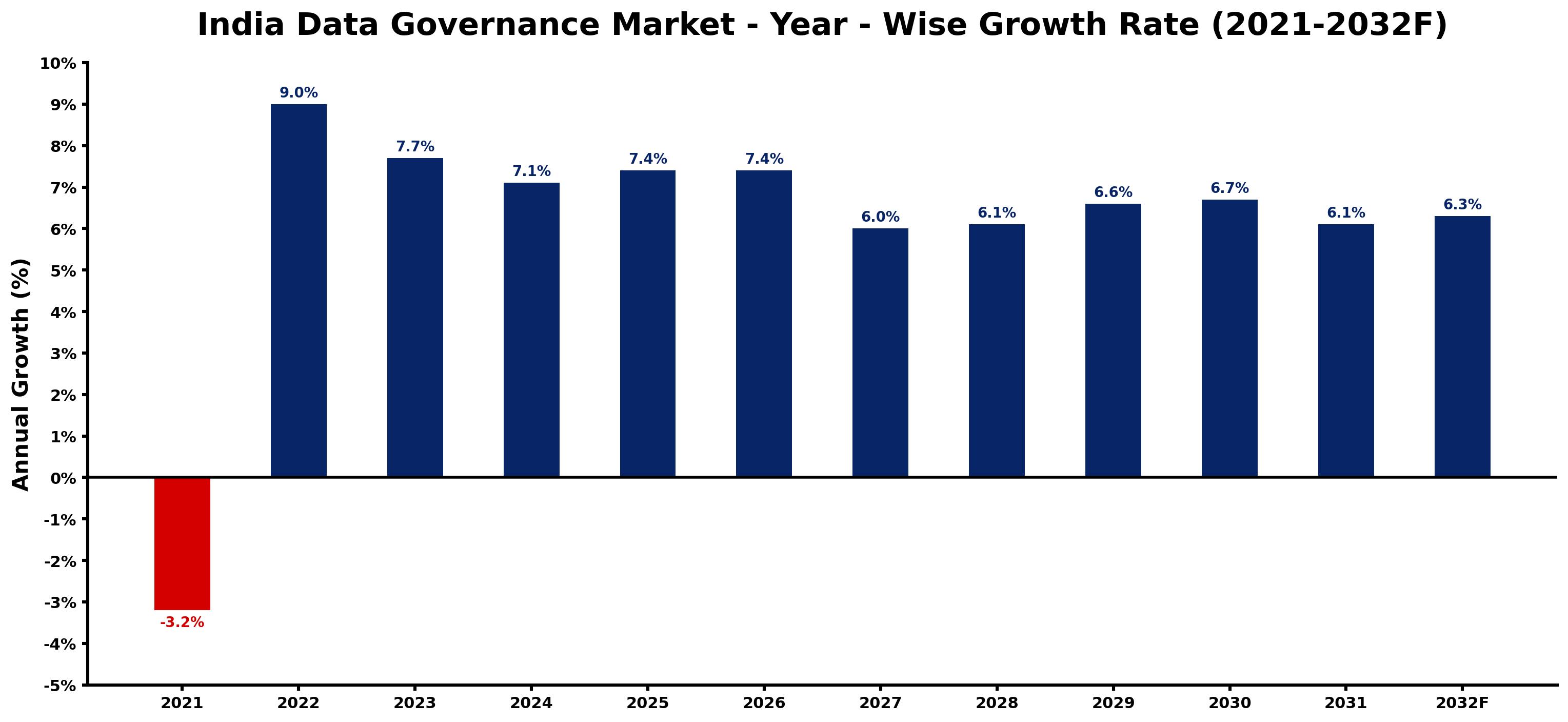
The table below presents the year‑wise growth rates along with the key drivers influencing the market
| Year | Growth Rate | Major Drivers |
| 2021 | -3.2% | Implementation delays by the Data Protection Bill review committee |
| 2022 | 9.0% | Implementation of the Digital Personal Data Protection Bill. |
| 2023 | 7.7% | Rise in data breaches prompting stricter regulation adherence. |
| 2024 | 7.1% | Government initiatives promoting data localization among businesses. |
| 2025 | 7.4% | Increased focus on privacy regulations by TRAI. |
| 2026 | 7.4% | Emerging start-ups enhancing data governance solutions across sectors. |
| 2027 | 6.0% | Growing adoption of IoT devices creates data management needs. |
| 2028 | 6.1% | Demand for data sovereignty in multinational corporations. |
| 2029 | 6.6% | Local businesses seeking compliance to enter international markets. |
| 2030 | 6.7% | Increasing awareness of cybersecurity threats among enterprises. |
| 2031 | 6.1% | Development of sector-specific data governance frameworks by NASSCOM. |
| 2032 | 6.3% | Collaboration between private and public sectors in data strategies. |
Note: Market size estimations and growth projections presented in this report are based on 6Wresearch's proprietary forecasting methodology, utilizing the latest available industry data, government publications, and primary research inputs.
India Data Governance Market Key Takeaways
Below are some of the specific key takeaways from the market, including:
- The increasing volume of data generated in India necessitates robust governance frameworks.
- Compliance with regulations such as the Personal Data Protection Bill is a primary driver for market growth.
- Organizations are prioritizing data security due to rising cyber threats and data breaches.
- The government's push for 'Digital India' is accelerating the adoption of data governance solutions.
- The shift to remote work has underscored the need for effective data management and governance strategies.
Evaluation of Restraints in India Data Governance Market
Despite the growth trajectory, several restraints hinder progress in the India Data Governance Market. A major challenge lies in the formulation of effective governance policies that strike a balance between data accessibility and security. Organizations often grapple with the complexity of compliance requirements, which can slow down the implementation of necessary governance practices. Additionally, the scarcity of skilled professionals in data governance roles further complicates efforts to establish a solid governance framework. As companies strive to meet regulatory demands, these challenges must be addressed to fully capitalize on market opportunities.
India Data Governance Market Trends
Several trends are shaping the India Data Governance Market. One key trend is the growing adoption of artificial intelligence and machine learning technologies to enhance data management and governance processes. These technologies provide organizations with tools to automate compliance checks and improve data quality.
Additionally, there is an increasing emphasis on data ethics and transparency, driven by consumer demand for privacy and accountability. Organizations are now focusing on ethical data practices, which not only align with regulatory requirements but also build trust with customers.
India Data Governance Market Opportunities
The India Data Governance Market presents numerous opportunities for growth and investment. As businesses expand their digital footprints, there is a pressing need for advanced governance solutions that address compliance and security challenges. Startups and technology firms that can offer innovative data governance tools are likely to capture significant market share.
on top of that, collaboration between public and private sectors to develop comprehensive data governance frameworks will create new avenues for investment. The increasing focus on data analytics will also drive demand for governance solutions that ensure data integrity and reliability.
Government Initiatives in the India Data Governance Market
The Indian government is actively shaping the Data Governance Market through various initiatives aimed at enhancing data security and compliance. With a focus on building a strong digital infrastructure, these initiatives are crucial for fostering trust in data-driven decision-making. Current regulatory frameworks emphasize the importance of data privacy and security, making government actions pivotal in driving market growth.
- A regulatory framework introduced in 2025 mandating strict compliance for organizations handling personal data.
- Ongoing efforts to launch a national digital infrastructure upgrade programme focused on enhancing data management capabilities.
- A planned public-private initiative expected to establish data governance standards by 2028.
- Recent workshops conducted by the Ministry of Electronics and Information Technology to educate businesses on data governance best practices.
- An initiative that began in mid-2025 focusing on enhancing cybersecurity measures across government and private sectors.
Future Insights of the India Data Governance Market
From 2026 to 2032, the India Data Governance Market is expected to witness substantial growth driven by increased regulatory pressures and the expanding digital economy. Organizations will prioritize investment in data governance frameworks as a proactive measure against compliance risks. on top of that, advancements in technology will facilitate more efficient governance practices, enabling companies to streamline operations while ensuring data integrity. As businesses adapt to these changes, the market will evolve, presenting new opportunities for innovation and collaboration.
India Data Governance Market Latest Developments
In the past year, the India Data Governance Market has seen a flurry of activity as organizations ramp up their data management efforts in response to regulatory changes and emerging threats. This uptick in focus on governance solutions reflects a growing recognition of the value of data as a critical business asset.
- A leading technology vendor launched a new data governance platform in early 2025, designed to streamline compliance processes for organizations.
- An initiative that began in Q3 2025 focuses on enhancing data literacy among employees across various sectors.
- In mid-2025, a collaborative project was announced between several major industry players to develop a standardized data governance framework.
- A rollout expected to begin in late 2026 will introduce a new compliance monitoring tool aimed at improving data security for SMEs.
- A major technology firm is currently upgrading its data governance solutions, with completion expected by early 2026.
India Data Governance Market - Key Attractiveness of the Report
- 10 Years of Market Numbers
- Historical Data Starting from 2022 to 2025
- Base Year: 2025
- Forecast Data until 2032
- Key Performance Indicators Impacting the Market
- Major Upcoming Developments and Projects
Key Highlights of the Report:
- India Data Governance Market Outlook
- Market Size of India Data Governance Market, 2025
- Forecast of India Data Governance Market, 2032
- Historical Data and Forecast of India Data Governance Revenues & Volume for the Period 2022-2032F
- India Data Governance Market Trend Evolution
- India Data Governance Market Drivers and Challenges
- India Data Governance Price Trends
- India Data Governance Porter's Five Forces
- India Data Governance Industry Life Cycle
- Historical Data and Forecast of India Data Governance Market Revenues & Volume By Application for the Period 2022-2032F
- Historical Data and Forecast of India Data Governance Market Revenues & Volume By Incident management for the Period 2022-2032F
- Historical Data and Forecast of India Data Governance Market Revenues & Volume By Process management for the Period 2022-2032F
- Historical Data and Forecast of India Data Governance Market Revenues & Volume By Compliance management for the Period 2022-2032F
- Historical Data and Forecast of India Data Governance Market Revenues & Volume By Risk management for the Period 2022-2032F
- Historical Data and Forecast of India Data Governance Market Revenues & Volume By Audit management for the Period 2022-2032F
- Historical Data and Forecast of India Data Governance Market Revenues & Volume By Data quality and security management for the Period 2022-2032F
- Historical Data and Forecast of India Data Governance Market Revenues & Volume By Others for the Period 2022-2032F
- Historical Data and Forecast of India Data Governance Market Revenues & Volume By Vertical for the Period 2022-2032F
- Historical Data and Forecast of India Data Governance Market Revenues & Volume By BFSI for the Period 2022-2032F
- Historical Data and Forecast of India Data Governance Market Revenues & Volume By Retail and Consumer Goods for the Period 2022-2032F
- Historical Data and Forecast of India Data Governance Market Revenues & Volume By Telecom and IT for the Period 2022-2032F
- Historical Data and Forecast of India Data Governance Market Revenues & Volume By Government for the Period 2022-2032F
- Historical Data and Forecast of India Data Governance Market Revenues & Volume By Healthcare for the Period 2022-2032F
- Historical Data and Forecast of India Data Governance Market Revenues & Volume By Manufacturing for the Period 2022-2032F
- Historical Data and Forecast of India Data Governance Market Revenues & Volume By Energy and Utilities for the Period 2022-2032F
- Historical Data and Forecast of India Data Governance Market Revenues & Volume By Transportation and Logistics for the Period 2022-2032F
- Historical Data and Forecast of India Data Governance Market Revenues & Volume By Component for the Period 2022-2032F
- Historical Data and Forecast of India Data Governance Market Revenues & Volume By Solutions for the Period 2022-2032F
- Historical Data and Forecast of India Data Governance Market Revenues & Volume By Services for the Period 2022-2032F
- Historical Data and Forecast of India Data Governance Market Revenues & Volume By Deployment Model for the Period 2022-2032F
- Historical Data and Forecast of India Data Governance Market Revenues & Volume By On-premises for the Period 2022-2032F
- Historical Data and Forecast of India Data Governance Market Revenues & Volume By Cloud for the Period 2022-2032F
- Historical Data and Forecast of India Data Governance Market Revenues & Volume By Organisation Size for the Period 2022-2032F
- Historical Data and Forecast of India Data Governance Market Revenues & Volume By Small and Medium-Sized Enterprises (SMEs) for the Period 2022-2032F
- Historical Data and Forecast of India Data Governance Market Revenues & Volume By Large enterprises for the Period 2022-2032F
- India Data Governance Import Export Trade Statistics
- Market Opportunity Assessment By Application
- Market Opportunity Assessment By Vertical
- Market Opportunity Assessment By Component
- Market Opportunity Assessment By Deployment Model
- Market Opportunity Assessment By Organisation Size
- India Data Governance Top Companies Market Share
- India Data Governance Competitive Benchmarking By Technical and Operational Parameters
- India Data Governance Company Profiles
- India Data Governance Key Strategic Recommendations






































