India Data Protection Market Size & Growth Rate (2026-2032)
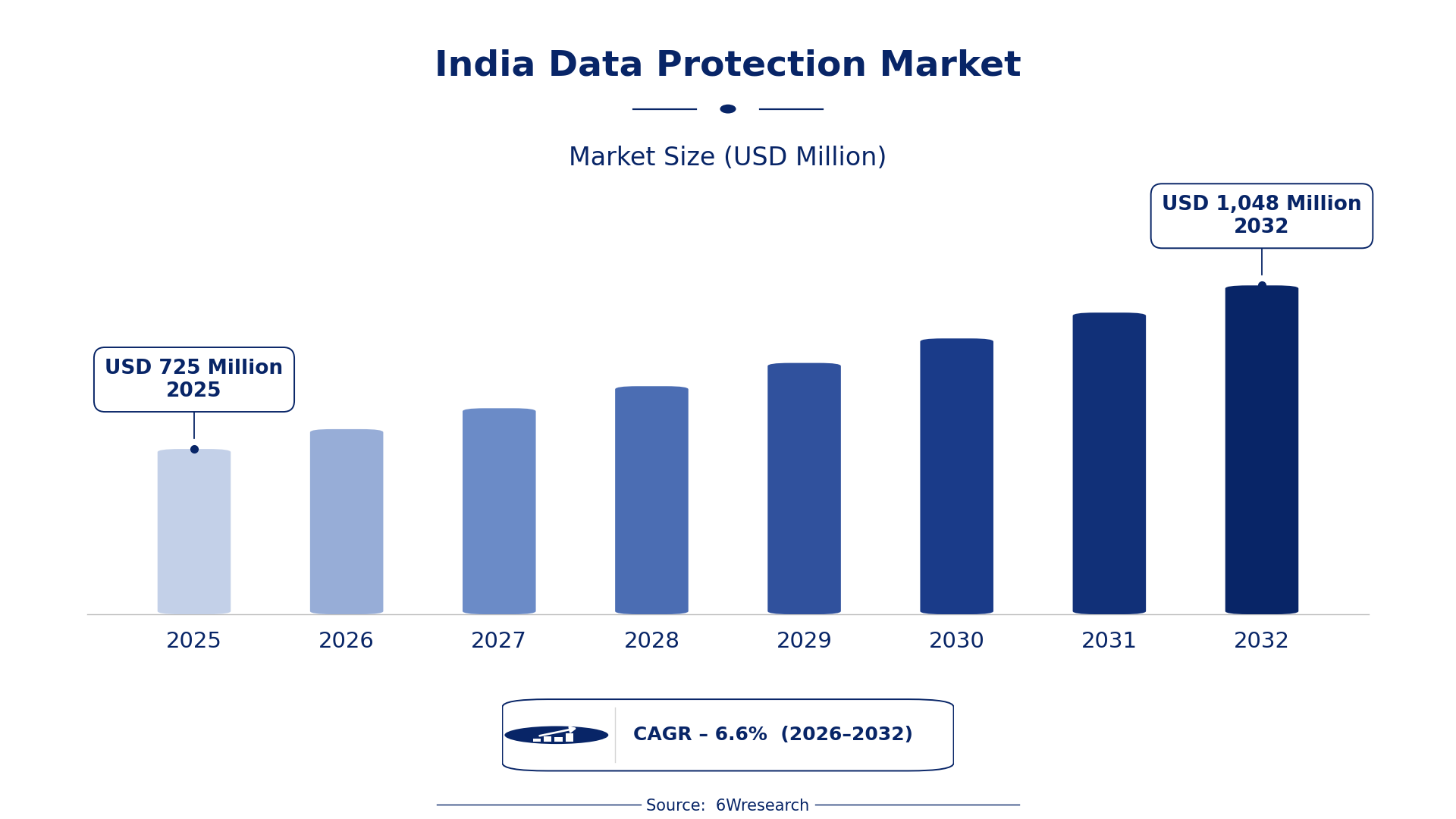
The India Data Protection Market was estimated at USD 725 Million in 2025 and is projected to reach USD 1048 Million by 2032, growing at a CAGR of 6.6% from 2026 to 2032.
India Data Protection Market Synopsis
The India Data Protection market is undergoing a transformative shift. As concerns over data breaches and privacy heighten, organizations are becoming more proactive in securing their sensitive information. Investments in advanced data protection technologies have surged, reflecting a robust commitment to compliance and security.
Looking ahead, the market is set to face challenges from evolving regulations and the dynamic nature of cyber threats. Companies will have to balance innovation with compliance, ensuring that their data protection strategies are not only effective but also aligned with legal frameworks.
India Data Protection Market Year-wise Growth Rate and Key Drivers
This graph illustrates the annual growth rates of the India Data Protection Market from 2021 to 2032, highlighting a steady upward trajectory and projected expansion over the forecast period.
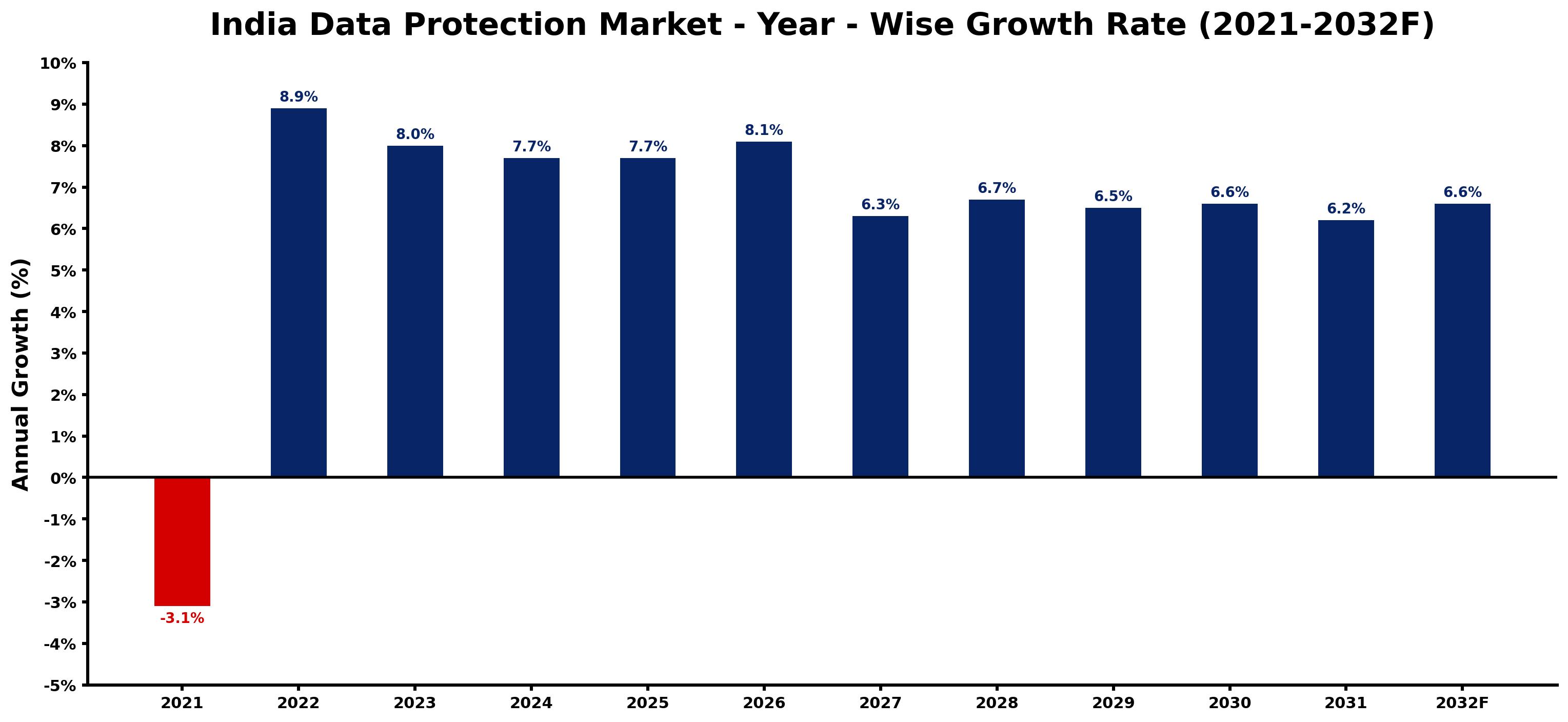
The table below presents the year‑wise growth rates along with the key drivers influencing the market
| Year | Growth Rate | Major Drivers |
| 2021 | -3.1% | Delayed implementation of Personal Data Protection Bill |
| 2022 | 8.9% | Implementation of Personal Data Protection Bill recommendations |
| 2023 | 8.0% | Increased enforcement of data privacy regulations by NPCI |
| 2024 | 7.7% | Demand for enhanced cybersecurity solutions from government sectors |
| 2025 | 7.7% | Rising awareness about data protection among Indian SMEs |
| 2026 | 8.1% | Growth in digital payment systems spurring data protection needs |
| 2027 | 6.3% | Heightened consumer concern over data privacy breaches |
| 2028 | 6.7% | Emergence of local data protection technology startups |
| 2029 | 6.5% | Continuous updates to the IT Act addressing data issues |
| 2030 | 6.6% | Increased cross-border data flow regulations requiring compliance |
| 2031 | 6.2% | Growing adoption of cloud services necessitating stronger data safeguards |
| 2032 | 6.6% | Boost in remote working leading to higher data vulnerability |
Note: Market size estimations and growth projections presented in this report are based on 6Wresearch's proprietary forecasting methodology, utilizing the latest available industry data, government publications, and primary research inputs.
India Data Protection Market Key Takeaways
Below are some of the specific key takeaways from the market, including:
- The increasing volume of sensitive data drives demand for robust data protection solutions.
- Compliance with emerging data protection regulations is a top priority for businesses.
- The COVID-19 pandemic accelerated the adoption of data protection technologies as remote work expanded.
- Encryption, access control, and data loss prevention remain crucial components of effective data protection strategies.
- The market presents significant investment opportunities for companies focused on innovative data security solutions.
Evaluation of Restraints in India Data Protection Market
Despite its growth trajectory, the India Data Protection market faces several restraints that impact its expansion. Regulatory compliance is a moving target, making it challenging for organizations to stay updated with the latest laws. on top of that, data leakage remains a persistent issue, complicating the security landscape. Organizations often struggle with managing security across varied environments, leading to vulnerabilities that can be exploited by cybercriminals. The economic uncertainty can also constrain budgets, hindering investments in comprehensive data protection solutions.
India Data Protection Market Trends
A noticeable trend in the India Data Protection market is the shift towards integrated security solutions. Companies are increasingly opting for platforms that offer combined functionalities, such as encryption and data loss prevention, streamlining their operations. on top of that, the rise of remote work has accelerated the need for cloud-based data protection solutions, allowing organizations to safeguard data regardless of physical location. Additionally, artificial intelligence is becoming a critical element in threat detection and response, enhancing the efficacy of data protection measures.
India Data Protection Market Opportunities
The opportunities within the India Data Protection market are abundant. Organizations are keen on investing in technologies that offer innovative solutions to emerging threats. The demand for compliance-related services continues to grow, providing a fertile ground for consultancy and training firms. Additionally, sectors such as healthcare and finance, which handle a large volume of sensitive data, are prioritizing investments in data protection. Startups specializing in niche technologies also stand to benefit from increased funding and partnerships with established firms looking to enhance their security capabilities.
Government Initiatives in the India Data Protection Market
The Indian government is taking a proactive stance on data protection, shaping the market through a series of targeted initiatives. The regulatory framework is evolving rapidly to address the growing concerns surrounding data privacy and security. With an emphasis on compliance, organizations are under increasing pressure to adopt best practices in data management. This regulatory environment not only enhances consumer trust but also drives market growth.
- A national data protection bill was introduced in late 2022, focusing on strengthening data privacy rights.
- The Ministry of Electronics and Information Technology is currently rolling out a public awareness campaign aimed at educating businesses on compliance requirements.
- In early 2023, a framework was established to support the implementation of data protection practices in small and medium enterprises.
- Upcoming legislation in 2024 is expected to mandate stricter penalties for data breaches, reinforcing the importance of robust data protection measures.
- A planned partnership initiative is set to launch in mid-2023, aimed at fostering collaboration between private firms and government bodies on cybersecurity innovation.
Future Insights of the India Data Protection Market
In the coming years, the India Data Protection market is likely to experience heightened demand driven by stricter regulations and the necessity for enhanced data security measures. As organizations grapple with increasingly sophisticated cyber threats, they will prioritize investments in advanced technologies such as AI-driven security solutions and comprehensive data governance frameworks. The focus will shift towards adopting proactive strategies that ensure compliance while building consumer trust. Overall, the future looks promising, albeit with challenges that will require constant adaptation.
India Data Protection Market Latest Developments
Recent industry activity in the India Data Protection market has focused on innovation and compliance. Companies are increasingly investing in advanced technologies to enhance their data security posture, especially in response to evolving threats. The past year has seen a surge in collaborative initiatives aimed at improving security standards across sectors.
- A major technology vendor launched a new encryption solution in Q4 2022, aimed at protecting sensitive data in transit and at rest.
- An ongoing partnership between leading cybersecurity firms commenced in early 2023, focused on developing a unified framework for data protection across industries.
- A government-backed initiative aimed at creating a national cybersecurity research center began in late 2022 and remains underway.
- An upcoming conference scheduled for early 2024 will feature discussions on the latest data protection technologies and regulatory changes impacting the market.
- A prominent organization is rolling out a comprehensive employee training program on data protection best practices, expected to conclude by mid-2023.
India Data Protection Market - Key Attractiveness of the Report
- 10 Years of Market Numbers
- Historical Data Starting from 2022 to 2025
- Base Year: 2025
- Forecast Data until 2032
- Key Performance Indicators Impacting the Market
- Major Upcoming Developments and Projects
Key Highlights of the Report:
- India Data Protection Market Outlook
- Market Size of India Data Protection Market, 2025
- Forecast of India Data Protection Market, 2032
- Historical Data and Forecast of India Data Protection Revenues & Volume for the Period 2022-2032F
- India Data Protection Market Trend Evolution
- India Data Protection Market Drivers and Challenges
- India Data Protection Price Trends
- India Data Protection Porter's Five Forces
- India Data Protection Industry Life Cycle
- Historical Data and Forecast of India Data Protection Market Revenues & Volume By Component for the Period 2022-2032F
- Historical Data and Forecast of India Data Protection Market Revenues & Volume By Solutions for the Period 2022-2032F
- Historical Data and Forecast of India Data Protection Market Revenues & Volume By Services (Professional Services and Managed Services) for the Period 2022-2032F
- Historical Data and Forecast of India Data Protection Market Revenues & Volume By Deployment Mode for the Period 2022-2032F
- Historical Data and Forecast of India Data Protection Market Revenues & Volume By On-premises for the Period 2022-2032F
- Historical Data and Forecast of India Data Protection Market Revenues & Volume By Cloud for the Period 2022-2032F
- Historical Data and Forecast of India Data Protection Market Revenues & Volume By Industry Vertical for the Period 2022-2032F
- Historical Data and Forecast of India Data Protection Market Revenues & Volume By Government and defense for the Period 2022-2032F
- Historical Data and Forecast of India Data Protection Market Revenues & Volume By Banking, Financial Services, and Insurance (BFSI) for the Period 2022-2032F
- Historical Data and Forecast of India Data Protection Market Revenues & Volume By Healthcare for the Period 2022-2032F
- Historical Data and Forecast of India Data Protection Market Revenues & Volume By IT and telecom for the Period 2022-2032F
- Historical Data and Forecast of India Data Protection Market Revenues & Volume By Consumer goods and retail for the Period 2022-2032F
- Historical Data and Forecast of India Data Protection Market Revenues & Volume By Education for the Period 2022-2032F
- Historical Data and Forecast of India Data Protection Market Revenues & Volume By Media and entertainment for the Period 2022-2032F
- Historical Data and Forecast of India Data Protection Market Revenues & Volume By Organization Size Large Enterprises for the Period 2022-2032F
- Historical Data and Forecast of India Data Protection Market Revenues & Volume By SMEs for the Period 2022-2032F
- Historical Data and Forecast of India Data Protection Market Revenues & Volume By Large Enterprises for the Period 2022-2032F
- India Data Protection Import Export Trade Statistics
- Market Opportunity Assessment By Component
- Market Opportunity Assessment By Deployment Mode
- Market Opportunity Assessment By Industry Vertical
- Market Opportunity Assessment By Organization Size Large Enterprises
- India Data Protection Top Companies Market Share
- India Data Protection Competitive Benchmarking By Technical and Operational Parameters
- India Data Protection Company Profiles
- India Data Protection Key Strategic Recommendations






































