India Digital Railway Market Size & Growth Rate (2026-2032)
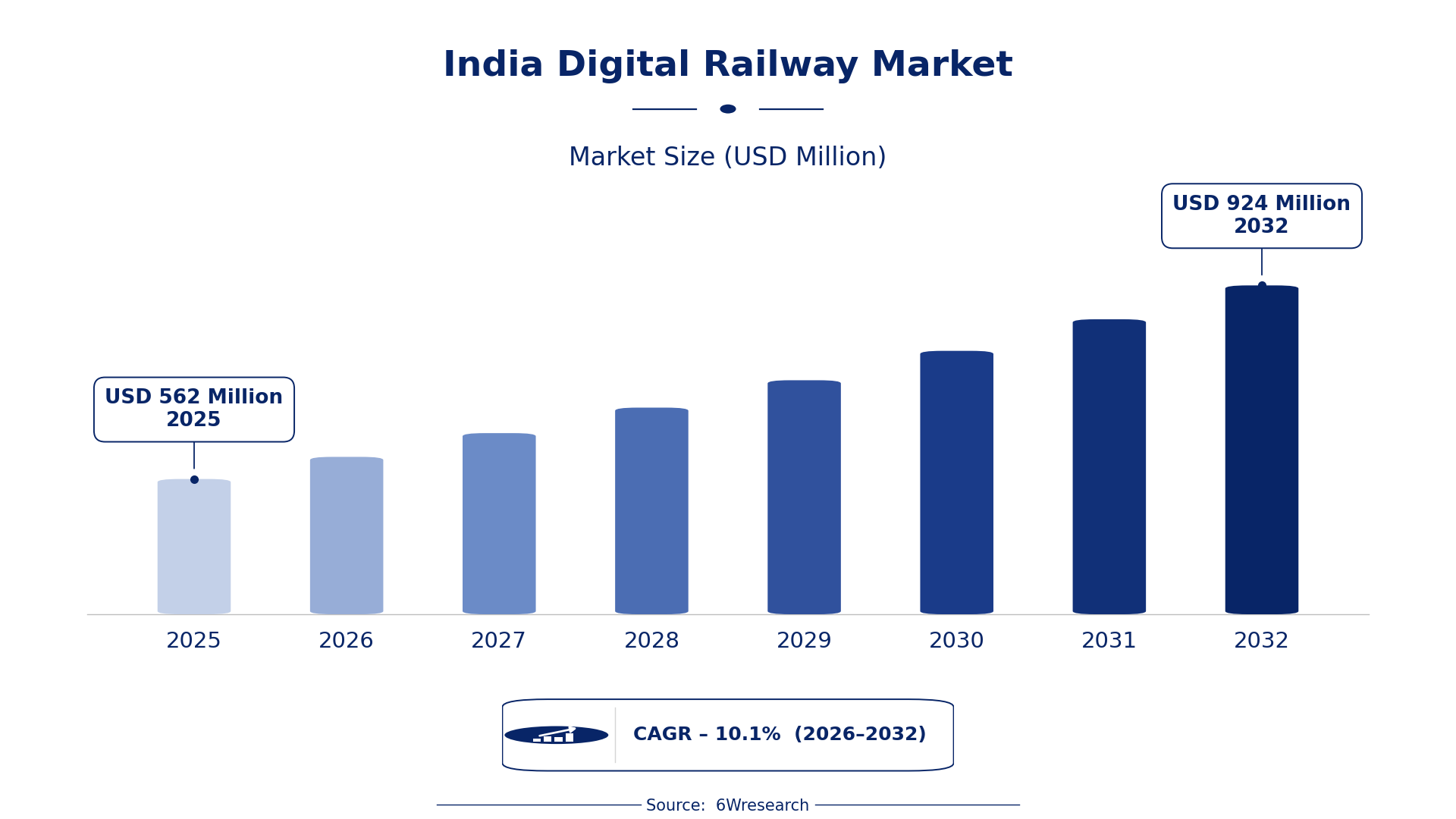
The India Digital Railway Market was estimated at USD 562 Million in 2025 and is projected to reach USD 924 Million by 2032, growing at a CAGR of 10.1% from 2026 to 2032.
India Digital Railway Market Synopsis
The India Digital Railway Market is witnessing a substantial transformation as the government prioritizes digital integration within its vast railway network. With an emphasis on enhancing safety, efficiency, and overall passenger experience, digital solutions are becoming indispensable in modern rail operations.
Key technologies such as IoT, predictive maintenance, and advanced data analytics are being implemented to address longstanding challenges within the railway sector. As investments pour in, the momentum for digital railway solutions is gaining traction, reshaping the operational framework of India's railways.
India Digital Railway Market Year-wise Growth Rate and Key Drivers
This graph illustrates the annual growth rates of the India Digital Railway Market from 2021 to 2032, highlighting a steady upward trajectory and projected expansion over the forecast period.
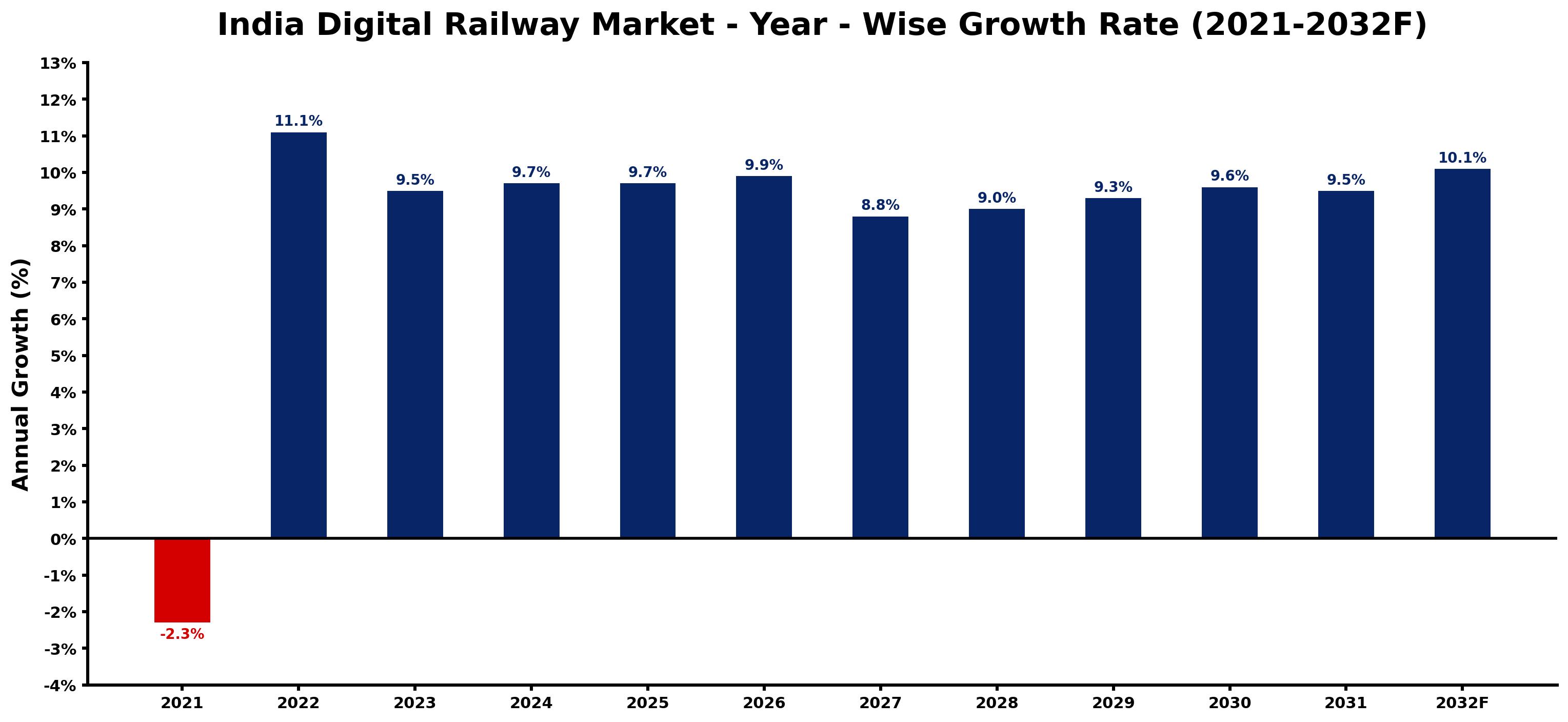
The table below presents the year‑wise growth rates along with the key drivers influencing the market
| Year | Growth Rate | Major Drivers |
| 2021 | -2.3% | Delayed infrastructure projects by Indian Railways Authority |
| 2022 | 11.1% | Indian Railways' modernization program accelerates digital infrastructure. |
| 2023 | 9.5% | Government's ‘Digital India’ initiative boosts railway technology adoption. |
| 2024 | 9.7% | Increase in passenger safety measures drives digital solutions demand. |
| 2025 | 9.7% | Railway connectivity in rural areas supports digital rail services. |
| 2026 | 9.9% | Rise in urban commuters fuels demand for real-time updates. |
| 2027 | 8.8% | Focus on sustainable transport increases interest in digital rail. |
| 2028 | 9.0% | Implementation of AI for train scheduling enhances operational efficiency. |
| 2029 | 9.3% | Growing integration of IoT in rail systems improves safety. |
| 2030 | 9.6% | Government incentives for smart rail projects bolster investment. |
| 2031 | 9.5% | Increased internet penetration leads to more online ticketing options. |
| 2032 | 10.1% | Adoption of cloud computing enhances data management in railways. |
Note: Market size estimations and growth projections presented in this report are based on 6Wresearch's proprietary forecasting methodology, utilizing the latest available industry data, government publications, and primary research inputs.
India Digital Railway Market Key Takeaways
Below are some of the specific key takeaways from the market, including:
- The Indian government's modernization initiatives are a primary driver of digital railway investments.
- Integration of digital signaling and predictive maintenance is enhancing operational safety and efficiency.
- There is a growing trend towards real-time passenger information systems to improve the travel experience.
- Partnerships between government and technology providers are shaping the future of railway infrastructure.
- The market is forecasted to grow significantly, reflecting the increasing demand for digital solutions.
Evaluation of Restraints in India Digital Railway Market
Despite the promising outlook, several restraints are limiting the pace of growth in the India Digital Railway Market. One major issue is the integration of new digital technologies with the existing infrastructure, which can be complex and resource-intensive. The need for a skilled workforce to manage these advanced systems is another barrier. on top of that, the initial capital expenditure required for implementing digital solutions may deter some stakeholders from making the necessary investments. Addressing these challenges is crucial for unlocking the full potential of digital transformation in Indian railways.
India Digital Railway Market Trends
Several trends are emerging that are shaping the India Digital Railway Market. The adoption of IoT technologies is enabling better tracking and monitoring of assets, leading to enhanced maintenance practices. There's also a pronounced shift towards automation in operations, reducing human error and increasing reliability. Additionally, the focus on passenger-centric services is pushing railway operators to implement more interactive and user-friendly platforms for real-time information.
India Digital Railway Market Opportunities
The market presents numerous opportunities for growth and investment, particularly in areas like smart station development and advanced predictive analytics. As urbanization continues to surge, the demand for efficient and reliable rail services will only increase. on top of that, the ongoing government initiatives aimed at modernizing infrastructure open up avenues for public-private partnerships, which can further accelerate the implementation of digital solutions in the railway sector.
Government Initiatives in the India Digital Railway Market
The Indian government is actively shaping the Digital Railway Market through various initiatives that focus on modernization and digital integration. By prioritizing these programs, the government aims to enhance the safety and efficiency of railway operations while improving the passenger experience. The public policy framework is geared towards fostering collaboration between technology providers and railway operators, which is crucial for driving innovation.
- A recently completed initiative focused on upgrading digital signaling systems across key railway corridors.
- A current program is underway that aims to implement real-time passenger information systems to enhance travel convenience.
- A planned public-private partnership set to launch in 2026 will facilitate the adoption of IoT technologies in railway maintenance.
- The government is promoting a national digital infrastructure upgrade initiative, expected to improve overall rail connectivity by 2027.
- A regulatory framework introduced in 2025 mandates improved safety standards through advanced data analytics.
Future Insights of the India Digital Railway Market
Looking ahead to 2026-2032, the India Digital Railway Market is positioned for substantial growth, primarily driven by ongoing government initiatives and technological advancements. As the railway sector embraces more digital solutions, we can expect a notable enhancement in operational efficiency and safety measures. The shift towards smarter rail systems will continue to attract investments, making this a dynamic sector with significant long-term potential.
India Digital Railway Market Latest Developments
Recent months have seen a flurry of activity in the India Digital Railway Market, with numerous developments highlighting the sector's commitment to modernization. The focus has been on implementing advanced technologies that enhance operational capabilities and improve the passenger experience. As railway stakeholders increasingly recognize the benefits of digital solutions, these initiatives are expected to gain momentum.
- A major technology vendor initiated a pilot project for predictive maintenance solutions in Q1 2023, currently ongoing.
- In mid-2023, a leading regional operator launched an upgraded mobile application for real-time train tracking and ticketing.
- An initiative began in early 2023 to equip railway stations with high-speed internet access, enhancing passenger connectivity.
- A rollout of automated ticketing kiosks is planned for late 2024 across several metropolitan railway stations.
- By early 2024, a collaborative project with a technology partner aims to integrate AI-driven analytics into operational processes.
India Digital Railway Market - Key Attractiveness of the Report
- 10 Years of Market Numbers
- Historical Data Starting from 2022 to 2025
- Base Year: 2025
- Forecast Data until 2032
- Key Performance Indicators Impacting the Market
- Major Upcoming Developments and Projects
Key Highlights of the Report:
- India Digital Railway Market Outlook
- Market Size of India Digital Railway Market, 2025
- Forecast of India Digital Railway Market, 2032
- Historical Data and Forecast of India Digital Railway Revenues & Volume for the Period 2022-2032F
- India Digital Railway Market Trend Evolution
- India Digital Railway Market Drivers and Challenges
- India Digital Railway Price Trends
- India Digital Railway Porter's Five Forces
- India Digital Railway Industry Life Cycle
- Historical Data and Forecast of India Digital Railway Market Revenues & Volume By Application for the Period 2022-2032F
- Historical Data and Forecast of India Digital Railway Market Revenues & Volume By Rail operations management for the Period 2022-2032F
- Historical Data and Forecast of India Digital Railway Market Revenues & Volume By Passenger Information System for the Period 2022-2032F
- Historical Data and Forecast of India Digital Railway Market Revenues & Volume By Asset Management for the Period 2022-2032F
- Historical Data and Forecast of India Digital Railway Market Revenues & Volume By Other Applications (other aplications includes connectivity and communication) for the Period 2022-2032F
- Historical Data and Forecast of India Digital Railway Market Revenues & Volume By Services for the Period 2022-2032F
- Historical Data and Forecast of India Digital Railway Market Revenues & Volume By Managed Services for the Period 2022-2032F
- Historical Data and Forecast of India Digital Railway Market Revenues & Volume By Professional Service for the Period 2022-2032F
- Historical Data and Forecast of India Digital Railway Market Revenues & Volume By Solutions for the Period 2022-2032F
- Historical Data and Forecast of India Digital Railway Market Revenues & Volume By Remote Monitoring for the Period 2022-2032F
- Historical Data and Forecast of India Digital Railway Market Revenues & Volume By Route Optimization And Scheduling for the Period 2022-2032F
- Historical Data and Forecast of India Digital Railway Market Revenues & Volume By Analytics for the Period 2022-2032F
- Historical Data and Forecast of India Digital Railway Market Revenues & Volume By Network management for the Period 2022-2032F
- Historical Data and Forecast of India Digital Railway Market Revenues & Volume By Predictive maintenance for the Period 2022-2032F
- Historical Data and Forecast of India Digital Railway Market Revenues & Volume By Security for the Period 2022-2032F
- Historical Data and Forecast of India Digital Railway Market Revenues & Volume By Other Solutions for the Period 2022-2032F
- India Digital Railway Import Export Trade Statistics
- Market Opportunity Assessment By Application
- Market Opportunity Assessment By Services
- Market Opportunity Assessment By Solutions
- India Digital Railway Top Companies Market Share
- India Digital Railway Competitive Benchmarking By Technical and Operational Parameters
- India Digital Railway Company Profiles
- India Digital Railway Key Strategic Recommendations






































