India Digital Workplace Market Size & Growth Rate (2026-2032)
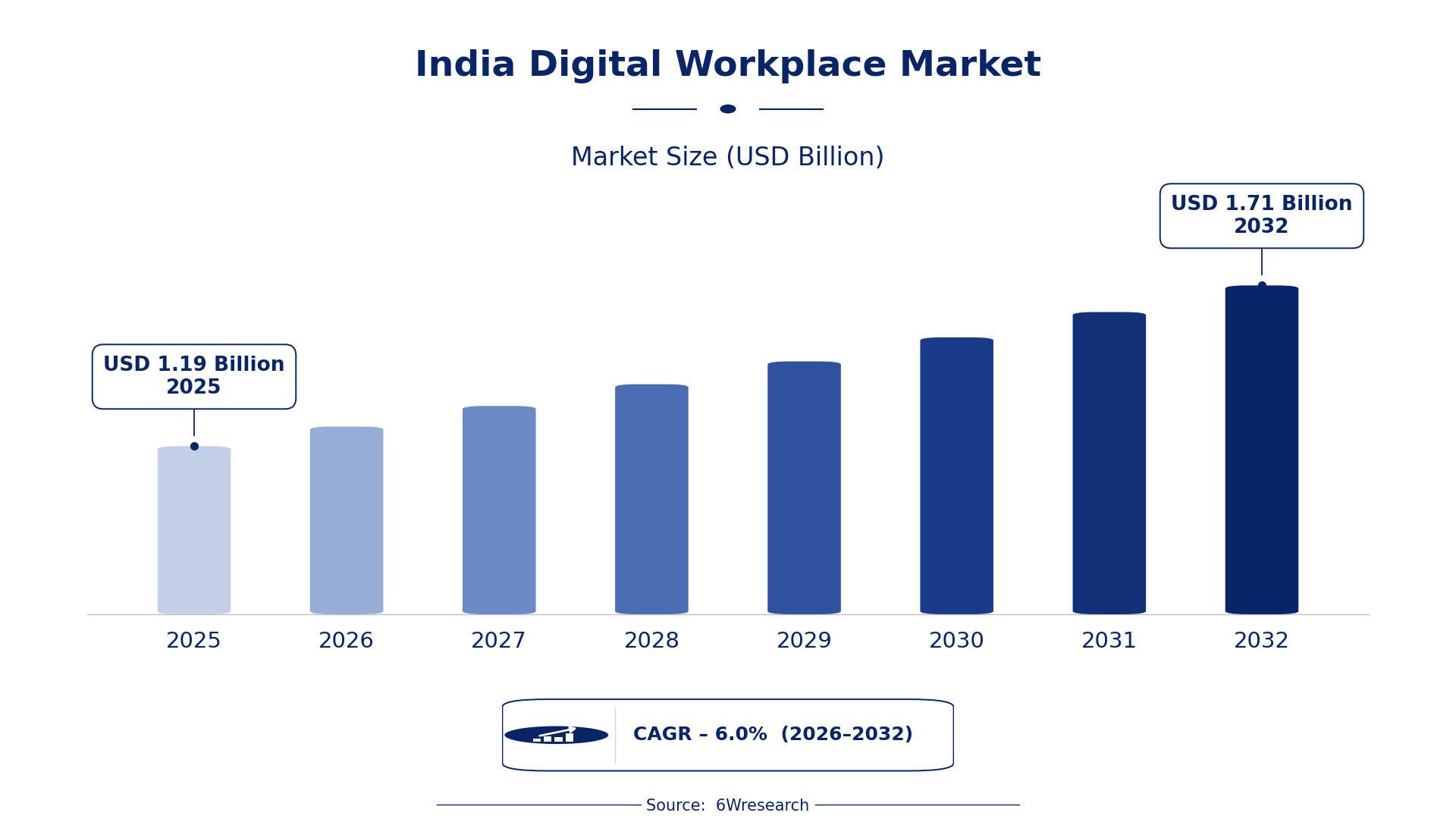
The India Digital Workplace Market was estimated at USD 1192 Million in 2025 and is projected to reach USD 1705 Million by 2032, growing at a CAGR of 6.0% from 2026 to 2032.
India Digital Workplace Market Synopsis
The India Digital Workplace Market has surged, fueled by the widespread adoption of remote and hybrid work models. Companies are increasingly recognizing the value of digital solutions that enhance collaboration and streamline operations, thus reshaping traditional workplace structures.
Looking ahead, the market is set to continue its transformation, driven by ongoing digital innovation and the quest for greater operational efficiency. As organizations expand their digital capabilities, the demand for comprehensive workplace solutions that prioritize security, productivity, and employee engagement will only intensify.
India Digital Workplace Market Year-wise Growth Rate and Key Drivers
This graph illustrates the annual growth rates of the India Digital Workplace Market from 2021 to 2032, highlighting a steady upward trajectory and projected expansion over the forecast period.
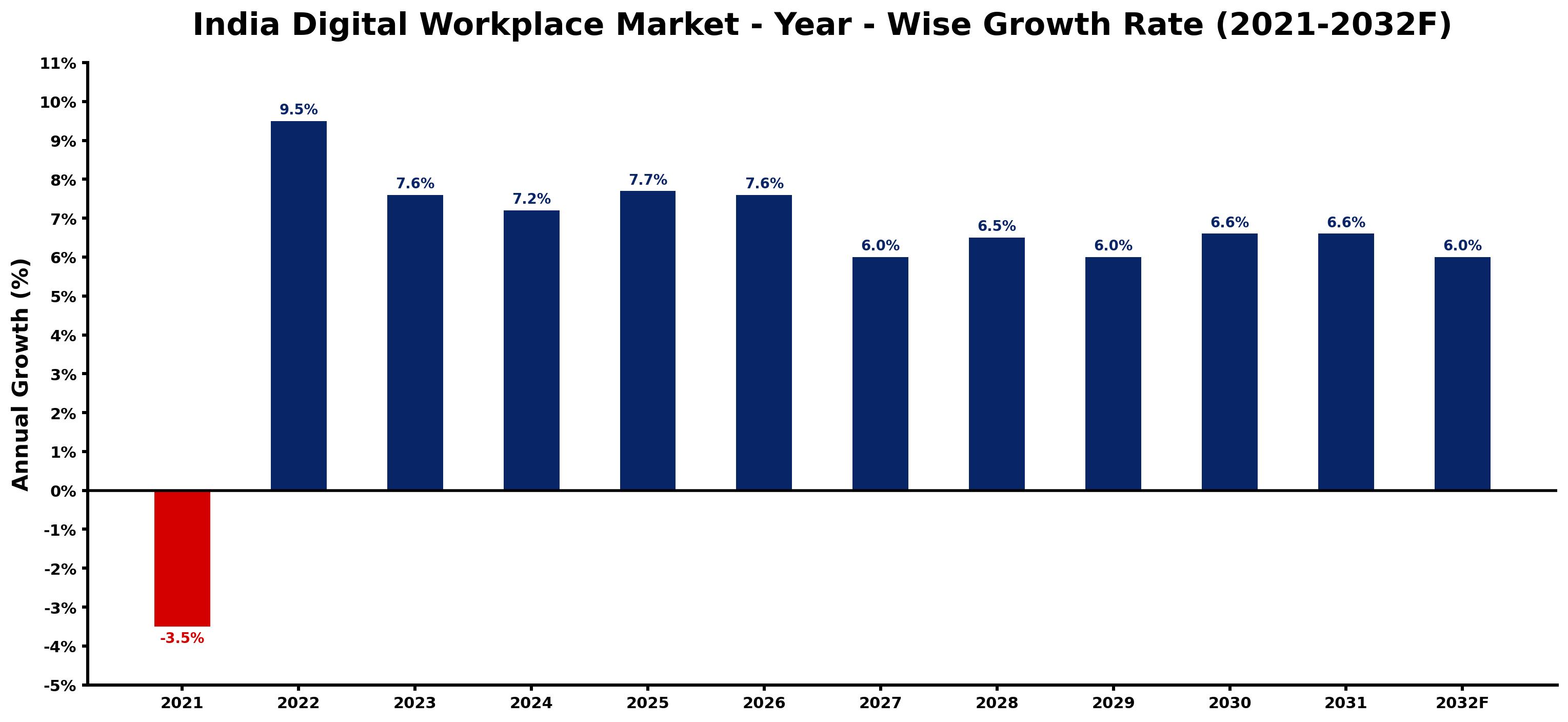
The table below presents the year‑wise growth rates along with the key drivers influencing the market
| Year | Growth Rate | Major Drivers |
| 2021 | -3.5% | Delayed adoption of digital tools post-COVID-19 lockdowns |
| 2022 | 9.5% | Rise in remote work policies among Indian companies |
| 2023 | 7.6% | Increased focus on employee wellness and productivity tools |
| 2024 | 7.2% | Growing adoption of AI-driven collaboration software |
| 2025 | 7.7% | Emphasis on cybersecurity measures in digital workplaces |
| 2026 | 7.6% | Surge in upskilling programs for digital tools use |
| 2027 | 6.0% | Enhanced infrastructure for high-speed internet access |
| 2028 | 6.5% | Support from NASSCOM for tech innovation initiatives |
| 2029 | 6.0% | Demand for hybrid work solutions in urban areas |
| 2030 | 6.6% | Boost from government initiatives like Digital India |
| 2031 | 6.6% | Emergence of local startups in the collaboration space |
| 2032 | 6.0% | Increasing penetration of mobile devices in workplaces |
Note: Market size estimations and growth projections presented in this report are based on 6Wresearch's proprietary forecasting methodology, utilizing the latest available industry data, government publications, and primary research inputs.
India Digital Workplace Market Key Takeaways
Below are some of the specific key takeaways from the market, including:
- The shift towards hybrid work is a primary driver of market growth.
- Organizations are investing heavily in digital tools for enhanced collaboration.
- Cybersecurity remains a critical focus as remote work becomes the norm.
- Employee engagement tools are increasingly important for talent retention.
- The market is characterized by rapid technological advancements and innovations.
Evaluation of Restraints in India Digital Workplace Market
The India Digital Workplace Market faces genuine constraints that can hinder its growth trajectory. Chief among these is the challenge of ensuring robust cybersecurity in increasingly complex digital environments. Many organizations struggle to integrate diverse digital tools, resulting in fragmented workflows that can stifle productivity. Additionally, employee engagement in a remote or hybrid setting remains an ongoing concern, as companies strive to foster a cohesive culture in a dispersed workforce.
India Digital Workplace Market Trends
Several trends are shaping the India Digital Workplace Market, notably the rise of AI-driven solutions aimed at enhancing productivity and collaboration. Cloud-based technologies are becoming standard, enabling scalable and flexible digital environments. Companies are increasingly prioritizing user experience, focusing on intuitive interfaces that facilitate seamless interaction across various platforms. on top of that, sustainability in digital operations is gaining traction, with organizations exploring eco-friendly technologies as part of their corporate responsibility strategies.
India Digital Workplace Market Opportunities
The opportunities in the India Digital Workplace Market are compelling, particularly for those willing to invest in cutting-edge technologies. As businesses seek to streamline operations, there is a growing market for integrated platforms that combine communication, collaboration, and project management tools. Companies that can offer tailored solutions addressing specific industry needs will find significant growth potential. Additionally, as organizations continue to prioritize employee well-being, platforms that enhance engagement and provide analytics will see increased demand.
Government Initiatives in the India Digital Workplace Market
Government policy is playing a crucial role in shaping the India Digital Workplace Market. The Indian government has recognized the importance of digital transformation in enhancing productivity and has initiated several programs aimed at improving the digital infrastructure across the country. These initiatives are designed to facilitate remote working capabilities and encourage the adoption of advanced technologies in businesses.
- A national digital infrastructure upgrade programme launched in early 2025 is focused on enhancing connectivity for remote workers.
- A regulatory framework introduced in mid-2025 aims to standardize cybersecurity protocols for digital workplace solutions.
- Current initiatives include a public-private partnership to enhance digital literacy and skills training, which is ongoing and expected to expand by late 2026.
- Upcoming policies are planned to incentivize businesses that invest in sustainable digital workplace technologies by 2027.
Future Insights of the India Digital Workplace Market
The future of the India Digital Workplace Market looks promising as organizations continue to adapt to evolving work models. By 2032, we expect to see a marked increase in the adoption of AI and machine learning tools that optimize workflows and enhance decision-making processes. As businesses prioritize employee experience and cybersecurity, innovative solutions that address these needs will likely dominate the market. The integration of emerging technologies such as virtual reality and augmented reality into workplace solutions will further revolutionize how organizations operate.
India Digital Workplace Market Latest Developments
Recent months have seen notable activity in the India Digital Workplace Market, reflecting a strong commitment from businesses to adapt to new work paradigms. Companies are increasingly rolling out digital solutions that cater to the needs of remote teams, emphasizing both productivity and engagement.
- A major technology vendor launched a new suite of collaboration tools aimed at enhancing remote teamwork in Q1 2025.
- An initiative that began in early 2025 is currently underway, focusing on integrating AI capabilities into existing workplace platforms.
- A partnership between two leading firms, announced in mid-2025, aims to create a comprehensive digital workspace solution tailored for SMEs.
- Upcoming in late 2026 is a rollout of an employee engagement platform designed to improve remote work experiences.
India Digital Workplace Market - Key Attractiveness of the Report
- 10 Years of Market Numbers
- Historical Data Starting from 2022 to 2025
- Base Year: 2025
- Forecast Data until 2032
- Key Performance Indicators Impacting the Market
- Major Upcoming Developments and Projects
Key Highlights of the Report:
- India Digital Workplace Market Outlook
- Market Size of India Digital Workplace Market, 2025
- Forecast of India Digital Workplace Market, 2032
- Historical Data and Forecast of India Digital Workplace Revenues & Volume for the Period 2022-2032F
- India Digital Workplace Market Trend Evolution
- India Digital Workplace Market Drivers and Challenges
- India Digital Workplace Price Trends
- India Digital Workplace Porter's Five Forces
- India Digital Workplace Industry Life Cycle
- Historical Data and Forecast of India Digital Workplace Market Revenues & Volume By Component for the Period 2022-2032F
- Historical Data and Forecast of India Digital Workplace Market Revenues & Volume By Solutions for the Period 2022-2032F
- Historical Data and Forecast of India Digital Workplace Market Revenues & Volume By Services for the Period 2022-2032F
- Historical Data and Forecast of India Digital Workplace Market Revenues & Volume By Deployment for the Period 2022-2032F
- Historical Data and Forecast of India Digital Workplace Market Revenues & Volume By On-premises for the Period 2022-2032F
- Historical Data and Forecast of India Digital Workplace Market Revenues & Volume By Cloud for the Period 2022-2032F
- Historical Data and Forecast of India Digital Workplace Market Revenues & Volume By Organization Size for the Period 2022-2032F
- Historical Data and Forecast of India Digital Workplace Market Revenues & Volume By Large Enterprises for the Period 2022-2032F
- Historical Data and Forecast of India Digital Workplace Market Revenues & Volume By SMEs for the Period 2022-2032F
- Historical Data and Forecast of India Digital Workplace Market Revenues & Volume By Vertical for the Period 2022-2032F
- Historical Data and Forecast of India Digital Workplace Market Revenues & Volume By BFSI for the Period 2022-2032F
- Historical Data and Forecast of India Digital Workplace Market Revenues & Volume By Consumer goods and retail for the Period 2022-2032F
- Historical Data and Forecast of India Digital Workplace Market Revenues & Volume By Telecommunication and ITes for the Period 2022-2032F
- Historical Data and Forecast of India Digital Workplace Market Revenues & Volume By Manufacturing for the Period 2022-2032F
- Historical Data and Forecast of India Digital Workplace Market Revenues & Volume By Healthcare and pharmaceuticals for the Period 2022-2032F
- Historical Data and Forecast of India Digital Workplace Market Revenues & Volume By Government and public sector for the Period 2022-2032F
- Historical Data and Forecast of India Digital Workplace Market Revenues & Volume By Media and entertainment for the Period 2022-2032F
- Historical Data and Forecast of India Digital Workplace Market Revenues & Volume By Others for the Period 2022-2032F
- India Digital Workplace Import Export Trade Statistics
- Market Opportunity Assessment By Component
- Market Opportunity Assessment By Deployment
- Market Opportunity Assessment By Organization Size
- Market Opportunity Assessment By Vertical
- India Digital Workplace Top Companies Market Share
- India Digital Workplace Competitive Benchmarking By Technical and Operational Parameters
- India Digital Workplace Company Profiles
- India Digital Workplace Key Strategic Recommendations






































