India Disinfectant Market Top 5 Importing Countries and Market Competition (HHI) Analysis
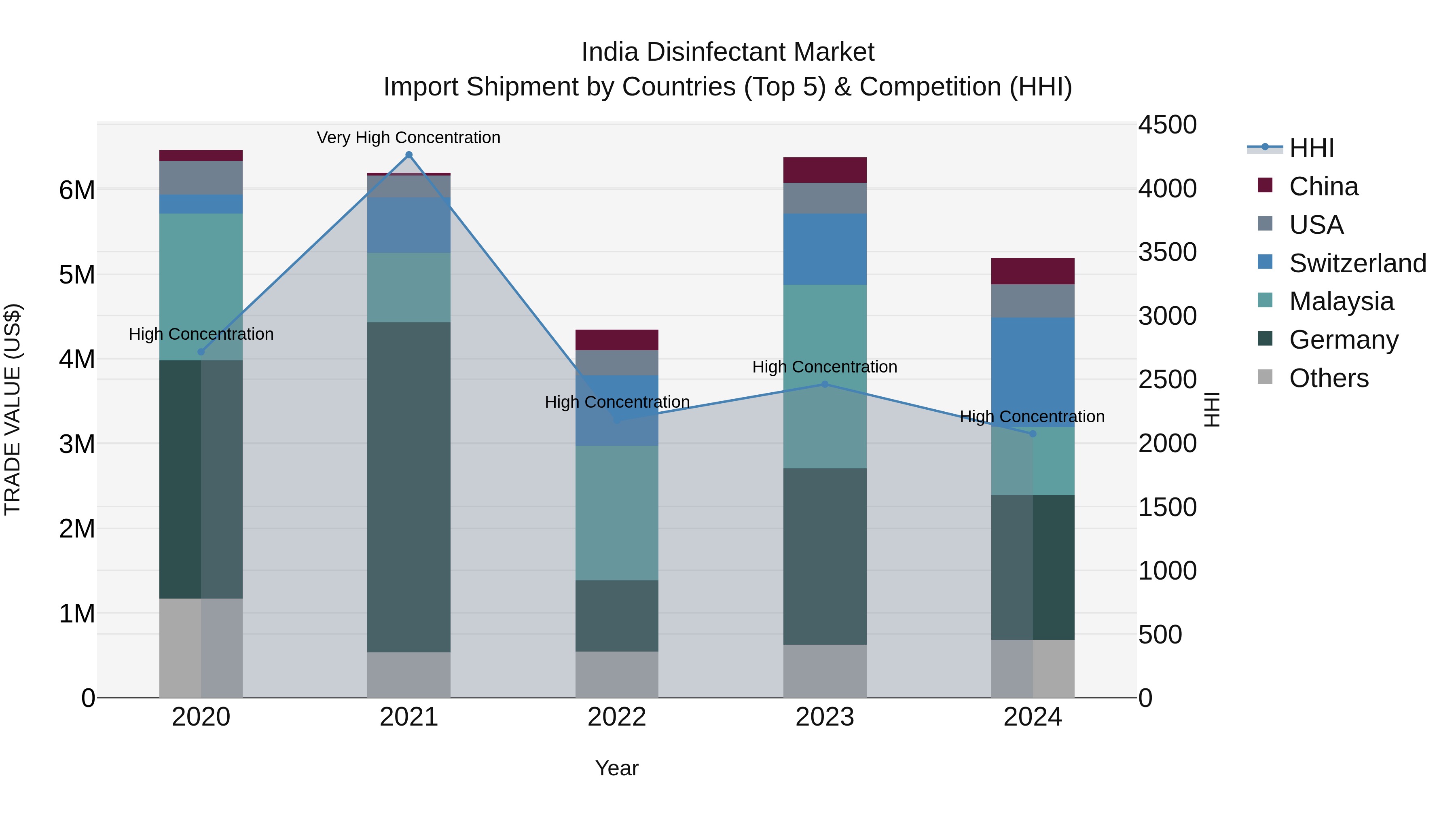
India`s disinfectant import shipments in 2024 saw top exporting countries such as Germany, Switzerland, Malaysia, USA, and China dominating the market. The Herfindahl-Hirschman Index (HHI) indicated a high level of concentration within the industry. Despite a negative compound annual growth rate (CAGR) of -5.35% from 2020 to 2024, the growth rate for 2023-24 experienced a steep decline of -18.69%. This data suggests a challenging market environment with declining demand for disinfectant imports in India.
India Disinfectant Market Overview
The India disinfectant market is witnessing significant growth driven by increased awareness of hygiene and sanitation due to the COVID-19 pandemic. The market is characterized by a wide range of products including surface disinfectants, hand sanitizers, and air disinfectants. Key players in the market are focusing on product innovation, environmentally friendly formulations, and strategic partnerships to gain a competitive edge. With the government emphasizing cleanliness and sanitation through initiatives like Swachh Bharat Abhiyan, the demand for disinfectant products is expected to continue growing across residential, commercial, and healthcare sectors in India. Rising concerns about infectious diseases and the need for effective sanitation solutions are further fueling market growth, making India a key market for disinfectant products.
India Disinfectant Market Trends
Currently, the disinfectant market in India is experiencing a surge in demand due to the ongoing COVID-19 pandemic. Consumers are increasingly prioritizing hygiene and cleanliness, leading to a higher adoption of disinfectant products across various sectors such as healthcare, hospitality, and residential. There is a growing preference for disinfectants that are effective against a wide range of pathogens, including viruses and bacteria. Additionally, there is a rising interest in eco-friendly and natural disinfectant solutions as consumers become more conscious of the environmental impact of traditional chemical-based products. Manufacturers are focusing on developing innovative formulations, convenient packaging, and expanding their distribution networks to cater to the increasing demand for disinfectant products in India.
India Disinfectant Market Challenges
In the Indian disinfectant market, some challenges include intense competition among numerous brands leading to price wars and margin pressures. Another challenge is the prevalence of counterfeit products, which can erode consumer trust in the market. Regulatory hurdles and the need for constant innovation to meet evolving consumer preferences and stringent quality standards also pose challenges for companies operating in the disinfectant sector in India. Additionally, the diverse and vast nature of the Indian market with varying consumer preferences and purchasing power across different regions adds complexity to product distribution and marketing strategies. Overall, companies in the Indian disinfectant market need to navigate these challenges effectively to succeed in this competitive and dynamic industry.
India Disinfectant Market Investment Opportunities
The India disinfectant market offers promising investment opportunities driven by increasing awareness of hygiene and sanitation, especially in light of the ongoing COVID-19 pandemic. Key areas for investment include the production and distribution of various types of disinfectants such as surface cleaners, hand sanitizers, and air purifiers. With the growing demand for these products across sectors including healthcare, hospitality, and residential, there is a significant market potential for innovative and eco-friendly disinfectant solutions. Additionally, investing in research and development to create advanced disinfection technologies and expanding distribution networks to reach a wider consumer base can further capitalize on the market growth. Overall, the India disinfectant market presents a lucrative investment landscape with the potential for long-term growth and profitability.
India Disinfectant Market Government Policy
The Indian government has implemented various policies to regulate and support the disinfectant market. The Bureau of Indian Standards (BIS) sets quality standards for disinfectant products to ensure consumer safety and efficacy. The Ministry of Health and Family Welfare regulates the registration and licensing of disinfectants to ensure compliance with health and safety standards. Additionally, the government has introduced initiatives such as the Swachh Bharat Abhiyan to promote cleanliness and hygiene practices, driving the demand for disinfectant products. Amid the COVID-19 pandemic, the government has issued guidelines for the use of disinfectants in public spaces and healthcare facilities to curb the spread of the virus, further boosting the market for disinfectant products in India.
India Disinfectant Market Future Outlook
The India disinfectant market is expected to witness significant growth in the coming years due to increasing awareness about the importance of maintaining hygiene and preventing the spread of infectious diseases. Factors such as the ongoing COVID-19 pandemic, rising healthcare expenditure, and growing demand for high-quality disinfection products in various sectors including healthcare, hospitality, and residential spaces are driving the market expansion. Additionally, government initiatives to promote cleanliness and sanitation, along with the introduction of innovative disinfectant products with advanced formulations and eco-friendly properties, are likely to further propel market growth. With a growing focus on infection control and sanitation practices, the India disinfectant market is poised for steady growth and offers opportunities for manufacturers and suppliers to capitalize on the increasing demand for effective disinfection solutions.
Key Highlights of the Report:
- India Disinfectant Market Outlook
- Market Size of India Disinfectant Market,2024
- Forecast of India Disinfectant Market, 2031
- Historical Data and Forecast of India Disinfectant Revenues & Volume for the Period 2021-2031
- India Disinfectant Market Trend Evolution
- India Disinfectant Market Drivers and Challenges
- India Disinfectant Price Trends
- India Disinfectant Porter's Five Forces
- India Disinfectant Industry Life Cycle
- Historical Data and Forecast of India Disinfectant Market Revenues & Volume By Product Type for the Period 2021-2031
- Historical Data and Forecast of India Disinfectant Market Revenues & Volume By Alcoholbased for the Period 2021-2031
- Historical Data and Forecast of India Disinfectant Market Revenues & Volume By Hydrogen Peroxide for the Period 2021-2031
- Historical Data and Forecast of India Disinfectant Market Revenues & Volume By Quaternary Ammonium Compounds for the Period 2021-2031
- Historical Data and Forecast of India Disinfectant Market Revenues & Volume By Application for the Period 2021-2031
- Historical Data and Forecast of India Disinfectant Market Revenues & Volume By Surface Cleaning for the Period 2021-2031
- Historical Data and Forecast of India Disinfectant Market Revenues & Volume By Wound Care for the Period 2021-2031
- Historical Data and Forecast of India Disinfectant Market Revenues & Volume By Industrial Cleaning for the Period 2021-2031
- Historical Data and Forecast of India Disinfectant Market Revenues & Volume By End Use for the Period 2021-2031
- Historical Data and Forecast of India Disinfectant Market Revenues & Volume By Healthcare for the Period 2021-2031
- Historical Data and Forecast of India Disinfectant Market Revenues & Volume By Pharmaceuticals for the Period 2021-2031
- Historical Data and Forecast of India Disinfectant Market Revenues & Volume By Foodservice for the Period 2021-2031
- Historical Data and Forecast of India Disinfectant Market Revenues & Volume By Form for the Period 2021-2031
- Historical Data and Forecast of India Disinfectant Market Revenues & Volume By Liquid for the Period 2021-2031
- Historical Data and Forecast of India Disinfectant Market Revenues & Volume By Gel for the Period 2021-2031
- Historical Data and Forecast of India Disinfectant Market Revenues & Volume By Spray for the Period 2021-2031
- Historical Data and Forecast of India Disinfectant Market Revenues & Volume By Distribution Channel for the Period 2021-2031
- Historical Data and Forecast of India Disinfectant Market Revenues & Volume By Online Retail for the Period 2021-2031
- Historical Data and Forecast of India Disinfectant Market Revenues & Volume By Offline Retail for the Period 2021-2031
- Historical Data and Forecast of India Disinfectant Market Revenues & Volume By B2B Sales for the Period 2021-2031
- India Disinfectant Import Export Trade Statistics
- Market Opportunity Assessment By Product Type
- Market Opportunity Assessment By Application
- Market Opportunity Assessment By End Use
- Market Opportunity Assessment By Form
- Market Opportunity Assessment By Distribution Channel
- India Disinfectant Top Companies Market Share
- India Disinfectant Competitive Benchmarking By Technical and Operational Parameters
- India Disinfectant Company Profiles
- India Disinfectant Key Strategic Recommendations






































